
“Any conception of the aether as a mere name for the recipient of electromagnetic energy is inadequate... The aether is a sub-stratum of the physical universe, which is the seat of all those processes which are not obviously connected with ponderable matter.” Whittaker, A History of the Theories of Aether and Electricity (1910).
“The most general solution of the wave-equation... is the sum of two functions, one representing a wave-disturbance travelling towards the origin, and the other representing a wave-disturbance travelling away from the origin.” Whittaker, 1903 paper On the Partial Differential Equations of Mathematical Physics
(Note for the Fanboys, a wave can only exist in a medium. Yes hard to believe isn’t it. In related Fanboy news a wave in water, occurs in the medium called water, which sits as a real materiality called a liquid in a basin. Did you also know that a cat is actually a cat?).
This is another physicist and experimenter that most people have never heard of. In the quotes above Whittaker is describing a 2-stroke engine which explains gravity and an aether substrate which is mandatory for the transmission of energy. Both are denied by ‘The Science’.
In the framework of mechanical reality, Sir Edmund Taylor Whittaker (1873–1956) is one of the most significant figures in the history of science. Unlike the Relativist-Priesthood tying its religious fanaticism to Einstein, the Rothschilds, money and power; Whittaker was a subject-matter-expert of both abstract mathematics and the physical mechanics of the aether. He wasn’t just a thin armed metaphysician-comedian with chalk and a blackboard.
Why is Whittaker important? Whittaker is the greatest historian of physics after Pierre Duhem (future post on this unknown and quite remarkable physicist and historian). Like Duhem, Whittaker is crucial because he recorded the heuristic or narrative movement in ‘Science’ from reality to maths; and he proved that Maxwell’s equations weren’t just maths, they were descriptions of Fluid Stress in a real, pressurised medium.
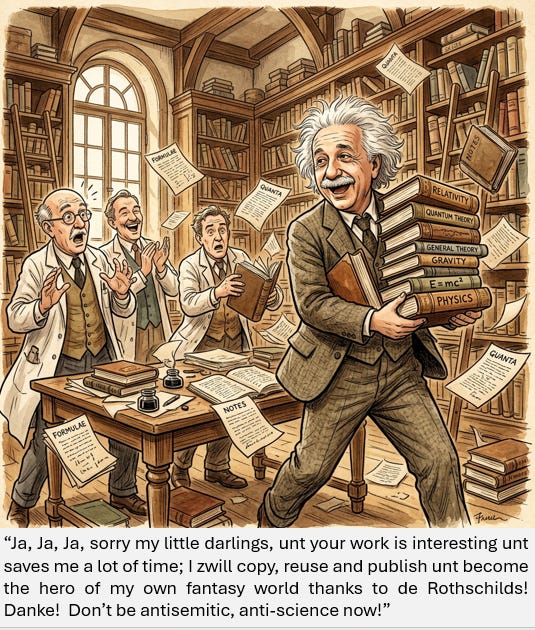
Another important reason to enjoy Whittaker is that he called out the clown-show called Einstein (1951). He references the fraud of Relativity to be the maths (and maths only) of Lorentz and Poincaré. Lorentz’s maths, that Einstein ‘borrowed’ without attribution, are based on the aether. Few know this.
Einstein simply copied Lorentz and removed the aether in his plagiarised 1905 manuscript, ‘The Special Theory of Relativity’. But just to be safe the ‘greatest scientist evah’, reinserts an ‘amorphous aether’ into his ‘General Theory of Relativity’ in 1915. You know, ‘The Science’. Speed of. It changes. It is fast. It is volatile and agile. It is consensus.
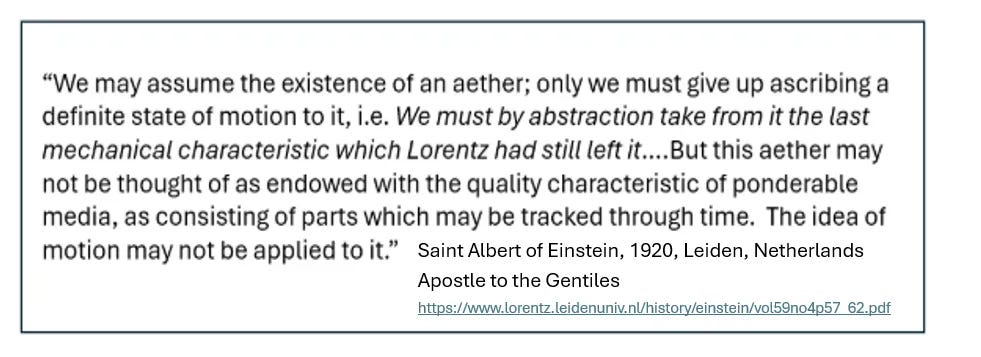
They now call it the Relativistic aether, or the Quantum Field aether, and deny any physicality or materiality to the plenum. This is as silly as denying a basin called a ‘lake’ contains water, and that the ‘water’ is imponderable or does not ‘move’ or have state, and changes of state.
For the Standard Model Fanboys Whittaker is an unbearable critic of Einstein’s geometrical legerdemain and anathema. Better to erase Whittaker and pretend that he did not exist. So, they did and do to Whittaker what they will do to anyone who transgresses the holy stricture and cannon of the Church of Relativity and the Gospel of Scientism. Burn and bury.
In simplest terms physics can be described as a form of mathematical meta-data, or a layer above mechanical-physical data, which describes real phenomena.
Whittaker was a computational engine. You meet these people. They have brains that are 2-3 x more efficient than the rest of us at processing numbers, arrays, equations and calculations. A walking computer. Now consider the meta-layer of ‘science’ called physics.
For many this ‘abstraction’ of physics and its equations is hard to understand and compute. It is due to this that frauds like Einstein can ‘fool’ the entire world. However, for some like Whittaker, they are seemingly born to be a natural large language model and code base. This is why they can see through the charade of Scientism and its Standard Model. His career illustrates his skills.
Whittaker was born in Southport, Lancashire England. He was educated at Manchester Grammar School before attending Trinity College, Cambridge, in 1892. At Cambridge Whittaker won the prestigious First Smith’s Prize in mathematics and the Mathematical ‘Tripos’, one of the most rigorous academic tests in existence. In 1896, he was elected a Fellow of Trinity College, where he began his career as a teacher and researcher in physics which at that time (not now), still prioritised the mechanical underpinnings of the universe and was not yet consumed by the Scientistic fraud of abstract geometry and meaningless models.
Whittaker’s career was marked by his leadership in both mathematics and astronomy.
Royal Astronomer of Ireland (1906–1912): Based at Dunsink Observatory, Whittaker spent six years as the head of Irish astronomy. This gave him a profound understanding of the ‘Orbital Miracles’ (his words) and celestial mechanics that he would later audit.
Professor of Mathematics at Edinburgh (1912–1946): He held this chair for over 30 years, transforming the University of Edinburgh into a world-class center for mathematical physics, premised on physical experimentation.
His contributions were not unnoticed. He was knighted in 1945 for his work in science; received the Copley Medal in 1954 which is the Royal Society’s highest honour, and in 1931 was awarded the Sylvester Medal for this work in differential-calculus equations. Whittaker was a player.
Whittaker believed in an aether as part of mechanical (real) science. We will get to his magnum opus in a minute. So what is this ‘aether’?
In the context of mechanical realism we can try to define an aether in physical terms. In the 19th century many competing aether-paradigms existed including the aether conceptualised as a fluid, a series of vortices and pressure systems, a sponge, an elastic, or a combination of materiality. These concepts are now never taught, or analysed, superseded by the ‘Standard Model’, and it is almost impossible for those indoctrinated in the ‘modern education’ system (propaganda) to understand the idea of a material plenum. A future post will go through these aetheric theories. Suffice it to say that until 1905 all serious physicists and scientists believed in some sort of aetheric medium.
One of the reasons why the ‘aether was dropped’ from the model of ‘science’ was from an inability to precisely identify and prove its material structure. Up until the early 20th century no one believed in Relativity (there were many such models before the comedian-Einstein entered the club). Practical men experimented with practical reality, not geometry, within the concept of an aether. Though difficult to physically identify, we can intuit through Socratic logic that an aether must exist.
The following cannot be declared in public. It is a thought crime.
An atmosphere cannot be a vacuum, look around you.
An atmosphere will change the more you move away from the surface of a planet (molecular diffusion).
You know from your own common sense that energy and waves need something in which to transfer or transmit (or do you believe that waves in an ocean would still happen if water did not exist?).
This is similar to a container medium of aetheric fluid.
The universe is much smaller than the Standard Model declaims but still much larger than our solar system of course.
Logically, within the ‘cosmic’ container, there must be a massive plenum or a cosmos full of ‘something’, rotating above the Earth and applying pressure on and around our planet.
This will create a viscous and subtle, macro-rotational current in the upper atmosphere of our planet (wind for example, cyclones, hurricanes, it is a part of weather and climate). This is physical proof of the aetheric wind which has been confirmed for 140 years by light interferometer experiments.
What are the components of this system?
A ‘toroidal aetheric plenum’ is a highly pressurised, frictionless, fluid like substance that fills space (a plenum).
It is the absolute opposite of a ‘vacuum’.
Toroidal is a term related to fluid dynamics and indicates ‘donut shaped’ macro and micro pressure systems.
It is the main transmission mechanism for energy and fluid transfer, featuring a sink (inward) and an exhaust (outward). It is a 2 stroke engine. This explains ‘gravity’.
You don’t need the magic of spacetime mergers, geodesics, ‘gravitational lensing’, dark matter, dark energy, or the favourite catch all buzzword ‘gravity’ to explain how our planet and cosmos operates.
The above key points are more or less what Whittaker documents and preserves (n.b. at the end there is an explanation on why the Standard Model incorrectly alludes to molecular diffusion as a ‘vacuum’).
Whittaker’s legacy is built on three foundational pillars that define a mechanical-realistic-view of life and support the aether.
A History of the Theories of Aether and Electricity (1910, 1951)
Whittaker’s magnum opus. This is a definitive forensic history of modern physics. It documents how the aether was the central concern of all great scientists from Descartes to Maxwell. The 1951 revision is famous for its ‘Relativity Chapter’, where he correctly identifies Lorentz and Poincaré, not Einstein, as the true architects of the mathematical transformations of Relativity.
The Calculus of Observations (1924)
Whittaker essentially founded the field of numerical analysis. He understood that ‘Data on a page’ is only as good as the physical observation behind it. Keep in mind that much of ‘Scientism’ uses fraudulent and manipulated data to justify its claims. When you analyse the original data sources, you quickly discover that the raw data does not possess durability or traceability in its transformations. This is an easy way to spot ‘kite-markings’ of data fraud.
Modern Analysis (Whittaker & Watson, 1902)
Known simply as ‘Whittaker and Watson’, this became the standard textbook for complex analysis for nearly a century. It provided the mathematical tools for the ‘Scalar Potentials’ that are found in Maxwell’s 20 equations which explain electro-magnetic energy premised on an aether.
We can take a quick look at his key work, ‘A History of the Theories of Aether and Electricity’ and understand why Whittaker is important.
Whittaker begins ‘A History of the Theories of Aether and Electricity’ by documenting the ‘golden age of mechanics’. Before the 20th-century Scientistic script was imposed and forcibly adopted, all notable physicists, including Faraday and Maxwell, supported the aether and viewed fields (energy, gravity, forces), as areas of abstract, irrelevant maths. In reality most real scientists viewed and view ‘fields’ as mechanical stresses within a substantial fluid or elastic medium.
Faraday Induction: Whittaker details how Michael Faraday (1839) visualised ‘Lines of Force’ not as imaginary vectors, but as physical tensions in an aetheric plenum. Induction was the result of a neighbouring body straining the fluid.
Maxwellian Vortex: Whittaker’s most critical observation is his preservation of Maxwell’s 1861 paper, On Physical Lines of Force. He documents Maxwell’s derivation of electromagnetism based on a mechanical aether composed of molecular vortices and idle wheel particles built on Faraday’s experimentation.
Original Maths: Maxwell’s original work utilised quaternions which are a 4-dimensional mathematical language that included ‘Scalar Potentials.’ These potentials represented the stored energy of the medium itself namely the aetheric pressure that modern Scientism has deleted.
It was through Whittaker (1951) that the author became acquainted with the ‘Maxwellians’ or the small group who took Maxwell’s dense set of 20 equations and reduced them into a digestible number of 4. This group of physicists included Oliver Heaviside, Heinrich Hertz, and J.J. Thomson. While they claimed to be simplifying Maxwell, Whittaker claims they were actually stripping the hardware from the software, or the aether from the mathematics.
Vector Purge: Oliver Heaviside (1893) was a very smart, self-taught engineer, an aetherist and the creator of the coaxial cable. To simplify the concepts around electrical charges and motion he famously removed Maxwell’s quaternions because they ‘smelt of metaphysics’ (his words).
Heaviside was an engineer and built cables. He was uninterested in 4-D math models. He replaced Maxwell’s very abstract scalar-potentials with a more straight-forward ‘vector analysis’. In doing this Heaviside deleted the ‘scalar potential (phi) and the ‘vector potential’ (A) of Maxwell, both of which are related to the aether.
Heaviside did not believe in a ‘vacuum’, or that a wire of copper transferred electricity within the wire like water in a pipe. He was trying to simplify the concepts to allow the construction of long-distance cabling.
The Result: By removing the potentials, Heaviside in effect removed the medium. The equations no longer described a fluid in motion; they described abstract signals moving through a void. This was seized upon by the scientistic cult and aligned with the inane notion of a ‘vacuum’.
Longitudinal or Long Wave Loss: This is very significant. Heaviside’s reductionism resulted in the theoretical deletion of Longitudinal Waves (Franklin’s and Tesla’s pressure waves). By forcing all EM radiation into ‘Transverse’ (light) waves, the Maxwellians prepared the ground for Einstein’s claim that no medium was required. We have now lost Franklin’s and Tesla’s insights on how to harness the longitudinal wave power of the aether (Tesla’s free energy).
Whittaker’s second volume (1951) serves as an updated witness to the 20th-century divergence from reality to geometrical gibberish. He explains that once Maxwell’s aetheric ‘potentials’ are removed, the scientific establishment was forced to invent ‘spacetime’ to fill the logical vacuum. What most people don’t realise is that ‘spacetime’ is a fiction, simply a mathematical model used to make equations balance and to replace the aether.
Einsteinian Circus: Whittaker well understood that the fraudulent ‘maths’ of Relativity were just a ‘Coordinate Transformation logic’ (his description), designed to hide the fact that the aetheric signal was being missed.
Abandonment of Mechanics: Whittaker notes that after 1905, physics stopped asking “What is the aether doing?” and started asking “What does the observer see?” This is the birth of modern Scientism where the observer’s perspective (Relativity) is treated as more real than the mechanical medium (real physics). The Observer fraud is central to modern physics and cosmology.
Potemkin Physics: By 1951, Whittaker concludes that ‘Maxwell’s Equations’ taught in universities are not Maxwell’s at all. They are Heaviside’s equations and the work of the Maxwellians. In essence they are a ‘mathematical shell’, a beautiful set of numbers that describe the behaviour of a ghost, or an Orion ‘astronaut’ in ‘the vacuum of dark space’ taking selfies with the iPhone.
It is not hard to predict or fathom the reaction of the ‘Establishment’ to Whittaker. Violent rage and threats of destruction poured down onto the denier of Einstein’s fantasy world.
When Whittaker published the second volume of A History of the Theories of Aether and Electricity in 1951, he committed the ultimate sin for Scientism, he entitled a chapter The Relativity Theory of Poincaré and Lorentz. You can still hear the screams from the Scientistic elite in 1951 reverberating today.
Rending of Tunics: The Establishment raged. Max Born, one of the fathers of Quantum Mechanics, a field with its own set of problems and issues, wrote a public, scathing letter to Einstein, stating he was ‘deeply distressed’ by Whittaker’s account and apostasy.
Deploy the Ad-Hominem Script: Born and friends claimed that Whittaker was ‘old and confused’ despite the fact that his mathematical proofs were flawless. They couldn’t find an error in his math, so they charged Whittaker with ‘historical bias’ and a general ignorance of science.
Messianic: Scientism has always needed a messianic figure. Their chosen high priest was the Rothschild’s protected-comedian-clown Einstein. He was used to justify the transition from a physical, substantial universe to a mathematical, abstract one. Whittaker’s insistence on the aetheric roots of Relativity (Lorentz’s equations) and his proofs of the aether plenum, threatened the entire ‘Lone Genius’-who-saved-humanity-marketing campaign.
After the 1950s, the Establishment shifted from active criticism to a passive-aggressive erasure. Whittaker’s physics is never taught nor mentioned. In ‘modern’ university textbooks, Whittaker is cited for ‘Whittaker Functions’ (pure math), but his work on the ‘Scalar Potential’ and the ‘Substantial Aether’ is omitted. This is part of the runbook they deploy to obliterate dissenters.
In the 21st century Whittaker’s work on Longitudinal Waves was picked up by alternative researchers like Tom Bearden and the Tesla-revivalists. In response to this the Establishment began to retroactively label his aetheric theories as ‘fringe’. As they do with anyone who disagrees with the theological cannon of the Standard Model, Whittaker is now calumnied as a pseudo-conspiracy-theorist, an actor on the edge of real science, a forlorn pathetic shadow of a real scientist, an alley-way skulking loser, naked, cloaked in a raincoat.
Interestingly, NASA uses Whittaker’s maths in its S-Band Transponders and Phased Arrays.
Whittaker was the last of the classical-aetherists and was one of the last defenders of the aether-plenum. A Cambridge educated elite, Whittaker was a mechanical realist. He witnessed and recorded for posterity the migration of physics from mechanical proofs operating within a container-medium or aether, to the non-existing vacuum, where maths and models replace reality.
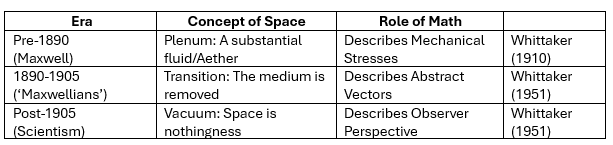
In many ways Whittaker’s 1951 work is a ‘Death Certificate of Real Physics’. The aether has never been disproven; it has simply been removed by abstract geometry and calculus, centred around the tautological ‘observer’ and layers of abstract geometry disconnected from physical proofs. No one is taught the aether. It is not even on the radar screens of ‘education’ or the ‘science media’. An entire era of mechanical physics (16th to 19th centuries) is now buried and forgotten. All the inventions of the ‘modern’ world - reliant on this era of physical mechanics - are now credited to ‘The Science’ of modern Scientism. You live in a dream world Neo.
But of course, everyone knows this, so this post is redundant! You remember school. Teacher Waddle-Quack insisted that you and other students study Whittaker to get ‘the other side of the story’ in the interest of critical thinking and ‘liberal viewpoints’. He was adamant that dogma and indoctrination have no place in the educational system and that physics must be first and foremost a mechanical explanation of physical reality. No Kings like Einstein in Physics he protested.
Or maybe not. Maybe Teacher Waddle-Quack yawned, rubbed his stomach seen rising through his shirt which sported a rainbow flag, pushed back his round eye-glasses and told you to stop asking stupid questions, open the textbook and memorise the state-controlled information source to pass the state-approved-test. Regurgitate or be ruined he raved.
All hail.
==
n.b. on diffusion and space
Barometric pressure (atmospheric pressure) is measured by a ‘Torr’, from the 17th century Italian physicist, Torricelli, who invented the barometer. He was trying to understand why the atmosphere limited the pushing of water through a pipe to 34 feet. He knew that is you used an engine to pump out ground water in a mine, it was the atmosphere pushing the water through the pipe and this had constraints. How then to measure the aether?
Torr measurement of the aether:
-1 Torr is equal to 1 mm of mercury on the barometer.
-The Standard atmospheric pressure on Earth at sea level = 760 Torr.
-The upper atmosphere (say 10.000 miles) has a 10 to the minus 17 Torr or 0.00000000000000001 torr - we discussed this in the analysis of the Apollo and Orion ‘missions’/films.
-This is what the Standard Model means by a mathematical definition of a dead, empty void.
-This indicates a molecularly diffuse medium but not a vacuum, the 2 are completely different ideas, a reduced materiality does not mean a desert devoid of energy, particles or fluid pressure.
-Reduce atmospheres still contain energy and need a medium to transfer that energy - an example would photons and light. They cannot be transmitted through nothing.
We discussed how a vacuum cleaner disproves the Standard Model - a model which transgresses Fermi’s laws on gaseous expansion and the 2nd law of Thermodynamics. This means that ‘space’ cannot be a ‘vacuum’ sitting next to the dense atmosphere of this planet. If that was true our atmosphere would not exist, it would rush from the Earth’s high density, to the low density of space. There is no barrier or container wall between the Earth and space. Something else is going on.
===
Sources
Born, M. (1954). Letter to Albert Einstein, 12 September 1954. In: The Born-Einstein Letters (2005 edn). London: Macmillan. Context: Evidence of establishment panic, based on emotions, egos and narratives, not proofs or even maths.
Mathis, M. (2010). The Charge Field. [Online] Available at: http://milesmathis.com/charge.html [Accessed: 18 April 2026]. Mathis outlines that a ‘charge’ is a physical, mechanical fluid density, effectively a modern re-branding of Whittaker’s scalar potentials.
Whittaker, E.T. (1903). ‘On the Partial Differential Equations of Mathematical Physics’, Mathematische Annalen, 57(3), pp. 333–355. Describes the Two-Stroke Engine model. In this paper, Whittaker proves that any electromagnetic wave is actually composed of two counter-propagating scalar potential streams, debunking the single-wave-in-a-vacuum myth.
Whittaker, E.T. (1910, 1951). A History of the Theories of Aether and Electricity. London: Nelson. Summarised in this post.
Zahar, E. (1989). Einstein’s Revolution: A Study in Heuristic. La Salle, IL: Open Court Publishing. Both Poincaré and Lorentz had the mathematical equivalence of Relativity years before Einstein, confirming Whittaker’s historical accuracy and highlighting the ‘heuristic’ (narrative) nature of the shift to a vacuum model.
No posts
Comments
Nothing yet. Say the first thing.
Sign in to join the conversation.