
What do we owe the people who have loved us when there is no longer enough time to become an entirely different person?
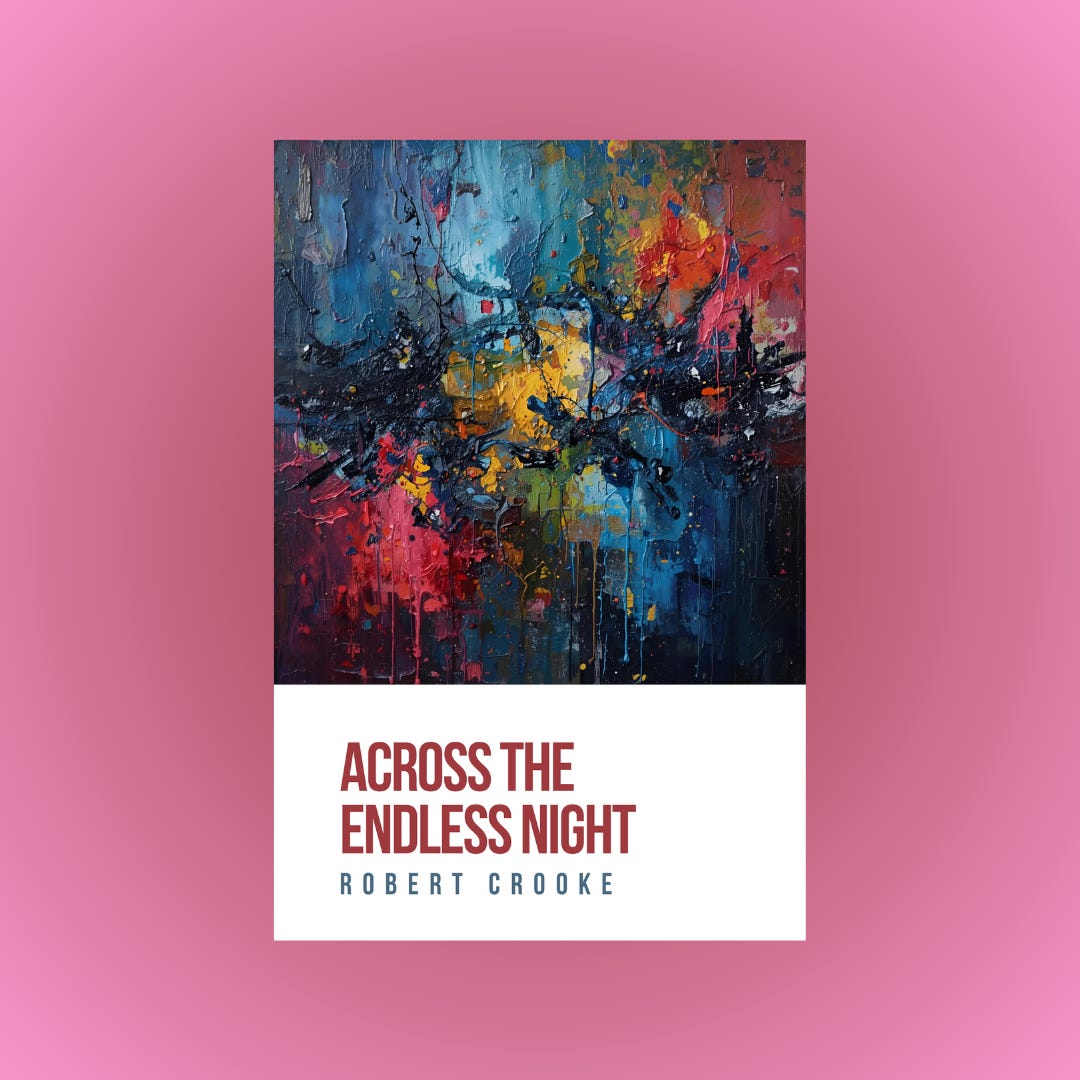
Robert Crooke returns to the world of Letting the House Go with Across the Endless Night, a compassionate and clear-eyed novel about an aging man, the family gathered around him, and the difficult work of understanding a life before it is over.
Six years have passed since the death of Richard Morris’s ex-wife, Irene. It is now 2021, and Richard is in his mid-seventies. His health requires increasing attention. The country feels divided and unsettled. His children, grandchildren, nieces, and nephews are building lives he cannot fully predict, much less protect.
Irene is gone, but she has not vanished from Richard’s life. Her final counsel still guides him. He brings flowers to her grave and moves through places shaped by her memory. As Eileen Charbonneau observes in her praise for the novel, Richard finds himself wondering whether he is “little more than an unexpected guest, a troubling memory.”
Anyone who has lived with grief knows the limitations of the phrase moving on. The dead do not always disappear simply because they are gone. Sometimes a relationship changes form. The conversation becomes private. A person’s voice settles into the way we make decisions, account for our mistakes, and measure the passing years.
Across the Endless Night makes its home in that complicated territory.
Readers first met Richard in Crooke’s critically acclaimed 2022 novel Letting the House Go, a 2023 Eric Hoffer Book Award category finalist.
Richard was never meant to be easy. His intensity, ambition, and self-absorption helped define him in the earlier novel, and Crooke does not conveniently erase those qualities here. He is more interested in the uneven, partial ways people actually change.
Richard has not been transformed so much as chastened. Age has worn down some of his certainty. Loss has taught him lessons he might have preferred to avoid. The generosity of his family surprises him, perhaps because he has finally become capable of recognizing forms of love that were difficult for him to see when he was younger. He is now a man deeply cherished by his family. That does not make the family itself any less complicated.
The Morrises remain multigenerational, restless, and fully occupied by their own ambitions and crises. Richard gives advice. He offers money. He interferes. When a son-in-law begins to spiral, Richard’s concern draws him into a situation that puts his own safety at risk. He is still Richard.
What has changed is his understanding of what it means to belong to other people.
One of the novel’s greatest strengths is Crooke’s confidence in the emotional weight of ordinary experience.
There are family secrets, health scares, and old losses that continue to reverberate. The novel confronts PTSD and the damage it can inflict on a veteran’s family. Richard must live with the deaths of both Irene and a sister whose absence reaches across decades.
Yet Across the Endless Night also understands that a quiet afternoon with a two-year-old and a sorting game can matter just as much. That sense of scale is essential to the novel.
Lives are not made only from their most dramatic moments. A medical scan sits beside a family gathering. A person may contemplate death in the morning and become absorbed in a grandchild’s habits that afternoon. Questions of literary ambition and artistic legacy coexist with the simple act of carrying fresh flowers to a grave.
Anne Leigh Parrish, author of The Hedgerow, describes the novel as a “lovely, nuanced exploration of acceptance, grief, regret, and reconciliation.”
Charbonneau, author of Seven Aprils, calls it “that rare thing, a literary novel that moves.” She also captures the novel’s immersive quality: “Throughout Across the Endless Night this reader felt dropped into a life, not a novel.”
Crooke creates that feeling through accumulation rather than spectacle: conversations, memories, familiar places revisited, and relatives whose lives do not exist merely to deliver a lesson to the protagonist.
The world continues around Richard, even as his own world begins to feel increasingly finite.
Parrish identifies the novel’s central question plainly: “What does it mean to anticipate mortality with grace and wit?” Mortality is easy to discuss as an abstraction. Richard does not have that luxury. The body interrupts. Medical appointments impose their own rituals and strange intervals of reflection. As Richard enters a CT scanner, he wonders, “Can they tell when a heart has been broken?” The question carries the quiet humor of a thought that is both deeply sad and faintly absurd. It is also unanswerable.
Medical technology can reveal a great deal about the body, but Richard’s life contains injuries and attachments no machine can locate. How might anyone measure the lasting effect of Irene? Where does childhood loss live inside an aging body? Can regret change shape? Can wisdom that arrives late still be put to meaningful use?
Crooke resists turning these questions into a familiar lesson about living each day as though it were the last. His interest lies somewhere more difficult. Richard has already lived most of his days.
What remains is the question of what he will do with the person those days have made.
Readers of Letting the House Go will recognize familiar characters and Crooke’s vivid Long Island setting. Six years have passed within Richard’s world, and there is real pleasure in returning to people whose lives continued after the earlier novel ended.
New readers can also begin here.
Across the Endless Night stands on its own as a family saga and a meditation on aging, memory, identity, and hope. The first novel adds history, but Crooke does not require readers to arrive prepared.
At the center of the book is a man who has achieved professional success as a novelist and now finds himself confronting a different kind of legacy. The lives of his family members extend beyond him. Their futures are vulnerable, uncertain, and radiant. Perhaps this is one of aging’s strangest recognitions: the world you love is already preparing to continue without you.
Across the Endless Night does not pretend that recognition is peaceful. Crooke allows it to be sorrowful, funny, frightening, and unexpectedly tender. Richard Morris has spent much of his life possessed of an intense sense of self. At the far end of that life, he must reckon with the people who helped make that self possible. He must also consider what, after the endless night, any of us might reasonably hope will endure.
Across the Endless Night by Robert Crooke was published by Unsolicited Press on August 4, 2026. The 436-page novel is available for $24.95.
Robert Crooke is a journalist, media executive, and author whose fiction, poetry, literary criticism, and essays have appeared in numerous publications. His novel Letting the House Go was a 2023 Eric Hoffer Book Award category finalist. Crooke and his wife live in Bridgewater, Connecticut. Learn more at www.robertcrooke.com.
Comments
Nothing yet. Say the first thing.
Sign in to join the conversation.