
The only other living soul on the premises was another woman—a shapeless middle-aged silhouette drifting through the Market Square, led on a leash by a hairy terrier. He clearly knew where he was heading, whilst she seemed to move on autopilot. Her attire and the way she ignored her surroundings suggested someone accustomed to being overlooked.
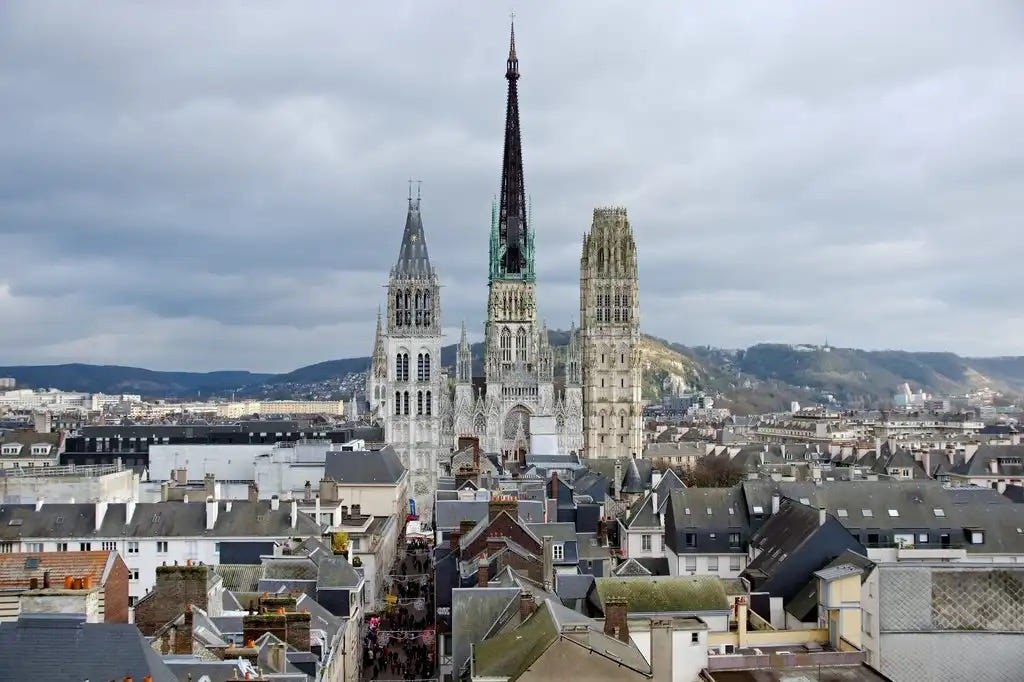
This was my very first morning in this town, and I woke up early, too early for a Sunday following my move—the morning light, still bright in this early autumn, penetrated the curtain-less windows. For a short moment, I couldn’t locate myself—the view through the large windows was unfamiliar—the Parisian rooftops replaced by a vaster, breathier skyline, the river, barely concealed by already half-naked trees, was still the Seine, but the cathedral’s spire breaking the monotony of the landscape instantly brought everything back to my mind: I was divorced and I was living here, alone.
A dozen boxes containing my clothes and books were piled up in the entrance. I left Paris with barely more than I had arrived with almost three decades earlier. Upon the divorce, it was agreed that I would leave all furniture accumulated through almost three decades of marriage behind in exchange of a modest sum of money. When the realtor told me apologetically that the owner’s condition was to sell the apartment furnished, with all furniture priced at the exact same sum as the one I had received from my husband—the gentle smirk of the universe—I accepted with relief.
So here I was in an unfamiliar apartment, surrounded with the furniture a stranger had picked up to make it a furnished rental. As I lay in bed on that first morning of my new life, listening to a strange feeling—half excitement, half bewilderment—nesting in my chest. The bed was comfortable, but not luxurious—a typical bed of a three-star hotel of a provincial town, but the view made up for every other inconvenience I may still run in. Clouds ran fast on the bluish surface of the vast sky, the wind brushing against the windows’ slightly soiled glass. A vivid memory popped up in my mind—a decade ago, when I first woke up in our then new Parisian flat, I watched the rooftops from the bed I shared with my husband, thinking, “this will be the view I will probably be seeing at the last day of my life.” Life proved me wrong.
The kitchen was fully furnished too, I inspected the cupboards, opening them one by one, hoping for another surprise from the unknown people who used to live here before me—but they were bare apart from an unfinished box of chocolate cereal, already gone slightly soft in the Norman damp. I needed coffee.
My dog was still asleep on the sofa—the green velvety affair that occupied most of the living room, sulkily turning its back to the view, uninterested in its beauty. The dog had no problem with readjustment—where I was, she was just fine. When I approached the door and grabbed her leash, she gazed at me with disbelief, her ears perked, but joined, already excited about going out.
To reach the market square that abounded with almost Parisian cafés, we had to cross the bridge that cut the town neatly in two halves—one quaint and ‘bourgeoise’, taken over by tourists who came here mostly to admire the Cathedral, and the other— inhabited by a mismatched population of emigrants, students, and self-employed women whose lives seemed, at least from the outside, as improvised as my own. I never thought I would leave Paris, which was the place I fantasised about since my early teens—the map of Paris was pinned to the wall above the sofa bed I used to sleep on—the constant reminder of a better life elsewhere.
The Seine under the bridge was of the same uncertain colour as in Paris, and the river’s proximity made it all less painful somehow. The grey sky filled with fidgety squeaking seagulls felt strangely familiar. I had grown up in another northern city built around water. The sky was the same but different—lower here, and the clouds ran faster, chased by the permanent Norman wind.
A narrow cobbled street, still deserted at this hour, soon opened onto the Market Square—a vast rectangle surrounded by unidentical old houses—an oversized motionless merry-go-round.
Tables and chairs, in red plastic, at one of the cafés were still herded outside—its owner more optimistic about the local capricious forecast or simply lazier than his neighbours. The terrace was empty, except for an old couple—both dressed in identical waterproof jackets and white tennis shoes, clinging to each other’s arm as if to a buoy, they stumbled out of the café in a silent, well-rehearsed movement. “This I will never be,” I thought, making a guess again, this time probably more accurate.
In the meantime, the ageless woman with the terrier disappeared into one of the old buildings encircling the square, swallowed whole, innocent dog and all, as the massive wooden door closed behind them with the dull sound of jaws meeting.
An uneven wooden form—more of a monster than a building—hiding the market occupied the middle of the square. Remains of an ancient church were pushed on the side, but still neatly visible from where I sat. Locals called this place ‘le bûcher’—the stake. I drank my already tepid coffee, which came with a still warm croissant, looking at the exact spot where Jeanne d’Arc was burned alive. Androgynous, she cross-dressed and preferred to burn alive rather than renounce her male attire and the right to carry arms. I found myself liking the sound of her; she too wasn’t from here but ended in this Northern corner of France out of rebellion and a stubborn desire to save her country. A few people were now crossing the square, unperturbed by the fire that had swallowed a young woman alive; they were used to this past, their past, as a newcomer never would.
In these thirty years I have moved around the continent several times. I lived on an island, where one could always feel how finite the land was. Every move came with a loss. Some were harder than others; some carried the promise of a better future. All made me a little lighter, as every loss helped me to shed another layer of unneeded skin.
This one may be my last. This, still unfamiliar town, in which I did not know a soul, may see my last day.
I have always been untethered. At the time of my first move, I did not know the word, certainly not in English. And even now I cannot find its equivalent in Russian, no matter how hard I try. But the feeling has always been there, no matter how attached I felt to any particular person or place at the time, it has always been there waiting quietly beneath the surface to be unloosened with the new move, the new loss.
I met Paris for the first time at sixteen—an unexpected school trip that released me from the confinement of the freshly crumbled Soviet Union for the first time. To pay for the trip my mother took the two hundred dollars my father was saving to buy a garage for his decaying Soviet car, which could not make it through another winter if parked outside in the snow. That was our family’s only savings, kept between the pages of some art book our one-bedroom apartment was filled with. She wanted me to break free in ways she never could. Paris felt uncannily familiar and warmer, kinder than my home city. I instantly knew I would end up settling there. And I thought I did. I still couldn’t tell my mother about moving out of Paris.
I was talking to a friend recently; her husband recently left her after thirty years of marriage. When I said I resonated with her confusion and her pain, she snapped back “You have no idea; you have chosen to leave.” She had a point of course. But does choosing a change that implies loss make it any easier? I left because I knew the price for staying would have been too high. I had a lot to lose. The responsibility for making the hard choice was unbearable at times. My friend was entitled to indignation, to anger, to victimhood, to grief… I was not. “You made the choice,” I was told again and again.
I moved for different reasons. The first time, I ran from the cold, the hunger, and the neglect. That one was easy—I was running for my life. Another time I followed love, and that one everyone understood. Several times I was pushed out from a place I was trying to root in by indifferent circumstances. I had to relocate short of other options, roots and all.
Every single one of these moves, no matter in which direction it propulsed me, enlarged the distance between me and my original place. Was I trying to find the right distance from my childhood memories—and from the hurts attached to them? Aren’t we all Schopenhauer’s porcupines trying to put the right distance between ourselves and others, in order to keep warm but avoid being wounded by their quills?
In this foreign town, I am still trying to find the right distance from my past. The distance that allows me to remain myself whilst staying close to those I love. By profession, I am a therapist, and most days I sit in front of a screen speaking with people scattered across the world. Together we wonder about distance: from families, from countries, from former selves, from old hurts. Many keep moving, convinced that the answer lies just a little further away. Sitting here beside yet another river, in yet another city, I am no longer certain they are wrong.
Somehow this town feels right. Close enough to Paris but also separate enough—a place with its own Seine, its own Cathedral, its own stake.
My phone rings, snapping me back into my new reality. My partner’s grinning face takes over the screen.
“I will get there by 7:30,” she announces cheerfully.
“I’ll come to pick you up,” I respond and start making the grocery list. The oysters are excellent at the market, and she loves opening them with a sharp turn of the knife.
No posts
Comments
Nothing yet. Say the first thing.
Sign in to join the conversation.