
The identity property or axiom in math is that A=A. So if A=B, then B=A.
And yet, in this post, I argue that, in the case of implicit bias, 0≠0. How can that be? Read on…
If you are not familiar with the implicit association test (IAT), go to the appendix here for an explainer. The IAT is the workhorse method for assessing “implicit bias” — a sort of chameleon term that, as far as I can tell, has a zillion different meanings or definitions across papers.1
Regardless, without going into all the technical details, the IAT is widely interpreted as assessing biases for or against groups. Let’s put aside that the only thing it measures are reaction times (speed at doing the IAT task) and reaction times are not any sort of bias. But the logic is this: If it is easier for people to categorize stimuli as belonging to either “Black/bad or White/good” than to either “Black/good or White/bad,” they will categorize stimuli into “Black/bad or White/good” faster (i.e., lower reaction times) than into “Black/good or White/bad.” If so, the interpretation is that people have stronger mental associations for Black/bad and White/good than for Black/good and White/bad. This is how “implicit bias” is measured with the IAT.
So the IAT, at its best, measures associative strength of concepts in memory. But calling this “bias” is more than a bit odd. For example, my guess is that most of you have a stronger association of ham with cheese and of quantum mechanics with physics than you do of ham with physics and of quantum mechanics with cheese. Is that a “bias”? Obviously not. Associative strength between concepts in memory is not bias.

Associations might or might not predict or even cause biases but they are not biases themselves. Calling IAT results “implicit bias” is a version of the labeling fallacy; here, it constitutes the subterranean slipping in of a conclusion (association strength is inherently a bias) that should require empirical support.
Let’s also put aside for this essay the now-overwhelming evidence that the IAT is not even a clean measure of associations — it is riddled with measurement confounds and artifacts — but those will be the subject of another post, so feel free to take my word for it or not (see the chapter referenced in footnote 1 for some examples).
But let’s put all that aside for the rest of this essay and treat the IAT as some sort of assessment of “implicit bias.”
IAT scores of 0 are routinely interpreted as “unbiased.” Scores (on a race IAT) above 0 are anti-Black biases. Scores below 0 are anti-White biases. If this is enough for you and you do not want some gory details, you can skip the next section, which goes into some (but still not full) detail on how IAT scores are computed.
Each individual taking an IAT receives a score that is a minor modification of Cohen’s d. For the statistically uninitiated, this will do: These scores have no upper or lower bound, but the scores generally range from -2 (people’s reaction times are much faster for Group 1/Good v. Group 2/Bad than for Group 1/Bad v. Group 2/Good) through 0 (reaction times are identical regardless of the Groups and good/bad setup) through +2 (people’s reaction times are much slower for Group 1/Good v. Group 2/Bad than for Group 1/Bad v. Group 2/Good). You can conduct an IAT with any pair of groups, not just those based on race, thus my use of “Group” here rather than Black and White. And you can conduct an IAT with any attribute (good/bad, pleasant/unpleasant, smart/dumb, strong/weak, etc.).
Here is how IAT scores are interpreted with respect to “implicit bias”:
-2 = much faster for Group 1/Good v. Group 2/Bad than for Group 1/Bad v. Group 2/Good = low number/fast reaction time minus high number/slow reaction time = a negative IAT score meaning strong implicit bias favoring Group 1.
0 = reaction times are identical regardless of the Groups and good/bad setup = no bias favoring either group.
+2 = much slower for Group 1/Good v. Group 2/Bad than for Group 1/Bad v. Group 2/Good = high number/slower reaction time minus low number/fast reaction time = a positive IAT score = strong implicit bias favoring Group 2.
That is just to give you a feel for the scoring. Actual scores are continuous (e.g., .23, 1.03, -.88, -.26, etc.). 2’s are actually very rare and used here just for illustration. Most scores in most studies of race IAT scores fall between -1 and +1. Mean scores on race IAT measures are usually statistically significantly above 0 (meaning “implicit bias favoring White people” by the conventional interpretation). This is sometimes called “the IAT effect.” For example, in the Axt et al (2026) study I reviewed here, the IAT effect (i.e., the overall sample mean on the IAT) was .467, seemingly indicating substantial anti-Black (or pro-White) bias:
I say “seemingly,” because, as that post pointed out, mean IAT scores in that study corresponded to pro-Black behavioral discrimination. This finding permits an answer to the question raised in the title of this post:
When using the IAT to measure “implicit bias” of course! It is a sort of trick question because the two 0’s refer to different things. The first 0 is an IAT score, widely interpreted as reflecting no bias, typically by researchers who never bothered to benchmark the IAT score against actual judgments or behavior (even when they had judgment or behavioral measures!). The second 0 is actual behavioral discrimination or judgment biases. Nothing requires 0 on the IAT to correspond to egalitarian behavior and judgments. At least in the Axt study reviewed previously, and in the one other paper that has attempted to assess this, it generally does not; instead, 0 on the IAT has, so far, generally been found to correspond to pro-Black biases in behavior or judgments.
This assumption that IAT~=0 is egalitarian pervades the “implicit bias” literature and is the basis for very high estimates of the prevalence of “implicit racial biases” in the U.S. In brief, if most people have IAT scores>0, and if this is "implicit anti-Black bias” then most people are biased — which is the basis for wild estimates like 60-80% of Americans have “unconscious racist biases.” But if the IAT threshold is higher than 0, which it is — often much higher than 0 — then those estimates are wildly overstated.2
IAT advocates have routinely interpreted scores of 0 on the IAT as egalitarian, and scores that are either statistically significantly above 0, or at least above some minimal near-zero threshold (.10, .15, etc.) as “implicit bias.” They should stop doing this.

To their credit, the Axt et al paper reviewed here acknowledged this quite explicitly:
… participants who displayed higher levels of bias on indirect measures were only less pro-Black or race-neutral in their behavior, rather than engaging in outright anti-Black discrimination (see also Axt et al., 2016; Blanton et al., 2009). Only a relatively small subset of participants with extreme pro-White scores on indirect measures (7.61% of the sample) engaged in statistically significant discrimination against Black relative to White targets, and to only a small degree.
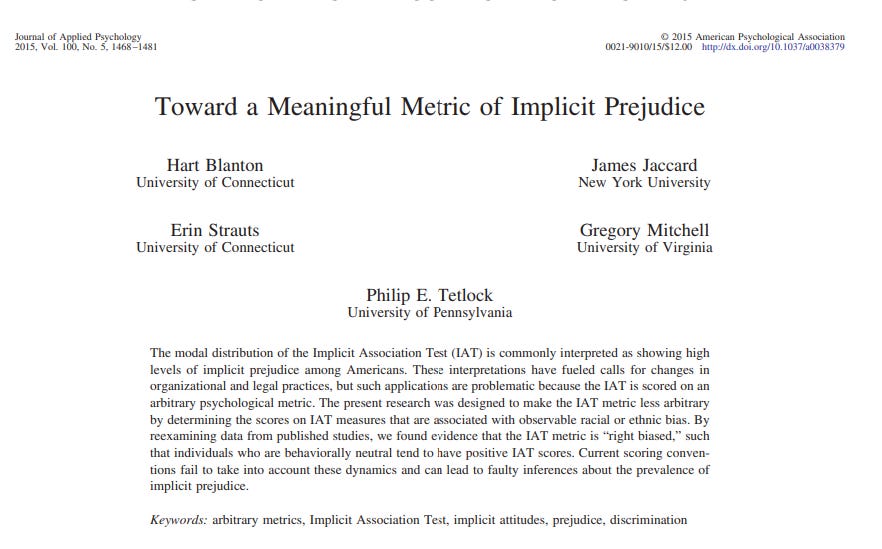
The value added in this post is that I will show how anyone with a working knowledge of basic bivariate regression can do this for themselves for any study that has some sort of outcome measure (judgment, evaluation, discrimination, etc.) that the IAT is supposed to predict. This is not original. Blanton and company first showed how to do this over 10 years ago and, with Axt et al as a notable exception, just about nobody else doing IAT research reports this! (Later in this post, I speculate on why that is, being that the technique is first undergrad stat class basic).
Rather than 0, the IAT scores that correspond to egalitarian behavior bop around quite a lot from study to study but, at least when this correspondence has been assessed, are consistently well above 0. This table from their paper shows the IAT scores that corresponded to egalitarian behavior on several measures from two studies in a previously published paper:
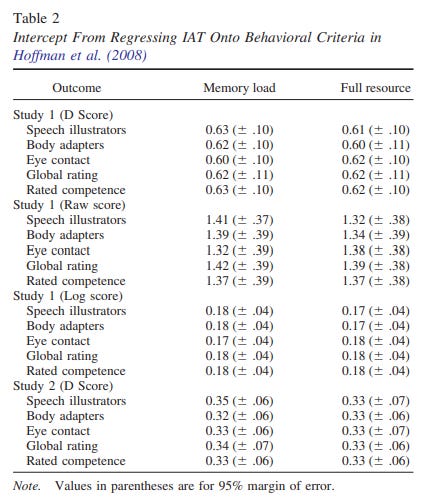
The “intercept” reported here is obtained from a regression of the IAT score on behavioral discrimination. In statisticsese, the “Y intercept” is the value of Y (or the outcome variable, in this case, IAT scores) when X (the predictor, in this case the “Outcomes” listed in the first column) is 0. As you can see in the table, the intercepts are always well above 0.
Basic bivariate regression prediction equation:
Y = C + b(X). Sometimes this is written as Y = A + b(X) or Y = b0 +b1(X) but its just notation variation; they are all the same equation. I am sticking with Y = C + b(X).
b is the unstandardized regression coefficient. C is the constant which is the Y intercept, which is the value of Y when X=0.
This can be seen quite simply: Y = C + b(X), so if X=0, then Y=C. When X=0, the regression line crosses the Y-axis of a graph — this is the Y intercept. When X=0, C is the predicted value of Y. I also note that this is basic 8th/9th grade geometry. Remember Y = mx + b? Its the same equation, with different letters. 8th grade b = regression C. 8th grade m = regression b. And 8th grade Y,x = regression Y, X.
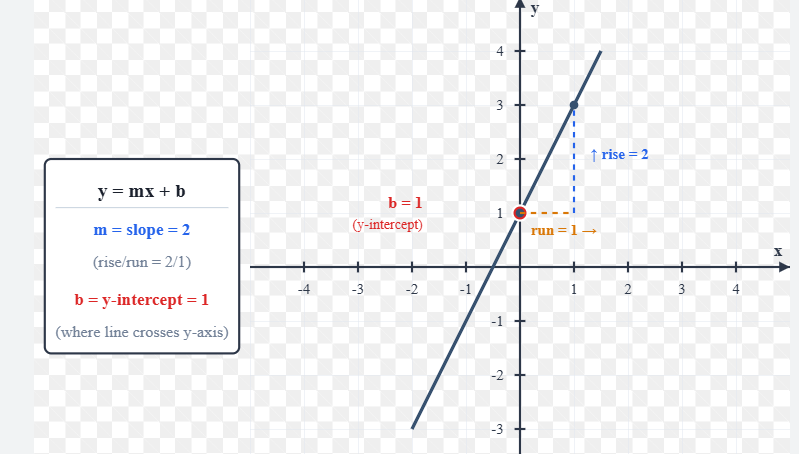
If Y is the IAT score and X is behavioral discrimination or judgmental bias,
Y = C + b(X) becomes: IAT = C + b(behavioral or judgment bias).
This is simple bivariate regression. I have undergrads who have done this. When behavioral or judgmental bias is 0, i.e., people are unbiased, IAT=C. C, the constant, is the predicted value of the IAT score that corresponds to unbiased behavior or judgments.
No one ever again needs to just assume that IAT=0=egalitarianism. They can treat this as an empirical question that can be tested and falsified using a very simple statistical test (bivariate regression). Most regression programs will provide a test of whether the constant (i.e., Y-intercept) is significantly above 0. Researchers rarely use this test, but its there if they want it, and, with respect to IAT scores, they should want it.
If the test of the constant is statistically significantly different than 0, then, by conventional statistical standards, the Y intercept cannot be assumed to be 0, i.e., the IAT score corresponding to egalitarianism is NOT 0. In Blanton et al’s table shown above, the intercept values for the D scores (the most common current metric for IAT scores) ranged from about .30 to .60. Higher scores than these corresponded to actual anti-Black bias, lower scores to anti-White bias.
This produces a bizarre irony. Consider the .63 intercept for competence ratings of Study 1 shown in Blanton et al’s table. This means that IAT scores of .20, .30, and even .50, generally interpreted as “implicit bias” against Black people in most of the IAT literature, actually corresponded to anti-White biases in judgments of competence.
Estimates of the “pervasiveness” of implicit bias made by assuming scores above 0 are biased (as done here, here, here, or here) are massively biased overestimates. The Blanton et al paper shown above also identified the race IAT scores that did correspond to unbiased judgments or behavior across eight published studies — and showed that doing so reduced the estimate of how many people have “implicit biases” against Black people by 2/3 or more in six of them.
Blanton et al were the first to show how to do this, and that was way back in 2015. So why isn’t this done in just about every study that uses the IAT to predict something? The actual behavior of psychologists in this regard is actually far worse than “not everyone has done it.” In fact, except for Axt et al, and Blanton et al, as far as I know, no one has done this. Its easy and just never done. And its a known controversy, regularly mentioned in reviews of implicit bias/IAT research, such as this one from 2019. So why not resolve it? I have some hypotheses:
They put the IAT on a pedestal. 0 does equal no reaction time difference between different versions of the IAT. If one assumes the IAT is a wonderful method, then 0 would indeed mean no difference in “strength of association” between the categories. These are strong assumptions that have never been justified. But, hey, if the IAT is your baby, or, at least your meal ticket to publications, grants, tenure, awards and the like, why would you want to risk all that by acknowledging that 0 may sometimes, even often, mean anti-White bias?
They do not understand regression. Its possible, but I doubt it. Many of those promoting wild overestimates of Americans holding implicit anti-Black biases have published papers with statistics far more sophisticated than simple bivariate regression.
They understand regression but it never occurred to them. Awash in infatuation with super fancy and sophisticated statistics, they simply never considered how this very simple method would resolve the “do IAT scores=0 correspond to egalitarianism?” controversies. This might explain a few researchers. But hundreds or thousands over almost 3 decades? It never occurred to anyone (except Blanton et al and Axt et al)? If so, “blind spot” is too weak to capture it; its more like “blind megamass.”
 - 11" x 17" - Jason Statham - 2018 | eBay")
Other purposes. Most of the papers using the IAT had other fish to fry besides testing whether IAT=0=egalitarian. What behaviors or judgments does it predict? How can IAT scores be changed? What are the IAT patterns for different groups or different types of attributes? If your focus is on something else, why bother testing this? Its just an unnecessary distraction from one’s main purpose.
They love 0=egalitarian because “social justice.” They “know” that America is a pervasively racist society. By using IAT>0 = “implicit anti-Black bias” they can come up with VERY HIGH numbers of “biased” Americans. What’s not to like? There are three non-mutually-exclusive and potentially synergistic subvariants of this:
They love the result as a springboard for declaring Americans massively (unconsciously) racist, so why undermine their own narrative by empirically assessing whether IAT=0=egalitarianism?
Confirmation bias. Regardless of whether they “like” the result, their a priori beliefs are that America is steeped in racism. The results finding 70% or so of Americans score above 0 on race IATs fits that belief. It never occurred to them to critically evaluate the assumption that IAT=0=egalitarianism.
Blind spot (or blind megamass). They were too busy exposing racism and working for social justice to think about whether IAT=0 corresponds to egalitarianism. I mean, who’s got time for that?
There is social pressure NOT to “see” the result that IAT=0 often corresponds to anti-White bias. I have a confession to make. I have a slew of papers using the IAT (which you can find here). NONE of them report this analysis. I have never had co-authors who were willing to do this, in part, because it was often not relevant to the main point of the paper, but also because they believed (correctly in my view) doing so would render the paper much more difficult to publish (see points 1-5 above). I would have happily engaged that battle with reviewers and editors, but I was not going to fight my own collaborators on it. And so we may have a real world example of something first speculated upon by philosopher Rishi Joshi:
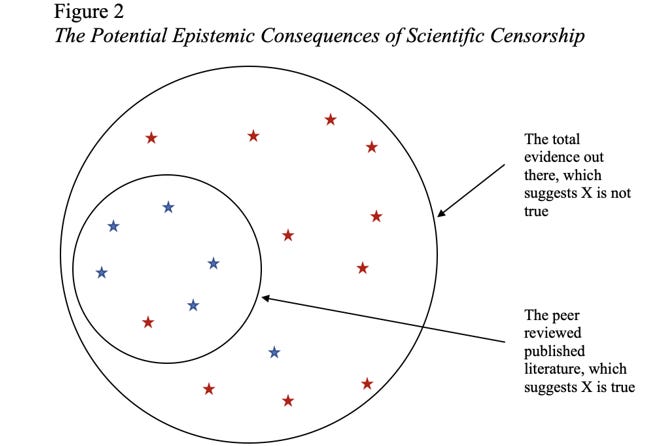
The figure displays Joshi’s key idea. He proposed that social pressure NOT to report evidence falsifying some claim could corrupt an entire academic literature. The small circle above shows an academic literature. Blue stars are evidence that something is true; red stars are evidence that it is false. If there is pressure NOT to report the falsification evidence, and scientists respond to that pressure by NOT reporting such evidence even when they have it, the evidence described in the academic literature (small circle) will look like the claim is overwhelmingly true even though the overwhelming evidence in the wider world outside that literature is that the claim is false.
Applied here, the literature overwhelmingly presumes that IAT=0=egalitarianism. To dare to test that would mean risking finding out that, at least in the study where said testing is being done, it is false. Given that the two papers that actually did this found that IAT=0 was very much NOT egalitarian (it corresponded to anti-White bias), testing this would likely both complexify interpretations of studies and risk pissing reviewers and editors off and generally making it harder to publish the paper. Academics have their careers to worry about. Publish or perish and all that. Plus, for much of the last 10 years, you would increase your risk of being subjected to some sort of cancellation attack by daring to challenge social justice narratives. And:
Before commenting, please review my commenting guidelines. They will prevent your comments from being deleted. Here are the core ideas:
Don’t attack or insult the author or other commenters.
Stay relevant to the post.
Keep it short.
Do not dominate a comment thread.
Do not mindread, its a loser’s game.
Don’t tell me how to run Unsafe Science or what to post. (Guest essays are welcome and inquiries about doing one should be submitted by email).
Footnotes
Varied definitions of implicit bias. We reviewed some of those widely varying definitions here, though, unfortunately, it is only available as a chapter in the referenced book (not online). Jussim, L., Careem, A., Goldberg, Z., Honeycutt, N. & Stevens. S. (2025). IAT scores, racial gaps, and scientific gaps. In Krosnick, J.A., Stark, T. H & Scott, A.L. (Eds.). The Cambridge Handbook of Implicit Bias and Racism (pp. 374-411). New York: Cambridge University Press. As we wrote in that chapter:
Scientific Gap: There is No Widely Accepted Scientific Definition of “Implicit Bias”
There is no widely agreed upon consensus as to what implicit bias means. There are a myriad of definitions in the literature, and, though the purpose of this chapter is not to review them, our view is that the overlap between the definitions is often minimal. Here are three examples:
“The notion of implicit bias can be puzzling. The idea is that people harbor mental associations based on race, gender, and other social categories that may lead to discrimination without intent, or possibly even awareness.” (Payne et al, 2017).
“More specifically, implicit bias can be defined as implicit group-based behavior, which is behavior that is influenced in an implicit manner by cues that function as an indicator of the social group to which others belong.” (de Houwer, 2019, p. 836).
“Cultural stereotypes may not be consciously endorsed, but their mere existence influences how information about an individual is processed and leads to unintended biases in decision-making, so called “implicit bias”” (Chapman, Kaatz, & Carnes, 2013, p. 1504).
Mental associations (first definition), behavior (second) and decision-making (third) are obviously completely different constructs. These definitions are also packed with claims and assumptions that are dubious at best. The “mere existence” of anything, including but not restricted to cultural stereotypes, cannot possibly “influence” anything (empirical evidence is required to determine whether they do). Defining associations of concepts in memory as “bias” imports a subterranean assumption that there is something wrong with those associations in the absence of empirical evidence demonstrating wrongness.
Also, as I pointed out here, Greenwald himself (the creator of the IAT and one of the foremost proponents of unjustified claims about it) provided a definition a few years ago that manages to be, by turns, false and logically incoherent.
Wild overestimates of those with implicit bias. IAT scores are approximately normally distributed around their mean. If the mean of a normal distribution is, say, .4, then about half the scores will be above .4 and have below .4. Most scores will be above 0. But if .6 is the point of egalitarianism, rather than most people having anti-Black implicit biases, only a minority, and possibly a small minority, have anti-Black implicit biases.
No posts
Comments
Nothing yet. Say the first thing.
Sign in to join the conversation.