
Welcome to my introduction to a new series of at least 4 posts (not including this one). The first was a review of recent-ish empirical research on racial discrimination, which has produced a great deal of findings even many of you may find surprising.

Implicit Bias and Racism
Recent Social Science Finds Little or No Anti-Black Discrimination
·
Jul 2

Anti-Black prejudice and discrimination was once very widespread. The obvious examples are slavery and the Jim Crow South. But discrimination was also common elsewhere, via practices such as redlining (where banks would often not provide loans to people living within areas marked off with “red lines” on a map (areas typically populated disproportionate…
The next three are on implicit bias, which, according to some, is a powerful driver of racial discrimination. These were inspired by two recent papers and something I’ve known for a long time. One recent paper debunks many of the early, wild claims about implicit bias. This inspired two separate Unsafe Science posts. One summarized the key findings of that paper.
The second post inspired by that paper shows (based on that paper and also earlier research) that scores of near 0 on the IAT, which are supposedly “unbiased,” are not only not unbiased, they generally correspond to anti-White bias.
The second paper inspiring a post here found that the race implicit association test (IAT), the workhorse method for assessing implicit bias, is heavily confounded by metaphorical meanings of “black” and “white” (I realize that is a bit cryptic, but that’s why I will do a whole post on it; if you do not know what the IAT is, don’t worry, a post already drafted explains it). It also discusses earlier work finding that the IAT is not even a clean measure of strength of associations, let alone “implicit bias” because the IAT is riddled with measurement artifacts.
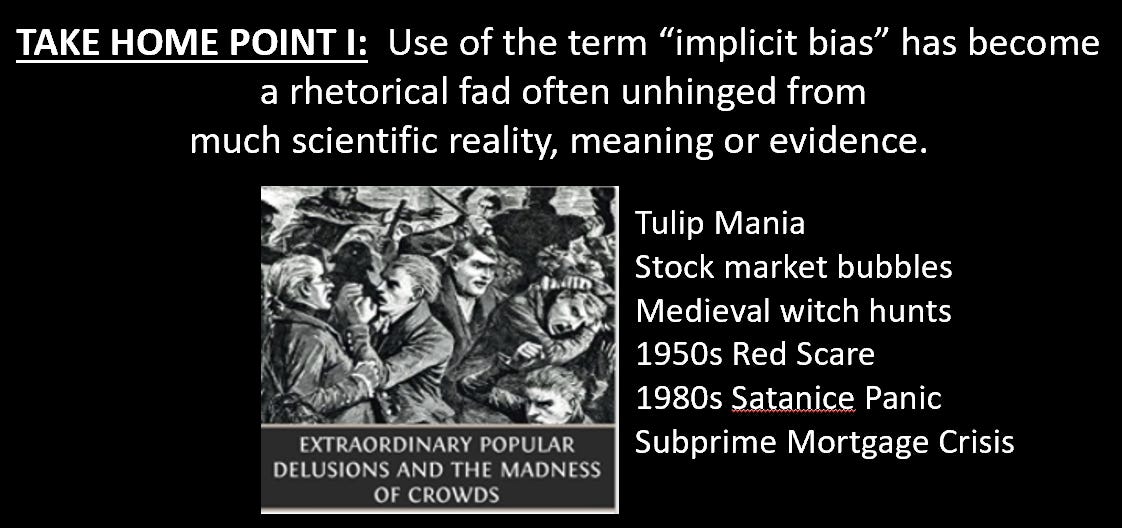
I am doing these posts because of a grand irony. Despite the extent and power of political biases to distort academic claims about bias and discrimination, and, worse, those distortions then infect the wider public’s beliefs, the actual underlying research is far more reasonable. That is, the problem (of political bias) is not so much “bad methods” (though that can happen), it is that studies using good methods have done little to stop academics from promoting nonsense about bias and discrimination, even in the peer reviewed literature.
This is a grand irony because: 1. the underlying research is often sound; 2. it often falsifies strong “social justice” narratives testifying to the power of bias and discrimination; 3. It is then duly ignored and those narratives are promoted even though they are largely disconfirmed by the underlying empirical studies. So, if one looks at empirical studies, there is often little or no concrete reason to believe researcher politics biased their results (although there are exceptions) because those actual results often contest the social justice narratives to which so many academics are committed. But there is political bias, and it is massive — because claims about the power of bias and discrimination are all over academic publishing. So the bias is far more in narratives than in actual underlying studies.
So the research is actually solid; but the narratives are far more influential and the narratives are a disaster area. This irony rears its head yet again with respect to research vs. narratives on discrimination in general and implicit bias in particular — thus this series.
I first discovered this pattern in each of my first two areas of research, begun as a graduate student:
Self-fulfilling prophecies1 were widely declared to be powerful and pervasive in narrative reviews, such as those appearing in the apex journal Science, in Annual Review Chapters, and Handbook chapters. And yet the actual underlying studies found self-fulfilling prophecies to be weak, fragile and fleeting. This paper was based on my dissertation:
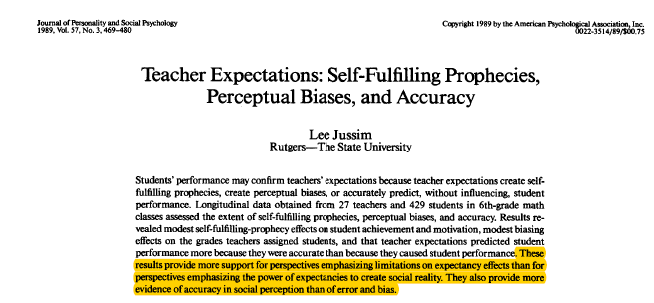
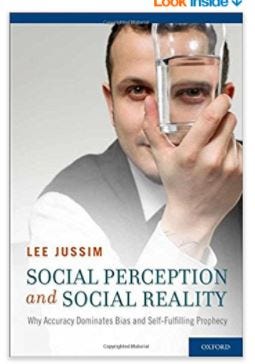
When I first conducted this work, I thought to myself, “Why are my findings so different than everyone else’s?” So I eventually reviewed vast literatures on this topic well beyond my dissertation, and found, lo and behold, pretty much everything out there found the same thing — if you looked at the actual results rather than the narratives, self-fulfilling prophecies were weak, fragile and fleeting, not powerful and pervasive. Discovering all that eventually became the inspiration for this book, covering the huge literature on this topic up to that point.
2. At the same time (grad school to early career), I also studied the role of stereotypes in person perception. The key question was this: To what extent to stereotypes or social categories bias judgments regarding individual people, and to what extent to people judge others based on individuating information — on their merits, behaviors and actual characteristics? The dominant perspective at the time was that stereotype biases were not just powerful and pervasive, they were the “default” basis for person perception. The 1990 article making this claim (without ever defining what “default” means) has been cited over 6000 times.
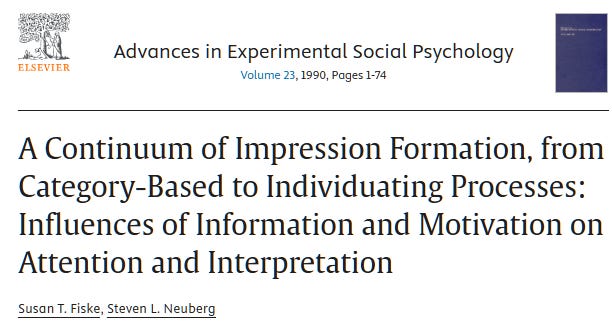
It has been cited over 5700 times since 1997. Why 1997? Because in 1996 a review and meta-analysis of all existing studies of stereotypes and person perception up to that time completely debunked claims about the power of stereotypes to bias person perception.
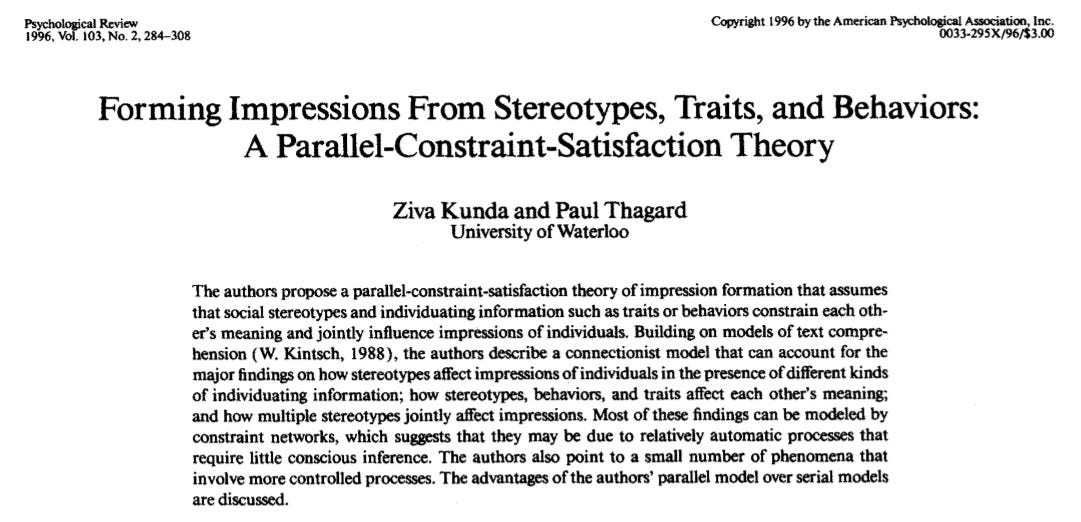
From that paper:
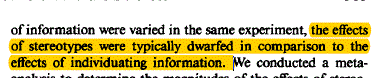
Kunda & Thagard has been cited 1445 times as of this writing (6/29/26). That means over 4000 papers cited Fiske & Neuberg without even acknowledging the existence of Kunda & Thagard’s debunking of one of its central claims.
The academic literature is filled with stuff like this, where the claims are wild but the underlying data clearly contest or debunk the claims. Without the gory details (you can find them in many other Unsafe Science or my old Psychology Today posts or, if you prefer more academic sources, my publications page):
Stereotypes are routinely declared inaccurate even though there are far more studies demonstrating moderate to high accuracy than inaccuracy.
Microaggressions are declared harmful on the basis of research that assesses neither microaggressions nor the harms they cause.
Biases favoring men in academic hiring are proclaimed throughout the peer reviewed literature when, in fact, there is vastly more evidence of biases favoring women than against them.
Racial gaps are routinely attributed to “systemic racism” in articles that do not even attempt to identify the specific “systems” the cause racial inequalities.
This gets me to an AI-created psychedelic surf song that I propose as the Theme for the 21st Century Academy. The song starts at 9:09 (link is to the full quasi-album). I present the lyrics in full below.
You say the sky is fallin’.
The world’s about to end.
I say, pass the joint baby,
let’s see what happens then.
You got your rules and your theories
all lined up in a row.
But I’m just riding this wave
watching the whole thing blow.
You talk so serious
like you know what’s true.
I just smile and say,
yeah well that’s just like, uh, your opinion, man.
Yeah well that’s just like, uh, your opinion, man.
You can keep your drama
I’ll keep your master plan.
That’s just like, uh, your opinion, man.
You say I should be worried.
You say I should be scared.
I say the ocean’s still movin’
and I’m already there.
You got charts and predictions
forecasting your hand.
I got a board and a good buzz.
That’s all I understand.
Yeah well that’s just like, uh, your opinion, man.
That’s just like, uh, your opinion, man.
Save your sermons for somebody else who gives a damn.
That’s just like, uh, your opinion, man.
Take it easy, dude.
The tide don’t care about your mood.
The wave don’t care what you believe.
It just keeps rollin’, you see?
Yeah well that’s just like, uh, your opinion, man.
Yeah well that’s just like, uh, your opinion, man.
I’m stayin’ breezy while the whole world tries to pull me down.
That’s just like, uh, your opinion, man.
That’s just like, uh, your opinion, man.
That’s just like, uh, your opinion, man.
Before commenting, please review my commenting guidelines. They will prevent your comments from being deleted. Here are the core ideas:
Don’t attack or insult the author or other commenters.
Stay relevant to the post.
Keep it short.
Do not dominate a comment thread.
Do not mindread, its a loser’s game.
Don’t tell me how to run Unsafe Science or what to post. (Guest essays are welcome and inquiries about doing one should be submitted by email).
Footnote
Self-fulfilling prophecies occur when one person’s initially erroneous expectation about a second person leads that second person to behave in a manner that confirms the initially erroneous but now fulfilled expectation. Students coming to achieve at levels consistent with their teachers’ high or low expectations for them is a classic example.
No posts
Comments
Nothing yet. Say the first thing.
Sign in to join the conversation.