
I’ve said many times that the thing that is most exciting about singlehood studies is that it is truly interdisciplinary. Having said that, I feel like we are the stage where there are people from many disciplines involved, but the hard work of integrating the different perspectives hasn’t really started yet. If you read a paper from the sociological perspective, you enter a cinematic universe where people are motivated almost exclusively by the societal messages they have been conditioned to believe. If you read a paper from the psychological perspective, you enter a cinematic universe where people are motivated primarily by their individual, possibly inborn, characteristics. Given that people are obviously motivated by both, how can we start the process of integrating these different disciplinary perspectives?
One principle I bring to my work is to try to use existing theoretical frameworks whenever possible. I’ve noticed that in a lot of disciplines, “theorizing” seems to be taken as something like a good in its own right. Theory is obviously important, but when academic disciplines strongly incentivize producing theory, you’re likely to end up with a good amount theory that is superfluous and redundant. Basically, I’m all for not reinventing the theoretical wheel. So when I was thinking about how we can help this process of integration along, my first step was to peruse the menu of available theoretical options. And it occurred to me that Self-Determination Theory (SDT), developed by Richard Ryan and Ed Deci, could be a big help, particularly as a framework for understanding why single people might want romantic partnership.
Developing a deeper understanding of SDT has been a big win for me in both my professional and personal life. It is one of those “once you know it, you see it everywhere” kind of theories, to the point that my students may or may not be sick of me talking about intrinsic motivation as it applies to their work. But there are some real start-up costs in understanding SDT because it is so multi-faceted; in my case, it took me about two years for the ideas to become intuitive. It doesn’t help that for the constructs I was trying to adapt, Ryan and Deci decided that the names of pretty much all of them would start with the letter “i”, so I was constantly getting all the different concepts (e.g., intrinsic, identified, and introjected motivation) confused with one another.
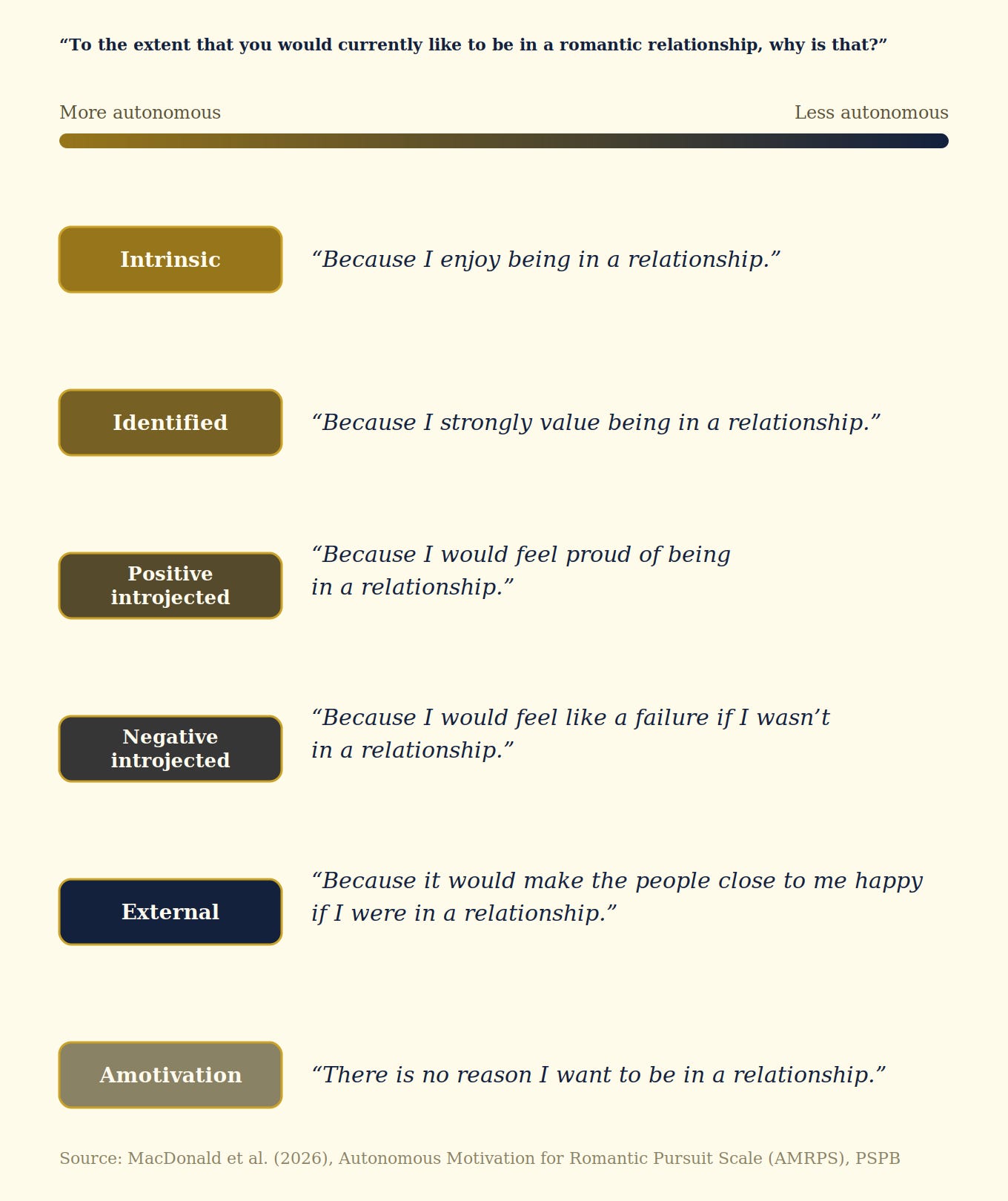
The part of SDT my lab used in our work says that the same behaviour (let’s say exercising) can be engaged in for a variety of different reasons, or because of a variety of different motivations that range from higher in autonomy to lower in autonomy. Intrinsic motivation is about doing something because you enjoy it, and is the most autonomous motivation. For example, you might jog because the activity itself is just fun. If that’s true, you’re more likely to persist at jogging and to meet your jogging goals because jogging is something you want to do. Identified motivation is about doing something not necessarily because you enjoy it, but because it is a means to achieve an important personal goal. Here, you might jog because being healthier is deeply important to you. This is a bit less autonomous than intrinsic motivation, but it’s still associated with persistence and success because the outcome is so important to you personally. It occurred to me that both of these kinds of motivations map onto the more psychological side of singlehood studies, the idea that people may want romantic partners because partnership is something they enjoy and personally value.
The next level down in terms of autonomy is introjected motivation. Here, you are motivated to build a more positive self-image. So you might jog in order to feel proud of yourself (positive introjection), or to avoid feeling lazy (negative introjection). Another level down is external motivation, where you’re motivated by the wishes or demands of other people. For example, if your partner is getting on your case about being out of shape, you might jog to get them off your back. When these less autonomous motivations are what are driving people to strive for a goal, people are less persistent and less successful because it’s easier to get knocked off track when you’re not doing it as an expression of something that is really personally meaningful. These levels of motivations struck me as mapping more onto the sociological side of singlehood studies, where the frame is more that people are motivated by societal pressure, such as the pressure to partner.
The final level of motivation in SDT is amotivation, where someone has no motivation to engage in a behaviour either because they see that behaviour as irrelevant to their goals (e.g., jogging has nothing to do with what they want in their life) or because they see no chance of success (e.g., they believe they are just not capable of jogging). It was coming across the concept of amotivation that really got me excited about using SDT to understand motivation for partnership. The founding impetus of singlehood studies came from people who have no interest in partnership, and see the whole domain of romantic relationships as irrelevant to their lives. And here was a theory that could bundle people who wanted nothing to do with partnership, who were seeking partnership because of internal or external pressure, and people who truly wanted partnership for their own personal reasons together in one theory and one continuum.
So, my lab decided we would develop a scale to measure people’s motivation to partner in light of these SDT ideas. It turned out I had two huge assets in this endeavour. The first was Serena Thapar, an undergraduate student and crazily high functioning individual, who took this work on as an independent project, an honours thesis, and a post-graduation endeavour. The second was Will Ryan, a member of our teaching faculty in my department, a world-leading expert in SDT, and an incredibly helpful and kind spirit. Together with Elaine Hoan, Yoobin Park, and Joanne Chung we set out to create and validate an SDT motivations for partnership scale.
I’m talking about this study now because the paper was officially published this week (on Canada Day!). I’ve actually talked about the results of the study on The Unromantic before, but only briefly. I talked about them in the context of a public critique the work had received. I regret how I responded to that critique, because the critique ignored the results of the study (which are an important challenge to that author’s perspective) and attempted to undermine the credibility of the work by questioning my motives. By not shifting the discussion back to the results, I unwittingly ceded the frame of the discussion to the author of the critique and essentially validated that it was okay that they just ignore results that undermine their perspective. That’s not how good faith debate works. So besides the fact that I just think the results are interesting and deserve to be expounded on in their own right, I also want to undo my mistake by spending some time here unpacking the results in more detail.
In the research, all of our participants were single, and you can see sample items for each motivation in the graphic below. In the first two studies we had 1,280 participants complete our new scale so we could look at how it correlated with other, possibly related, constructs. In the second study, we had another 4,020 participants complete the scale (and some other measures), and then checked back in with them six months later to see if they were still single.
Let’s start by talking about the single people who had the most autonomous motivation for partnership, those who enjoy partnership itself (intrinsic motivation) and those who personally value partnership (identified motivation). The most important finding here was that these were the motivations that participants most strongly endorsed as reasons to pursue partnership. I think this is a bit of a challenge to the sociological perspective, which focuses more on social pressure to explain motivation for partnering. In fact, our participants actually slightly disagreed (on average) that they were motivated to partner in order to please others.
A key prediction from SDT is that when you are motivated to do something because you enjoy it or it’s personally important to you, you’re more likely to be persistent in pursuing the goal and more likely to achieve it. And when we checked in with people who were more autonomously motivated for partnership (i.e., intrinsic or identified) six months later, they were indeed more likely to be partnered. I think one of the big tasks in front of singlehood studies, given that partnership isn’t for everyone, is that we should try to figure out who it is for. Although it’s a little obvious, our study shows that partnership is for people who intrinsically want it.
So, what about our less autonomously motivated singles, the ones whose motives for seeking partnership were more about improving their self-image (introjected motivation) or making other people happy (external motivation)? One interesting thing about them is that they were relatively high in the fear of being single. So it looks like these are people who aren’t so much drawn toward partnership, but instead are trying to avoid singlehood. For me this highlights one of the most important contributions of singlehood studies, especially the sociological perspective. I think relationship science has tended to take the frame that people want relationships because they love love, but has ignored the social pressure and messaging around the idea that being in a relationship is something that makes you a worthwhile person.
But what about when we checked in with less autonomously motivated singles six months later? Interestingly, negatively introjected daters in particular were less likely to end up being partnered. So this opens up the idea that all this social pressure to partner may actually backfire, at least in the largely Western context where we collected our data. That is, when you try to make people feel bad about themselves for not partnering, you may actually make it less likely that they will partner.
Thanks for reading The Unromantic! This post is public so feel free to share it.
And what about amotivated singles? The most interesting thing here was when we checked in at the six month mark to see who was partnered. As just a straight correlation, not surprisingly, people who were more amotivated for partnership were less likely to be partnered. But in our key analysis we accounted for shared variance by examining all the motivations simultaneously, and we controlled for desire and intent to find a partner so that our results were about why you wanted a romantic partner, not just how much you wanted a romantic partner. Conducting the analysis that way, we actually found that singles reporting higher levels of amotivation were more likely to be partnered than those reporting lower levels of amotivation. You can see the technical explanation and details in the paper (basically, a suppression effect), but in short this led us to the conclusion that you can be amotivated for partnership for at least two reasons.
First, there is the classic “single-at-heart” profile of people who just have no interest in partnership or even romantic connection in any form (think aromantic singles). But there is potentially another profile, of someone who has romantic and/or sexual desire and is getting it satisfied through non-committed relationships like casual sex. In our past research, we’ve shown that singles who are happy with their sex lives report lower desire for a partner, but maybe because they catch feelings for one of their ostensibly casual flings, are more likely to actually end up committed to a romantic partner. In general, we think that this amotivated category was the most interesting in the whole study, and opens up room to think about different reasons why someone might want to stay single. Of course, that suggests that we should create a SDT scale for reasons for singlehood. The trick is that we tried, but statistically the scale didn’t hang together, so we had to abandon the project.
The thing I really like about our paper that was just officially published is that it makes a genuine attempt to not just recognize a diversity of perspectives in singlehood studies, but to integrate them. It’s not a perfect attempt, and because it is rooted in a psychological perspective, I’m sure my colleagues from other disciplines won’t be fully satisfied. But if so, I would encourage them to do the same and develop models that take us out of our silos and into the real world, where multiple things are always happening at once.
No posts
Comments
Nothing yet. Say the first thing.
Sign in to join the conversation.