
Imagine this exchange between a heterosexual couple:
Her: I don’t feel that you’ve been contributing enough to the housework, I need you to contribute more.
Him: Your belief that I do not contribute enough to the housework is hurtful.
I would imagine most people read this and feel like something is missing in this guy’s reply. What strikes me is his lack of curiosity about the basis of her perception, and the way his response leaves no room for the possibility that maybe she’s onto something. It comes across as defensive, and maybe heading down the road of gaslighting by placing the problem at the level of her belief rather than his behaviour.
I think about this hypothetical often, because there is a parallel that happens frequently in singlehood studies. It’s common for researchers to write a sentence along the lines of, “single people are stereotyped as less social, more lonely, and less happy than partnered people.” The authors then move on to discuss the harmful and stigmatizing effect that such negative views of single people can have. But there is a similar lack of consideration about whether people are onto something; maybe these beliefs about single people have some truth to them, even if they are some combination of reality and exaggeration.
The impulse to focus on negative beliefs about single people is understandable. I often have the chance to talk to single people about my work, and I see how much many of them appreciate that their singlehood experiences are drawing more academic and cultural attention and how validating it is for someone to talk about single people as something other than lost and pitiable. Leaving a conversation about society’s views of single people at “society is being unfair” would be a validating end point.
But I’m wary of the idea that seems to be held in some academic circles that if society believes something, then those beliefs must be incorrect assumptions socialized by cultural narratives. It’s a view that clearly has value up to a point. But it always strikes me as being cynical about the abilities of regular people to observe the world they live in. It also positions academics as more evolved than regular people (we’re always claiming that we’re “moving beyond” some belief that normies are supposedly stuck in), which is a dangerously intoxicating way for academics to see ourselves. In short, I think people’s perceptions are right more often than we give them credit for.
One paper that was influential on my thinking here is research that was conducted on people’s judgements of gender differences. It turns out that people are actually pretty good at accurately inferring the degree of differences between men and women. The authors of the paper point out that we probably should expect people to be good at assessing group differences when they spend a lot of time with people from the groups that they are rating. So, for example, people who spend most of their time with people of their own race might not be great at accurately estimating differences between racial groups because they don’t have a lot of first-hand experience. But when it comes to gender, people are around different genders all the time, so they have a pretty good basis on which to make their judgements. As a result, it makes sense that when people are asked to estimate how big gender differences are, they mentally refer to all the men and women they’ve met and do a pretty good job.
So, should we expect people to make accurate estimates of differences between single and partnered people? Well, people are not only around single and partnered people often, but everybody has themselves been single and most people have at some point been partnered. That means that people’s familiarity with single and partnered people should be pretty high, especially because of their personal experiences being single and partnered, and so you’d expect judgments of differences between single and partnered people to have some degree of accuracy.
In my recent chapter in the Oxford Handbook of Singlehood, I did a deep dive into the literature on relationship status and well-being, in part to figure out whether people’s beliefs that single people are lower in well-being are real or imagined. So, are people right to think that single people have lower well-being than people who are partnered? In short, yes, but some of the effects are bigger than others, and it really depends on what aspect of well-being we’re talking about.
Overall, the evidence is consistent that partnered people are higher in well-being on average. Some of this is definitely a selection effect. For example, partnered people are higher than single people in extraversion, and extraverted people are both happier and more likely to go from being single to partnered. But there’s also a whack of high quality studies consistently showing that life satisfaction goes up when people go from single to partnered.
Importantly, the boost in life satisfaction when going from single to partnered looks relatively small. If you think getting into a romantic relationship is going to redeem you in some overarching way, you’re barking up the wrong tree; the difference is more quiet and subtle than that. The small magnitude of the difference also means that although partnered people are happier on average, most single people are happy with their lives in an absolute sense. And with all the variability in people’s life satisfaction scores, there’s plenty of single people who are as happy or happier than the average partnered person.
Where you start to see some larger differences between single and partnered people is when you look at specific domains in people’s lives. With sexual satisfaction especially, it appears most people’s frequency of having sex and satisfaction with their sex lives goes up dramatically when they get into a relationship. There’s also good evidence that loneliness goes down, although this effect is more moderate. The data on loneliness aren’t as abundant, but there’s reasons to think that this drop in loneliness might be more about a decrease in emotional loneliness (“Do I have close, intimate connection?”) than social loneliness (“Do I have enough friends?”).
So let’s take this back to the idea that people tend to view singles as less social, more lonely, and less happy than partnered people. Is this all in people’s heads, or are they actually seeing something real? Well, single people really are on average more introverted (a moderate effect size), more lonely (a moderate effect size), and lower in life satisfaction (a small effect size). This isn’t to say that singlehood is without advantages – single people have broader social networks and newly single people report increases in satisfaction with work-life balance for example. But is society just completely out to lunch when it comes to its views of single people? It sure looks like the answer is no.
I think that it’s time for singlehood studies to come to terms with all of this. It’s obviously good that we’re talking more about how society views single people, and raising awareness that many single people are happy. But at the same time, you can’t tell the public that they’re not actually seeing something that they really are seeing, and expect to maintain the credibility you need to push for things like policy change.
Another theme I explore in the chapter is that although a lot of people in singlehood studies are motivated by the desire to help single people, I think we need to acknowledge that ignoring real differences can hurt single people themselves. For one thing, if it really is true that partnering is one pathway to higher well-being for many people, it would be negligent to hide that and leave it out of the policy equation.
And for another, it’s not just society in general that has the potential to feel misled, it’s single people themselves. If the data are right that singlehood is associated with higher levels of loneliness, it seems odd to try to tell single people that they aren’t really lonely.
Personally, I think the data are pointing to something real. I spend a lot of time monitoring online singlehood spaces, and even among many of the most enthusiastic advocates of singlehood the one caveat that I see most frequently mentioned is that it gets lonely sometimes. As singlehood scholars, it shouldn’t be our business to make single people feel like there is something wrong with them for the very normal experience of being lonely that our data says is common. Here’s a section from my chapter:
For example, in a post on the Reddit forum Ask Women Over 30, one user posted the question, “The worst thing about being single?” and answered her own question as follows:
Not being allowed to be sad about it. “Love yourself, focus on your friends, your career, at least you’re alive, not every relationship is perfect, at least you’re not settling” blah blah blah. I’m aware of all of it and I still. Want. My. Person. I want long lasting, safe, romantic love. I want to sleep with the same person every night and grow and live and learn and travel and cry and mourn and rejoice with my person! Why is it SO BAD to want that?
This is such a normal experience in singlehood, and yet I feel like singlehood studies really doesn’t have space for it. I see a statement like that reddit quote and I see someone doing a healthy thing; being open to the full range of their emotional experiences. Of course, I anticipate the sith-busting response that being partnered doesn’t guarantee you won’t be lonely. But that argument is built on the false premise that I’m saying partnering guarantees you won’t be lonely, or that I’m saying all this means that everybody should seek partnership. As Donovan Woods reminds us in one of his (joking? not joking?) Valentines cards, loneliness is always going to be part of the human condition no matter what your relationship status.
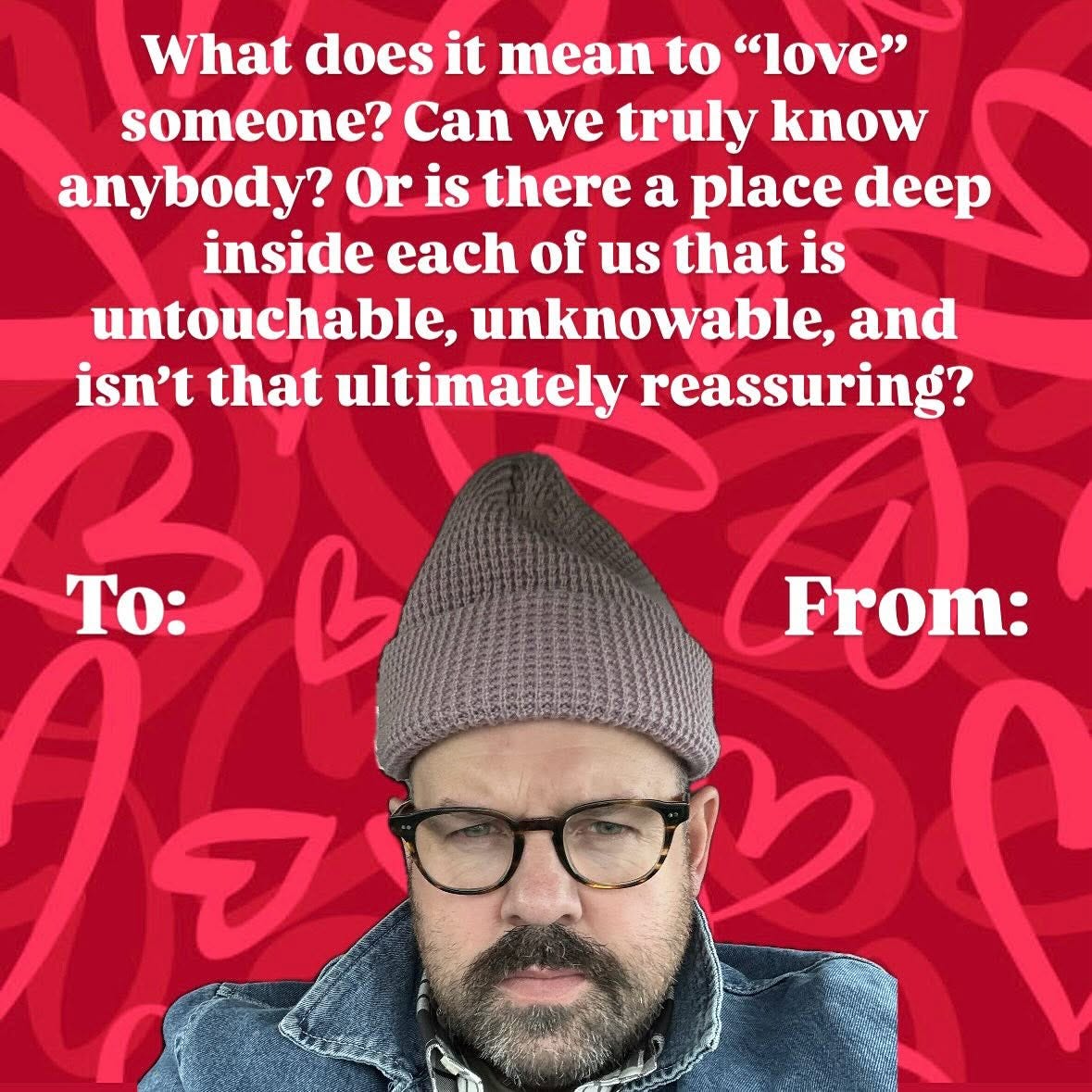
It’s just that the data seem to show that for a lot of people, being partnered somewhat increases the odds that you might be able to take the edge off that a bit. If we’re serious about highlighting the full range of experiences around singlehood, I don’t think we should be selling the idea of partnership benefits as nothing but fantasy.
Of course, these well-being benefits can absolutely be happening at the same time that society exaggerates their strength, and that negative stereotypes are making single people’s lives harder.1 It can be both. It’s always both.
Also, none of this contradicts that single people are on average doing pretty well and that partnership isn’t for everyone. It’s also not to say that the work of assessing this question is done – for example, most of the data has been collected in wealthy, Western countries, so it’s not a good idea to generalize this elsewhere. Our understanding of the issue is certain to evolve.
But I’ll say it again – we’re past the point where we can talk about society’s negative perceptions of single people without doing the hard work of integrating that idea with data that some of those perceptions have a basis in truth. Most of the single people I talk to understand this and are fine with it. I think it’s time for singlehood researchers to catch up.
Sometimes scholars will argue that stigma and discrimination can 100% account for single people’s lower well-being. Although arguments for a role for loneliness have good quantitative data behind them, these stigma based arguments do not. It’s not to say such arguments are implausible, but the available data do not support the confidence with which such arguments are often made. Further, relief from stigma is an especially poor explanation of some of the more domain-specific benefits of partnering, such as why people’s sexual satisfaction skyrockets when they enter partnership. Stigma may ultimately prove to play an important role, but the extent to which this hypothesis has been systematically tested is surprisingly limited.
No posts
Comments
Nothing yet. Say the first thing.
Sign in to join the conversation.