
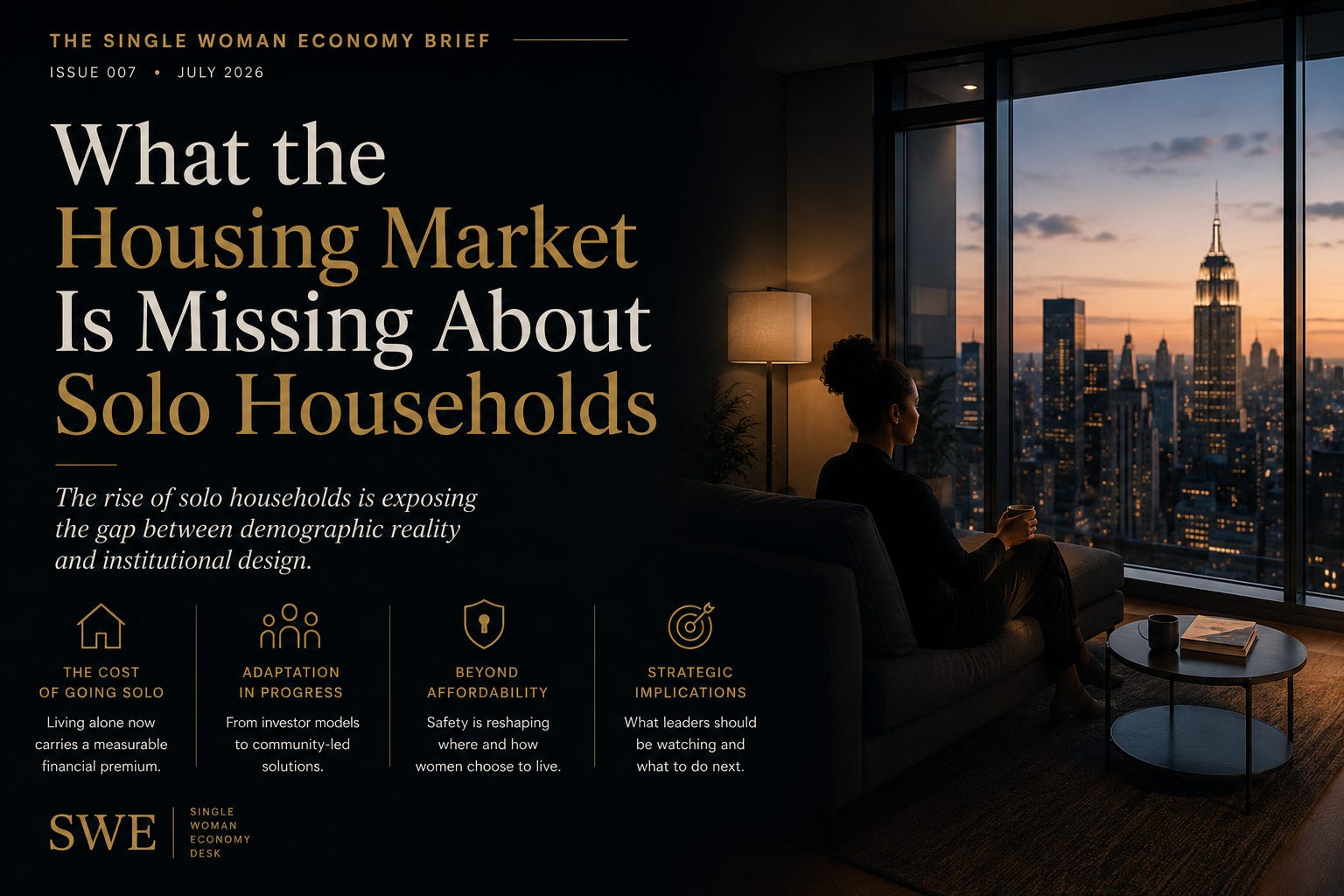
The way we live is changing faster than the housing market designed to serve us. More adults are building permanent lives on their own, yet much of the housing market still assumes that adulthood ends with two people sharing one home and two incomes sharing the cost.
The evidence is becoming difficult to ignore.
In the US, living alone now costs an estimated $7,110–$10,470 more per year than sharing a one-bedroom with a partner. In New York City, that rises to around $20,100 a year. Zillow Singles Tax Report
In the UK, analysis suggests that living alone costs around 38% more than sharing with another adult, with London carrying the highest estimated premium.
Markets have noticed the shift. Investors have poured billions into co-living, while new housing models continue to emerge. Yet many of the highest-profile co-living businesses have struggled to build commercially sustainable models. This week’s Brief argues that these are not separate stories.
The Singles Tax, co-living, women buying homes with friends and resident-led housing communities all point to the same underlying signal:
The number of solo households has changed. Our housing institutions are still catching up.
This week, we explore how one of the biggest demographic shifts of the past two decades is exposing a growing gap between the way people live and the way housing markets are designed.
You’ll read:
Why the “Singles Tax” matters and what it tells us about the cost of building a life outside a couple.
Why billions have been invested in co-living, yet many of its biggest operators have struggled to build sustainable businesses.
Why shared living isn’t new, and how today’s co-living movement differs from traditional house shares and HMOs.
How women are adapting, from buying homes with friends to creating intentional communities designed around safety, independence and long-term living.
What organisations should learn as housing markets begin adapting to the permanent rise of solo households.
Housing markets still operate on an assumption that few people ever stop to question. That adulthood is lived in pairs. It’s an assumption embedded almost everywhere: in the cost of renting a one-bedroom apartment, in mortgage affordability calculations, in utility bills, in deposits and, ultimately, in the economics of home ownership itself.
The expectation isn’t simply that people might live with a partner - it’s that they eventually will. For decades, that assumption broadly reflected how many people organised their lives. But demographic change has been moving in a different direction.
Across many developed economies, more people are living alone for longer. Some never marry. Others divorce. Some choose to remain single. Others are widowed. Increasingly, living alone is not a temporary stage on the way to coupledom - it’s a permanent way of life. The market, however, has been much slower to adapt.
Solo households continue to absorb costs that were largely designed around the economics of sharing. That’s why the idea of the “Singles Tax” has started to emerge. Recent housing analyses by Zillow Research and StreetEasy Research have begun quantifying the additional cost of living alone, giving a name to something millions of people have experienced for years: building a life alone often costs significantly more than building one with another adult. But the Singles Tax is only part of the story.
Over the past decade, investors have poured billions into co-living, operators have promised a new way of living for independent adults, women have increasingly begun buying homes with friends, and resident-led communities have created entirely different housing models outside the mainstream market. Viewed separately, these look like unrelated trends. Viewed together, they reveal something much bigger.
They suggest that housing is beginning to adapt to the permanent rise of solo households - but that adaptation remains incomplete, uneven and, in some cases, commercially unsuccessful. That is this week’s signal. The question is no longer whether more people are living alone. The question is whether our housing institutions have fully recognised that they are designing for a demographic that is no longer the exception, but an increasingly permanent part of modern society.
Here’s what the data I could find tells us.
1. The Cost of Living Alone Is Now Measurable
Living alone has always been more expensive than sharing a household. What’s changed is that researchers have started measuring the gap. According to Zillow Research, the additional cost of living alone compared with sharing a one-bedroom home with a partner is estimated at between $7,110 and $10,470 per year across the United States. In New York City, that rises to around $20,100 per year.
The same pattern is emerging elsewhere. Analysis by Zable estimates that living alone in the UK costs around 38% more than sharing with another adult, with London carrying the highest estimated premium. While the methodologies differ, both point to the same conclusion: solo households face materially higher housing costs than shared households.
2. Investors Recognised the Opportunity - But Not Necessarily the Solution
The rise of solo households has not gone unnoticed. Over the past decade, billions have been invested in co-living, a model designed to offer flexible housing with shared amenities and built-in community. Yet some of the sector’s most prominent businesses have struggled to build commercially sustainable models.
Common, once North America’s largest co-living operator, raised more than $113 million before filing for Chapter 7 bankruptcy in 2024. Quarters filed for bankruptcy in 2021. HubHaus shut down, while The Collective lost its flagship Williamsburg development. At the same time, institutional investment continues. Firms including Ares Management, Greystar and Flow are still investing heavily in the sector, suggesting that investors remain convinced demand exists - even if the commercial model is still evolving. The demand appears real but the business model is still being tested.
3. Shared Living Isn’t New. The Marketing Is.
People have shared homes for generations. House shares, HMOs, boarding houses, lodgers and student accommodation have long provided practical ways to reduce housing costs. What’s changed is how shared living is being positioned. Modern co-living is increasingly marketed around community, belonging, networking, wellness and lifestyle - not simply affordability. That shift reflects something important. The conversation is no longer just about finding somewhere cheaper to live. It’s about designing housing for people who may build long, successful and financially independent lives outside traditional family households.
4. People Are Adapting Faster Than Markets
Not all innovation is coming from institutional investors. Across both the UK and the US, people are beginning to experiment with different ways of living as traditional housing models become harder to access or less suited to the way many adults now live. Some women are choosing to buy homes with friends. Others are exploring intentional communities that balance private living with shared spaces, mutual support and lower housing costs.
One of the best-known UK examples is New Ground Cohousing in North London. Opened in 2016 after a resident-led campaign lasting more than two decades, the community was designed by older women for older women and combines private homes with shared communal spaces. BBC – New Ground Cohousing
A similar conversation is now emerging in the United States. Author and entrepreneur Elizabeth White, whose work on financial insecurity among older adults led to the creation of NUUage Coliving, argues that housing has become one of the defining challenges facing women as they age. Rather than replicating traditional retirement housing, NUUage explores how older adults might combine privacy, affordability and community through purpose-built shared living. Elizabeth White – About NUUage Coliving Senior Living Innovation Forum – The Forgotten Middle
These initiatives remain relatively small but they point towards something important. As solo households become more common, some of the most interesting housing innovations are emerging not from large institutional developers, but from people redesigning housing around the way they actually want to live. For many women, there is another dimension that deserves greater attention.
Housing decisions are not always driven by affordability alone. They are also shaped by questions of safety, security and peace of mind. A recent academic paper on women’s access to student housing in India introduces the concept of a “Safety Premium” to describe the additional financial and social costs some women incur in order to access accommodation they perceive to be safe.
While the research is grounded in the Indian housing market, the underlying insight has broader relevance. A woman may choose a more expensive neighbourhood, a building with better security, or to live with trusted friends because those choices reduce perceived risk. In that sense, affordability cannot always be understood through financial measures alone. For some women, safety forms part of the overall cost of securing a home.
That does not mean every woman makes housing decisions in the same way, nor that safety is the primary consideration for all women. It does, however, highlight an important question for policymakers, developers and housing providers: if safety influences where and how people live, should it be treated as a central part of housing design rather than an individual cost for women to absorb?
The rise of permanent solo living is not simply a housing trend. It has implications across multiple sectors that continue to organise products and services around the assumption of shared households.
Housing and Real Estate
The opportunity is unlikely to be solved by simply building more co-living developments. The stronger commercial opportunity may lie in designing housing that balances independence, privacy, safety and community, recognising that solo households have diverse needs rather than a single preferred way of living.
Questions to watch:
Will developers rethink the design of one-person homes?
Can housing provide opportunities for connection without requiring communal living?
Which models prove commercially sustainable over the next decade?
Financial Services
Many financial products continue to assume two incomes, shared financial risk or joint borrowing. As solo households become more common, lenders, insurers and wealth managers may need to rethink how affordability, risk and long-term financial resilience are assessed.
Questions to watch:
Do mortgage affordability models disadvantage permanent solo households?
Will more financial products be designed specifically for one-income households?
Employers
Housing affordability increasingly shapes where people can afford to live, how far they commute and how financially secure they feel. Employers concerned with recruitment, retention and employee wellbeing may find that housing becomes an increasingly important workforce issue.
Questions to watch:
Will employers expand housing assistance or location flexible working?
How will rising solo living influence employee financial wellbeing strategies?
Could housing costs become a greater driver of talent shortages in expensive cities?
Public Policy
Governments have traditionally planned housing around assumptions of family formation, marriage and home ownership. As solo households become more common, policymakers may need to reconsider how housing need, affordability and supply are measured.
Sweden offers a useful case study. According to Statistics Sweden, single-person households without children accounted for 42% of all Swedish households at the end of 2025, making them the country’s most common household type. Yet Sweden continues to face significant problems matching housing supply with demand. The OECD’s 2025 Economic Survey of Sweden points to planning constraints, shortages and affordability pressures that continue to limit access to suitable housing.
Sweden therefore illustrates both the scale of the demographic shift and the institutional challenge it creates. A country can have a large and established population of solo households while its housing system still struggles to provide the right quantity, location and type of homes.
Questions to watch:
Which governments begin planning for solo households as a permanent demographic rather than a transitional life stage?
How will measures of housing affordability evolve as one-person households become more common?
Could Sweden offer an early indication of the pressures other countries will face as solo households grow?
Housing is often presented as an affordability problem. This issue suggests something broader. It is also an adaptation problem. As the number of people living alone continues to grow, organisations face a choice. They can continue designing products, services and policies around assumptions that no longer reflect how millions of people actually live. Or they can recognise that demographic change creates new patterns of demand, new commercial opportunities and new institutional responsibilities.
The question is not whether solo households will become more common. In many countries, they already are. The more important question is which organisations will adapt first.
The Single Woman Economy is not defined by relationship status. It is defined by the economic consequences of demographic change. Housing is one example. Financial services, insurance, healthcare, travel and retirement planning may be next.
The organisations that recognise this shift early will be better placed to build for the households that exist today rather than the ones institutions have historically assumed.
The Single Woman Economy Brief is a weekly market intelligence publication exploring how demographic change is reshaping consumer markets, workplaces and institutions. Each week, I examine one question through the lens of evidence, commercial strategy and institutional design, looking beyond headlines to understand what organisations should be paying attention to next.
Once a month, the Desk publishes a longer Market Intelligence Edition, taking a deeper look at a single industry. Last month’s edition examined the travel sector and asked what every industry could learn from the first market to recognise the economically independent woman as a primary customer.
Ashanti Bentil-Dhue | Single Woman Correspondent
Comments
Nothing yet. Say the first thing.
Sign in to join the conversation.