
Whenever matriarchy is discussed online, one argument appears almost immediately:
Women are naturally more caring than men.
Women give birth.
Women nurture children.
Women perform most of the care work.
Women are more empathetic, cooperative and protective.
Therefore, the argument goes, a society governed by women ( a matriarchy) would be safer, kinder and fairer than one governed by men. This is not a minor claim by the way. Variations of the same argument are repeated over and over again: power will be exercised more ethically because women are more caring, and children will be better protected because women are naturally maternal.
But where is the evidence for this? Are women born more caring, or are girls trained to care? Are we observing female nature, or skills women develop through a lifetime of expectation, repetition and responsibility? And does performing more care prove that women are morally superior or politically safer than men?
Before we describe matriarchy as safer for all simply because of women, we need to establish whether its promise of safety rests on evidence, or on another approved version of what a woman is supposed to be. A quick note before we begin: there are far more studies, sources and competing interpretations than I can include here. I’ve selected a small number of verifiable sources to examine the central claim, but some of these questions may deserve their own investigations as this series continues.
One of the first things often cited in these debates is a woman’s ability to be give birth. According to research, pregnancy, childbirth and breastfeeding can produce changes that support responsiveness to a baby. But scientists have not identified a universal instinct that makes every woman want children, bond immediately or care selflessly. A systematic review found associations between oxytocin and mother-infant bonding, but the evidence was preliminary and oxytocin is not exclusive to mothers. So biology may support infant care but it does not prove that ‘caring’ belongs exclusively to women.
But if the ability to give birth does not make women universally maternal or caring, can we look beyond reproduction? Are women born with a greater capacity to care, or are girls taught from childhood that caring is what women are supposed to do?
The most accurate answer I could find is that biology may play a role, but there is clear evidence that caring behaviour is also taught and reinforced. For example a review of 45 studies found that parents spoke to, played with and selected toys for children differently according to their sex. A 2023 study also found that when men and women were given the same expectations about empathy, the reported difference between them disappeared. The report suggests that women may describe themselves as more empathetic partly because society expects them to be. We can’t fully separate nature from nurture, but the research I found does not support the claim that every woman is born naturally more caring.
If women are naturally maternal, what does that mean for women who do not feel maternal at all? An average difference between women and men does not define every woman. We cannot claim that all women possess a maternal nature while ignoring women who tell us clearly that they do not.
We also need to distinguish between three groups that are often collapsed into one. A child-free woman has chosen not to have children, but she may still identify as maternal and enjoy nurturing or caring for others. A childless woman does not have children, although she may have wanted them and may identify strongly as maternal. A non-maternal woman is describing how she experiences herself, not simply whether she has given birth. She may be child-free, childless or already a mother. Also being a mother and feeling maternal are not the same thing.
In any case, the question is not simply whether all women feel maternal. I started to think about what happens when motherhood is treated as proof that a woman is caring, responsible and worthy of respect. If becoming a mother gives women greater authority in society, where does that leave women who are child-free, childless or do not feel maternal, especially within a matriarchy?
If motherhood becomes closely linked with responsibility, sacrifice and moral authority, it could also become an unwritten test of whether any woman is considered fit to lead.
Would child-free and childless women face a burden of moral proof?
A child-free woman might then be required to prove that she is still caring enough to lead. She may need to point to her work as a teacher, aunt, mentor, volunteer or community organiser to reassure people that she contributes to the lives of others. An openly non-maternal woman would face an even sharper test: could she be trusted with authority if she refuses to perform the very quality said to make female leadership superior? She would not merely have to demonstrate competence, she would have to prove that her rejection of motherhood had not made her selfish, cold or morally incomplete.
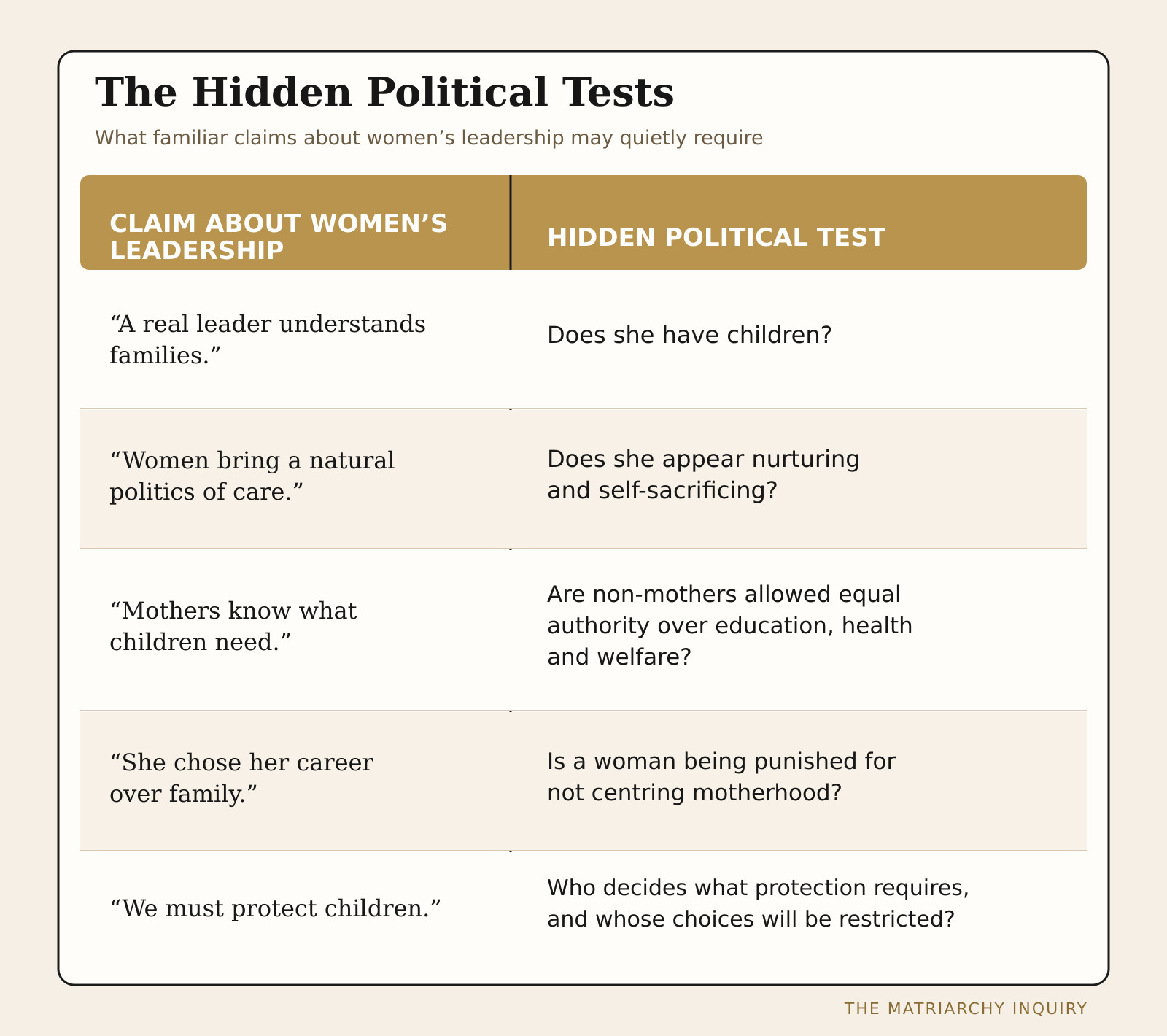
We already live in societies that treat motherhood as a quintessential symbol of womanhood. Child-free women are often called selfish and childless women may be treated with pity or assumed to be incomplete. Women who openly say they are not maternal can be viewed as cold, unnatural or insufficiently feminine. In one study, participants rated voluntarily child-free adults as less fulfilled than parents and expressed anger, disapproval and disgust toward them. The researcher described this as evidence of parenthood being treated as a moral imperative. Other research has found that child-free women experience pressure to justify their decision and manage the stigma attached to rejecting motherhood.
Would matriarchy weaken this judgement, or strengthen it? If women are already judged according to their relationship with motherhood, what happens in a system whose alleged moral superiority rests on women being naturally maternal? Would maternal identity become even more important to a woman’s status, belonging and right to exercise power?
In societies described as matriarchal, motherhood can create several forms of authority. Mothers continue the maternal line, while mothers and grandmothers may gain influence through age, caregiving and responsibility for the household’s future. Among the Mosuo, households are organised around maternal relatives and continue through women’s children. Minangkabau women are central to ancestral households and the transfer of family property. Among the Akan, maternal descent shapes identity and succession, and queen mothers can hold political influence. In Haudenosaunee governance, Clan Mothers select male chiefs and can help remove them if they fail in their duties.
Titles such as Clan Mother or queen mother don’t necessarily mean that every woman holding the role is a biological mother. Her authority may come from her family line, age, ability, appointment or cultural status. However, leadership, care and political power are often described through maternal roles. Of course, a woman without children may still be a daughter, sister, aunt, land user, heir and full member of her maternal line. Popular discussions of matriarchy rarely answer this question based on what I could find.
Before automatically declaring matriarchy as liberating for all women, we have to ask which women its definition of womanhood would actually liberate. That led me to my next question: if motherhood gives women greater authority, which mothers would be seen as most deserving of it?
We already distinguish between “good” and “bad” mothers according to whether women perform motherhood in approved ways. A review of 115 studies found that contemporary mothers are expected to be attentive, secure their children’s future, combine (juggle) employment with mothering, remain in control and appear happy with the role. But not every woman has the same money, health, time or support to meet those expectations. Race, class, disability, sexuality, marital status and family structure all influence which mothers are viewed as responsible and respectable. A matriarchal society could therefore elevate motherhood while still placing its preferred version of the “good mother” closest to power. So we can’t assume that a society which values motherhood will value every mother equally.
Then I thought about whether there are other ways we could look at this that are not defined by motherhood and found the work of political theorist Joan Tronto who offers another way to think about care. Instead of asking which women are naturally caring, she asks what care people need, who performs it, who has the power to define those needs and how responsibility should be distributed. Care becomes a public and democratic responsibility rather than a private female instinct. Schools, healthcare systems, employers, communities, families, governments and citizens all have responsibilities within it.
Under that framework, a child-free or non-maternal woman does not need to imitate motherhood to be fit to lead. Her legitimacy can rest on competence, accountability, attentiveness to other people’s needs and a commitment to distributing care fairly. That would mean that a child-centred society would not require a mother-centred political order. We can recognise care as essential without turning maternity into the entrance requirement for female power.
I thoroughly enjoyed researching and writing about this because there are so many factors and questions to consider. The research suggests that reproductive biology can influence caregiving, but it does not establish one universal maternal nature shared by all women. Care is also developed through experience, conditioning, expectation and responsibility. Once maternal identity becomes the political reason women should hold power, we must ask which women qualify, which mothers count and whether women who reject motherhood would be required to prove their moral worth.
That is why we are doing The Matriarchy Inquiry: not to defend patriarchy or dismiss matriarchy, but to slow down, define the claims and ask how the proposed system would work for actual women, not an idealised version of us. Thank you for reading and, especially, for thinking through these questions with me. I love reading your comments and seeing the questions this series is generating, so please keep them coming. What do you agree with? What do you think I have missed? And, most importantly, what do you disagree with?
In Episode Four, we will move from women’s supposed maternal nature to what happens when women actually acquire political and institutional power: do women govern differently, and what does the evidence really show?
With Love, Ashanti - the Unpunishable Woman.
Comments
Nothing yet. Say the first thing.
Sign in to join the conversation.