
TL;DR: Once your free product is working, the next thing to build is a cheap paid product that solves the problem your freebie created. Timo Mason🤠’s method gives you the sequencing, the format rules, and the pricing that makes that product convert. My half adds five prompts that pull your own judgment into the product, so a competitor can’t rebuild it the week after they buy it. The last one is a file you write once and attach to every build after, which is what keeps your fourth product sounding like your first. Subscribe for more.

This newsletter goes back to one idea: Your twenty years of knowing what works should run inside systems you own, instead of leaking into tools that make you sound like everyone else with the same $20 subscription.
I called this idea Unpromptable. Being impossible to replace by AI.
One of the four pillars of Unpromptability is building assets that compound. An asset is something you build once that keeps working after you stop touching it. It builds trust and spreads your ideas, even when you’re not there. It also helps you earn an income.
And if you build it the right way, each asset makes the next one easier to build.
That’s why I brought in Timo Mason. He runs Write Your Way to Wealth and sells digital products for a living. His method for turning a freebie into a paid offer is the cleanest I’ve seen. His funnel have made 8,000 sales so far.
Timo’s half makes your product effective. My half makes it yours, so nobody can rebuild it the Friday after they buy it. What survives that test is the part carrying your judgment. Your edge cases. The things you refuse to do.
You’ll leave with not just any product, but a product that’s specifically from you, for your audience. Irreplaceable. Let’s go.

New here? I'm James. I help founders and creators build AI systems that make them impossible to replace.
My mission is to help you use AI to become irreplaceable at what you do by turning your expertise into systems no one else can replicate. This piece is co-written with Timo Mason🤠 , who builds and sells digital products for a living.
For the principle underneath all of it, start with The Only Moat Left In The AI Age.
All of this assumes you already have a freebie people are downloading. If you don’t, that’s the thing to build this week.
My first product took two hours, cost nothing, and was a Google Doc full of prompts I’d tested over months of writing with AI. People downloaded it. Some of them donated, which added up to $300. Two of them later booked bigger projects with me.
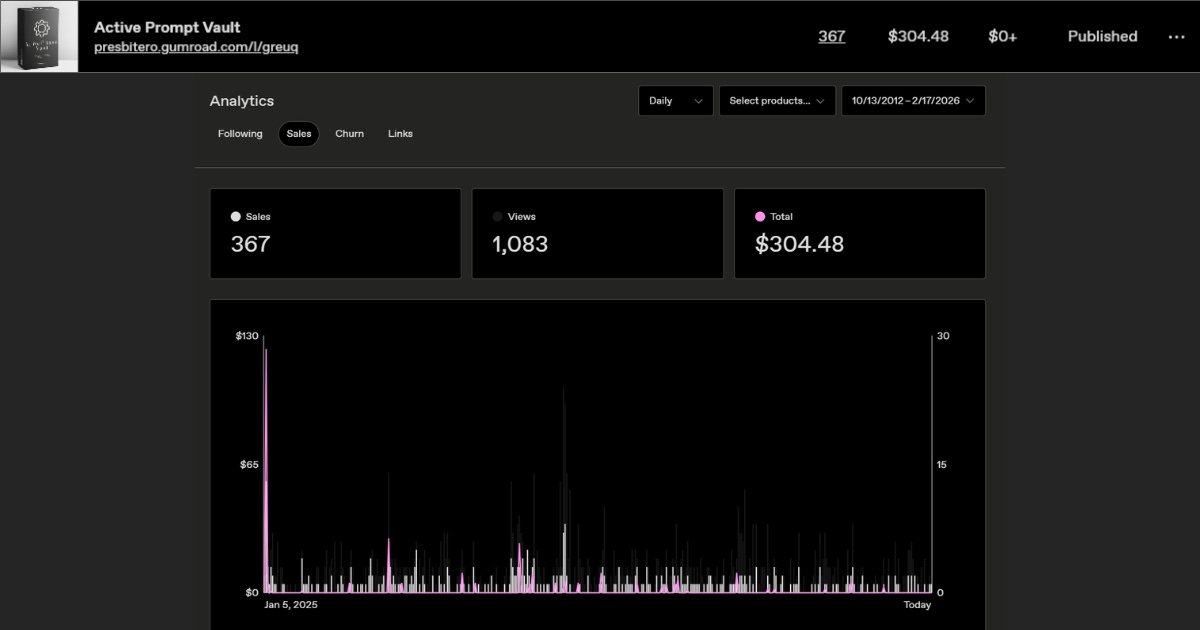
The doc was never the point. It gave people something to hold, and holding something is what turns a reader into someone who trusts you.
The bar is lower than you think. A checklist, a spreadsheet, a document that answers one question you keep getting asked in DMs. Pick the narrowest problem you can find, answer it properly, and ship it before it’s pretty.
I walked through the full build in Create a digital product with AI. Timo also wrote about his method for this, and you can find it in his newsletter. Timo also wrote about his method for this. You can find it in his newsletter.
Your freebie is working. It’s bringing in subscribers and people are getting value from it.
Now it’s time to turn that attention into revenue.
The mistake most creators make is building a random paid product that has nothing to do with the freebie that attracted their audience in the first place. Instead of creating disconnected product islands, you want to build a product ecosystem where each product naturally leads to the next.
In this article, I’ll show you how to turn a freebie into your first low-ticket funnel, the optimizations that increase conversions, and the principles behind building a product ecosystem that compounds over time.
If you don’t have a freebie yet, read this article first.
Your Target Persona has a problem, you hand them the solution in your freebie, and solving that first problem automatically creates the next one. Your low-ticket product is the solution to that next problem.
Problem → solution → problem → solution…
I built a free GPT that helps people ideate viral content, it worked well, people used it, and it solved their problem of having no ideas.
But solving that ideation problem created a new one immediately. They now had to write the actual content.
So I put a viral content writing tool directly in front of them right after, and it converted really well. :)
This “Problem → Solution” Framework is your foundation for a successful digital product funnel, but to maximize the conversion rate, there are 3 optimizations you should have in place…
But before that, here’s James.
As you’re finding that new problem, you need to think about another dimension -- one that will take your product from “digital product” to “branded asset”“ and that is your differentiation.
The boost is checking which direction your readers already asked you about. You have that on record. It’s in the questions people sent after downloading the freebie, the replies you never filed, the comments under the post that promoted it.
Think through Timo’s framework first, then run the ones below, and build where the two agree.
Prompt 1: The evidence sweep
What it does: turns your scattered audience evidence into a ranked list of problems your readers actually hit, in their own words.
Before you run it, gather: the freebie itself, every question anyone asked you about it, any refund or unsubscribe reasons, and the last ten conversations you had with a customer or client.
Prompt 2: The judgment test
What it does: takes the directions that survived and scores them by how much of your expertise the product can absorb. A product that only needs public information stays cheap and copyable. A product that needs your judgment is the one worth owning.
And now, for Timo’s optimizations.
One of the biggest conversion boosters is keeping both products in the same format.
If someone downloads a GPT, they’re already comfortable working inside ChatGPT. Asking them to suddenly use a separate AI app or another platform creates unnecessary friction.
Examples:
GPT → GPT
Text course → Text course
Notion template → Notion template
Whatever the format is, keep it consistent and just make the paid version more valuable at solving the next problem.
Timo’s rule is sound. Same format, less friction, more conversations.
But if you really want to differentiate in true Unpromptable fashion, you need to extract your judgement, your own experience, and be sure it helps a specific person, at a specific moment, with a specific problem.
Your product should give the answer you’d give if the person were sitting across from you, which usually depends on things the textbook never mentions. That answer lives in your head and it has never been written down.
Run this before you build anything.
Your two products are related, so the branding needs to say that out loud.
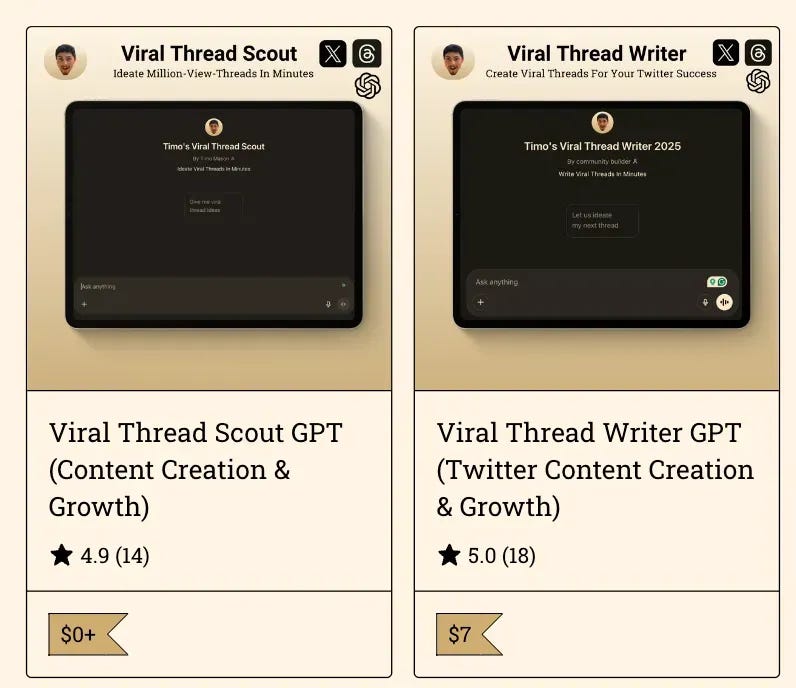
The name should share a structure, and the visuals should feel like they belong to the same family. If the visual identity is completely different, the connection feels off even if the reader can’t say why.
If you’re building related products, make their branding related.
Timo’s rule is the standard for a reason. Products that look related sell each other without you saying a word.
Holding that consistency by hand gets harder with every product you add. Six months from now you’ll be building product four at eleven at night, and you’ll pull up product one to remember how you named things and how you opened it. That works until it doesn’t.
The boost is writing it down once. Not a prompt you run, a file you keep. Every product you build after reads from that file, so product four carries the same decisions as product one without you going back to check.
Use this:
Asset 4: The house style file
What it is: a plain text document you attach to every build. Write it once, update it when something changes.
What goes in it:
Naming convention, with three real examples from products you’ve already made
How every product opens, and how it closes
What every product always includes, and what it never includes
Words and phrases you don’t use
Your visual defaults: colors, fonts, layout
Two or three samples of your actual writing, pasted in full
That last one carries more weight than the rest combined. Rules tell the model what to avoid. Samples tell it how you sound.
This purchase should feel effortless.
There isn’t a universal perfect price, but remember: this isn’t where you’re trying to maximize profit. You’re trying to convert a reader into a customer.
For that reason, I usually price my first upsell at $7.
The real goal isn’t making money from this product.
It’s creating your first paying customer.
As the saying goes:
“You don’t make money with the upsell. You make money with the upsell of the upsell.”
Once someone has bought from you once, buying future products becomes much easier.
Before you set the price and hit publish, run one last check on the product itself.
Two products can look identical from the outside and be worlds apart underneath. One carries public information anyone could have assembled. The other carries decisions you only make after doing the work for twenty years. You can’t tell which one you built by reading it back, because everything in there looks obvious to you.
So hand it to a machine and tell it to rebuild the thing. Whatever it can’t reproduce is what you actually made. That’s the part your buyer pays for, at seven dollars or wherever Timo’s logic takes you.
Prompt 5: The replication test
What it does: tries to rebuild your finished product from scratch, then reports what it couldn’t reach.
Run this on your product draft.
Whatever survives is what you’re charging for. If nothing survives, run the judgment interview again and put the answers back into the product before you launch it.
The problem-solution loop you just used to go from freebie to $7 product works exactly the same way for your next upsell too.
Your $7 product solves the problem your freebie created. But solving that problem creates a new one, and that new problem is exactly what your next upsell (at a even higher price point) should solve.
You can use the same framework and same 3 optimizers from today to build out your funnel more & more.
Freebie → $7 product → $50 product → TO infinity and beyond! :D
The gap between a product that sells once and a product nobody can copy is entirely in what you fed it.
Timo’s method gets you a real product, and getting there beats most people. Run his prompt, pick the direction, ship at seven dollars. But if you really want to ensure that a competitor can’t copy it next Friday, you need to load it with something they don’t have.
Your edge cases, your refusals, the corrections you make when a situation goes sideways in a way the textbook didn’t cover. Those can’t come from a prompt. Only from the years you spent getting them wrong first.
The house style file is where that compounds. Write it once, attach it to every build after, and your fourth product carries the same judgment as your first without you rewriting a word.
If the launch mechanics are what’s stalling you, Timo’s Gumroad Game Plan walks through the setup end to end.
Your judgment is the input. AI shapes it into something people can buy. Give it a prompt instead and it hands back a product that already exists, sold by someone who got there first.
Comments
Nothing yet. Say the first thing.
Sign in to join the conversation.