
As someone who isn’t yet 40 but close, I consider myself fairly young.
I’ve seen my share of life but I still have much more to see.
Others have lived much more than I have — 60s, 70s, even 80s — who have grown older and wiser with time and seen the world transform before their very eyes.
I don’t have that much experience, but what I do have is that, during my time, I have seen technology increase exponentially faster than it did for others. (Curious if that means I’m older for my physical age.)
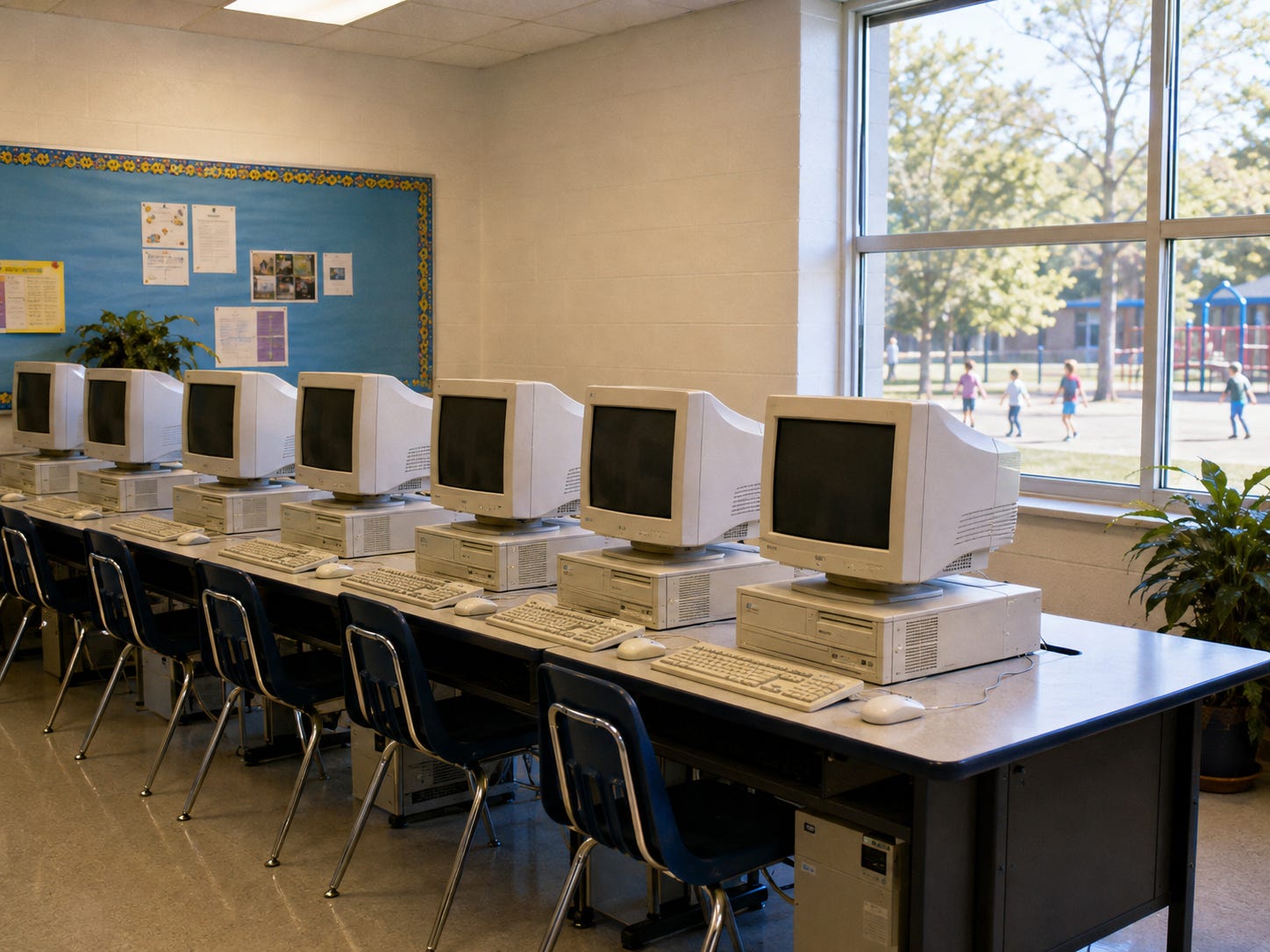
The other day, I saw the following image that took me back in time, back to my childhood in elementary and middle school.
This image spoke volumes to me because it immediately transported me back to when I was a little child in school. I remember when I had seven classes or so and then I had computer class.
In computer class, we would leave the main building that housed all the classes and walk over to the room by itself. This room was known as the computer room — or the computer lab. One teacher would supervise, and all of us little children would sit at a computer and learn whatever lesson was for the day. Here we learned to use the mouse; here we learned to type, and so on.
As a millennial, I don’t recall using the school computers to use the internet. That was what the library was for. At times, especially now in high school, when I was at the library, I could access the internet on the computer.
At home, we had a dial-up modem to access the internet. In those days, you could not use the phone and the internet because there was one line. (As I type this up, I imagine some of my younger followers, Gen Z and younger, may think that this sounds archaic but these were the times back then).
This was the world that I grew up in. In this world, the internet stayed in a room and that was it. It never left the room. However, in today’s day and age, the internet is everywhere — to the point that you cannot easily escape it.
In this article, I’m going to examine this phenomenon. I’ll show how this can be a trap for one’s sanity, but ultimately how being aware of this societal change can provide freedom and autonomy from it.
If you’re constantly attached to your device or can’t seem to get away from the ‘net, then this piece is for you.
How the internet went from being a place we visited to something we carry everywhere.
Why the smartphone turned the internet into a personal, always-accessible “net.”
How constantly living inside the digital world can affect attention, relationships, leisure, and sanity.
Why treating the internet as a place you intentionally enter—and leave—can restore some autonomy.
What those of us who remember computer rooms can teach younger generations about living with technology.
One of the lessons I’ve learned in this esoteric world of ours is that words have meanings.
For example, the cell phone — the use of the word cell — can be seen as intentional because the device acts as a “prison cell” for your mind. The word “net” has a similar connotation.
“Net”-flix was one example that I recall fitting under this name/esoteric meaning example, showing how Netflix acted as a “net” to entrap your attention via “flicks.” This information sounds weird to some, but when you notice the amount of naming and symbology in our world, this work moves from weird to intentional.
As I reflected on this, I recalled that the word “internet” has “net” in it. So now, this begs the question: does the internet — that net — have the ability to capture our attention captive? The result is a resounding yes.
However, back in the day, you could use this great device with reins around it. You had the computer room. The lab where you could go in and research and work on the computer, and get your work done and that was it.
After your 30 minutes in the computer room, you could leave the “internet” and go on about your day. You could play, learn in other classes, and work in those classes as well.
Somehow, we were able to work and learn without the internet just 20 years ago. However, now, most people can’t seem to escape the internet.
Why is this the case? Ladies and gentlemen, I present to you the innovative trap for your mind: the cell. (See how words come together?)
In a previous article, I talked about how our phones are really mini-supercomputers yet we squander all that power watching cat videos all day. Sure, you may learn something here and there — but the majority of people use these mini-computers to ingest whatever the internet has to offer.
And this is a great travesty of modern society.
Instead of the internet staying trapped away in a computer room, thanks to the cell phone, the internet is now with you all the time. You wait in line and are bored; you escape to the internet. You’re on a call and bored; you escape to the internet.
Anytime you are bored or unstimulated you can escape to the internet. The cell phone has taken the monster of the internet and put it in your pocket.
In our modern society, this is completely normal. Cell phones are how most move around nowadays.
But what if one — for those who remember — applied the lessons of the past to our modern world? What if we treated our phones as computers — and only used the internet in the room?
What this would look like would be drastically different today.
In the past, when you went to the computer lab, you were there to work. You were focused on whatever task was in front of you, because you had to work and get off. You had to leave the internet.
This same analogy applies to social media. When Facebook was first created, you could only log in on the desktop in the computer room. After a while, you had to leave Facebook — and the computer — and go out into the real world. Today, that’s not the same.
Today, one is always plugged into the computer room — even though they are not physically in there. At the dining room table, family members are mentally in the computer room, even though they’re physically together. Families and friends “hang out” with each other in person, but mentally, they’re in separate computer rooms, even though they’re closer than ever.
As a society, we’ve lost the distinction between the computer room and the real world and think the two are intertwined.
The problem is, you never get to leave the digital world and bring it into the physical — where it begins to destroy the natural, alive, and tangible world.
One caveat that comes up is that nowadays people say cellphones and computers are used for work. This further shows the captivity we find ourselves in when we are constantly in a state of “work” and cannot seem to enjoy life, as I discussed in my work on leisure.
You work in the computer room, and that’s that. You don’t work — especially in the presence of your friends and family members.

Seeing this image and my use of technology in this new light may make me think differently. I’ve already started treating my phone as a computer from a while back — but now I’m able to leave it behind, because I don’t need to go to the computer room.
At this certain time, I need to be a father, a husband, a teammate, an individual — and socialize and interact with my fellow natural world. This is how all of us over the age of 35 were raised, and it’s quite shocking that within 10 years, the internet went from being in the room to being in the palm of a hand.
By treating our phones and the internet as a mental and physical place that we go to when we need to work, we stay connected in the physical realm. Studies show no difference between taking notes by hand and on a laptop — with some studies even showing the pen might be better than the keyboard. This was a lesson I recently learned after realizing I used to fill notebooks with words—and now I type most of what I learn.
Technology will continue to grow and it has produced some amazing results. The internet itself, in a positive light, has connected and brought millions together. It’s allowed ideas to grow and flourish — and also captivity and bondage — but that’s just the potentiality of this world.
Currently, however, one can see the overgrowth of technology, especially on the younger population. One can see the grasp of technocracy as it instills itself in people’s minds — especially now with AI making decisions for educated humans.
Our one hope is to remember that we’re supposed to use the computer for work, but then we have to go to the real world. You have to go outside, play in nature, and interact in the real world. This is what we have to get to.
Set limits on how often you’ll go to the computer room—even though it is remote everywhere.
Recess is right around the corner. And I know you’re not going to stay in the room over recess, will you?
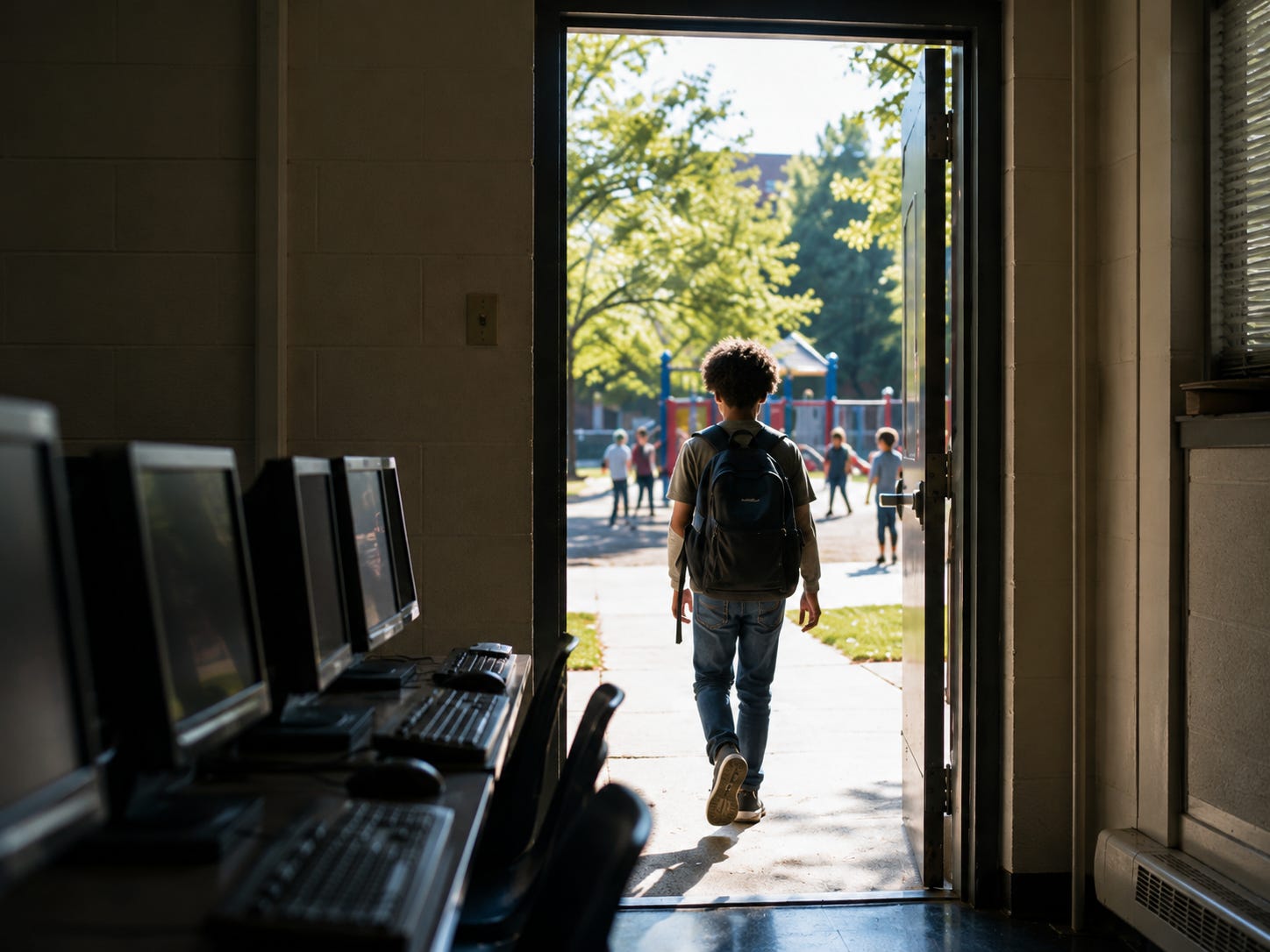
The internet used to have a physical boundary. You entered the computer room, used it for a purpose, and eventually left. Smartphones destroyed much of that boundary by placing the internet in our pockets, which means boredom, work, entertainment, social media, news, and stimulation are now available constantly.
That doesn’t make technology inherently bad. It means that the responsibility for creating boundaries has shifted from our environment to us. If we don’t intentionally leave the digital world, there is nothing built into modern life that forces us to do so.
The computer room provides a useful mental model: use technology deliberately, accomplish what you came to accomplish, and then return to the physical world.
Start thinking of your phone as a portable computer rather than something that must remain attached to you. Before opening it, know why you’re entering the “computer room.” When the task is complete, leave.
Create parts of your day where the computer room simply isn’t available, especially during meals, conversations, family time, leisure, nature, and other experiences you supposedly value in the physical world.
Most importantly, practice experiencing moments of boredom without automatically escaping to the internet.
The ability to remain outside the net may eventually become one of the most important forms of personal autonomy we have.
As always, thanks for the time and attention. Have a great and wonderful day.
— Ashe,
Franklin O’Kanu
If you’ve enjoyed this work as a paid member and you’re ready to change the world, upgrade to become a Founding Member
If you’re already aware but want to take a step toward becoming the best human you can be, you can check out my guide.
11 Insights for Being The Best Human This 50-page guide is the clearest map I’ve created for navigating the madness of modern life. It blends ancient wisdom, spiritual clarity, and grounded daily ritual — helping you remember who you are and why you’re here.
If the world feels off, this guide will confirm why — and help you take back control.
📥 Immediate download · PDF format
If this article opened your eyes, there’s more behind the paywall. Exclusive, in-depth pieces that go deeper, challenge more, and reveal the truths they don’t want us to see.
🔑 Become a paid member and gain access to premium and archived articles, exclusive podcasts, and thought-provoking chats you won’t find anywhere else.
📖 Prefer a comprehensive take? My book, An Unorthodox Truth, is a fact-based journey through 200 years of deception—a must-read for those seeking clarity in a manipulated world.
☕ Feeling generous? Leave a simple tip to support this work—every bit helps me continue creating meaningful content.
Comments
Nothing yet. Say the first thing.
Sign in to join the conversation.