
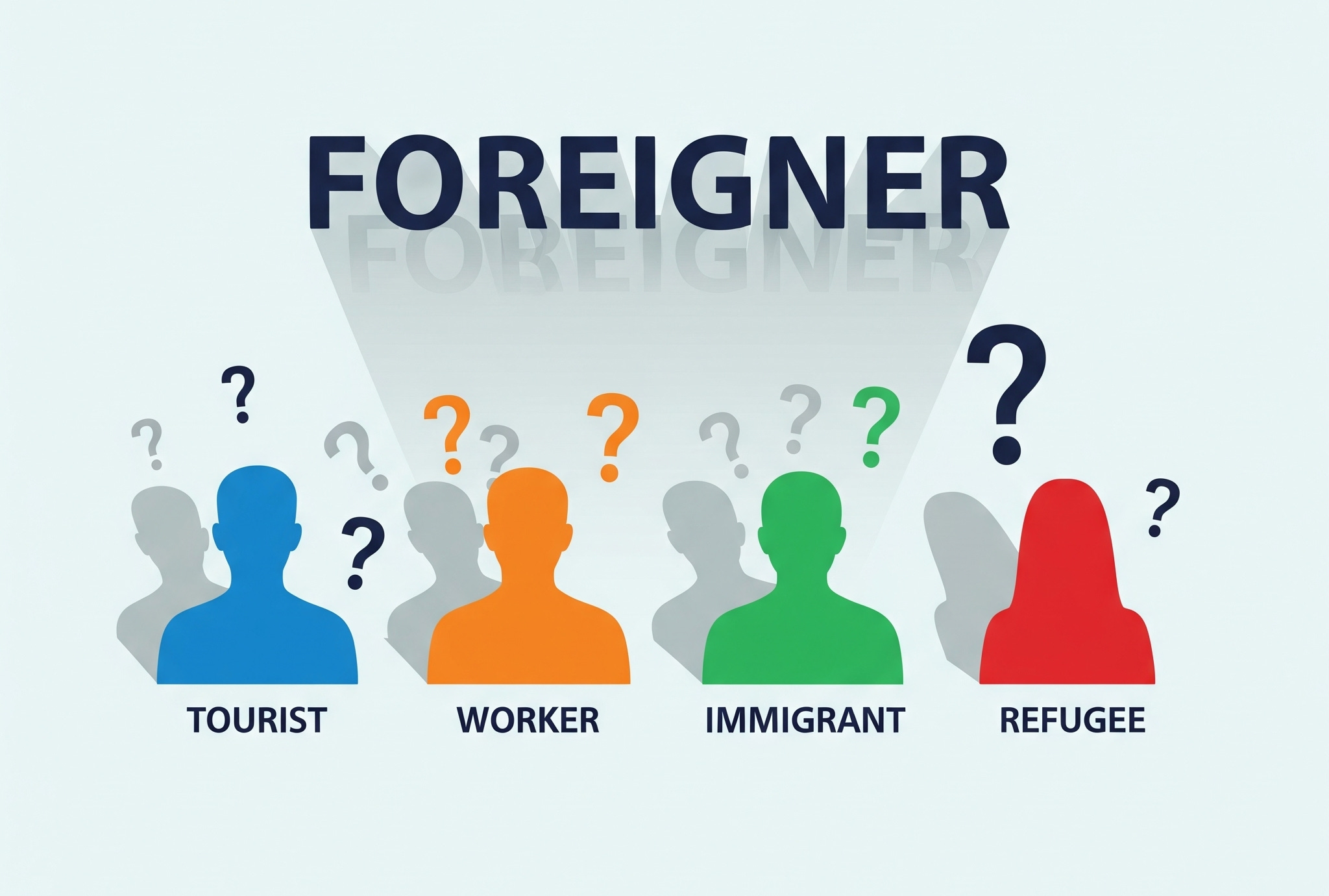
Many Japanese people—even politicians—often confuse the terms used to describe non-Japanese residents in Japan:
Foreign workers (外国人労働者 Gaikokujin Roudousya)
Immigrants (移民 Imin)
Refugees (難民 Nanmin)
This lack of clarity has led to messy and unproductive debates, where people argue over the wrong issues because they haven't even defined the terms properly.
Making matters worse, people often lump tourists into the "foreign residents" category, even though tourists aren't residents at all. Japanese people tend to see the world in binary terms—Japanese or outsider—which makes rational discussion nearly impossible.
To avoid confusion, this article won't delve deeply into refugee issues. Instead, I'll focus on the "labor force" discussion and address the vague resistance many Japanese have toward "immigration."
Here's Japan's current position: "We won't accept immigrants. But we're short on workers, so we welcome labor only."
For years, the Liberal Democratic Party has implemented what amounts to the worst possible immigration policy—accepting large numbers of foreign workers while maintaining the sophistry that "this is not immigration."
This is completely broken logic. The scale of population decline has reached a point where this approach can no longer keep up. We should accept immigrants—or rather, we have no choice but to accept them.
But when we do, we cannot abandon the principle of "when in Rome, do as the Romans do." In other words, we should transition to a system that openly and honestly accepts immigrants, while ensuring they follow the rules. We need to establish proper legal frameworks covering Japanese language requirements, cultural understanding, rule compliance, and consequences for violations. We must create a proper reception system and then officially proceed with immigration acceptance. Otherwise, we're stuck.
We’re reaching the point where Japan loses one million people every year. (According to the Ministry of Internal Affairs and Communications, the Japanese population decreased by 898,000 in 2024.) In the post-war baby boom era, 2.6 million people were born annually. Less than 80 years later, births in 2024 dropped to the 600,000 range—less than a quarter of the peak. This is an incredible pace, and the declining birthrate won't stop. We just don't simply have enough taxpayers to support the number of retired people.
The government's failures caused the employment ice age that hurt the baby boomers' children—the junior baby boomers—preventing them from creating a third baby boom. The anger of people calling for foreign exclusion should be directed not at foreigners, but at the government. It's the government's fault we're short on people. Not foreigners' fault.
Regardless of who's to blame, the demographic reality is undeniable. I particularly felt this turning point during the recent election, for two reasons:
First, the clear generational shift from Baby Boomers to the "Lost 30 Years" generation. Previously, parties promising to protect pensions and healthcare won. Now, as Boomers age out and their voting power wanes, parties willing to tackle social security reform gained significant ground. The "second baby boom" generation especially faced tough times like the employment ice age, leading to deep societal frustration.
Second, the unprecedented rise of xenophobia. While this has been a hot topic in Japan since before the election, it's honestly nothing new. Japan has always been harsh toward "outsiders"—those not from this village, this prefecture, this school, or this family (women traditionally had very low status when they married into families). Japan is inherently tough on outsiders.
The current surge in xenophobia reflects the flip side of unprecedented acceptance efforts, including local governments actively recruiting foreign residents as the reality of Japan not functioning with Japanese people alone becomes undeniable.
By the way, I wrote about my thoughts on the recent election here.

Do you know what stance this program took until recently? "Wonderful Japan will teach technology to people from developing countries." It was positioned as Japan's contribution to the world. Pretty shocking, right?
Finally, last year, they changed the stance to: "Japan is running short on workers, so please come work here." But they still haven't abandoned the position of "we don't want to accept immigrants, but we want labor only."
We're past the point of saying such things. Rather than just having people provide labor, wouldn't it be better to have them consume in Japan and contribute to Japanese culture?
Of course, this isn't easy. That's exactly why we should urgently focus our discussions not on whether to accept people or not, but on establishing the rules for acceptance.
The reason politicians maintain their contradictory "we won't accept immigrants" stance despite the contradictions is simple: it doesn't win votes. Why does the majority of voters oppose immigration? Because in Japan's historically homogeneous society, having unknown people enter feels instinctively scary. I can understand that. I think the overwhelming majority are people with vague images of "foreigners = unfamiliar = unknown = scary" rather than those with strong hatred toward foreigners.
But seeing for example a Southeast Asian Muslim wearing a hijab working at a convenience store and saying "that's somehow scary" represents a kind of sheltered naivety that comes from living in an overly safe society. Convenience store multitasking is actually quite difficult, and they're doing it in Japanese, a foreign language. That's impressive.
How many Japanese people unconsciously think, "If they want to come to Japan, this level of effort is only natural—there must be tons of people who still want to come, so we're doing them a favor by letting them in"? With the weak yen in recent years, Japan is no longer automatically the preferred destination for workers.
Many of these Asian convenience store workers contribute to our social security system—they pay taxes and social security fees, naturally. Japan's social security system has reached a point where it cannot function without foreigners. It's embarrassing for adults to say "unknown people are scary" without knowing such basic facts.
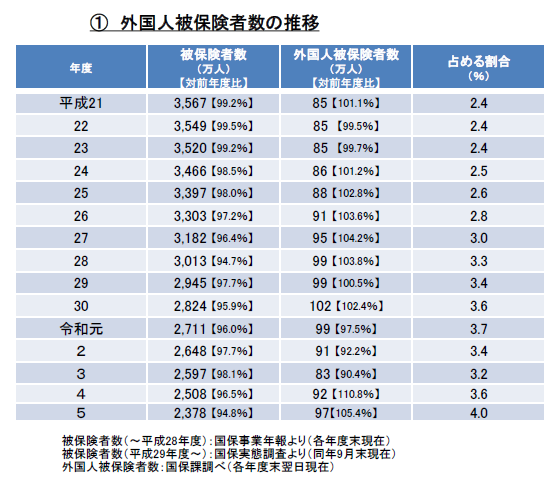
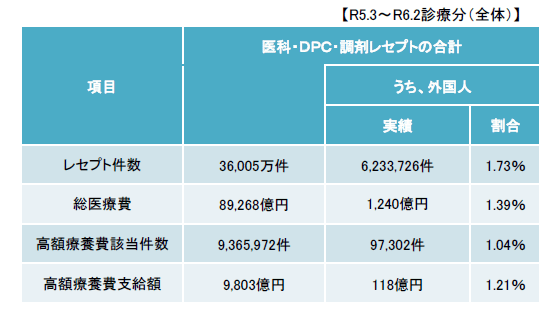
According to the Ministry of Health, Labour and Welfare, while foreigners make up 4% of all insured persons in fiscal 2023, they account for only 1.39% of total medical expenses. The reality is clear: relatively young and healthy foreign workers are supporting Japan's elderly healthcare system.
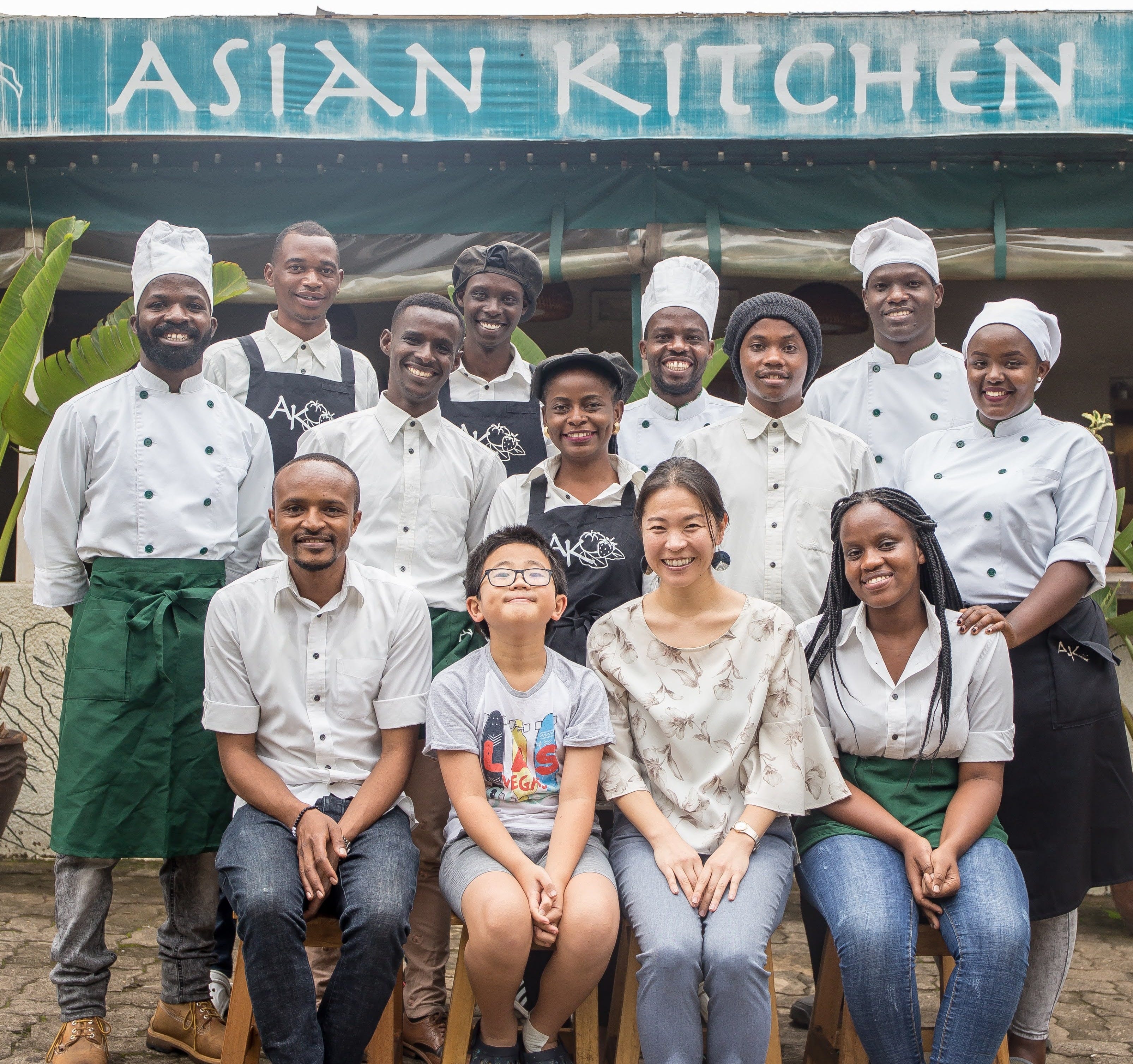
I can say this from personal experience. Having run a restaurant in Rwanda, spent summers in Canada, and frequently traveling around the world, my personal sense is that Japanese people's level of rule-following discipline and their ability to prioritize what's best for the group while constantly observing their surroundings and adjusting behavior is truly world-class. (Every coin has two sides, so there are many downsides to this too—I'll skip the details here, but it can be suffocating.)
When I first went to Rwanda with this sensibility, I was quite frustrated by people not lining up properly and poor public behavior by Japanese standards. (Though as a foreigner, I should have adapted to local customs of course and there were many good aspects to their way of life.) So I can easily imagine that if people who don't understand Japanese culture enter, Japan's order could collapse, and I've experienced firsthand the stress when that order breaks down.
But as I keep saying, Japan simply cannot function with Japanese people alone anymore. So the most important thing to do now isn't debating whether to let people in or not, but creating mechanisms to ensure incoming foreigners follow Japanese rules. Building these mechanisms and the operational systems to actually implement them is urgently needed.
This should be the maximum focus of debate—not tinkering with the technical intern training system or blindly shouting things like "foreigners will worsen public safety!" We need to put maximum effort into creating proper "when in Rome, do as the Romans do" mechanisms and figuring out how to implement them.
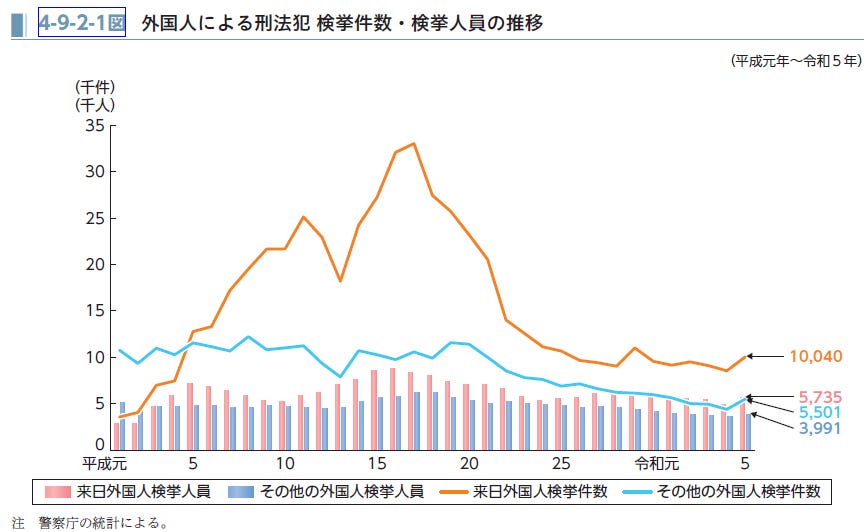
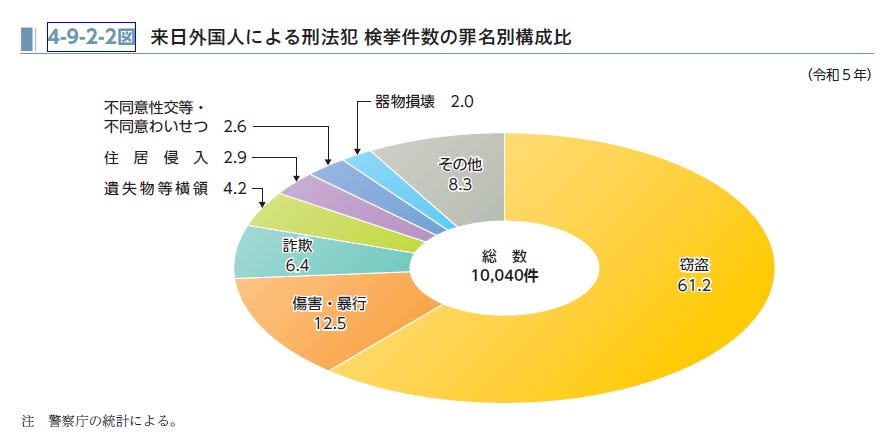
According to the annual "Crime White Paper" published by the Ministry of Justice, despite the rapid increase in both short-term visitors and medium- to long-term foreign residents, foreign crime rates have remained essentially flat in recent years. The facts show that about 60% of crimes committed by foreigners are theft, while violent crimes like murder and robbery are so rare they fall into the "other" category.
Also, you often see arguments like "more immigrants means more fraudulent welfare recipients," right? But this is based on serious misconceptions.
According to 2023 data, foreign welfare recipients number about 40,000—just 2% of all welfare recipients. Since foreigners make up about 2% of Japan's population, the ratio doesn't suggest foreign recipients are disproportionately high.
Even examining fraud cases, instances of fraudulent claims by Japanese citizens vastly outnumber foreign cases in both frequency and amount.
By the way, I fundamentally believe in "when in Rome, do as the Romans do." This applies worldwide, not just to Japanese people. When I was in Rwanda as a foreigner, I always kept this principle close to my heart.
In Rwanda, I constantly needed visa renewals because, as a Japanese person, it was up to the Rwandan government to decide whether I could stay in their country. For example, when foreign employers are sued and go to court, foreigners typically lose. Before questions of right or wrong or legal issues, foreigners almost never win. If you find this unreasonable, if you don't like it, there's really nothing else you can do but leave. There's no point in a foreign me complaining about what's wrong or incorrect about this country. The fundamental principle is "this is Rwanda."
The same applies to Japan. If there are people who disrespect Japan and engage in wrongdoing, they must be held accountable. Japan needs to consistently enforce its laws for everyone, regardless of nationality. Doing so also protects other foreigners who pay taxes, follow Japanese rules, and contribute to Japanese society.
For example, Sweden actively accepted immigrants during the 2010s refugee crisis. But in recent years, some areas have seen frequent gang conflicts.
Refugee recognition was more lenient than Japan's, and access to social welfare was easier. People came aiming for this, but many couldn't even speak English. This made finding work difficult, and in worst cases, some joined criminal organizations, worsening public safety. Poor immigrant integration has become a social problem.
I heard that in Sweden, saying "anti-immigration" would have gotten you labeled racist decades ago, but it looks like the situation has changed somewhat now.
European cases provide lessons that poor integration during immigration acceptance leads to public safety deterioration. Japan should avoid repeating these failures.
But still, Japan's refugee recognition rate is absurdly low. Looking at 2019 data, the recognition rate was 0.29%. Compare this to the US at 58%, Germany at 20%, or Canada at 68%.
I think Japan's refugee recognition rate is too low. Since refugees are fundamentally different from immigrants or foreign workers, I won't go deep into this topic today, maybe I will write about this separately somewhere.
While Japan has loudly proclaimed multiculturalism and diversity in words, immigration debates should shift focus from idealistic discussions to concrete construction of foreign resident acceptance systems, based on the reality of Japan's population decline.
Rather than needlessly shouting xenophobia or making patchwork improvements to the foreign technical intern training system, we urgently need to establish legal frameworks, educational systems, and implementation structures for helping newcomers understand and follow Japanese rules and culture.
Xenophobia is surging like never before. Will we really proceed with xenophobia, or take a reality-based path?
I believe only the reality-based path exists, but some people won't see reality until they proceed with xenophobia and hit a dead end. I hope it won't be too late when they realize this.
No posts
Comments
Nothing yet. Say the first thing.
Sign in to join the conversation.