
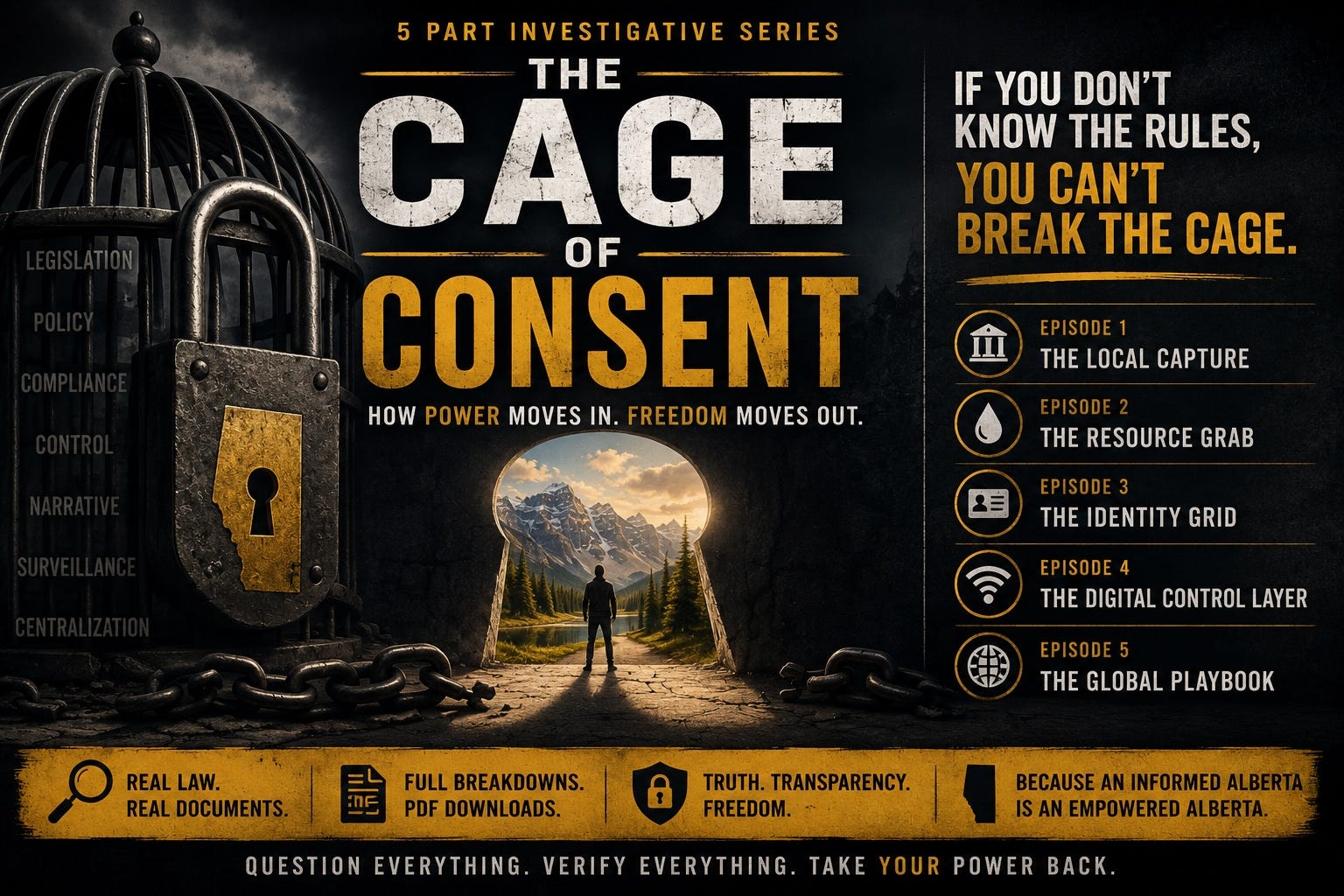
A Note on Production & Technology:
The video and audio elements accompanying Cage of Consent mini series are produced using AI synthesis tools. To be clear: I am not anti-technology or anti-innovation. Technology should serve human potential. What I oppose is the predatory exploitation of technology, the non-consensual harvesting of our personal data, mass surveillance, and administrative centralization. I use these tools intentionally to analyze and expose the very systems being built around us.
For the past several years, I’ve spent thousands of hours reading legislation, regulations, court decisions, government reports, and policy documents. What began as research into a single issues gradually uncovered something much larger.
My current journey didn’t begin with broadband fibre networks, artificial intelligence, digital identity, CBDC, UBI or AI Data Centres.

As I followed the Universal Ostrich Farms case, I watched regulations, policies, and legal interpretations become central to the story. Regardless of where someone stands on the outcome, the case forced me to ask a question I had never seriously considered before:
That question became the catalyst for everything that followed.
The deeper I looked, the more I discovered that what appeared to be isolated policy decisions were often connected by a common pattern: authority was increasingly being consolidated, while local decision-making was diminishing.
That realization became the foundation for The Cage of Consent.
Although this series focuses primarily on Alberta legislation and Canadian examples, this is not an Alberta story. It is not even a Canadian story.
I chose Alberta because it offers one of the clearest and most concentrated examples of these changes happening in real time.
Here, we can examine the legislation itself.
We can read the amendments. We can compare what existed before with what exists today. We can watch authority move from one level of government to another, not through dramatic headlines, but through carefully written statutes, regulations, ministerial orders, administrative bodies, and policy changes.
The names of the bills will be different where you live. The political parties will be different. The personalities will be different. Even the language may vary.
But the pattern is remarkably familiar.
Whether you’re in British Columbia, Ontario, Texas, California, Australia, New Zealand, the United Kingdom, or Europe, I encourage you not to focus on Alberta.
Instead, focus on the mechanism.
Once you understand how these legislative mechanisms work here, you’ll know exactly what to look for in your own jurisdiction.
This series isn’t asking you to accept my conclusions. It’s inviting you to examine the evidence, understand the legislative language, and ask one simple question:
and if I was a betting gal I’d go all in on YES!

No posts
Comments
Nothing yet. Say the first thing.
Sign in to join the conversation.