
Let’s be honest for a second, most of us pay no attention to politics and those of us that do… pay way too much attention to national politics. We spend hours arguing about federal press conferences, global trade wars, and whatever circus is currently running on TV. It makes sense because Federal politics is loud, theatrical, and built for television…
“All the world’s a stage, and all the men and women merely players…” Shakespeare had it right, but if he were alive today, he’d probably add that the biggest production isn’t on Broadway or in Parliament, it’s playing out right down the street at your local city hall…
Meanwhile, at 7:00 PM on a rainy Tuesday, your local city council voted on a set of administrative bylaws that will impact your water, your property, and your private data far more than any federal soundbite ever will.
We like to think that local government is where the real democracy happens, where you can walk into city hall, look your mayor in the eye, and ask why your potholes aren’t being filled. But if you’ve been paying attention to what’s quietly playing out across the country (and specifically right here in Alberta), a very different picture is starting to emerge.
Time for a reality check, while we were arguing about national headlines, the administrative guardrails protecting our communities were being quietly dismantled from the inside out.
If you look at recent policy moves in isolation, they just look like boring, dry administrative updates. (And let’s be real, the people writing them count on you finding them boring so you won’t read them). But when you stack the evidence together, the pattern becomes impossible to ignore.
Let’s trace the top 3 breadcrumbs…
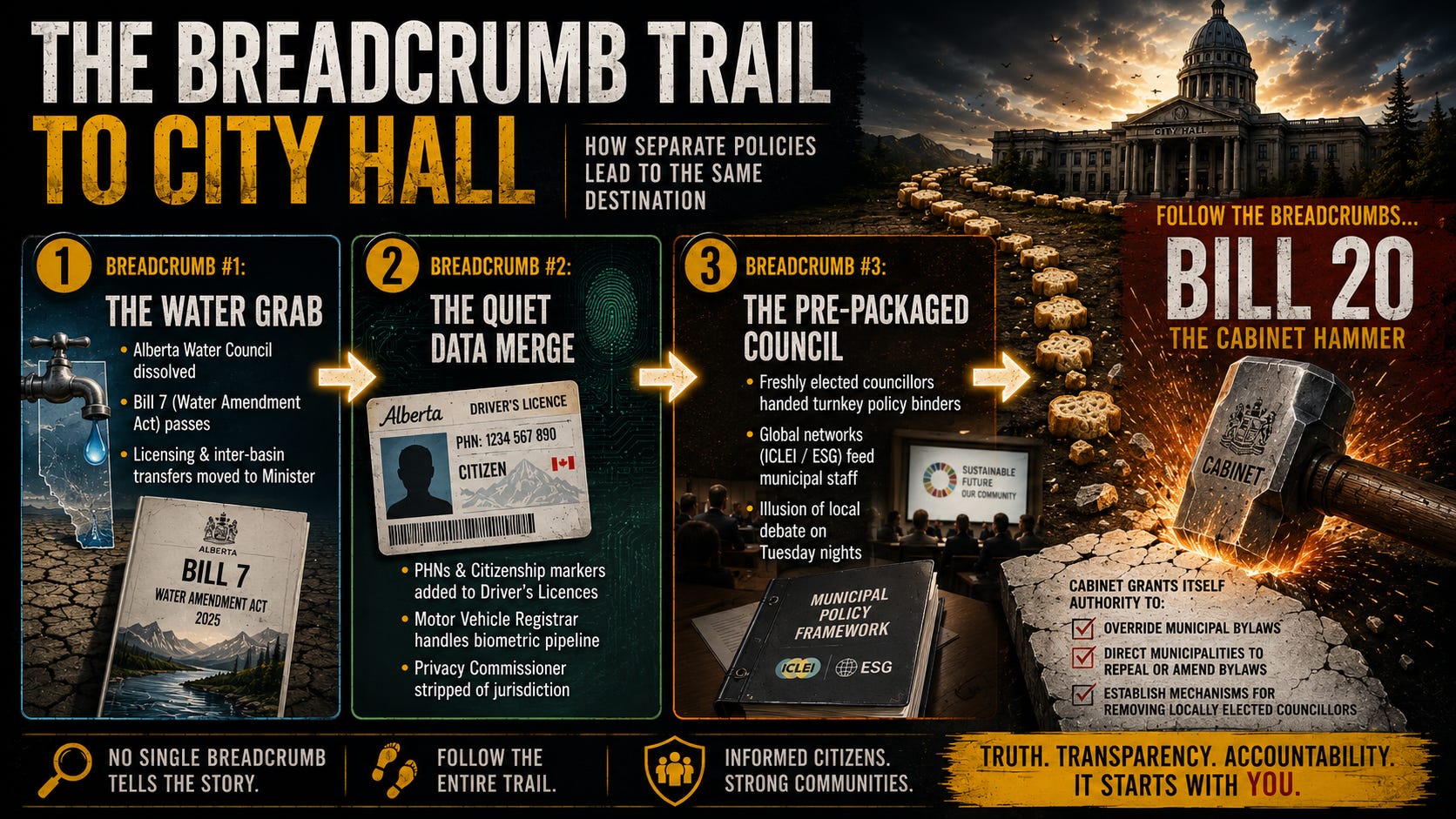
The Water Grab: The independent Alberta Water Council, a public board that protected community water rights for over two decades, was dissolved.1 Right alongside that, Bill 7 (The Water Amendment Act) was introduced, consolidating water licensing and inter-basin transfers under ministerial discretion. Local municipal oversight? Stripped away. Bill 7 isn't just a technical update to water laws, it's a centralization maneuver. By replacing full legislative debates with Ministerial Orders, removing return flow obligations, and creating massive new super-basins, the province is taking water oversight out of public view and placing it directly into administrative hands2
The Quiet Data Merge: I know this is not your local council but it is too big to overlook… Look closely at your driver’s licence. The province quietly rolled out new identification pipelines, mandatory display of Personal Health Numbers (PHNs) and citizenship markers directly on driver’s licences. At the exact same time, Alberta’s Information and Privacy Commissioner publicly raised the alarm, warning that the Registrar of Motor Vehicles, the central agency handling these merged data streams, is not subject to provincial privacy laws.3
The Ultimate Administrative Hammer (Bill 20): Enter the Municipal Affairs Statutes Amendment Act. Under Bill 20, provincial Cabinet gave itself the power to bypass traditional judicial processes to remove locally elected councillors under a vague “public interest” mandate. Even worse? Cabinet can now unilaterally step in and strike down local bylaws if they don’t align with provincial direction.
If a town council tries to stand up for its local economy or pass rules to protect its own community, the province now holds a legal sledgehammer to crush the bylaw or sack the council.
That isn’t local representation. That’s an administrative takeover.4
And keep in mind, that's only three breadcrumbs. We have an entire bakery to unpack.
Sorry I can’t leave it there … look at Regulations under the Local Authorities Election Act (LAEA) where they created legal frameworks for registered local political parties (tested in major centers like Calgary and Edmonton) and expanded campaign spending/fund-transfer rules. Resulting in local city halls transition from independent local representatives to disciplined, party-line blocks that vote as a caucus, making it far easier to pass top-down legislative packages without local dissent.
Did you know … Regulatory updates governing Intermunicipal Collaborative Frameworks (ICFs) granted the province direct ministerial authority and mandatory arbitration mechanisms to resolve intermunicipal cost-sharing and land-use disputes. Resulting in rural counties that want to preserve agricultural land or limit high-density urbanization can be legally forced into regional framework agreements that align with broader provincial housing and density quotas.
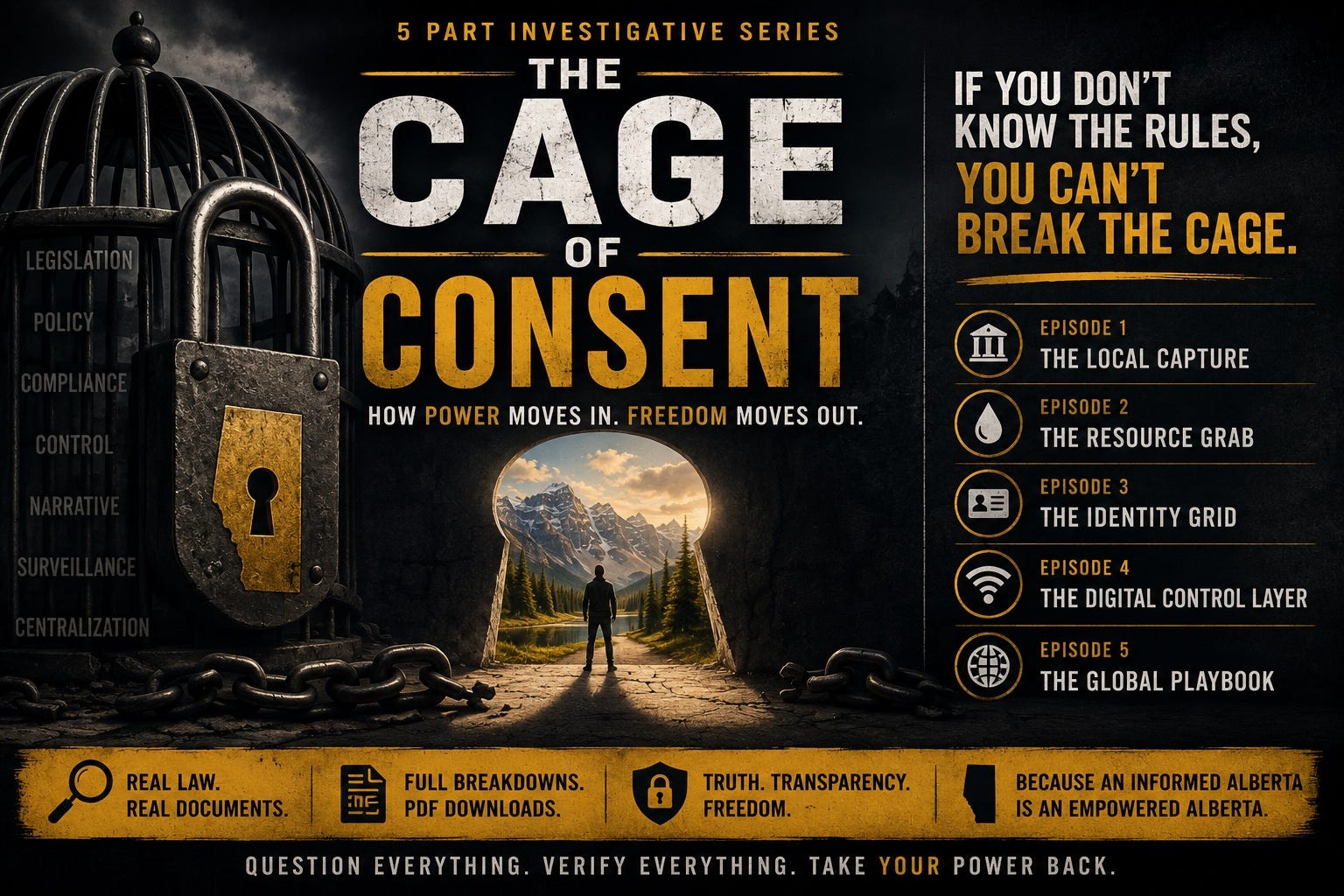
Watch Part 1: The Local Capture, I put together a short, 4-minute breakdown to walk through this evidence and show you exactly how the machinery works on the ground.
The “Pre-Packaged” Council Problem
Here’s the punchline to the whole joke… most part-time local politicians aren’t even writing these policies.
When a freshly elected city councillor takes office, they aren’t handed a blank slate. They are handed massive, pre-packaged policy binders written by permanent administrative staff … staff who are plugged into international planning networks like ICLEI (Local Governments for Sustainability) and some who are on the payroll of the United Nations or one of its subsidiaries oh say like UNESCO. 5
I would have to write a 12 volume book to expose only what I have uncovered, for the readers digest version I suggest everyone get familiar with 2 documents, 1. The Municpal Primer and 2. Alberta Guideline for Developing a Municipal Development Plan While it is 287 pages of info you wish ya knew, I draw your attention to a specific paragraph…on page 10 “Respecting the landowner’s right to the use and enjoyment of their land and restricting those rights only to the extent necessary for the greater public good and public health” , LET THAT SINK IN FOLKS!!!
The councillors are given the illusion of choice, the public is given the illusion of a vote, and if anyone on the council dares to go off-script? Bill 20 sits in the corner like an administrative bouncer ready to show them the door.

Stay tuned for Episode 2:
The National Pincer (How Ottawa Traps the Provinces and Bypasses Your Vote) coming soon
copy and pasted from email sent to me:
As the Commissioner has stated in her news releases and her letter to the Alberta government, this Office does not have jurisdiction over the Registrar of Motor Vehicles, which is the branch that will be collecting the personal information to put it on driver’s license or identification cards. The Registrar of Motor Vehicles is not subject to the Protection of Privacy Act (POPA) that the Information and Privacy Commissioner oversees; therefore, we cannot accept your complaint. Please direct your complaint to the Registrar of Motor Vehicles.
We are developing information and guidance to assist Albertans, public bodies, organizations, and other entities that will be handling this sensitive personal information. We encourage Albertans to check our website for this guidance.
No posts
Comments
Nothing yet. Say the first thing.
Sign in to join the conversation.