
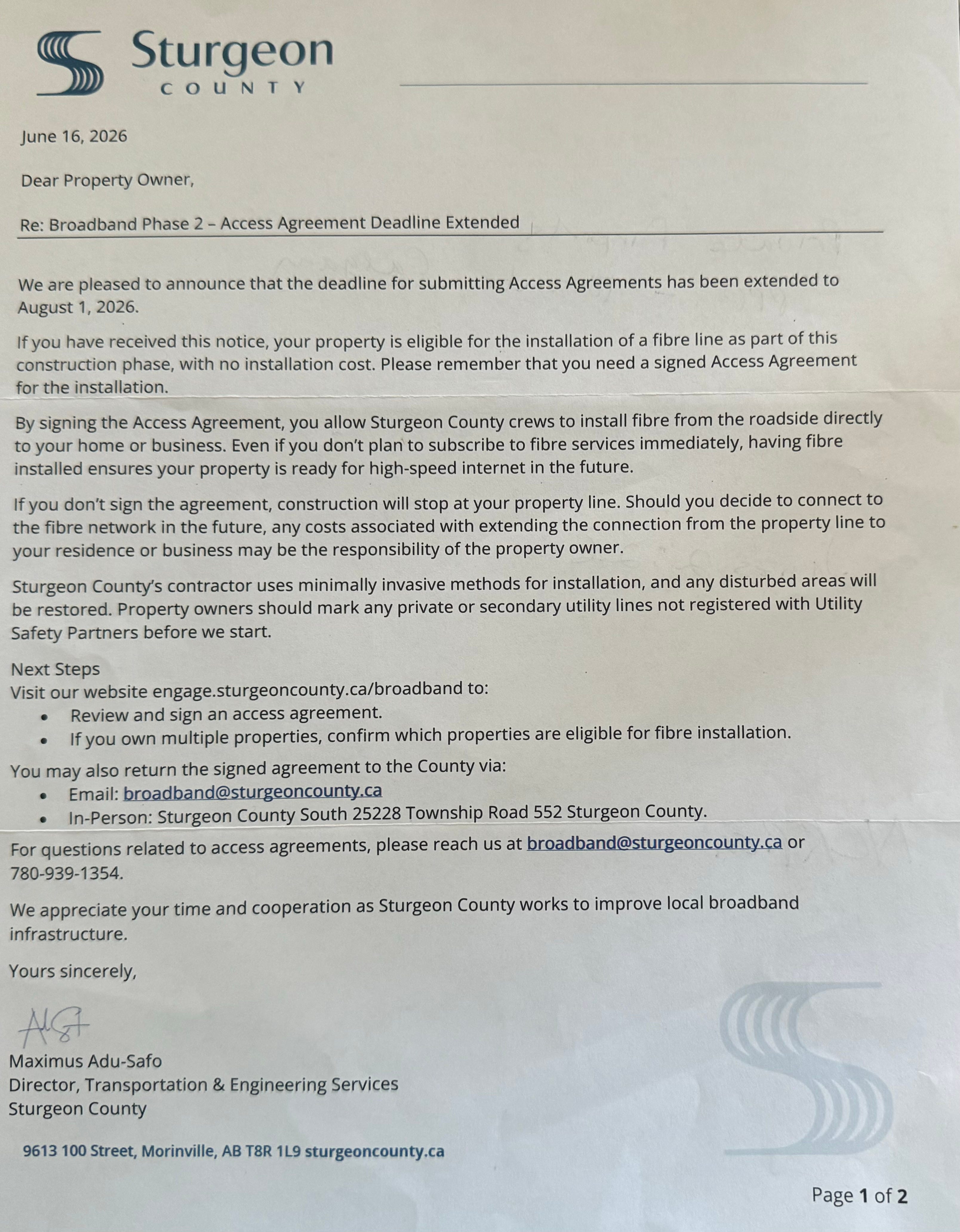
At first glance, it looks routine. A municipality is offering to bring fibre optic internet to your property at no installation cost. The deadline has even been extended to August 1, 2026. And they are “pleased” to announce I can still get in on it.
Many people will sign without giving it a second thought. I almost did…but something was nagging at me so I read the documents.
Not just the letter. Not just the Access Agreement. But also the referenced, Government of Canada’s Rural Economic Development Strategy and the National Connectivity Strategy.
That’s when I realized this isn’t simply about faster internet.
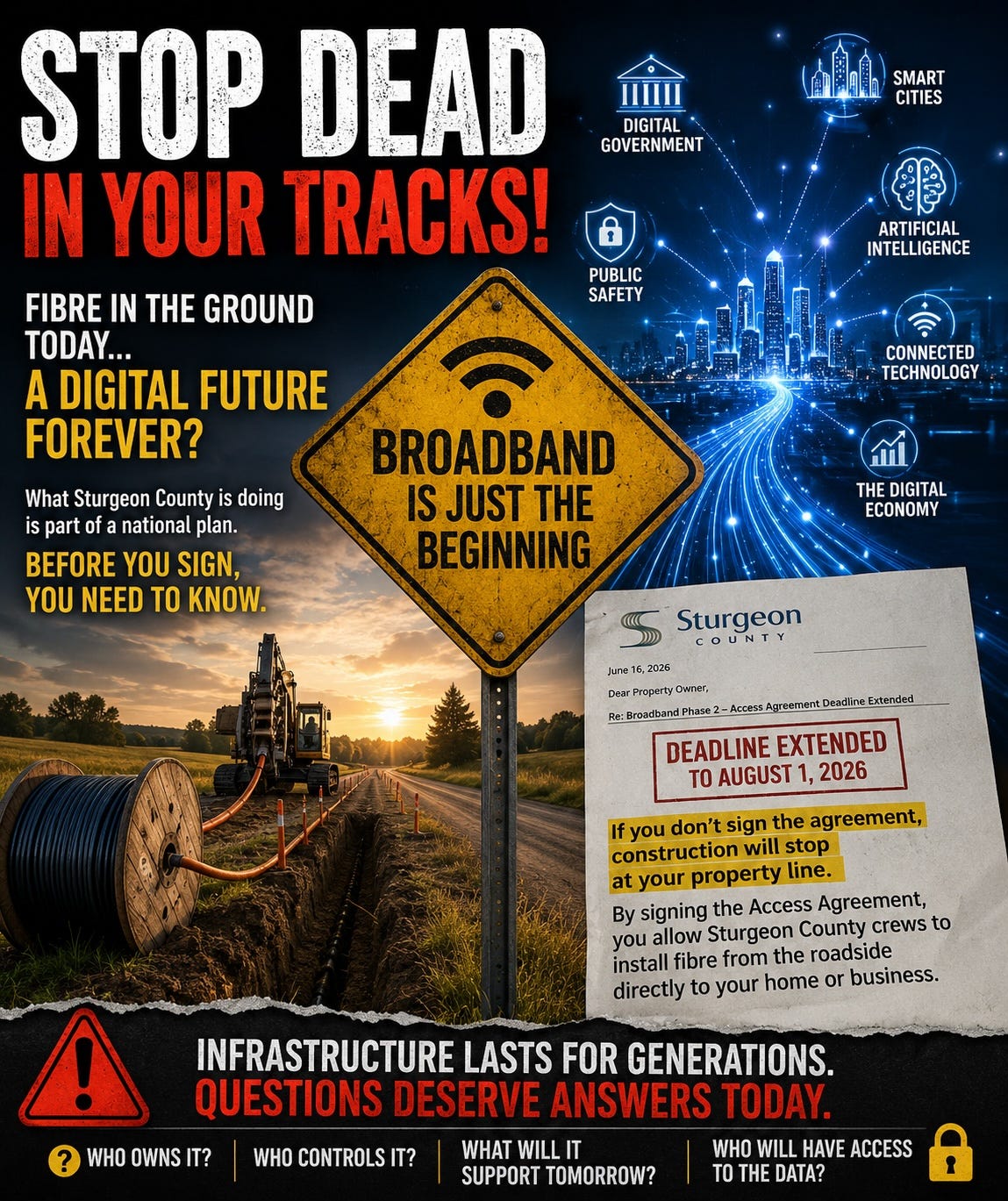
It is about building a permanent communications backbone that the Government itself describes as supporting economic development, public safety, digital government, connected technology, artificial intelligence, Smart Cities, and the digital economy.
Read their own documents.
Then ask yourself one simple question:
If you live in Sturgeon County, you’ve probably seen the crews.
Hydrovacs. Dozers. Directional drills. Surveyors. Contractors. Fibre cable disappearing beneath roads and across farmland.
Most people barely notice.
Here’s the question nobody seems to be asking:
Why are governments across Canada spending billions of dollars to install fibre optic infrastructure to virtually every community, every industrial park, and increasingly every rural property?
The federal government has committed billions of dollars through its national broadband strategy with the goal of connecting nearly every Canadian by 2030.
Sturgeon County is simply one project among hundreds.
So ask yourself...
Why now? Why this fast? Why everywhere? Why everyone?
Because fibre optic cable isn’t just about watching Netflix.
It is the digital highway of the twenty-first century.
Once installed, that highway can carry almost anything:
• Internet
• Telephone
• Emergency communications
• Utility monitoring
• Municipal operations
• Traffic management
• Industrial automation
• Environmental sensors
• Connected infrastructure
• And technologies that may not even exist yet.
The cable itself is neutral. The real question is not what fibre is.
The real question is:
What systems will eventually ride on top of it?
That is why the Access Agreement being presented to Sturgeon County landowners deserves far more attention than it has received.
Buried inside are provisions granting ongoing access to private property, allowing County-owned communications infrastructure to remain on the land indefinitely, with rights to inspect, maintain, replace, and upgrade equipment over time.
This is no longer simply an internet subscription, in fact NO internet provider is even signed on yet!
It is permanent infrastructure. Whether you welcome that or question it, one fact should concern every Canadian: Very few people have stopped to ask what Canada’s digital infrastructure will look like ten, twenty, or thirty years from now.
Infrastructure lasts for generations. Policies change. Governments change. Technology changes. Uses change.
The decisions being made today will shape the Canada our children inherit tomorrow.
That is why every Canadian, not just those in Sturgeon County, should be paying attention.
Back to the Access Agreement … And suddenly I wasn’t thinking about internet anymore.
Because this isn’t simply an application for internet service, in fact as I mentioned there is no internet provider selected yet!
One that gives Sturgeon County permission to install County-owned communications infrastructure on private property and provides ongoing rights to access that infrastructure for inspection, maintenance, servicing, and replacement. The agreement states the installed facilities remain the property of the County.
“Sturgeon County has the right to install, access, and maintain fibre optic cables, conduits, optical network terminals and other accessories and equipment (the “Facilities”) on the Property. Sturgeon County, its officers, employees, agents or contractors (the “County”) can enter the Property, with any necessary equipment or machinery, for the purposes of: installing the Facilities from the roadside to the primary building on the Property; inspecting, servicing, and replacing the Facilities as may be required from time to time; and accessing the primary building, by appointment, to install, service or replace the Facilities. The Facilities are and shall remain the sole and exclusive property of the County,…”
In contract law, leaving a term like “other accessories and equipment” completely undefined is the equivalent of handing the state a blank check. Because there is no exclusionary clause stating that these “facilities” are limited strictly to passive internet cables, the door is left wide open. If public policy shifts or new municipal mandates are introduced five or ten years from now, the government already possesses your signed, permanent legal consent to attach any device they deem an “accessory” to your home, whether that means smart grid sensors, data-collection relays, or automated surveillance cameras, without ever having to ask your permission again.
Furthermore, the contract serves as a massive liability trap. While the County relies on your voluntary signature to cross your property line, the document explicitly states that you are solely responsible for marking unregistered private lines (like well, septic, or detached garage power lines). If their contractors cut your lines, they aren’t liable. But if their equipment is damaged on your property post-installation, the financial burden of repairs falls entirely on you.
That made me stop DEAD IN MY TRACKS!!!!
It should make you stop too.
To understand the true nature of this project, we must look at the sheer financial absurdity of its scale. The money funneling into Sturgeon County isn’t a random local grant; it is a highly coordinated, multi-level taxpayer injection. The official funding breakdown reveals the exact weight behind this push:
Funding Source Contribution Amount:
Sturgeon County $7,109,067
Province of Alberta $4,313,811
Government of Canada $4,313,811
TOTAL FUNDING $15,736,689
Ask yourself: In an era where Canada is drowning in unprecedented debt, where inflation is rampant, where record numbers of families are lining up at food banks, and where people are actively losing their homes to skyrocketing living costs, why are all three levels of government suddenly unified in spending nearly $15.8 million dollars to install physical wires to rural properties that already have functional high-speed wireless, cellular, and satellite internet? Now I am not a math major but when you break it down, the government is spending upwards of $7,000+ per household just to run a physical line from the roadside ditch to a private porch.
Since when does a debt-ridden state care this deeply about rural entertainment? The answer is simple: They don’t. They are building a utility grid that they require every single citizen to be physically plugged into.

This is not a localized coincidence. Identical, synchronized broadband initiatives are being rolled out simultaneously across the United States, the European Union, Australia, and G7 nations. It is a top-down global mandate.
When you investigate the documentation of the United Nations’ Agenda 2030 and the World Economic Forum’s frameworks for the “Fourth Industrial Revolution,” the puzzle pieces lock into place. Global planners have openly stated their commitment to a total “Whole-of-Government Digital Transformation.”
A physical fiber-optic connection running into every single home and business is the fundamental baseline infrastructure required to execute the next phase of centralized global control:
Programmable Central Bank Digital Currencies (CBDCs): A cashless society controlled by programmable digital money requires a flawless, 100% interconnected network grid where no property can go “off-grid.”
Smart Grids and Environmental Enforcement: Real-time monitoring of household energy grids, smart water meters, and individual carbon-tracking systems require massive data pipes capable of constant, automated telemetry.
Digital Identity and Biometric Authentication: The transition away from localized physical governance into centralized digital IDs, digital health passports, and online access to societal services requires every citizen to be anchored to a trackable network endpoint.
The global technocratic “beast” cannot implement these systems But because a direct federal mandate to drill holes into every citizen’s house would spark immediate revolt, they have decentralized the execution. on paper; it requires physical access to your private land.
But where is the data from this new grid ultimately meant to go?
Look no further than platforms like the World Council on City Data (WCCD) (news.dataforcities.org). Heavily backed by the United Nations and the Canadian federal government, the WCCD is an international body that certifies municipal infrastructure under strict global “ISO Smart City Standards” (such as ISO 37120 and 37122). Their open goal is to standardize the collection of real-time, high-calibre data from local communities to monitor everything from energy usage to carbon emissions.
There is a fierce debate among those who oppose this global takeover. Some argue that fighting local projects is a waste of time, a distraction from hitting the “head of the beast” at the international level.
But does that way of thinking miss a fatal flaw of the global agenda?
The international framework can pass all the resolutions they want, and the federal government can allocate billions in grant money, but the entire apparatus is completely halted at your property line unless you sign that paper. The system legally cannot touch your home without your signature.
Focusing on this broadband project is not a distraction, it is the frontline in my opinion. It is the exact physical space where the global digital grid attempts to grip your life.
If you want to stop the digital trap, the solution is remarkably simple. Do not sign the agreement. Warn your neighbors about the open-ended language in the text. Let them know that saying “NO” carries no penalties, and that their current internet will remain completely intact.
They can lay their global grid in the public roadside ditch, but as long as we hold the line, they cannot have our homes.
Under contract law and consumer protection, the window to change your mind depends entirely on how and where the agreement was signed.
In Canada, provincial consumer protection acts (such as Alberta’s Consumer Protection Act) grant citizens an absolute “cooling-off period” to cancel a contract without any penalty.
The 10-Day Window: If a municipal rep or contractor solicited, negotiated, or finalized this agreement in person at a doorstep (a direct sale/prepaid contract), the homeowner has an absolute legal right to cancel within 10 days of receiving the signed copy.
The Extended Window (Up to 1 Year): Under Section 28 of Alberta’s Consumer Protection Act, if a contract fails to explicitly include mandatory information, such as the exact statutory wording of a buyer’s right to cancel, detailed payment disclosures, or clear definitions of services, the cancellation right can legally be extended for up to one full year.

I have probably dumped enough for one day…but please stay tuned…While managing data inside our homes is a critical first step, the larger structural battle isn't happening on our screens, it is happening on our land. In part 2, we expose the physical "Infrastructure Supercycle" of 2026, breaking down how tech giants and telecom monopolies are quietly engineering the largest corporate land grab in modern history to anchor the global AI engine right beneath our feet.

No posts
Comments
Nothing yet. Say the first thing.
Sign in to join the conversation.