
Dear Unlock Aid community,
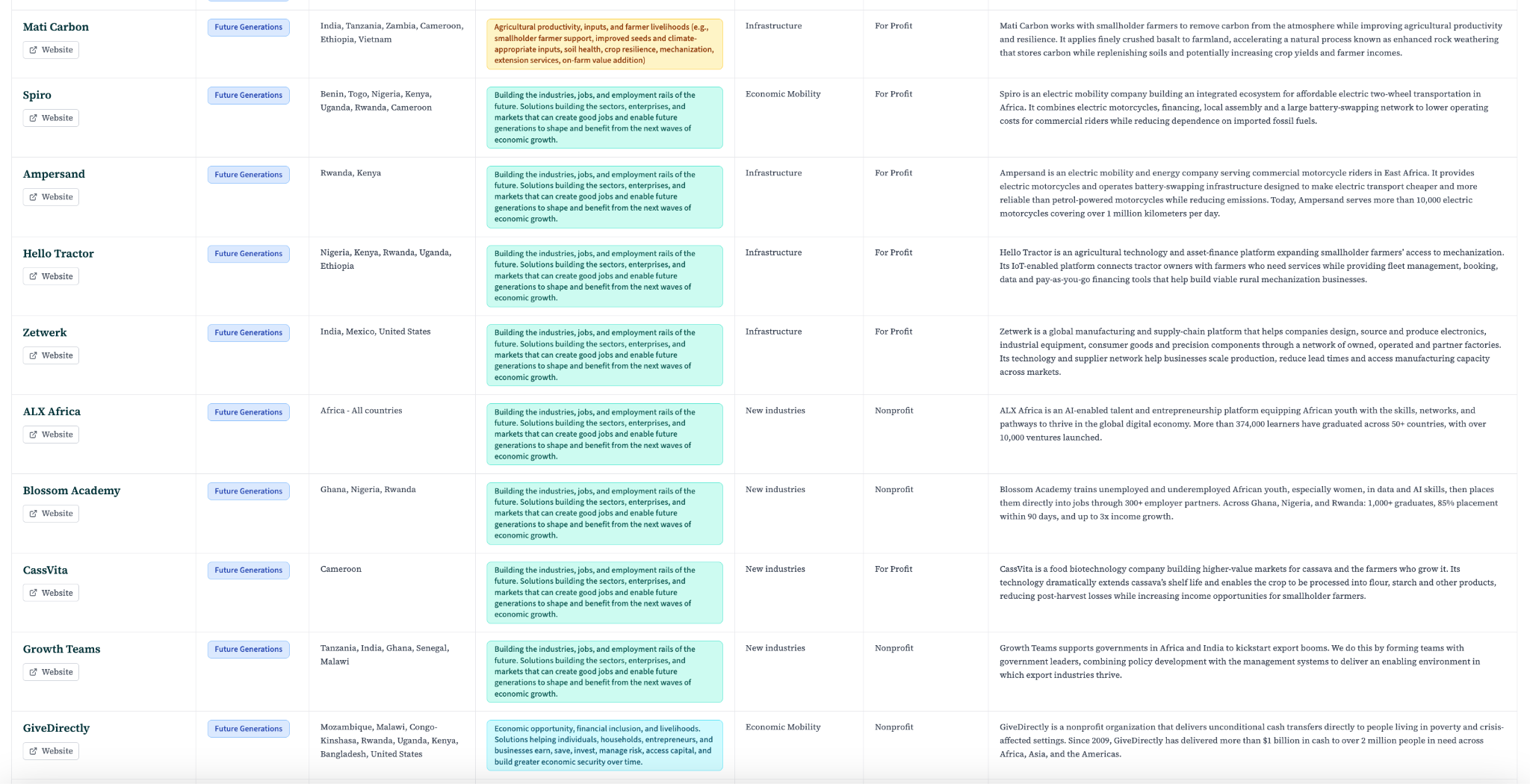
Today, we’re announcing the third and final edition of the Unlock Aid Solutions Index: 40 pacesetting organizations helping build the conditions for children, young people, families, and communities to thrive.
The organizations selected span five areas essential to expanding opportunity for the next generation:
Building the industries, jobs, and employment rails of the future;
Economic opportunity, financial inclusion, and livelihoods;
Education and pathways to opportunity;
Mothers, babies, caregivers, and systems of care; and
Infrastructure for thriving and resilient communities.
Children and young people need more than any one intervention to thrive. They need healthy beginnings, education and pathways into meaningful work, families with economic security, communities with essential infrastructure, and countries with productive industries capable of participating in the economies of the future.
Following a competitive review process, our Expert Review Committee selected these 40 organizations from a strong pool of nearly 130 applicants.
Together, they offer a glimpse of what the future of global development is already becoming.
When we launched the first edition of the Solutions Index at the end of last year, the global development landscape was changing rapidly.
Policymakers, philanthropists, investors, and governments were asking which organizations they should be working with as the traditional aid architecture underwent profound disruption.
Unlock Aid has spent years working alongside many of the pacesetting organizations operating at the frontier of global development. We knew there was already a generation of entrepreneurs, social enterprises, locally-rooted organizations, and other innovators demonstrating different ways to solve problems and deliver results.
What they too often lacked was visibility with the institutions controlling the largest pools of development capital.
We created the Solutions Index on the premise that better global outcomes would require giving greater visibility, capital, and opportunity to organizations capable of delivering results differently, along with supporting business models designed for the future.
Over the past year, through our Solutions Index work, we applied that lens first to identifying pacesetting groups working in global health, then to food security and nutrition, and now, with our final edition, to future generations, where we asked a broader question:
What would it take to build the kinds of futures we would want for the next generation, everywhere?
The world is undergoing profound change. Artificial intelligence is changing healthcare, education, scientific discovery, finance, government, and the nature of work. Advances in clean energy, digital payments, diagnostics, manufacturing, connectivity, and data are similarly expanding what organizations can build and how quickly they can build it.
Support for the cutting edge in global development cannot afford to operate several innovation cycles behind the rest of the world.
In our recent post on Horizon 3 thinking, we described one destination for global development: a world where the distance between a solution existing and that solution being available everywhere is measured in months, not decades, and where it travels in every direction.
Innovations developed in Nairobi, Lagos, Jakarta, Bogotá, or Kigali should be able to travel just as readily as innovations developed in San Francisco, London, or Washington. The organizations in this edition of the Solutions Index help make that future more possible.
Our Expert Review Committee evaluated applicants based on:
Demonstrated impact and measurable outcomes
Organizational maturity and absorptive capacity
Financial sustainability and revenue diversification
Local endorsement and country alignment
A clear pathway to scaling impact cost-effectively
These 40 organizations represent a wide range of sectors, geographies, and models. What connects them is that each is helping expand what is possible for the next generation.
Explore the Future Generations Solutions Index.
→ Click here to read our original call for applications and evaluation framework.
This is our third and final edition of the Solutions Index, following previous editions focused on global health and food security and nutrition. Across the three editions, 90 organizations are featured.
This edition would not exist without the rigor, judgment, and expertise of our Expert Review Committee.
Thank you to:
Efosa Ojomo, Director of Global Prosperity at the Clayton Christensen Institute and co-author of The Prosperity Paradox
Shiro Wachira, Head of Portfolio & Investor Relations at Equator
Ineza Mutimura, Co-Founder & CEO of Funders of African Descent
Daniel Yu, Founding Partner of Africa Jobs Fund
Shalane Yuen, Founding Managing Director at Trevor Noah Foundation
All individuals advised as volunteers and served in their personal capacities.
When we created the Solutions Index, our immediate goal was practical: make it easier for decision-makers to find organizations already demonstrating better ways to deliver results.
Three editions later, the larger lesson we’re taking away is this: the future of global development is already being built by entrepreneurs creating new markets, organizations finding better ways to deliver essential services, companies building critical infrastructure, innovators applying new technologies to longstanding problems, and locally-rooted leaders designing solutions around the realities they understand firsthand.
The 40 organizations featured in this edition of the Solutions Index are signals that show us where ingenuity is emerging, how development models are evolving, and what becomes possible when organizations are built around the future rather than the assumptions of the past.
To the organizations selected: congratulations, and thank you for building.
And to the policymakers, philanthropists, investors, governments, and partners deciding where to place resources next: It’s time to follow the builders.
To Progress,
Unlock Aid
Comments
Nothing yet. Say the first thing.
Sign in to join the conversation.