
A few years ago, I used to work with small community groups and event organizers on community safety and sexual misconduct. In the the course of this work, I sometimes developed tools and frameworks on addressing toxic masculine patterns and/or sexual misconduct.
So when a reader asked me how men can divest from the patriarchy after I shared a bell hooks quote, I said I’d write a how-to guide/essay on doing just that. So I ask: if you found this piece valuable, please share it with your male friends, family members (et al) — but please don’t steal or illicitly share it!
I understand that tools and frameworks aren’t popular or standard in feminist philosophical writing.
What they are is crucial in actually destroying the patriarchy.
It’s not enough to merely point out the patterns, that which we already know from waves of feminist theorists and our lived experiences, but to give applicable guidance on how to, starting with getting men to start destroying the patriarchy within themselves.
If you’d like to read this essay and more, support this cause, and help me spread the word on feminist theory, dangerous people and the dynamics of sexual assault (knowledge I’ve gained through years of unpaid, mostly uncredited work), $7/monthly or $68/annually (a 20% discount) gets you access, or a founding membership for additional support. Any of these options helps you support anti-rape, feminist writing and work.
I paywall my best essays (the ones with new material and research), for reasons I’ve explained in this essay, this one especially, also this one, and last but not least this one.
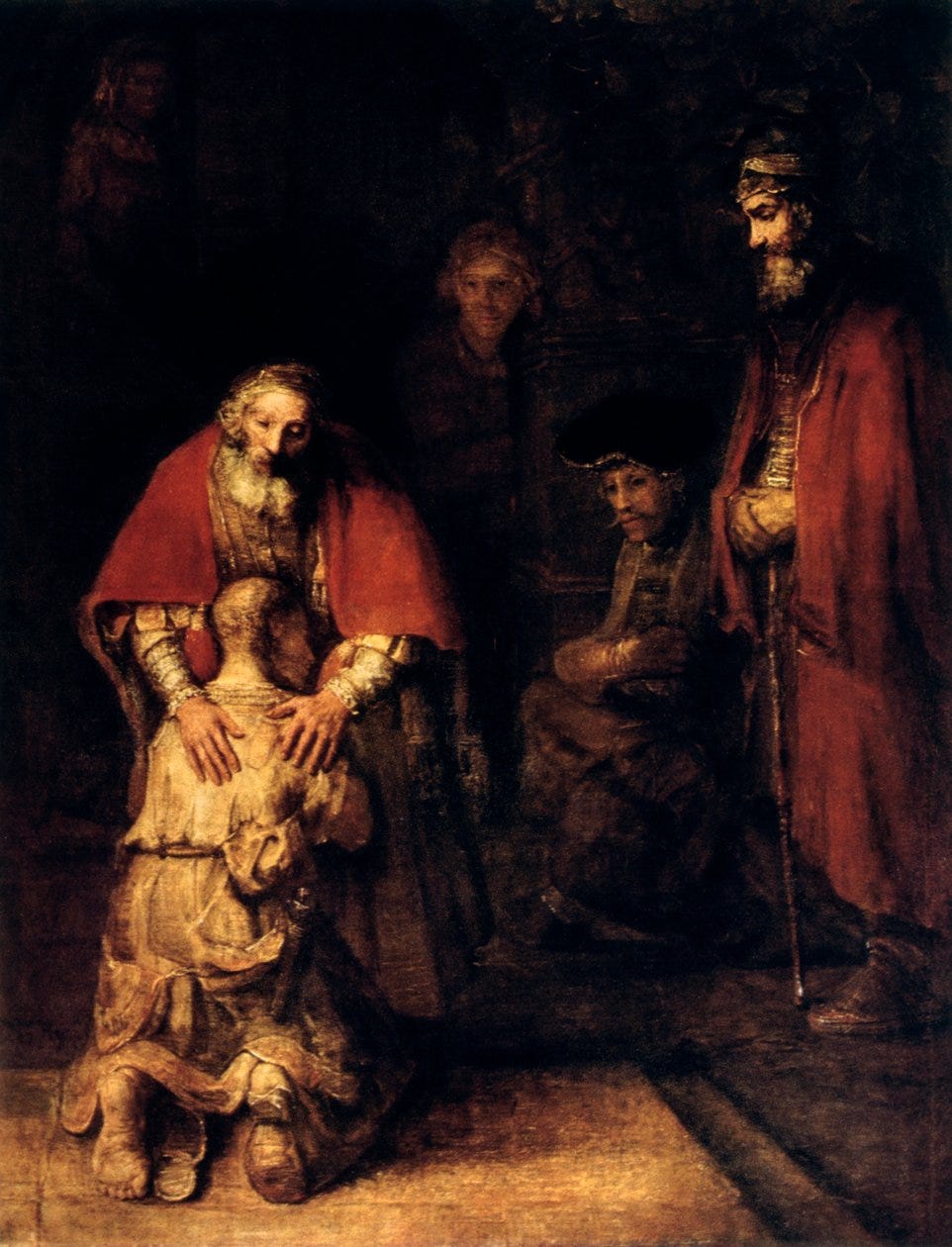
Rembrandt Harmenszoon van Rijn, The Return of the Prodigal Son
“A male who has divested of male privilege, who has embraced feminist politics, is a worthy comrade in struggle, in no way a threat to feminism, whereas a female who remains wedded to sexist thinking and behavior infiltrating feminist movement is a dangerous threat.”
bell hooks, Feminism Is for Everybody: Passionate Politics
There’s a rite of passage that queer kids who grow up in the bay area go through, or so my fellow gays and lesbian bay area native1 tell me. Reading Anne Rice’s vampire novels.
Her characters, especially the vampires Louis and Lestat from Interview with the Vampire (and onwards) are famously queer. The romances between Louis, Lestat, and the boyish teenage (!!) vampire Armand from the AMC t.v. show are fetishized by heteronormative women in much the same way as the hockey players on Heated Rivalry are, but at a much smaller scale.
I haven’t watched the show. From what I know of it, the queerness became more about identity in a modern way, whereas the book characters, it was more rooted in behaviors, and more gender and sexuality fluidity. Male vampires and witches had affairs with other men, her female ones with women, but they just as easily had opposite sex affairs. I’ve always found fluidity beautiful, imagine being attracted to someone regardless of their identity or anatomy. None of these vampires or witches followed gendered conventions. Women witches became wealthy and powerful, moreso than their male counterparts. And all felt at many times lonely.
Her characters were analogous to the queer community, outcasted and ill-fitting for the rest of the world. Perhaps I had no business reading Anne Rice’s highly erotic work at twelve and thirteen, especially as she frequently wrote about teenage girls slightly older than me having sex with much older men 😞. At the time, I loved her books. They offered a beam of hope to a lonely preteen and teenager. And I was of the mindset that older men leeching younger ones was gross at that age, too.
At that age, The Queen of the Damned was my favorite. Partially because of its setting in ancient Egypt; I’d read every book every local library branch carried on the subject.
The premise of the book begins with the awakening of the long-slumbering old queen of the vampires. She was the wife of a pharaoh who built a religion of their transformation into vampires (that of Isis bringing back her husband, Osiris, from death). She has heard the prayers of humankind. Her solution for humankind is to kill all the men. She visits out-of-the-way primitive villages where the women are easily swayed into believing her a goddess as did the ancients. They kill their menfolk upon her command.
Susceptible to religion, which frequently starts off as a cult before becoming a source of power for those in charge of it, just as some people who spend too much time on social media become.
Violence begets more violence. When Akasha, the queen of the damned, calls on the vampires who are still alive to join her in the quest to become gods and goddesses worshipped by humans, they point out how her plan can never be fulfilled, that humanity will not be saved by killing off all men. That women who aren’t religious and easily swayed would rise up and defend their men, too.
One of the vampires eloquently argues this: even as a so-called goddess cannot save humanity from their worst problems. Death. Disease. Loneliness. All you can do is kill, one of the vampires tells her.
“There is a horrifying loneliness at work in this time. No, listen to me. We lived six and seven to a room in those days, when I was still among the living. The city streets were seas of humanity; and now in these high buildings dim-witted souls hover in luxurious privacy, gazing through the television window at a faraway world of kissing and touching.”
— Anne Rice, The Queen of the Damned
There are this small subset of women who call for feminist/lesbian separatism, political lesbianism, misandry, and the like. They will remain a tiny cult, lonely, embittered, and raging on TikTok, Reddit, and Substack these days. Their hate spirals onto other women who disagree with their rhetoric, not recognizing the inconsistency and ill-logic of their arguments. I’ve always found it very strange that is never men who bully me for more frequently writing about abusive patterns in men. It’s this type of women who instead bully and actively silence me when I write bout white feminism (racism in feminism) and/or that women also must work on ourselves to overcome patriarchal conditioning, upholding rape culture due to internalized misogyny and gravitation toward the power of the patriarchy.
They use the same sort of tactics of harassment and silencing that they claim men use against women. They embody the misogyny and angry dominance of the patriarchy itself, justifying their hate and oppression via their mantel of victimhood, believing it their right to oppress others by proclaiming themselves the most oppressed. It’s revenge over growth. It harms us all. It’s the desire for immediate change and power.
“We have either been socialized to believe revolutions are always characterized by extreme violence between the oppressed and their oppressors or that revolutions happen quickly. We have also been taught to crave immediate gratification of our desires and swift responses to our demands. Like every other liberation movement in this society, feminism has suffered because these attitudes keep participants from forming the kind of commitment to protracted struggle that makes revolution possible. As a consequence, feminist movement has not sustained its revolutionary momentum. It has been a successful rebellion.”
— bell hooks Feminist Theory: From Margins to Center
“Every mass movement”, wrote Eric Hoffer of cult-like dynamics and wildly unchecked mass movements, “shapes itself after its own specific demon.” And so, these women and this small offshoot of feminism seeks to resemble the very type of men and masculinity they and it claim to abhor.
“Bitterness is the coward’s revenge on the world for having been hurt.”
― Zora Neale Hurston
Consider the fates of feminists such as Valerie Solanas, Sheila Jaffreys, or even the decline of Gayle Rubin (perhaps the most admired of sex positive feminists, who justifies pedophilia in her work), versus the long admiration and influence of those they criticized, including Judith Butler and Catharine A. Mackinnon. Compare that to the escalating popularity of bell hooks and Andrea Dworkin years after their deaths, women who were also called conservative, men-loving (bell hooks), sex negative. That many of second wave’s separatists and political lesbians became today’s most embittered trans-exclusionary “feminists” is no surprise. The hate toward anyone who disagrees, the bullying of anyone perceived to be more vulnerable and an easier target is par for their course.
It’s born of a a sort of learned helplessness, a refusal to set firm boundaries with self or others, an emotional reactivity that leans into immaturity. Vampire queen Akasha, frozen as a young woman in her twenties from another time, is an apt symbol. It’s born of not recognizing one’s own power, needing to control everything. and continually striving for more in the wrong place.
Ironically, the very mindset of the worst type of masculinity. Entitlement, superiority, and controlling behaviors are the traits of a rapist, too.
It was simply easier for feminist women to talk about challenging and changing patriarchy than it was for us to talk about men—what we knew and did not know, about the ways we wanted men to change. Better to just express our desire to have men disappear, to see them dead and gone…
So it’s an oversimplification to speak the truth that we sometimes wish men dead—unless we also speak the truth which is perhaps even harder to face (as we try to find out own powers, to be our own women): the truth that this wish is unbearable to us. It rends us. As a young woman in my twenties who had not yet found her own powers, I often wished the men in my life would die. My longing for my father’s death began in childhood. It was the way I responded to his rage, his violence. I used to dream him gone, dead and gone.
bell hooks The Will to Change
I started thinking about this most especially after a recent experience I had with a friend, a sister – a young woman who has been very deeply touched and changed by the women’s liberation movement. When I first met her she was much involved in the antiwar movement and committed to nonviolence. Now she has concentrated above all on resistance to her own oppression and that of her sisters; and she was no longer sure that she was committed to nonviolence. Though in the past she had remained nonviolent in the most extreme situations – taken jailings, taken beatings, she told me that she could now all too easily imagine killing a man.
We had a long talk. I spoke to what seems to me the deep, deep need for the women’s movement to be a nonviolent movement – if we want to make the changes that we need swiftly and surely as we can, and if we want to see the fewest possible people hurt in the struggle. For I can more and more see this struggle becoming a very bloody one.
— Barbara Deming, On Anger
It’s strange work and hypocrisy if we ask men to divest themselves of anger and violence, while we encourage women to indulge in it as a precursor to feminism.
Deep within their hearts, humans are loving. They are often fearful and insecure, which drives their hate and anger. To encourage women toward the latter and call it feminism is truly a disservice to them (us).
To ask men to divest themselves of it, to perhaps take on more of what services women and what’s stereotypically considered feminine — living with emotions and deeper connection. That would be a service to humanity.
“By claiming that they wanted the power men had, man-hating feminists (who were by no means the majority) covertly proclaimed that they too wanted to be rewarded for being out of touch with their feelings, for being unable to love.”
— bell hooks, The Will to Change
When I read the perspectives of women who call themselves anti-feminist, the number one reason they do is that they believe that feminism is about hating men, would ask them to disavow men. They speak of concern for their sons and brothers. So much rhetoric on social media today leans into that, conflates feminism with misandry that one cannot blame these women. That we have to fight against this is part of the feminist fight.
The large majority of women already love men and boys. I do not mean all men, I mean these women have at least one man whom they loves, whom they are or long to be loved by. I do not mean romantically necessarily, I mean her father, brother(s), cousins, uncles, friends, colleagues, coworkers, sons, grandsons, and more.
And if The Queen of the Damned came to life and a power-hungry woman sought to call upon women to kill mankind as a solution to their problems, the majority of women would join men in rising up to protect the men and boys.
To paint every man as the abuser and the oppressor is an injustice that the majority of women recognize, especially when it comes to the men they love.
To work against the male abusers and rapists — to have men join us in that fight is a precluding condition for winning that struggle to stop them.
It is a fiction of false feminism that we women can find our power in a world without men, in a world where we deny our connections to men. We claim our power fully only when we can speak the truth that we need men in our lives, that men are in our lives whether we want them to be or not, that we need men to challenge patriarchy, that we need men to change.
— bell hooks, The Will to Change
To live with men, we women (and others) must.
This is difficult as long as the patriarchy exists. What we as feminists ask of men is to instead join us in calling out and disavowing the abusers and rapists, to work with us to destroy the patriarchy. We must ask that they recognize how the patriarchy may benefit them in some ways, but hurts them in other, very important ways.
We should ask them to begin with destroying the patriarchy within themselves first, by divesting as much of the privilege and dominator-based culture norms it grants to them.
Because while the patriarchy may seem seductive, with its promise of domination and power to men, it does not leave men happier or healthier. It has left men dying deaths of despair, overdosing and addicted, homeless and struggling, at greater rates than women. It has hurt and harmed men, too.
bell hooks’ The Will to Change is perhaps the most influential book on doing just that. It is beautiful yet vague, telling men to get in touch with their emotions but not offering steps or realistic guidance on doing so. I do not mean that as a criticism. It is not a how-to guide. What I’m doing is differentiating it from this piece, which is more of a practical guide than hooks’ philosophical treatise. And there are many more authors and philosophers who have covered this, including Barbara Deming (whom bell hooks drew upon heavily for The Will to Change), and male authors and thinkers such as Paul Kivel, Jackson Katz, Christopher Pepper, Stanley Fritz, and more. There are books written by parents on raising better boys and/or feminist ones, including by authors such as Sonora Jha and Ruth Whippman.
This is a guide that is about adolescent and adult boys and men undoing their patriarchal conditioning, divesting of the privilege (and harm) that came from it, deepening connections, and letting go of anger, entitlement, and other negative, harmful patriarchal (sometimes abusive) behaviors and emotions. It’s built from work against sexual misconduct in community groups and a few non-profits, conversations with both victims and a few with men accused of sexual misconduct in those communities, and conversation and co-learning with men who work with men and boys to address unhealthy masculinity and questionable behavior.
Comments
Nothing yet. Say the first thing.
Sign in to join the conversation.