Lucille Bluth is wrong about the price of a banana but she accidentally reveals her willingness to pay. A banana costs less than a dollar. Lucille would happily pay ten dollars for one1. That means every time she buys a banana for a dollar, roughly nine dollars of value silently flows into her pocket. The price feels like a fact about the banana, like its color or curvature. But it’s not — it’s one particular point on a negotiation frontier, and Lucille happens to be on the very comfortable side of it.
That dollar is consumer surplus — the gap between what the buyer would be willing to pay and what she actually pays. Intro econ presents it as a Good Thing™ (and it is) but here’s what’s been bugging me: consumer surplus is unequally distributedby construction.
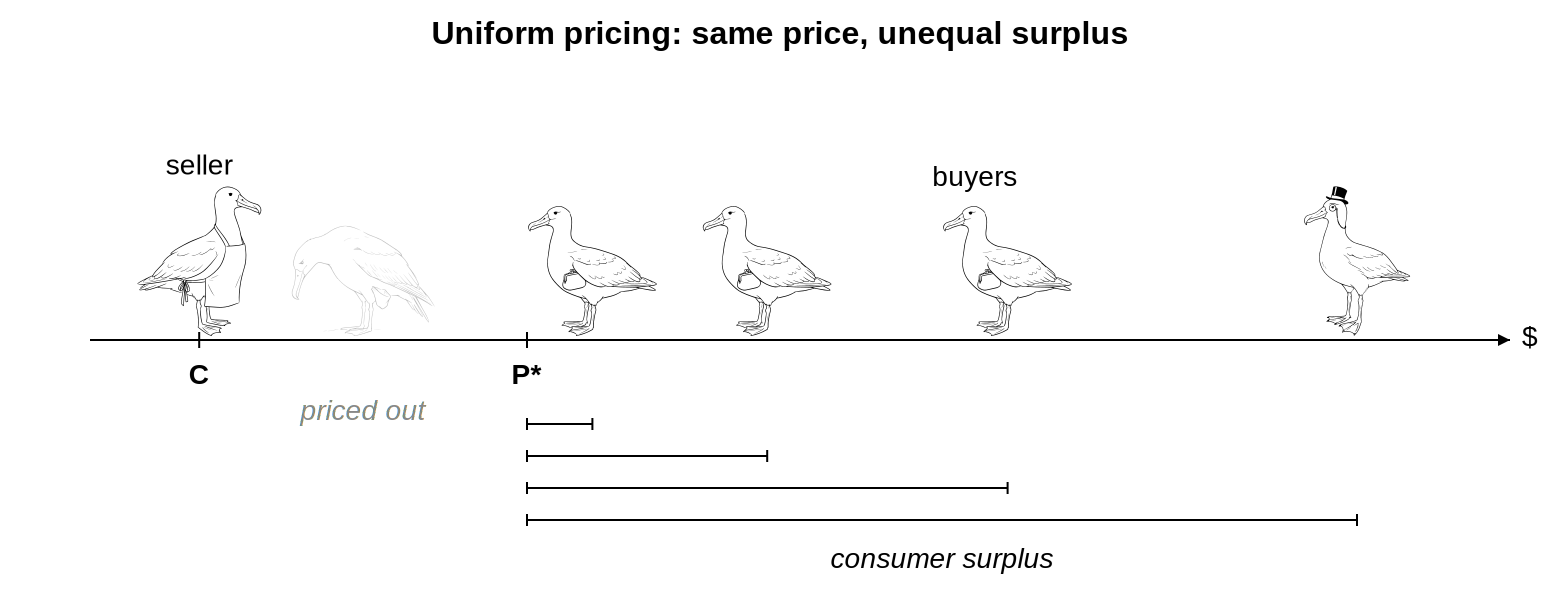
The price of a banana settles at the point where some marginal customer is just barely willing to buy. That person gets essentially zero surplus. Meanwhile, someone for whom the price is a rounding error walks away with a windfallgolden banana. Under uniform pricing, the richer you are, the better the deal you get2.
A seller has a good that costs C to produce. Buyer i would pay up to Rᵢ. If a trade happens, total surplus is Rᵢ − C. How should it be divided?
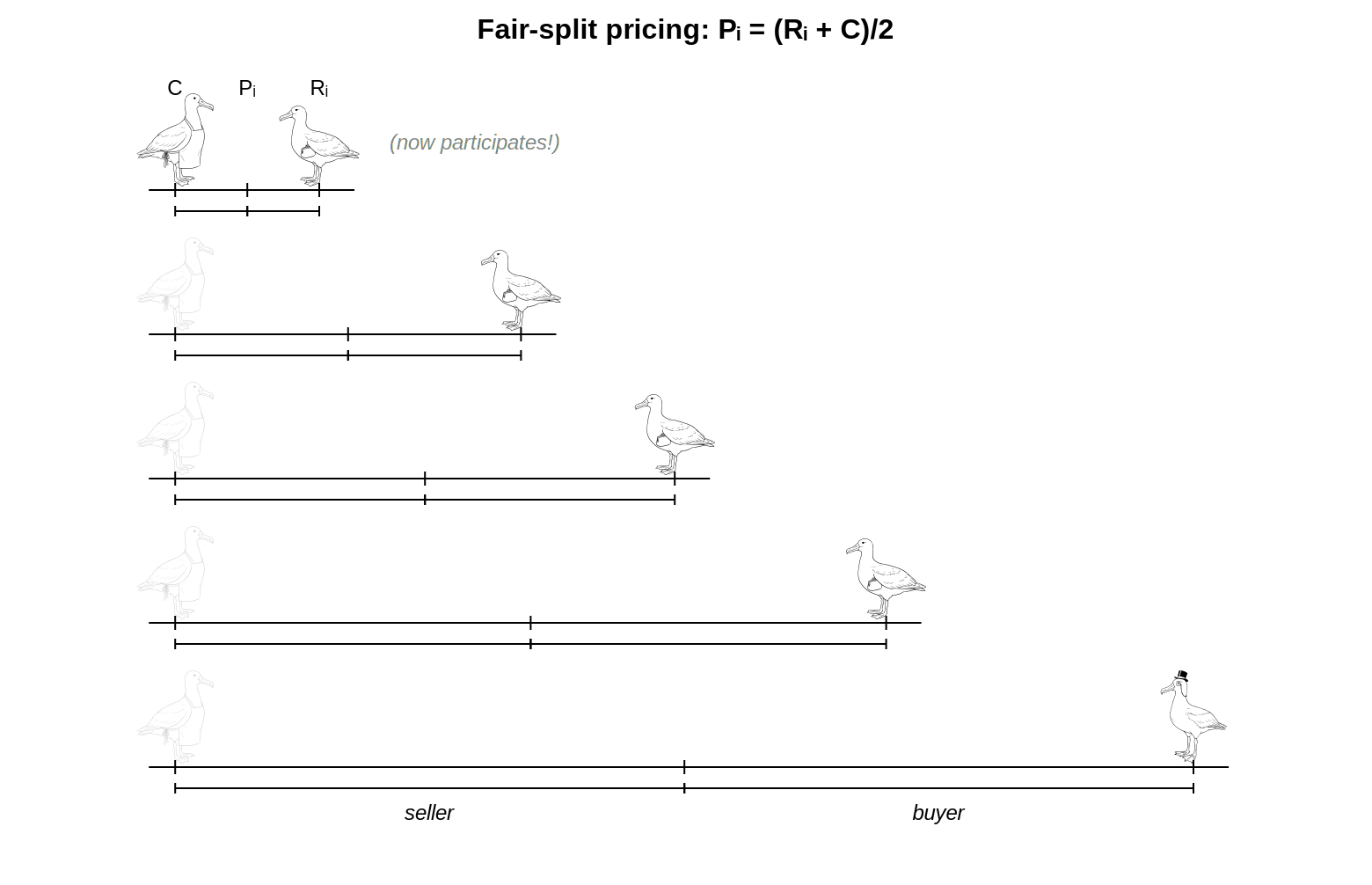
Nash bargaining gives a clean answer: split it equally3. Each side gets (Rᵢ − C)/2, so the fair price for person i is
\(P_i = \frac{R_i + C}{2}\)
This is the formal version of what Yudkowsky calls a cheerful price4 — the number at which neither side is merely tolerating the deal but both walk away actually glad it happened.
Technically this is price discrimination (which is almost universally condemned) — person i pays a different price than person j. But it’s price discrimination with a fairness constraint: every trade splits the gains 50/50. Nobody is the sucker5.
Compare to uniform pricing, where the seller picks one P* and everyone with Rᵢ ≥ P* buys. The seller gets (P* − C) per sale. Buyers get anywhere from “almost nothing” to “enormous.” And everyone with C < Rᵢ < P* doesn’t participate at all, even though there’s a deal that would make both sides better off — the classic deadweight loss triangle.
Below, some albatrosses. The one in the top hat is our whale — so far out on the right tail that the uniform price is a rounding error to him.
Under fair-split, everyone with Rᵢ > C participates. Deadweight loss disappears.
More people get bananas, surplus is distributed equally. What’s the catch?
Whether the seller loses depends on the shape of the demand distribution. I ran some simulations.
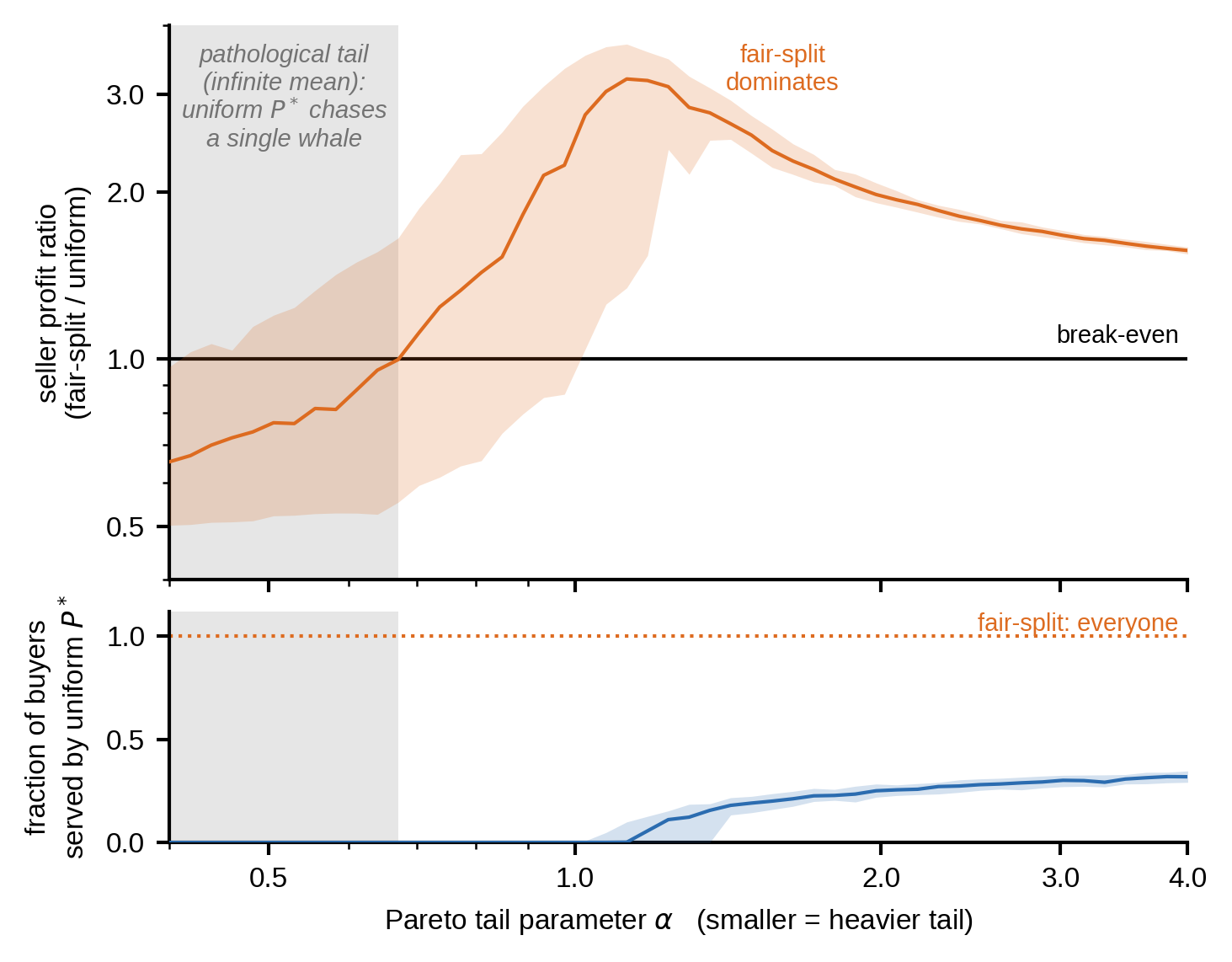
Setup: 10,000 customers, reservation prices Rᵢ whose excess over cost is Pareto-distributed with tail parameter α. Compare profit-maximizing uniform price against fair-split, sweeping α from “absurdly heavy” to “merely heavy.”
When the tail is heavy enough, fair-split crushes uniform pricing — 2× or more. The bottom panel shows why: when demand is heavy-tailed, the optimal uniform price ends up so high that it excludes most of the market. Fair-split serves everyone. In the grey zone on the left (α < 1, infinite mean), a single customer holds essentially all the surplus and the uniform seller just chases that one whale — our top-hatted friend, cornering the market by accident6.
But the chart doesn’t tell us which α we’re actually at. Reservation prices are subjective — you can’t survey people for their true willingness to pay. If demand turns out to be concentrated, uniform pricing already captures most customers and fair-split just gives away margin7. The whole thing hinges on the shape of a distribution we can’t see.
A hint from the wild: the Japanese luxury fruit market, where single Yubari melons sell at auction for upwards of $30,000. When a melon — a melon — commands five figures, you know the right tail of willingness-to-pay goes very far out. The fat-tailed regime isn’t a modeling convenience; it’s a functioning business. The question is whether it’s the default.
(Yes, the auction for the season’s first pair isn’t uniform pricing — it’s an arbitrary segmentation of a commodity into quality brackets, priced separately so the top bracket can approximate the top buyer’s Rᵢ. Which is sort of the point: when the tail is fat enough, sellers invent excuses to charge different people different amounts. “Premium” tiers, “pro” plans, bespoke enterprise quotes — fair-split is the principled version of what all of that is groping toward8.)
Fact 1: Wealth is Pareto-distributed. Known since Pareto (1896), confirmed by modern data (Jones 2015). Tail parameter typically between 1 and 2.
Fact 2: Utility is approximately logarithmic in wealth. Bernoulli (1738) proposed it to resolve the St. Petersburg paradox; empirical estimates of relative risk aversion cluster around 1–1.5, consistent with log or near-log9.
Combine them. If u(W) = log W, the reservation price for a good providing utility v satisfies log(Wᵢ − Rᵢ) + v = log Wᵢ, which gives
\(R_i = W_i(1 - e^{-v})\)
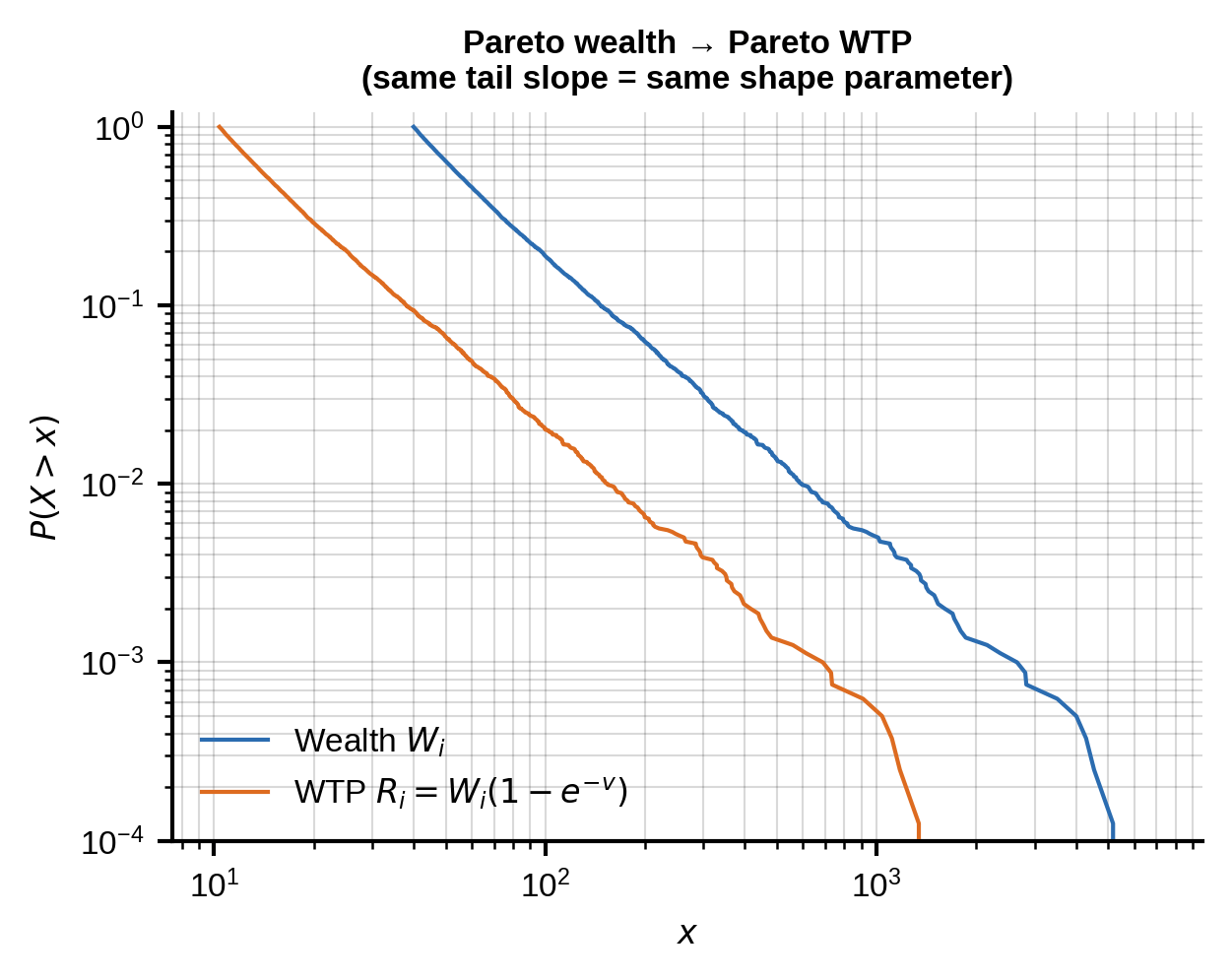
Willingness to pay (WTP) is linear in wealth. The constant depends on the good, not the buyer. So the distribution of reservation prices is a scaled copy of the wealth distribution — Pareto with the same shape parameter10.
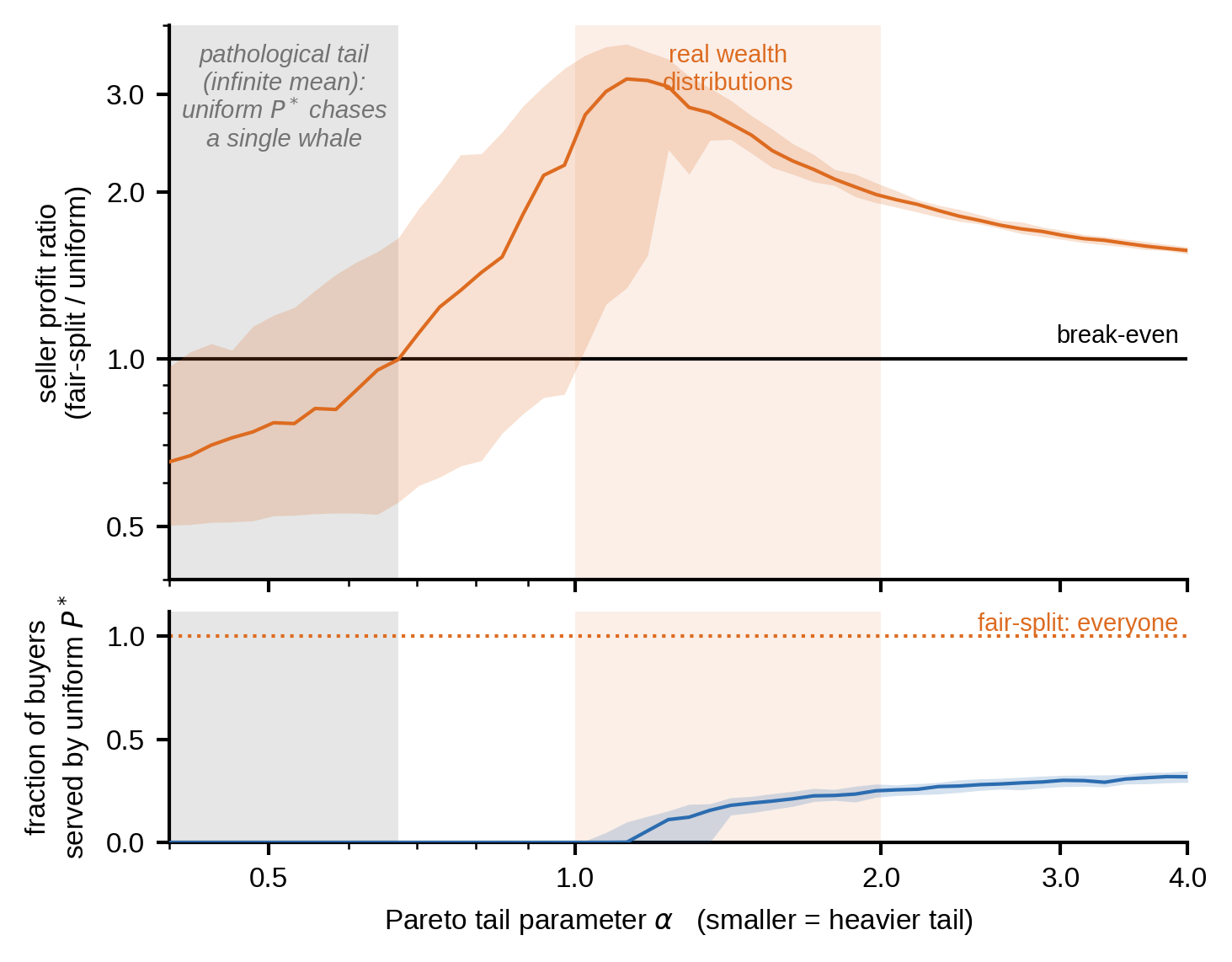
Go back to the chart. The tail parameter for real wealth distributions sits between 1 and 2. That’s α ∈ [1, 2]:
Right where fair-split makes the seller 2–3× more profit than the optimal uniform price — peaking around α ≈ 1.1, which is roughly where U.S. wealth data sits11.
So for any demand distribution shaped like actual wealth, fair-split is a Pareto improvement — more profit, more participants, no deadweight loss12.
Nice in theory. But sellers won’t voluntarily adopt fair-split if they think they can extract more through opaque discrimination. And buyers can’t negotiate at the grocery store.
In the last installment, I wrote about situations where naive “pick the highest-EV option” leads to worse outcomes. This has the same flavor.
A naive utility-maximizing buyer accepts any deal where Rᵢ > Pᵢ — any positive surplus. Locally rational, globally exploitable. The seller can set Pᵢ just below Rᵢ and capture almost everything. You get a banana and a rounding error.
The alternative: be the kind of buyer who rejects deals in proportion to how unfair they are. If you walk away with probability proportional to perceived unfairness, the seller’s best response is either to lower the price, or to reveal information that corrects your unfairness estimate — since a miscalibrated buyer leaves money on the table for both sides.
This is structurally the ultimatum game, where responders who reject unfair splits discipline proposers into more equitable offers13. The costly commitment to sometimes walk away from positive-EV deals is what gives the mechanism teeth.
In the last post, I also argued that the strategies effective altruists already practice — diversification, risk management, cooperation — are justified by slightly more sophisticated decision theory than naive EV maximization. Same pattern here, on the buyer’s side.
A naive buyer accepts any positive-EV deal. A slightly more sophisticated buyer asks: what offer-acceptance policy, if universalized, produces the best outcomes? And the answer is: one that demands a fair split and credibly rejects unfair divisions, even at a cost.
If this sounds like Yudkowsky, it should. “You can get better outcomes by being the kind of agent who credibly commits to rejecting unfair offers” is a core move in functional decision theory. You don’t evaluate “should I accept this offer?” You evaluate “what acceptance function should I be running?” — and the answer is one that rejects unfairness, because sellers who can predict your function will adjust their offers accordingly14.
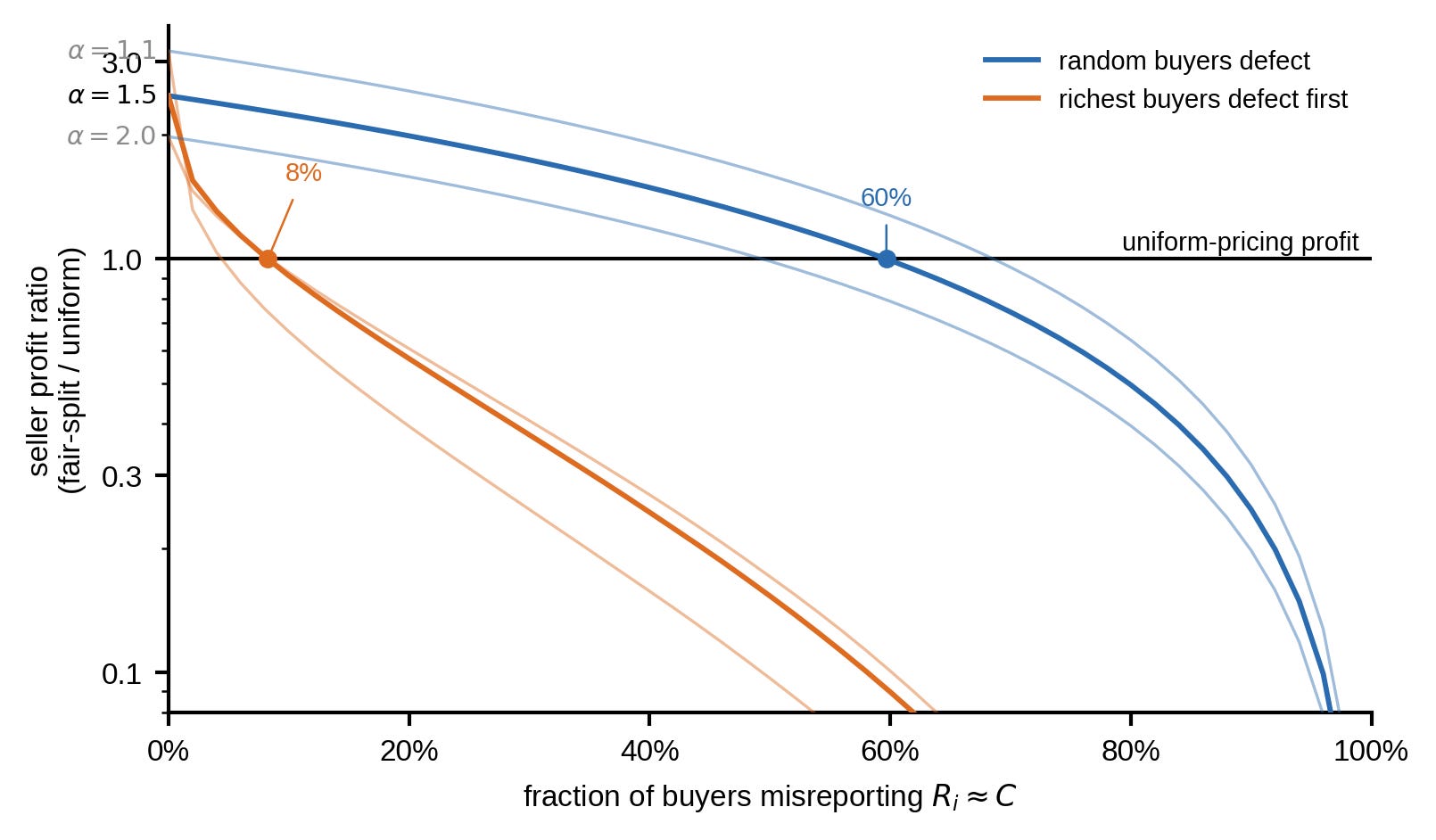
Probabilistic rejection is the buyer’s defense against a seller who knows Rᵢ and tries to pocket all of it. The mirror-image failure is a buyer who knows their own Rᵢ is high, reports it as barely-above-cost, and gets charged Pᵢ ≈ C. How many liars does it take to break the scheme?
It depends entirely on who lies. If defection is uncorrelated with wealth — a random p-fraction of buyers misreport — the seller’s fair-split profit degrades linearly in p, and at α = 1.5 it still beats uniform pricing until about 60% of the market is lying. A majority of your customers have to be cheating you before you’d have been better off with a price tag.
If the richest buyers are the ones lying, it’s a different story: at α = 1.5 the scheme breaks when about 8% defect, and at α = 1.1 it’s closer to 4%. This isn’t a separate fact from the one that makes fair-split work in the first place — it’s the same fact. Under a Pareto tail a handful of whales hold most of the surplus; that’s why meeting them halfway is so profitable, and that’s why losing them is so costly. The mechanism’s leverage and its fragility are the same thing viewed from two sides15.
There’s a problem with all of this, and I don’t want to end the post pretending it isn’t there.
Fair-split asks the most from the people with the most power to resist it. The whales — the buyers far out on the right tail — are the ones who’d pay more under fair-split than under uniform pricing. And they’re also the ones who can afford lobbyists, who sit on corporate boards, who shape the norms around what “fair” means in the first place. The math says meeting them halfway is a Pareto improvement. The politics says they have every reason to prefer opaque price discrimination that works in their favor, and the means to get it16.
So where does that leave us? The decision theory still holds. Probabilistic rejection of unfair offers is still the right policy for a buyer to run, the same way that diversification is the right policy for an investor — even when the environment makes it hard to execute perfectly. The gap between “this is the correct strategy” and “this strategy will be adopted” is the oldest gap in political economy, and I’m not going to close it in a Substack post.
But I think it’s worth knowing what the correct strategy is, even before it’s politically feasible. Especially before.
Thanks for reading. Comments open for arguing about bananas.
Full disclosure: I feel quite similar to Lucille when it comes to bananas. I used to have a party bit — back when I went to parties — where I’d corner people and evangelize about bananas. Biodegradable packaging! Delicious at every stage of ripeness! Monkeys love them! I might not pay $10 for one, but at, say, $2 I’d still feel genuine enthusiasm about the trade.
This is kind of obvious once you say it out loud, but I think it genuinely surprises people. We’re so used to thinking of “same price for everyone” as the definition of fairness that we don’t notice it produces extremely unequal outcomes. An econ-literate reader will want to point out that I’m implicitly giving the seller market power; under textbook perfect competition the price is driven down to C and the seller captures nothing. Two things. First, that doesn’t touch the point — at P = C the surplus Rᵢ − C is still bigger for richer buyers, so the regressivity is intact; competition just changes who doesn’t get a share. Second, the textbook case is rare in practice. Most businesses you actually buy from have differentiated products and nontrivial margins, which is why they exist. So “a seller who gets to pick a price above cost” is the normal case, not the special one.
Symmetric Nash bargaining with equal weights and zero outside options. Rubinstein (1982) showed this is also the limit of an alternating-offers game as the time between offers goes to zero, which gives it non-cooperative teeth. If you want the fully general version: the Shapley value assigns each player their expected marginal contribution, averaged over all permutations of players joining the coalition. With two players and one surplus to split, this collapses to exactly 50/50 — each player is pivotal in half the orderings. The equal split isn’t arbitrary; it’s what falls out of the axioms.
He’d earlier been using “happy price,” which is Michael Ellsberg’s coinage with slightly different connotations. The informal version is a heuristic for negotiating with friends: ask for the number that makes you feel cheerful rather than the number you can barely live with, so nobody ends up quietly resenting the trade. (Rᵢ + C)/2 is what you get if you turn that heuristic into a formula and assume symmetry.
The economist Ivan Png proposes a taxonomy that makes the relationship clearer: complete discrimination → direct segmentation → indirect segmentation → uniform pricing, in decreasing order of both profitability and information requirement. Fair-split is complete discrimination (personalized prices) with an added fairness constraint. Standard first-degree price discrimination captures all surplus for the seller; fair-split captures half. Same information requirement, very different politics.
There is also a third regime lurking off the right-hand edge of this chart, but you have to leave the Pareto family to find it. If demand is concentrated — everyone has roughly the same Rᵢ, as under a tight Gaussian — uniform pricing already captures almost everyone at a price near the common valuation, and fair-split just hands back half the margin for nothing. In that world the seller loses ~30%. So: concentrated demand → uniform wins; fat tail → fair-split wins; infinite-mean tail → uniform wins again, degenerately.
The seller’s decision is: do I offer everyone a fair split, or post a price tag? And the answer flips depending on the tail. Getting it wrong in the concentrated-demand case costs ~30% of profit. Getting it wrong in the fat-tailed case leaves 2–3× on the table.
Two examples of fair-split-adjacent pricing that already exist: sliding scale fees (common in nonprofit legal services and therapy, where the price is pegged to the client’s income) and international pharmaceutical pricing (drug companies charge less in poorer countries — Danzon 1997 found this raises revenue while expanding access). Neither is exactly Nash bargaining, but both scale price to ability-to-pay and both work commercially. The mechanism isn’t hypothetical; it’s just not named.
Tirole (1988, pp. 96–97) notes this: under log utility, the willingness-to-pay parameter equals income, so “the distribution F is the income distribution.” Textbook IO. What I haven’t seen is someone closing the loop to the pricing implications.
There’s a bonus here too: log utility means the dollars taken from whales (flat part of the curve) cost them less utility than the dollars saved by newly-included buyers (steep part). Fair-split is progressive in utility terms, not just dollar terms.
Yes, that’s Pareto the distribution delivering Pareto the efficiency criterion. Vilfredo had range. Fine print: this is a Pareto improvement for the seller and for the previously-excluded buyers who now get to participate. Individual buyers who were already in the market pay more under fair-split than under uniform pricing — they still get a positive deal (half the surplus), but a worse one than the windfall they were getting before. The “improvement” is over the (seller, buyer population) pair, not over every individual buyer. Whales lose surplus. That’s also why the political economy is hard — see the ending.
Ichinose and Sayama (2014) showed this formally: probabilistic rejection by responders causes proposers to increase offers. The mechanism doesn’t require sophistication. It just requires sometimes saying no.
Two caveats. First, this requires the buyer to have some signal of unfairness, even a noisy one. If you’re completely in the dark about cost structure, your rejection probability is uncorrelated with actual unfairness and the seller learns nothing. Seeing the seller’s distribution of prices — where they place you relative to other customers — would help, and the fact that sellers resist revealing this is itself informative. Second, a human standing in a store can’t credibly commit to this. Walking away to prove a point is costly and invisible. This is the kind of mechanism that works much better as a cultural norm, or encoded in a tool that negotiates on your behalf. Tipping is the cautionary tale — it started as exactly this kind of voluntary surplus-sharing and collapsed into a procedural norm that has almost nothing to do with calibrated fairness anymore.
Two reasons this is less fatal than it looks. First, the richest buyers are also the hardest to disguise — the seller’s estimate of Rᵢ comes from observables (wealth, behaviour, purchase history), not self-report, and a whale claiming to be a minnow is exactly the kind of signal a seller can learn to discount. Second, the seller has access to the same move the buyer does: commit to probabilistically refusing to sell when the reported Rᵢ is implausibly low relative to the prior. That’s the FDT rejection mechanism pointed the other way, and it restores the equilibrium for the same reason it does on the buyer’s side. What you can’t survive is a world where whales can costlessly and undetectably masquerade as marginal buyers — but that’s just the general observation that a bargaining solution needs at least a noisy signal of the thing being bargained over, which we already conceded in footnote 14.
This is the same tension that shows up in progressive taxation, land value taxes, and basically every other policy where the efficiency argument is clean but the political economy is a mess. The people who’d need to agree to the change are the people who benefit most from the status quo. I don’t have a solution. I’m just noting that “Pareto improvement” doesn’t mean “easy to implement.”


Comments
Nothing yet. Say the first thing.
Sign in to join the conversation.