
Previously in this series: Soldiers, Scouts, and Albatrosses. Five years later!
An undergrad budgets fifty bucks, a family five thousand, a country five hundred billion. At every level the same neural substrate is confronted with a somewhat similar job, and the resulting behaviour is also somewhat similar. “A billion here, a billion there,” the Senate minority leader is supposed to have said, “and pretty soon you’re talking real money,” which is what avocado-toast-math sounds like with the decimal point moved nine places. The undergrad who agonized over getting that avocado toast1 will, eventually, sit in a meeting and have opinions about federal budgets, using that same brain.2
Human perception operates on a log-scale and here I’ll argue how some of our cognition might too.3 I’ve been mulling over a toy model for thinking about cognition on logarithmic scales for a few years now, and it’s earned its keep enough times that I want to share it, dear reader.
Imagine you have a really important task, one where success or failure will have a long-lasting impact on your future career and happiness and whether your spouse is proud of you. You are probably picturing the same task that I’m thinking of: estimating the digits of a real number x between 0 and 1.
In particular, let’s say you start out ignorant of all the digits. Then you get to pick a position k to observe, you make a (possibly noisy) observation, you submit your best guess, repeat.
That’s it, that’s the game.
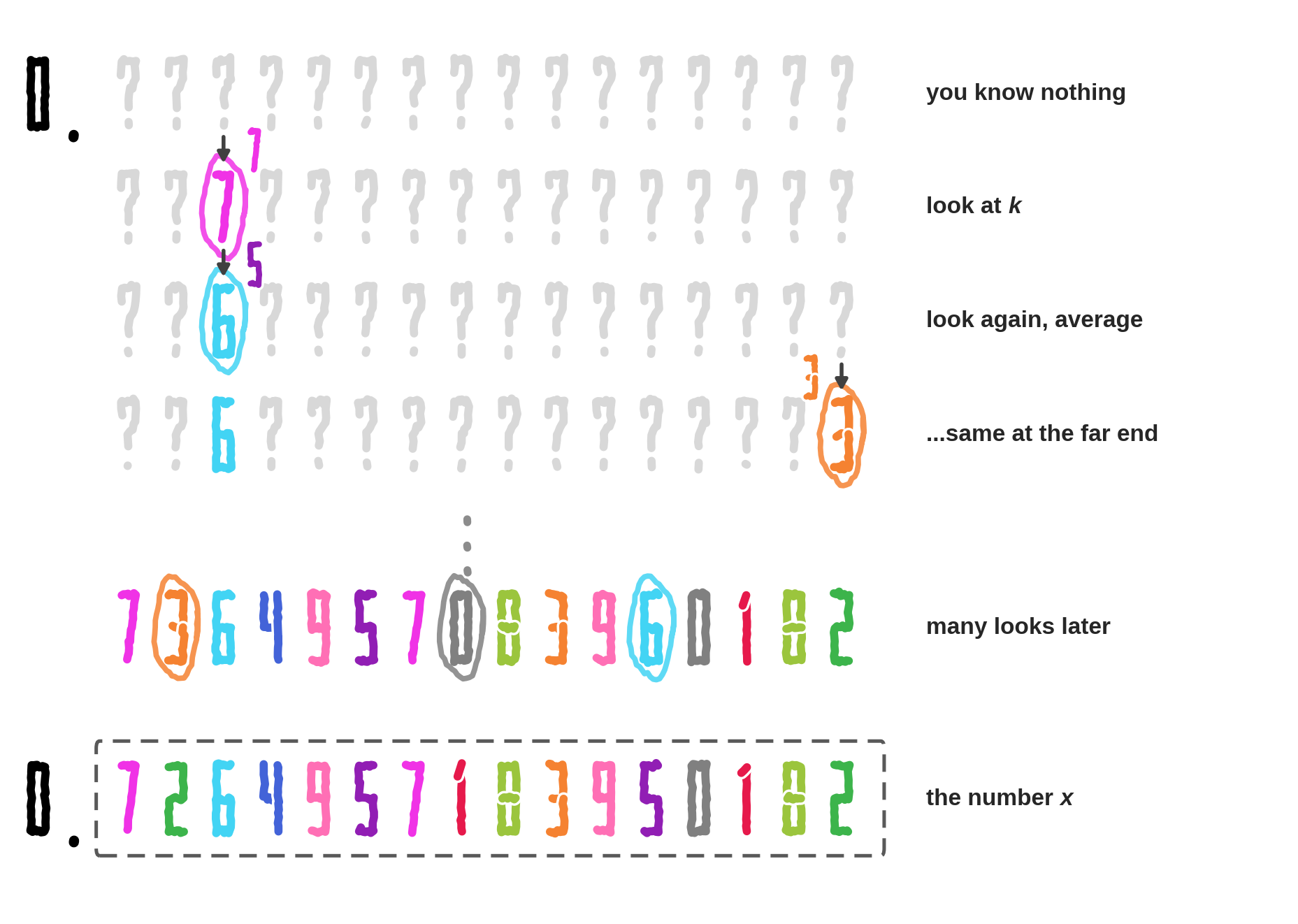
You might intuit how best to play this game: a mistake at digit k contributes at most 10−k to your error. So being wrong at digit 3 costs up to 1013 times4 more than being wrong at digit 16, and if digit 3 is still unresolved then work on digit 16 literally does not matter. The right thing to do is therefore boring: spend looks on position 1 until it stops moving, then position 2, then 3, allocating roughly in proportion to weight (which works out to a tidy little triangle of effort). Call this the gather: work the digits in order of significance, one at a time.

Okay, that’s the setup. What is it for?
If we transpose the gather back into the land of cognitive science we recognise its recommendations as common sense (Violating the gather is the Law of Triviality, or “bikeshedding”).
Don’t worry about the colour of the wedding invitations if you’re not dating anyone yet.
Don’t plan the company ping-pong tournament when the CEO just got ousted.
Don’t turn on the dehumidifier when the ship is sinking.
Don’t worry about stepping on one small snail while not donating even 5% of your income to an effective charity.5
Wait, that last one doesn’t sit quite right; hold that feeling.
At this point you might reasonably object: this is still not much of a game, where is the challenge, where is the surprise? You’d be right if x was just an actual uniform random point in (0,1), then yes, that’s the whole story, you can put the post down.
But there is another way of looking at this! Numbers don’t just fall out of the coconut tree.6 Every x anyone has ever cared about is the output of something: a ratio, a recurrence, a physical law, an economy, a person. The digits of those numbers are the trace of a hidden generator.
Which means uncertainty comes in two flavours. There’s surface uncertainty: given a fixed generator, what’s the next digit? And there’s generator uncertainty: given the digits so far, what’s the generator? The ideal procedure for the second is: consider every program that could have produced what you’ve seen, throw out the ones your next observation rules out, and put more weight on shorter programs. Your best single guess is the shortest program still standing. For any data with compressible structure, reducing generator uncertainty wins by a lot, because one good hypothesis predicts all the remaining digits at once.
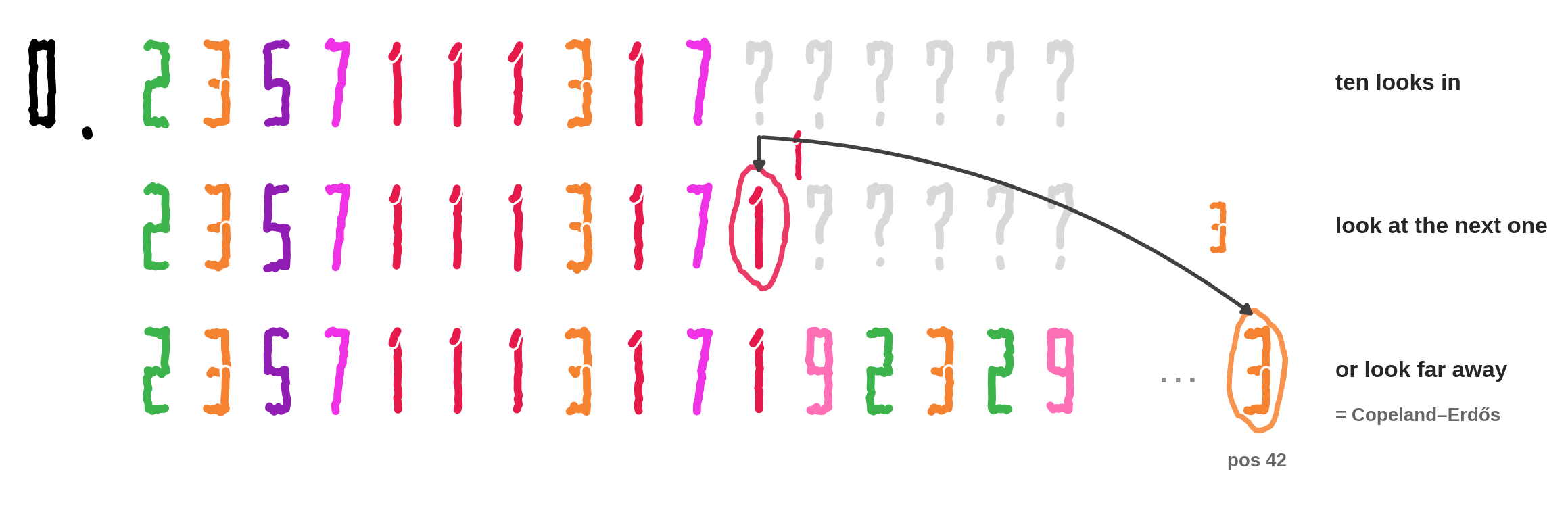
Concrete version: you’re playing the digit game and your first ten looks come back 2, 3, 5, 7, 1, 1, 1, 3, 1, 7. Instead of naively gathering the next digit (1), you might notice a pattern: the first four digits are the first four primes and the next six are 11, 13, 17 glued together. And that produces one very promising candidate for the generator of this number: the Copeland–Erdős constant.
With a candidate generator in hand, the question is what else could have produced these ten digits. Under any prior that’s exponential in description length, the probability that I’m fooled (i.e. some non-CE generator matched everything I’ve seen) is a sum of 2−K(g) over complexities K of impostors g. But the sum of exponentials is roughly entirely just its largest term. So “what’s the chance I’m wrong” collapses to “how short is the shortest impostor.” This is the same large-deviations move I belabored once before: the rate function is the least-surprising path to the bad event, and here “least surprising” means “shortest program.”7
Which suggests how to proceed: make the shortest surviving impostor longer. Pick a position the adversary couldn’t have anticipated (say, 42) and look8. If it comes back 3 (which is the second digit of 83, which is prime!), every impostor that didn’t predict 3 at 42 is dead, and the survivors had to spend description-length on a position they had no business knowing about. One look at a digit worth 10−42 in the gather buys you a few nats of rate function, and a few nats of rate function buys you orders of magnitude of confidence.9
Call this the adversarial hunt: you have a candidate generator and you’re trying to kill its imposters. The low-order digit is valuable because you chose it freely.
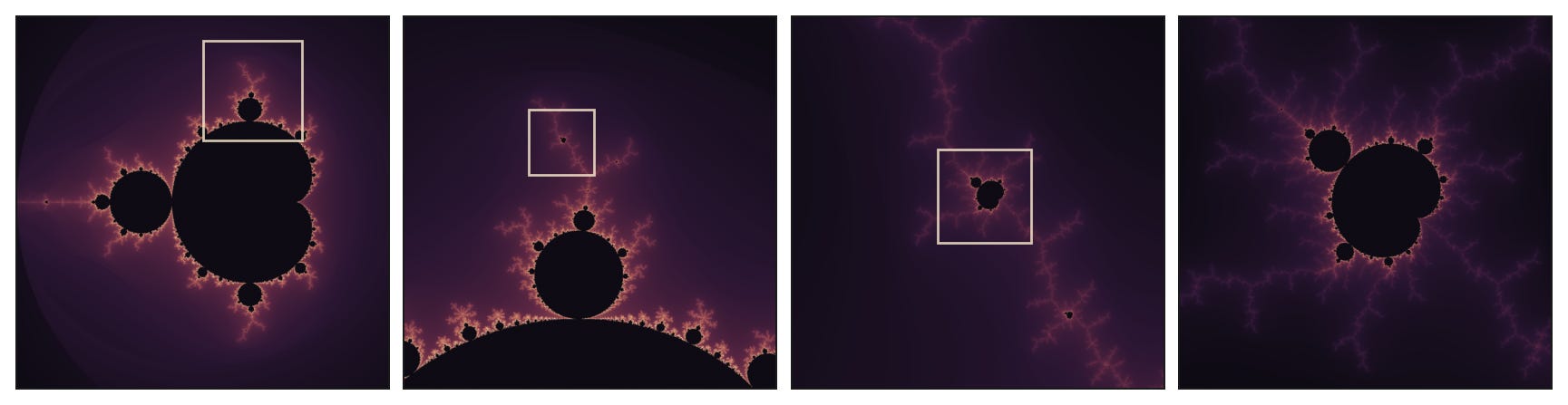
Change of pace: Nassim Taleb has argued across several books that fractal structure is the rule rather than the exception for consequential phenomena: wealth distributions, war casualties, market returns, disease prevalence, technological change. In The Black Swan, chapter 16:
A mountain is somewhat similar to a stone: it has an affinity with a stone, a family resemblance, but it is not identical. [...] As with the mountain and the stone, the distribution of wealth above 1 billion is not exactly the same as that below 1 billion, but the two distributions have “affinity”.
Consider, then, the generalised digit game: instead of identifying decimal numbers x, we are tasked with identifying any phenomenon that spans across scales. Similar to the gather in the simple digit game, we are still drawn to operate at the largest scale of the phenomenon to have the largest impact. But when the small and the large share an (approximate) generator, local observations carry information about the structure of the whole, and some type of hunt might become feasible.
The positive cases are everywhere once you start looking:
Fruit flies tell us about humans because the mechanisms involved (Hox gene regulation, synaptic plasticity, cell cycle control) are evolutionarily conserved, so one organism’s trace lets you infer laws that hold across organisms.
Cavendish’s tabletop apparatus told us the shape of the universe because gravitation is position-invariant: measuring it on one table generalises to every table, including the cosmic ones.
Bunsen and Kirchhoff’s lab spectra told us what stars are made of because atomic transitions produce the same signatures everywhere: a flame on a workbench is diagnostic of objects light-years away.
But the generalised digit game can be insidious. Local structure existing is no guarantee for it to also apply globally:
Thalidomide’s clean rodent trials couldn’t tell us it was safe for humans because placental development isn’t evolutionarily conserved the way Hox regulation is: the 1950s mouse results failed catastrophically on the species that actually took the drug.
The Literary Digest’s ten million mail-in ballots couldn’t tell us who would win in 1936 because their sample of telephone subscribers and car registrants wasn’t drawn from the same generator as the electorate: Depression-era America had split into two populations and they were polling the richer one.
Thatcher’s analogy between a balanced household budget and sovereign finance couldn’t tell us about state solvency because a household and a state aren’t outputs of the same generator: running out of pounds means something different when you’re the one who issues them.
In the language of the digit game: sometimes you don’t get to choose the digit, you just happen to observe at small scales because small scales are the only place you can stand. Call that the inductive hunt. It’s softer (no rate function, no adversary, just a bet that the generator is scale-invariant) and depends entirely on whether the scale-invariance assumption holds.
Here I’ll ask your indulgence with some handwaving, because the thing I want to say is bigger than the argument I can currently make for it.
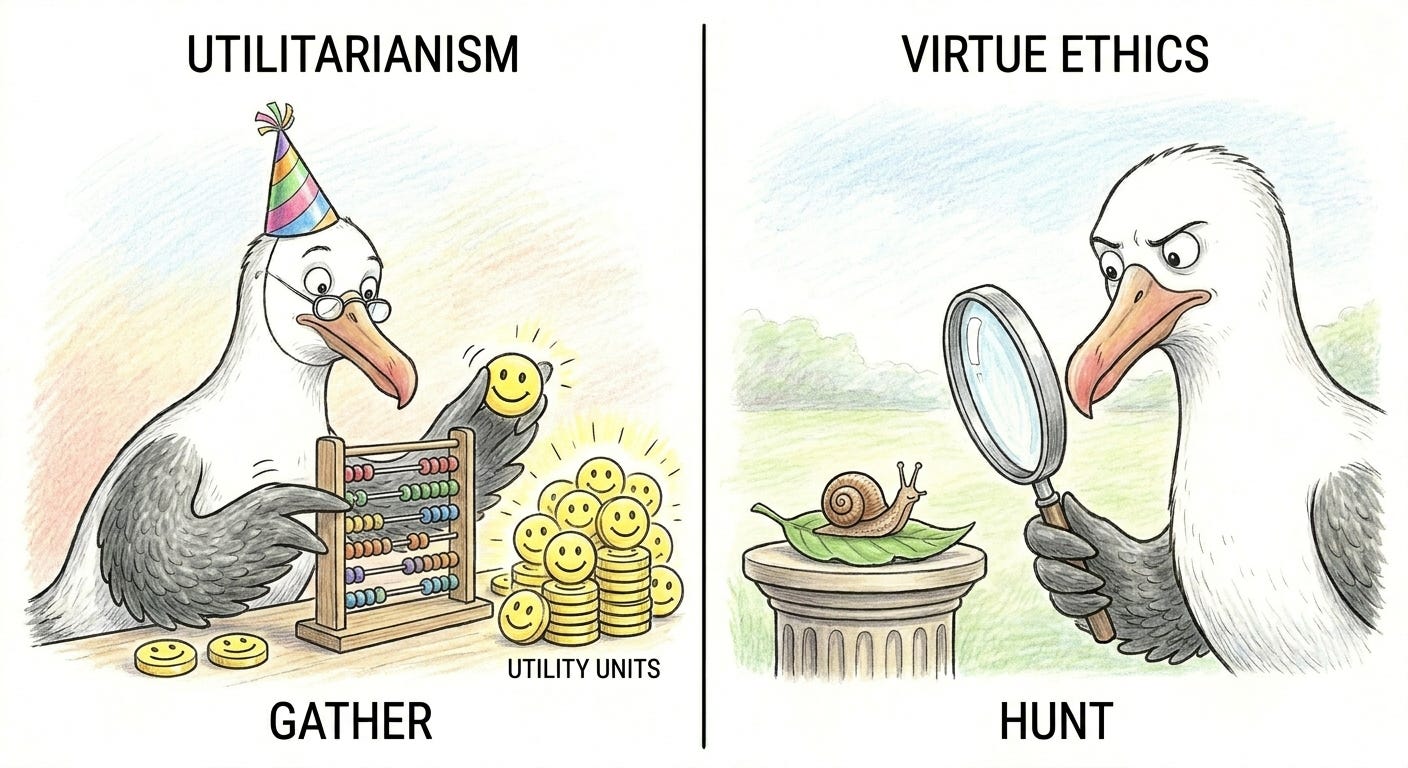
Remember the bullet I asked you to hold onto, the one about the snail and the donation. The others in that list were about tasks, where allocating by weight is obviously correct. That one was about a person, and the arithmetic slid sideways. I think the trick is that when we're judging someone (including ourselves), character is the generator and acts are its trace. Crushing a snail is a digit; not donating is a digit; and under any description-length prior, one generator explaining both is a much shorter story than two unrelated coincidences. That's “how you do anything is how you do everything,” recast as a compressibility claim rather than a vibe.10
I don’t think this resolves the utilitarianism-vs-virtue-ethics standoff — it just gives a nicer metaphor for one side’s oldest move. “Cultivate character because it produces good outcomes across situations you haven’t anticipated” is just indirect consequentialism, the thing utilitarians say when they’re being careful; the virtue ethicist who thinks character is constitutive of the good, not instrumental to it, is unmoved. What the framing does buy is smaller and more useful: “is this a gather or a hunt?” becomes a question I can ask in the moment, without first having to decide which moral theory I hold. Most live disagreements about whether small things matter aren’t disagreements about metaethics; they’re disagreements about whether there’s a generator. And that I can sometimes check.11
I’m fond of the digit game at this point! It’s been through several drafts and I’m still not sure it’s right, but the question it makes me ask (”is this argument-about-details a gather or a hunt? surface uncertainty or generator uncertainty?”) has been more useful than any of the specific claims. The generalised digit game doesn’t tell you which regime you’re in; it tells you to check, and to notice when the answer is different from what you assumed.
Dirksen probably never said it: the Dirksen Center’s archivists searched 12,500 pages of speech notes and came up empty. One caller relayed Dirksen’s own account: a newspaper fella misquoted him once and he thought it sounded so good he never bothered to deny it. The on-the-record version is Reagan’s budget director telling the Atlantic that none of them really understood what was going on with all those numbers.
This is the well-known Weber–Fechner observation applied to thinking rather than perceiving: in order for our brains to handle ten orders of magnitudes, we consider them one-by-one and not all-together.
Ten trillion. If a look at digit 16 is worth one second of your time, the proportionate attention at digit 3 is about 300,000 years, roughly the entire run of Homo sapiens. (I checked that arithmetic twice, which is itself digit-16 work.)
Nobody actually reasons this way! The realistic version is “my work is important, the barista doesn’t register.” Same arithmetic.
Okay, measure-theoretically almost all of them do: pick a real uniformly at random and with probability 1 its digits look statistically indistinguishable from a random string, in every base. But the numbers with short descriptions form a set of measure zero, and they’re exactly the ones you meet in the wild.
Squint and the rate function is Kolmogorov complexity restricted to the bad set: both are “minimum cost over ways the thing could have happened,” with cost measured in nats. The Zillow post has the picture: failure probability exponential in J, adversary’s cost linear in J. Here J = K(shortest impostor), the adversary is the impostor, and the spot-check is you nudging J up. I’m not going to pretend this is a Varadhan-grade theorem; it’s the Laplace-method intuition with a Solomonoff prior bolted on.
This is the same move as Schwartz–Zippel polynomial identity testing and Merkle tree audits: when you can’t separate hypotheses by reasoning, make them commit on unseen data.
I think there might be a phase transition at depth ≈ K(x): above it you’re gathering, below it the generator’s found. For Ω-flavored x that depth is infinite and anyone claiming a pattern is wrong by construction.
The brusque-but-excellent surgeon is the obvious counterexample. Coupling strength matters, not every small-k observation is diagnostic.
This is in the neighborhood of MacIntyre’s After Virtue: his version is that modern moral discourse lost the concept of a telos, and without a shared generator for human life you’re left with interminable disagreement.
No posts
Comments
Nothing yet. Say the first thing.
Sign in to join the conversation.