
Before I start — a confession: I read a piece by Amie McNee this week called “I quit hustle culture and now I do MORE,” and I sat with it for a while over a coffee because she’s so right. I’ve been walking down this journey for ten years. So it’s worth considering what happens to our ambition AFTER you quit hustle culture.
But first, what is hustle culture? It’s our addiction to productivity at the expense of your health, relationships, joy, and basically living. It’s particularly prevalent in the U.S. but also in the Western World. If you want a good video on it, here’s one.
Here’s what I expected would happen when I finally stopped hustling:
I’d lose my edge.
I’d fall behind.
I’d turn into one of those people who “found balance” and somehow lost their fire.
Here’s what actually happened:
I got more ambitious than I’d been in twenty years.
I did the best work of my life.
I gave interviews to CNN while dripping ocean water from my body, freshly back from a kiteboarding session.
I spoke at the World Economic Forum and won the People’s Stage award for Wisdom2.0 while feeling more alive.
Let me tell you how I got the whole thing backward for so long.
For years, I thought my ambition was the problem.
I was a CMO. I partly helped build the machine. I created the campaigns that promised you’d finally be enough after the next purchase, the next milestone, the next level. I was damn good at it. And I was running the same script on myself. I lived in the W.I.N. cycle: Work Nonstop. Ignore Everything Else. Never Rest. I called it drive. I wore my exhaustion like a badge of honor.
I built a side hustle while still grinding away at my 9-to-5. I pulled 18-hour days to grow my marketing agency. I stacked up long day after long day, bouncing between doctors and meetings. I even slept with my phone so I wouldn’t miss a tweet from the other side of the world, trying to effectively manage my Australian clients from Lake Tahoe.
So when I finally started to unhustle, I braced myself for the fallout. If ambition got me here, slowing down should cost me, right? That’s what we’re taught. Less hustle means less success. Simple math.
The math was wrong.
The thing nobody tells you: your ambition was never the problem. What was done to it was.
Here’s what mainly drives this:
The Protestant Work Ethic as a Foundation
The Protestant work ethic is at the root of all this. Sociologists like Max Weber called it out as the backbone of modern capitalism. The idea was simple: work hard, earn your salvation. That belief slid right into an economy obsessed with constant profit. Over time, it turned into our default setting. Now, “living to work” feels normal, even though it flips life upside down.

The Legacy of the Industrial Revolution
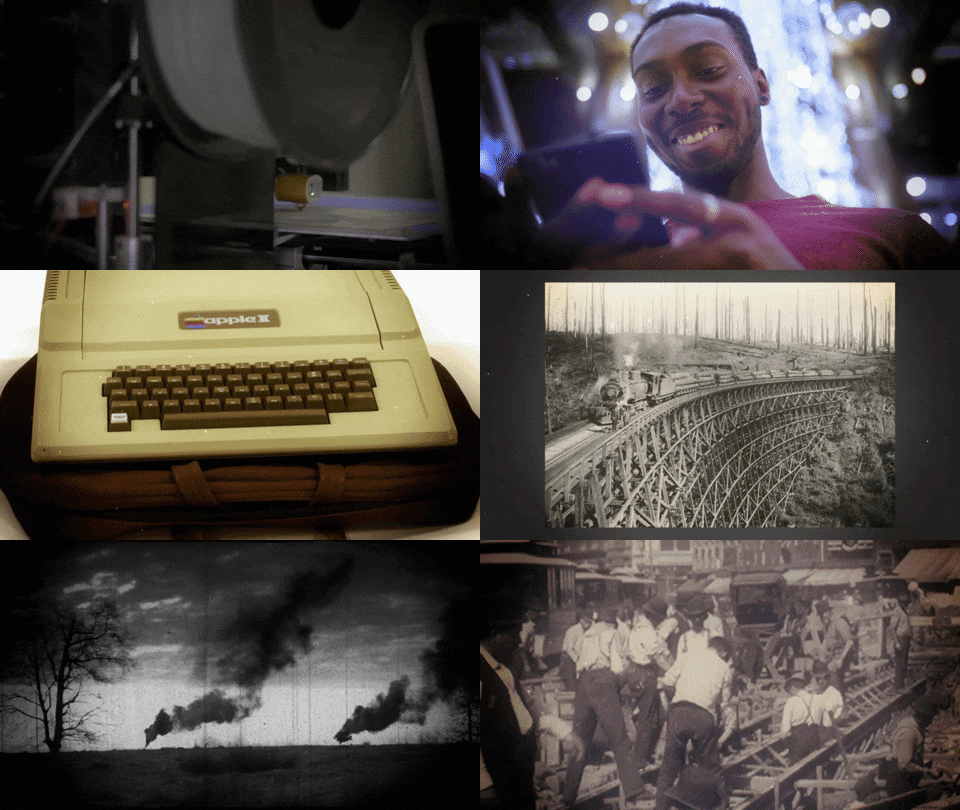
Much of our modern approach to productivity is a vestige of the Industrial Revolution, where businesses adapted practices to ensure consistent speed and output from human “machines.” While these methods were designed for factories, we still impose these rigid methodologies on knowledge work, even when they fail to spark—and often actively stifle—the creativity required for such roles. We are essentially trapped running on a hamster wheel, working longer and harder while mistakenly believing it will lead to genuine fulfillment. I wrote more about this here. Women, in particular, suffer because of the second shift they perform at home after work ends. I wrote about this a while back.
The Internalization of Value
This stuff isn’t just out there in the system. It’s in our heads now. That’s the scariest part? We’ve swallowed these values so deeply that we police ourselves. We feel guilty for resting. We trick ourselves into thinking our worth is tied to our to-do list. We’ve been taught to wear stress and overwork like fancy jewelry, showing off the rat race as if it’s something to be proud of.

A Mechanism for Avoidance
Our obsession with doing isn’t just about work. It’s emotional. We fill our days with busyness and distraction so we don’t have to stop, rest, or face what’s really going on inside. Haste is everywhere because most of us are running from ourselves.

This is a kind of mental slavery. The system needs us to believe these lies about productivity to keep going. Breaking free takes a conscious, sometimes radical, act of rebellion. It means putting your health, your relationships, and real rest above worshipping work.
The urge to build, create, strive, improve—that’s not something capitalism invented. It’s human. Hustle culture didn’t give you that drive. It hijacked it. It took something natural and twisted it into one thing: productivity that lines someone else’s pockets.
Here’s how you know the difference. Captured ambition always feels like not enough. No matter what you do, the hole just gets bigger. That’s not an accident. If you feel almost-enough, you keep buying, keep grinding, keep performing. Satisfied people are terrible for business.
Real ambition feels different. It doesn’t come from a hole. It comes from a well.
When I stopped performing for worth and started following what I actually wanted, I found a well I didn’t even know was there.
I talked to over 300 high performers who stepped off the default path. Not one of them lost their ambition. They just moved it—from the system’s scoreboard to their own. They still wanted a big life. They just stopped letting someone else decide what “big” means.
One of the people I spoke with is Anne-Laure Le Cunff. She worked at Google. After a health scare, she quit her job to become a neuroscientist. She started sharing everything she learned in what she called Ness Labs, which grew to a strong community for entrepreneurs. She wrote a book. Her ambition is alive and well. The terms are different.
At first, I thought unhustling meant wanting less. Turns out, it actually meant wanting what’s truer. The wanting got honest.
When I stopped hustling, I found a whole reservoir of energy I never had before. I wrote a book. I built the Unhustle movement. I got on stages. Not to prove anything. Just because I finally wanted to.
This is the part that sounds like a scam, so let me get ahead of it.
I know how this sounds: quit hustling, and you’ll hustle harder! Another productivity hack pretending to be freedom. Give your hammock an ROI.
That’s not it. I’m not telling you to rest just so you can crank out more work. The second you rest to perform better, rest turns into hustle lying down. The point is, you aren’t for sale while the Default world would do anything to convince you otherwise.
When I stopped abandoning myself to succeed, success stopped costing me the things that made it worth having in the first place.
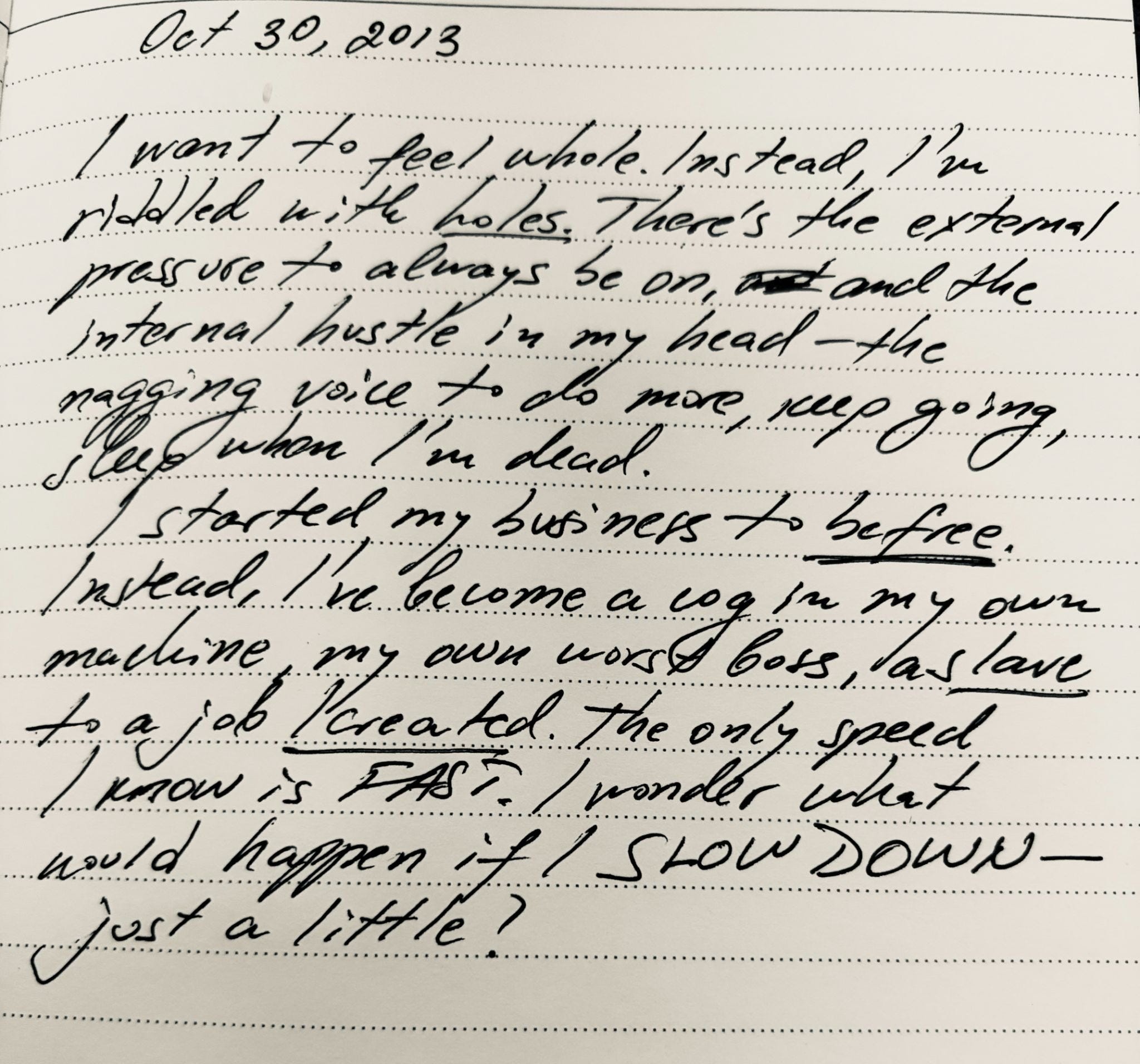
Back in 2013, I wrote in my journal in a dimly lit room in a hotel after Madonna’s health club opening:
“I want to feel whole. Instead, I’m riddled with holes. There’s the external pressure to always be on, and the internal hustle in my head—the nagging voice to do more, keep going, sleep when I’m dead. I started my business to be free. Instead I’ve become a cog in my own machine, my own worst boss, a slave to a job I created. The only speed I know is fast. I wonder what would happen if I slowed down—just a little?”
After years of walking on the unhustle journey, let me tell you: you absolutely can slow down. And your ambition actually wants you to. But most of all, because you’re human.
I still don’t fully understand why it worked. I only know that it did and that I’m not going back.
Unhustle is not anti-ambition. It’s anti-self-abandonment.
Your ambition was always yours. They just tricked you into renting it back to them, hour by hour.
Take it back.
Milena
P.S. Start by asking yourself how rich your life really is. Try the life wealth assessment and see where you stand.
Comments
Nothing yet. Say the first thing.
Sign in to join the conversation.