
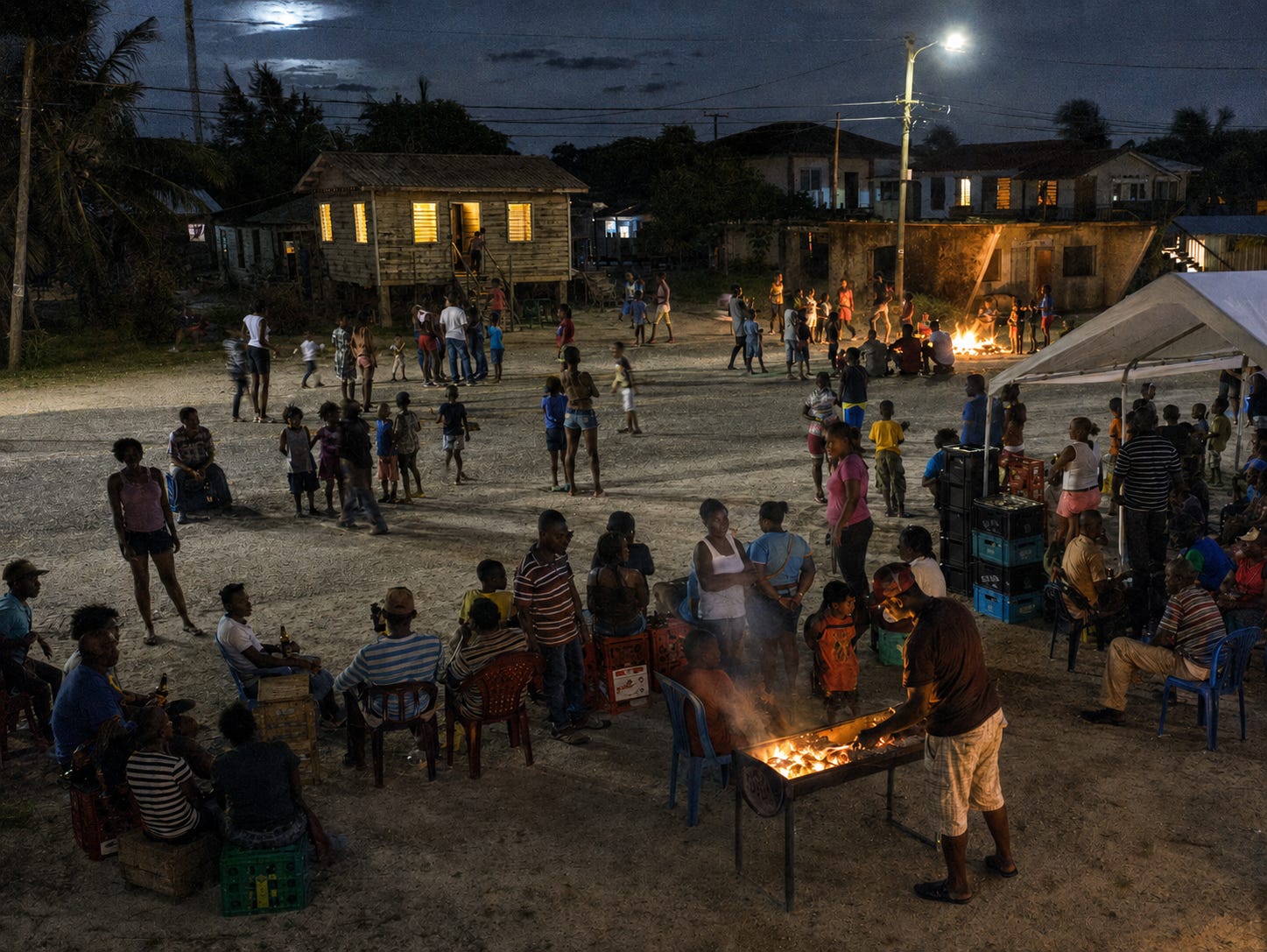
Drive south down Placencia Road, and you pass through Seine Bight, a small Garinagu fishing village turned local multicultural community. By Canadian standards, you’d call it a shanty town: Plywood shacks with no siding, Frankenstein additions built for utility, not looks, and small buildings propped up on leaning stilts.
When I first moved to Belize, I wasn’t sure what to make of Seine Bight. My comfy Canadian life trained me to stay away from places that look like it. I was told they were unsafe, and that I’d be likely to get robbed, or worse, in such places. But after 4 years living just up the road—the little community in which I live is actually a part of Seine Bight—my preconceived notions of what a place “is” at first glance have been completely rearranged in my head.
At night, the streets fill with people. Local people linger out in front of their homes, and along the roadside—or straight up in the road. Kids, adults, and elders, all together, enjoying the reprieve from the daytime heat. Different races and ethnic groups commingling. Multiple languages in play. Everyone laughing, drinking, and playing music—and of course, soccer. The whole community comes out in force. Not to celebrate anything in particular; just to be a part of the community. Some have AC, and many others have TV, so there are plenty of reasons to stay inside, but they don’t.
Yet, foreigners, with my previous perspective, typically stay away.
The locals congregate outside, in stark contrast to my Canadian upbringing. While I spent a lot of time outside growing up, it was almost exclusively during the day; nighttime outings were reserved for holiday fireworks or other planned events. For the most part, being outside at night, especially as a teen, pissed off your neighbours, and brought the cops around. After that, you were legally obligated to go inside.
I have a vivid memory of my next-door neighbor, with whom my family had a good relationship, calling the cops on me because my friends and I were “playing in the road” one summer night. He told my parents on me too, and they gave me hell for it. It didn’t matter that practically no one came down our street past 8 pm and that we were all Canadian boys used to yelling “car!” while playing street hockey during the day. Yet, it was somehow “dangerous” and taboo to be curbside at night; just enjoying the cool night air.
This is not the way in Seine Bight.
Ms. K, the woman who looks after our kids during the summer, just celebrated the one-year anniversary of her babysitting business. We were among her first customers, so our kids attended the celebration.
She’s become a steadfast fixture of the community, providing affordable childcare for families in Placencia Village—even to gringos like us. She lives in a roughly 300-square-foot plywood building with her 3-year-old daughter, which doubles as her daycare location. It has a bedroom, a small AC that only runs at night, a bathroom with a shower, and a small kitchen that doubles as a playroom, with lots of toys for the kids.
We pay her modest weekly invoices at the bank because she’s saving money to realize her plans to open an off-site daycare, so she can serve her community in an even bigger way. When you talk to her, you’ll hear someone with dreams and aspirations who is also content with what she has. She lives in a community full of friends and relatives, and everyone trusts her with their kids.
Ms. K is truly loving and doesn’t judge, discriminate, or carry any expectations of the families she helps. And the community supports her for it. 68 of the children she cares for in some capacity—day and night—turned out for her party. Our kids were the only white ones, I might add. While I have never been one to racially discriminate, I can admit that it’s taken me a long time to break the habit of recognizing when we are the only white family at the events she throws. Nevertheless, I’m grateful for the opportunity she’s afforded me to experience that. She’s also providing my boys the opportunity to grow up in a truly integrated interracial community that doesn’t seem to keep tabs on skin colour. While Canada is diverse—a point it boasts about—living in Belize has made me realize how much segregation is actually baked into that. To iterate on what I mean here, there are lots of Taiwanese/Chinese in Belize, but no “Chinatown” exists anywhere in the country.
Community was one of the things that was missing in our lives when we moved abroad. After COVID, Canada didn’t feel like it had much of it left. We’d been mandated apart for so long that people just stayed apart. Most of my family, who lived a mere 50 kms away, didn’t visit my firstborn son for almost six months after he nearly died at birth during the pandemic. I have friends who didn’t meet either of my boys before we left—and not for a lack of trying on our part.
Then we moved to Belize, and found communities that had more or less said no thanks to all of that bullshit. While Placencia had to comply with mask mandates and vaccine passports because it’s a tourism economy, most of the community here mingled freely. And other villages, in more remote areas, simply went about their days as they always had, and everyone around them accepted it.
There’s something to be said for that: the power of a real community.
And this isn’t necessarily a Belize thing; I’ve seen this in my travels too. All through Southeast Asia, places that, at first glance, seemed dangerous or untrustworthy because they were low-income were the places where the sense of community—helping and supporting others—showed up when least expected.
In the winter of 2007, I was riding The Loop, a 450 km motorcycle trek in Laos. One of our group blew a tire late in the day, in the middle of nowhere. Some local villagers came out to fix the flat, which took a long time because someone had to go to a neighboring village to get a part. Night set in and the entire community flooded into the streets. I felt uneasy as I caught glimpses of the mass of people around us, silhouetted in the moonlight. I remember thinking—this was a time before international cell phone plans—that these people could disappear us and no one would ever find our final resting place.
The repair took hours, and the fellows on the tools persevered through a difficult fix. They could have price gouged us—aka Gringo Tax—because we were in dire straits in the middle of backcountry Laos, but they didn’t. They charged what they felt was a reasonable fee of USD 2.00. 1 for the parts and the other for the labour. They gave us water and snacks while we waited, sharing their food, which I don’t doubt they could use, with a small group of foreigners they didn’t know and would most likely never see again.
In the end, I felt like a fool for ever doubting who these people truly were.
Just like in Seine Bight, the community flooded to the streets at night. In this dark, remote, and poor place, the people carried themselves like they had everything they needed. Because they did; they had each other.
I am not romanticizing poverty here. Belize and Laos are developing countries. I can’t speak of the modern economic state of Laos, but Belize is quite poor in places—I see it almost every day—and it’s not quaint or charming in any way. I’ve written before about people living without plumbing or electricity in communities not far off from my relatively affluent one, and none of that is a lifestyle choice anyone necessarily made.
What I am saying is that living in Belize has shown me a stark dichotomy: On one hand, my home country of Canada—like so many other developed nations—is a society organized around siloed individuals or families bolstered by materialism. It’s a culture that has substituted a sense of community for individual luxuries: big houses and expensive cars that leave you feeling as empty as a 5000-square-foot house occupied by two people. On the other hand, my current place of residence, and new home, is mostly none of that. The people I now see around me find ways to be happy that have nothing to do with what they own. And that’s because they have one another. They have a sense of community that fills the void consumerism only deepens.
Being here has given me a glimpse of what a community truly is. And what it could be back home if people there could set aside the expectations and judgments long enough to see their neighbours as folks who want to live in peace and count on those around them.
And, I will admit, there is a big gap between how my family lives and how many of the locals do. And that’s a hard gap to close. It’s a tight one with a long history, and it takes time to integrate and be vetted by the longstanding members. So I can’t call this community “mine.”
Not yet, and that’s fair.
As always, hit me up if you want to chat about the reality of four years on the ground in Belize or just riff on life abroad in general.
No posts
Comments
Nothing yet. Say the first thing.
Sign in to join the conversation.