

Thank you for bearing with me as I have been publishing less due to moving. I should be back to a faster writing pace soon, we are mostly all unpacked and settled in. There were a lot of earnings calls worth mentioning these last two weeks, some good (ACDC & ALTG) and some bad (PTLO).
Macro (skip if not interested):
The big worry overhanging the stock market right now is interest rates. On Friday the 10 year treasury spiked 0.138% percentage points from 4.461% to 4.597%. There are several research analysts who have noted that 4.5% is the threshold where the stock market starts to feel the pressure of interest rates. Others argue that 5.0% is the red line, and we might visit it shortly.
Tom Lee of Fundstrat has been arguing for several weeks that the market will test the new Fed Chair, Kevin Warsh. I didn’t take that warning too seriously at the time, and yet here we are, Tom Lee appears to have been correct.
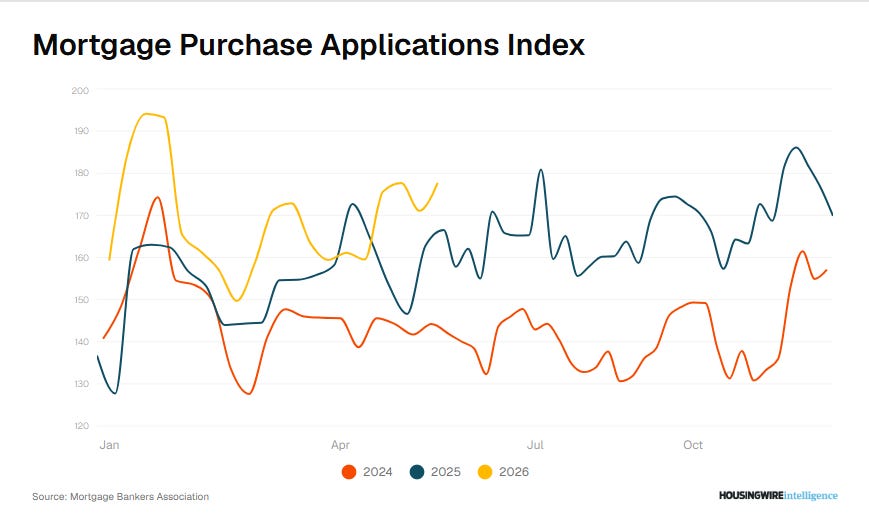
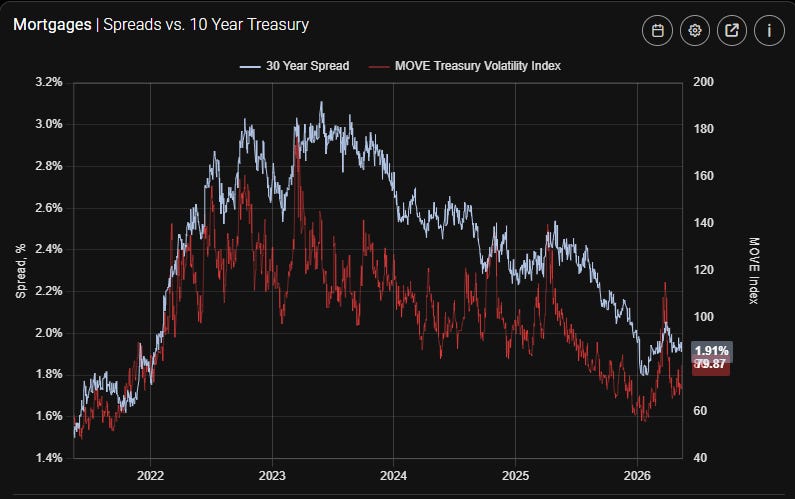
Ever since January, I have been focusing on accumulating shares of mortgage originators. And this current interest rate behavior has led to sharp selloffs in financials broadly and mortgage originators specifically. This has proven me very wrong in the short term, but it remains to be seen if I will stay wrong in the medium to longer term. The mortgage purchase applications index shows a housing market that is slowly thawing due to rising real wages, home prices flat to slightly falling, and some interest rate relief in the form of mortgage spreads narrowing to 1.9% from a 2023 high of 3.1%.
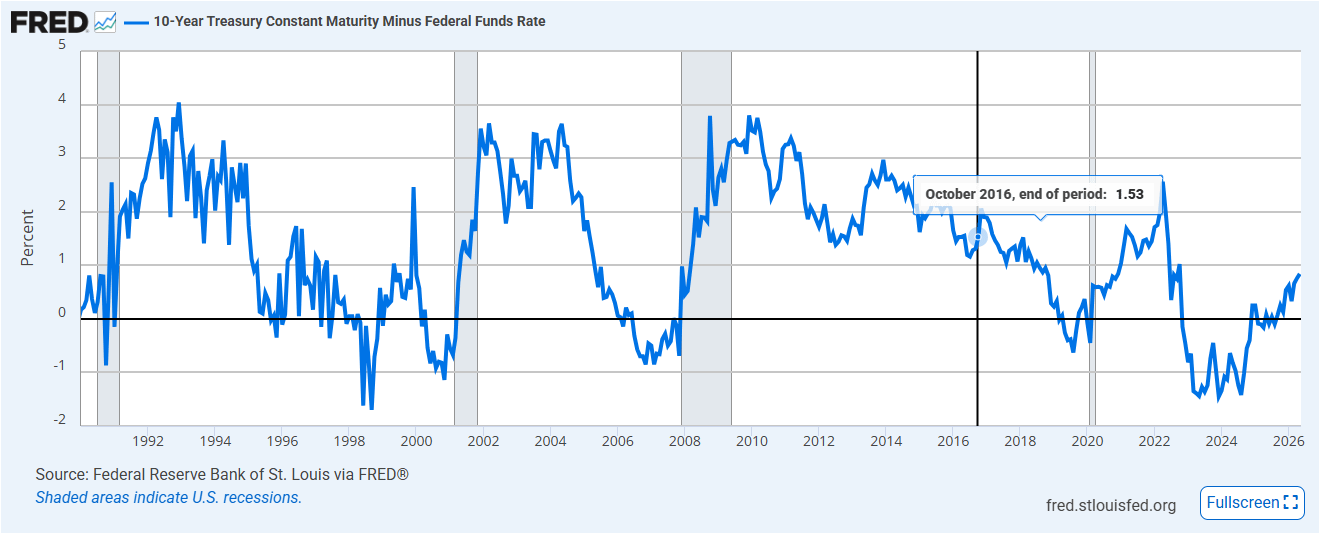
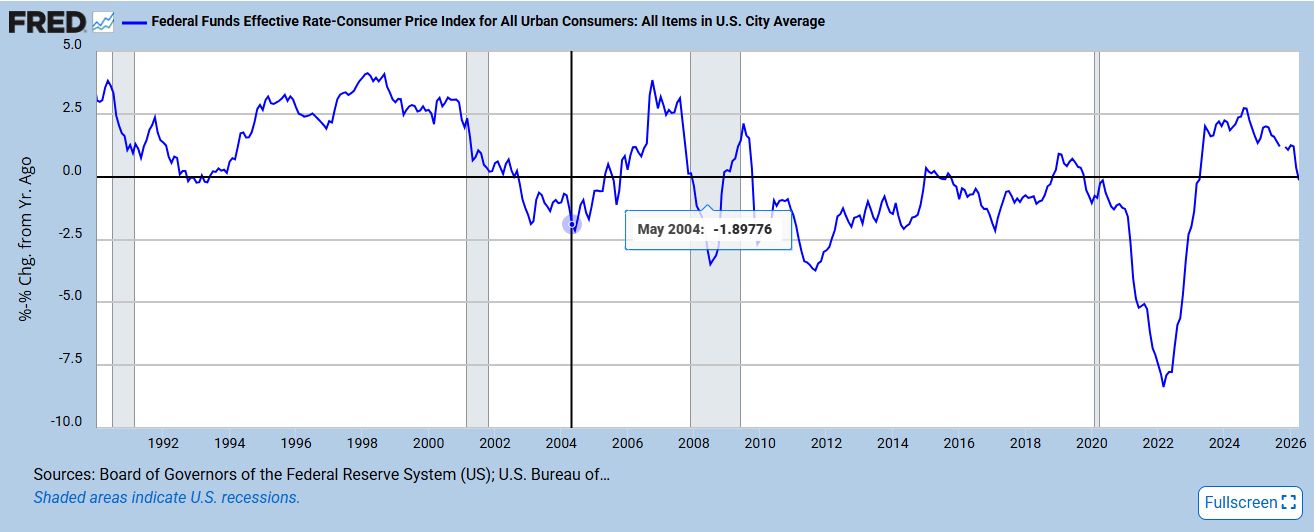
Despite the overwhelming chorus of people who believe that the Federal Reserve will increase interest rates to combat inflation, I still believe that the Fed will attempt to cut. First, unless the Fed is implementing Yield Curve Control, their focus is on the overnight rate, which remains historically high around 3.6%, and the spread between the overnight rate and the 10 year treasury remains historically low around 0.84% versus a longer run average of 1.5% during the Zero Interest Rate Policy (ZIRP) period after the Global Financial Crisis (GFC) or 2.5% before the GFC. If we have really left behind ZIRP, then we should expect spreads to go much higher. Part of that return to normal could be the 10 year treasury going higher, but a lot of it will probably be the overnight rate going lower. Post GFC, it is unusual for the overnight rate to have a positive real return compared to inflation, ignoring all the criticisms with how inflation is measured.
I believe that Fed policy is leaving ZIRP behind, but I don’t believe that Fed policy is leaving negative real overnight yields behind. That is, current policy makers don’t believe that investors should be paid an amount above inflation for money that is invested without duration risk. Based on current inflation measures, that would mean that as of February, there was room to cut the Fed Funds rate by between 1.0% and 1.25%. However, with the oil spike from the Iran War, inflation concerns are rising again. The big question is to what extent will the Fed “look through” the “transitory” Strait of Hormuz effects.
The overnight rate can still be cut if the Iran War resolves after Trump’s visit to China is over, the Fed looks through the temporary effects of the oil price shock, or AI unemployment concerns outweigh inflation concerns. When asked about the prices of fuel and fertilizer on April 21st by Senator Kim in the Senate Banking Committee, Warsh responded “Senator, if my reform agenda, if confirmed, stands for anything, it’s for the central bank, especially the Fed chairman, to stay in its lane.” This implies that for Kevin Warsh, rate cuts are still on the table.
And it does make some sense, there is a difference between prices rising because of an increased money supply, and prices rising due to a supply shock such as a crop failure. Does it make sense for the central bank to increase interest rates and reduce the money supply if the US corn crop failed, for example? At exactly the time when farmers would need to borrow money for the next year’s planting, higher interest rates would dampen the farmers’ replanting efforts to fix the supply shock. Just because Volcker did it in the 1980’s, doesn’t mean it was ever the correct thing to do.
We are about to find out how the Federal Reserve works, does the committee hold the power, or does the Chairman? Warsh wants to cut the overnight rate, and if he holds the power, he will do so immediately. If the committee holds the power, rate cuts might be pushed out until 2027 when we have a better line of sight on oil prices. Historically, the Federal Reserve Bank was originally set up with the appearance of diffused power in order to satisfy congress, but the reality of dictatorial rule. Does the Fed’s dictatorial rule only benefit Democrat presidents? Academic literature from ten years ago found a consistent bias favoring Democrats, more recent academic literature claims a consistent bias favoring Republicans. I think odds are good that the market is wrong about the probability of rate cuts.
There are two reasons why the overnight rate is so impactful at this moment. The first is that large percent of the US government debt has been rotated into short duration treasuries. With 34% of the marketable Federal Debt with a duration less than 1 year, a 1% cut to the overnight rate would save over a $100 billion on the annual deficit. While Trump reduced the deficit for 2025 by $426 billion over 2024, the last four months of 2026 have seen a deficit increase of $13 billion over 2025. I believe it is Trump’s plan to use rate cuts as a way to continue shrinking the deficit. An improving Federal fiscal situation would help relieve market fears about a debt spiral, and therefore long run inflation concerns.
The second reason why the overnight rate is important is because a significant part of the economy is tied to overnight rates. Home Equity loans, dealership floor plan financing, small cap SOFR+ debt, etc. can all respond to cuts to the overnight rate even if the 10 year treasury stays between 4.0% and 5.0% for the next decade. If the overnight rate is cut low enough, home buyers might even start to choose the 5/1 Adjustable Rate Mortgage over the 30 year fixed, which could help to unfreeze the housing market. Of course there are risks to the 5/1 ARM, but the frozen housing market has been a drag on the US economy and the US consumer since Jerome Powell’s rate hikes of 2022.
Finally Getting to Opendoor (OPEN) and Beeline Holdings (BLNE):
Besides continued narrowing of mortgage spreads, another way that mortgage rates can come down is by innovation from mortgage originators removing structural costs. About 0.85% of the interest rate of a typical $400,000 30 year mortgage is the cost of originating that mortgage, if it were paid fully upfront in points, it would be about $25,000 on a $400,000 home instead of a 0.85% interest rate difference. About 60% of that amount is the labor costs associated with a traditional mortgage origination, and about 40% is gross profit to the mortgage originator.
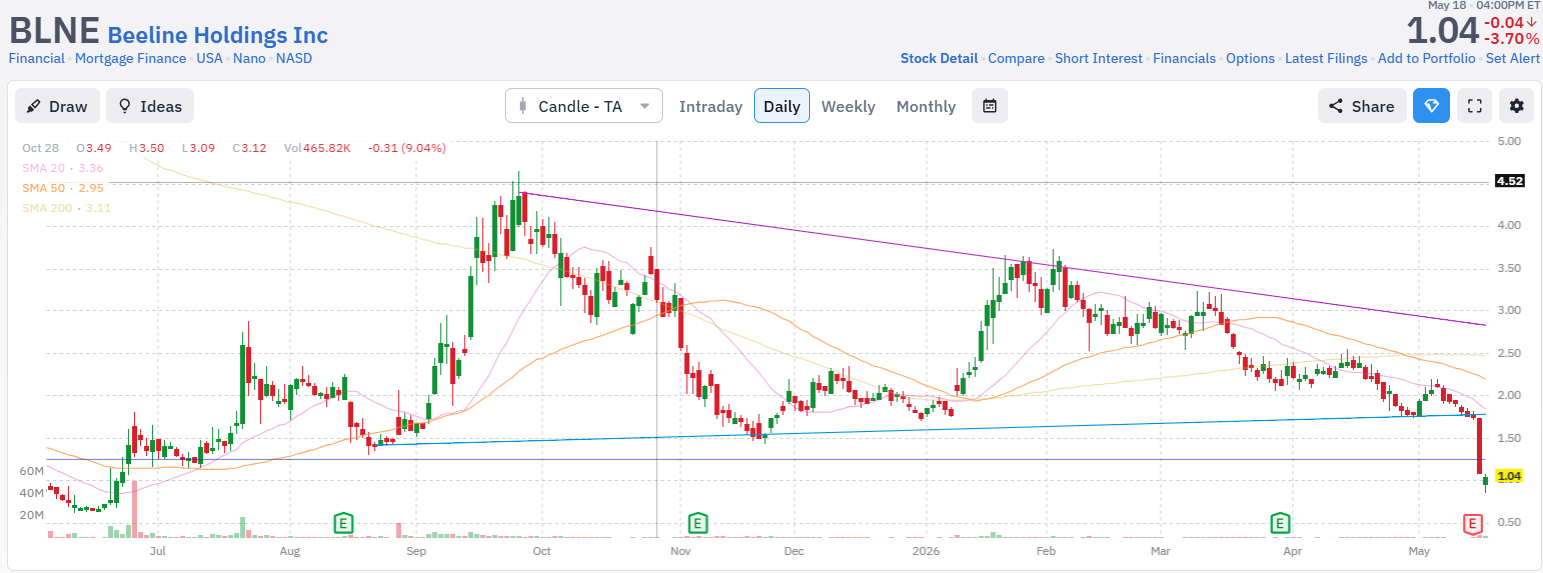
As an online mortgage originator, BLNE was able to beat traditional lenders by 0.25%, which is why we chose them for our new home. The experience was pleasant and efficient, but still required a lot more human intervention than I was expecting. Beeline is still somewhat earlier in their AI cost cutting journey than I had anticipated. The stock price was destroyed after the last earnings call, falling from $1.74 to $1.05 as the growth came in slower than investors had anticipated, and the path to profitability is farther away. I believe the primary concern that led to this selloff is the amount of dilution that will take place with operating cash flow at over negative $3 million per quarter. BLNE does have some borrowing capacity, but investors don’t seem to believe that growth will outpace expenses in the short term. Management is guiding toward a 10x of revenue within seven quarters, but with 7% quarter over quarter growth, it seems the market doesn’t believe management.
OPEN, in their mortgage pilot program in Colorado was able to undercut mortgage rates by the full 0.85%, with a plan to eventually forgo not only labor costs with AI, but also the gross profit of mortgage origination. By choosing to take only one bite at the apple, OPEN has the strategy of passing the full cost savings directly to the homebuyer. This is a strategy for overwhelming market domination. For existing home buyers, if a traditionally listed home comes with a 5.85% mortgage, and Opendoor home comes with a 5.00% mortgage, then the Opendoor homes will be prioritized by homebuyers in this current market atmosphere with more sellers than buyers.
If someone is buying through Opendoor, they also get some benefits if they choose to sell their old home through Opendoor as well. Again, management is focusing on taking only one bite at the apple and passing savings onto the customer. This significantly simplifies the process of buying a home, as there is no need to go under contingency and risk the home sale falling apart while waiting to sign the closing paperwork on buying the new home. Very few buyers can qualify for two mortgages simultaneously and sell their old home at their own pace. By tying up both ends of the process, OPEN is able to create a reinforcing feedback loop that mirrors what Uber has in the taxi market, creating a winner-take-most outcome. Unlike Uber, who had negative cashflow of $30 billion to capture their market, it looks like OPEN will likely take their market with only about $5 billion of negative cash flow.
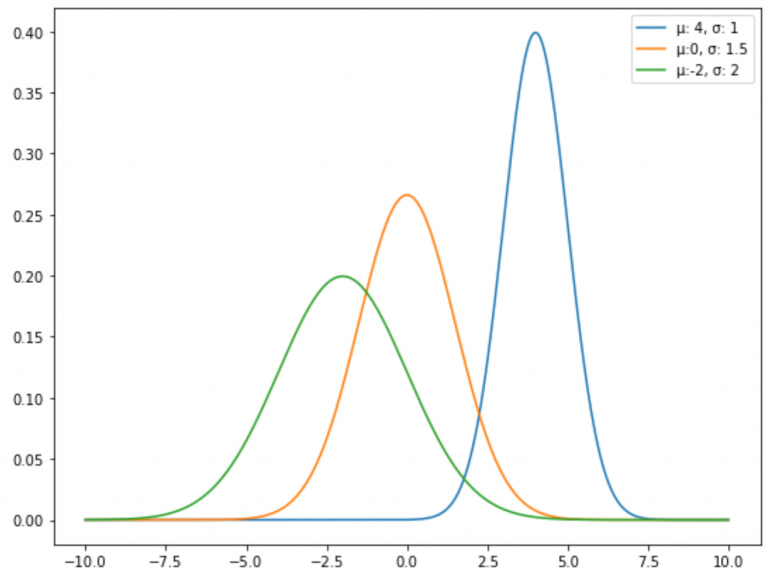
The biggest surprise for me with Opendoor was management’s decision to attempt to pay more for homes. I had detailed in 2024 when I first wrote about OPEN the problem of adverse selection, people with bad homes are more likely to take OPEN’s offer. Opendoor is able to use AI to predict the probability of a lemon, and they are able to offer more for a home that is easier to predict. I did not end up choosing to sell my home through Opendoor, my home is from 1946, and has a high probability of being a lemon. The OPEN offer was 30% below the Zillow estimate. But there is customer feedback that when the probability of being a lemon is low, OPEN is paying somewhere closer to 5% to 10% below the Zestimate. Keep in mind that the sellers agent and buyers agent typically cost around 5% to 5.5%, so an offer 5% below the Zillow quote is absolutely amazing. Visually, this is a classic scenario where as variance decreases, the average can increase, it looks a bit like the chart below:
Most of the improvement that has taken place at OPEN is directly due to this differentiation of how much to pay for homes based on their probability of being a lemon. Since this policy was implemented, the gross profit of different cohorts no longer decays over time, and has remained stable at around a 10% gross margin. Where once, lemons dragged on profitability as they were discovered over time, now, homes that need more repairs are getting lower offers, and homes that need fewer repairs are getting higher offers.
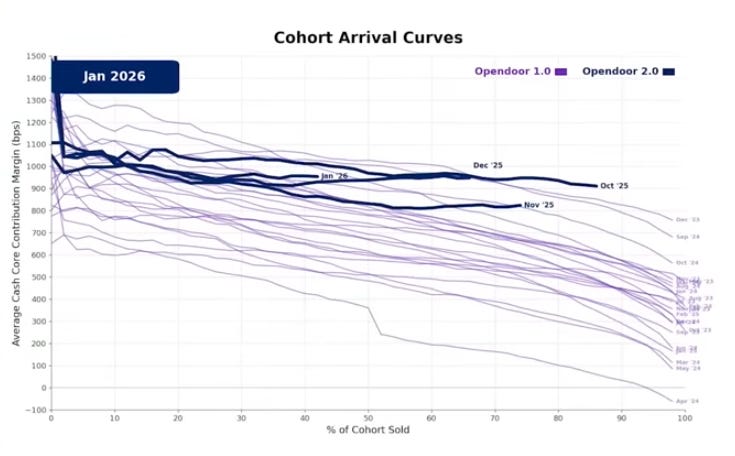
It takes a significant amount of time for each vintage to mature, so even as OPEN improves under the surface, we still have scant evidence, only three cohorts more than 60% sold. The new CEO only started at the end of September last year. But this one change has fundamentally altered the business model, and now it’s only a matter of volumes at scale, and further efficiency gains. With the rollout of national mortgage origination and title services, and probably eventually insurance origination as well, Opendoor is going to aggressively take market share, and after market share, and then transition to increased fee-based revenue streams.
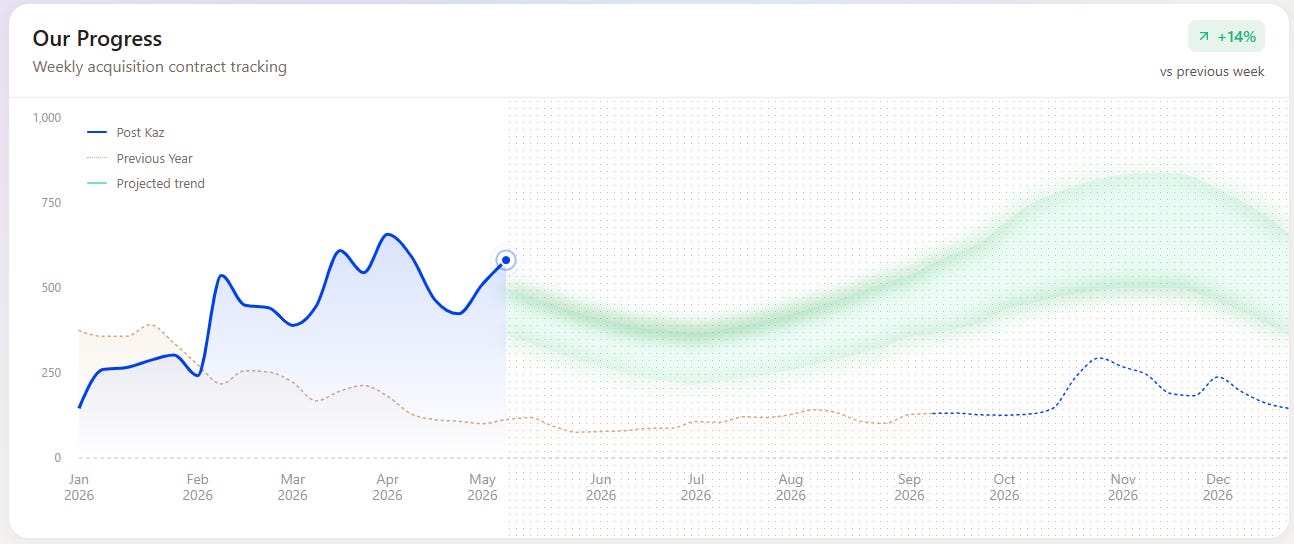
Volumes have been significantly above guidance although guidance has been changing over time. The original idea was to fix systems and cut costs for at least the first six months, and then focus on ramping up volumes through advertising spend. But possibly due to the free advertising that comes from being a meme stock, volumes started increasing well in advance of management’s guidance, or even their plan. With the catalyst of a flip to quarterly positive EBITDA within the next few quarters, there is continued room for the free meme advertising to drive continued volume growth. A GAAP net income profitable Opendoor will be talked about, and again, when mortgages roll out nationwide, being almost a full percentage point below competition will be talked about.
Despite increasing evidence of excellent execution, the stock price has fallen from $10.70 last September to $4.28 today. The disconnect between fundamental improvement and stock price continues to amaze me. While I had previously stated that my OPEN position was full, it was 15% of my portfolio in September, I have room and conviction to start adding more. I don’t have the cash to start adding more, as a handful of puts that I sell for income have been assigned recently, but barring any more assignments, I’ll be back to buying on Monday.
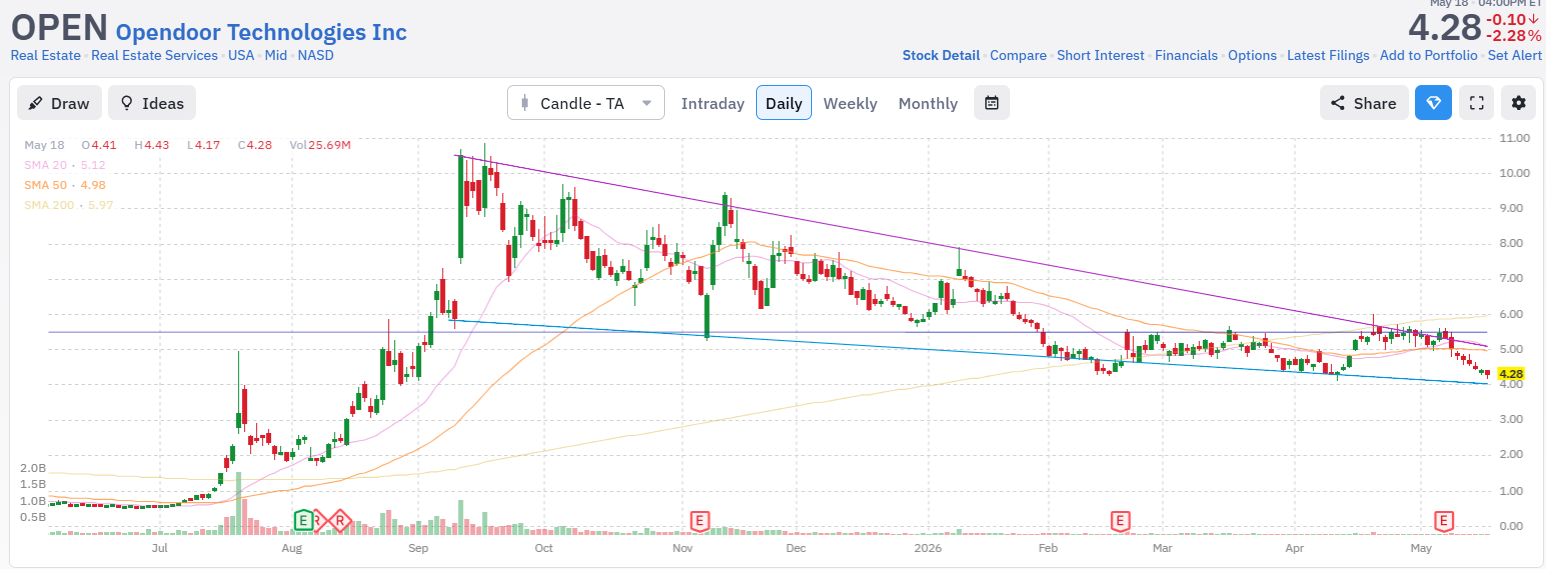
A typical turnaround takes years, and it can be painful to be patient with new management while waiting for evidence of improving fundamentals, especially with macro and sector headwinds. But an innovative management team swims upstream against the headwinds, and this is exactly what OPEN has been doing. There are a lot of great companies that are looking through the cycle, or navigating the cycle, but there are precious few innovating, improving, and growing through the cycle. So many tech companies stay private until they use the public markets for exit liquidity, it is truly rare to have access to a management team of this quality in such a small company.
Over the next few quarters, as we see the rollout of an AI driven nationwide mortgage underwriting program, I believe the results will be shocking. Already, the percentage of homes on the market for more than 120 days has fallen from 51% to 10%. Also, financial results from the last two quarters have been marred with liquidating old inventory, so gross profit has been significantly below 10% for the last two quarters. In the next six to nine months we should be transitioning to seeing financial metrics where all houses sold were acquired under the new pricing scheme, and we should see positive GAAP EBITDA if not positive Net Income.
I don’t know how long it will take for the market to wake up to Opendoor, but I like adding to positions that deliver fundamental improvements despite headwinds, have a clear path to profitability, and where management is doing all the right things. Price targets on Opendoor have become controversial, but it does have a distinct possibility of becoming the network that overlays the US housing market first, and then expanding internationally. It sounds absurd to claim that OPEN could grow from a $4 billion market capitalization to $200 billion, or even a $1 trillion market capitalization, over the next ten to fifteen years, but here we are. Of course management has large stock based performance plans, but I also expect at some point free cash flow to be funneled into share buybacks. In the short term, 3x price to sales is very reasonable when OPEN flips to positive EBITDA, that would be a share price close to $13 within the next nine months.
No posts
Comments
Nothing yet. Say the first thing.
Sign in to join the conversation.