
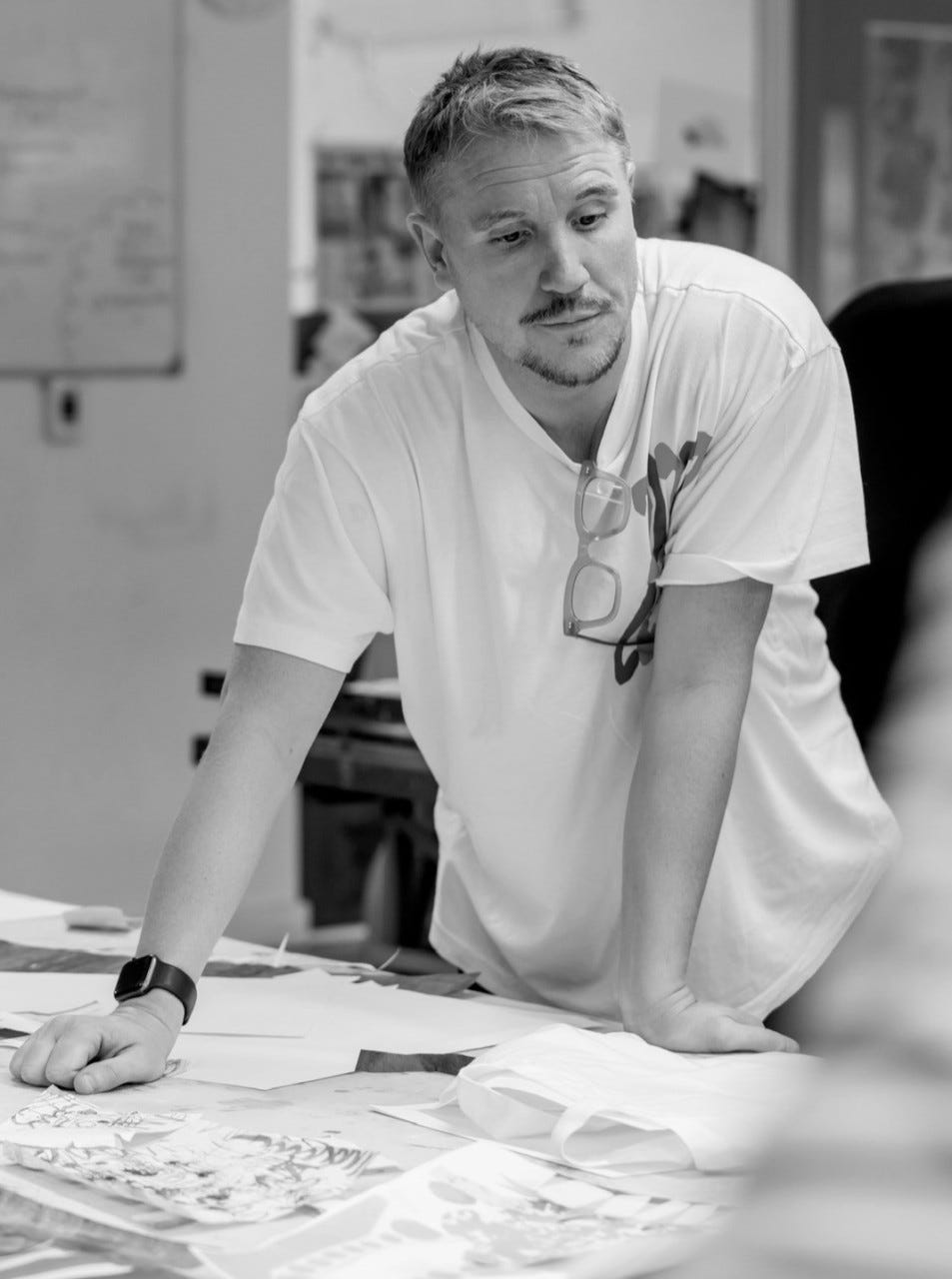
When the graphic artist and director Jimmy Turrell gives a talk, he shows a video of someone using AI image tools to make “Jimmy Turrell style” visuals.
It’s especially ironic, given that his work leans so heavily on hand-made techniques like collage, drawing and screen printing.
Yet he seems more intrigued than angry, and has clearly thought deeply about what makes his work special. It’s why clients from Nike to The New Yorker, Getty to Glastonbury, and Penguin to The Prodigy have commissioned him to create covers, music videos, on-stage visuals, brand collabs and more.
In our conversation we covered:
Why AI can’t understand culture
The importance of finding inspiration everywhere
The pressure for creatives to get on camera
I think it’s, what part of the creative process should you hand over to AI? Your ideas? The editing? The final judgment?
I had this young designer come in recently to show their portfolio. The brief was to mix part of the services industry with a fashion label, and they’d chosen Gucci and the London Underground.
I asked about the research and the story behind the two brands, and they said, “Well I Googled them and put them into Midjourney.” There were no sketchbooks or anything, and that’s where AI is a problem for me.
If you’re just pumping a couple of prompts into Midjourney or ChatGPT, then you’ve only got a surface level understanding of what you’re trying to do.
Listen, I’ve seen some amazing AI work out there. But AI is terrible at understanding culture. It knows what things look like, but it rarely knows why they matter.
If I was giving advice to students, I would say learn AI. But learn typography, learn storytelling, learn how to think. The AI bit will get easier every year, but I don’t believe the thinking part will.
It’s actually made me more experimental within my own work because it’s given us a lot more time in terms of the organisation of my practice.
Even things like working out my fitness plan, so I’ve got more time to come in and create on the studio floor. Before I felt like I was spinning a million different plates and I was trying to jam in that flow period. Now it’s time blocking things for me, and it’s freed me up to create.
I’ve just done a massive fashion project, and last week they suddenly asked me to design the boxes too. I’ve never done product design – I’m awful at anything to do with grids, or things folding out, or whatever.
And then I was like, this is maybe where I can use AI. Not for the image, which I created as a hand collage and then screen printed. But how do I design it around the box? How do I physically make this thing happen?
I wanted to learn a new skill and I think AI can give you a little view into a world that you haven’t been into before.
There definitely should be concerns. I think what you’re going to get over the next five years are much smaller teams, much faster iteration. More curation and art direction.
But people are hunting for the humanity in things. And so for me, it’s actually made us double down on the things that I’m known for. I’m still completely addicted to making things with my hands, whether that’s screen printing, collage, drawing. And AI can’t replace the tactile, visceral feeling of that.
I’ve invested in better studio kit, to film me working. But I haven’t really dived into that world of video – talking to the camera and that sort of thing.
I like to be a bit of an enigma and I like the work to have a bit of mystique. I don’t want it to be explained too much. But it’s a conundrum, and I think it’s something we’ve all got to deal with.
It’s already happened to be honest.
In terms of editorial, I get a lot less than I used to, maybe one job a month. I get a lot more fashion jobs, more advertising jobs, and more music jobs, especially record design, because of the rebirth of vinyl.
But I think I’m happier. I’ve worked for pretty much everyone in terms of editorial design, but you get to a stage where you think, how many more Trump illustrations can I do?
Whereas now you get a big fashion brand asking for my take on, say, Berlin in the 1970s. That’s so much more interesting.
And I’m doing more artist residences, physically going to places and making work there. I just came back from a month in Bulgaria where I did a residency in this place called L44.
We were getting up at 5 in the morning and going to these mental gypsy markets where there was all incredible ephemera – beautiful 1960s kids magazines and Soviet-era drawings. AI can’t get a handle on that sort of stuff.
I Googled myself (laughs). I did a vanity search and this guy in São Paulo had my name tagged in the metadata of his YouTube videos.
He was pumping these images out and it was very strange seeing them. There was an uncanny valley thing where there are definitely elements of my creative decisions in there, but some things were a bit off.
Both. I’m very interested in getting two disparate worlds and slamming them together.
For instance, I was in Sweden looking around with my wife, and I found a load of old sewing manuals in a skip. I took them and whizzed them back to England.
And then I’m in WH Smith’s looking at the new Wired magazine and it’s got pictures of a new stealth bomber that’s not out until 2028. You clash those together, and you get this very strange world that’s never existed before because one’s from the future, and the other one’s from the past.
I can’t imagine ever asking AI to do that.
When I got those manuals, I did a deep dive into why sewing’s important to the Swedish economy. I looked into what makes this new bomber so different. So there’s this knowledge base the guy in São Paulo isn’t getting.
I think it is different, but nothing’s created in a vacuum. We’re all influenced by designers before.
It’s about trying to find your own voice within that. And AI has definitely made it more difficult to find your own voice. Pinterest has become lots of AI versions of the other stuff that’s already on Pinterest. It’s really fucking weird.
I think designers are worrying about the wrong thing in a way. Everybody’s asking whether AI will replace designers, but I’d rather ask what makes you impossible to replace?
Your taste, your references, your personality. Your ability to connect ideas that don’t obviously belong together. Those things become more valuable.
It’s Paul Smith’s old adage – inspiration is in everything.
I remember a few years ago, you’d get these magazines with cover stories about the coolest shapes this month, or the best gradients.
It was so microscopically looking into the industry, and that led to designers copying each other, based on what was cool and hip at that moment in time, rather than using everything that’s out there.
Exactly! AI has actually made me more ambitious to find stuff like that.
I was looking at movie posters online the other day, and you can really tell which ones are real and which ones are made with AI. You can feel the soul in the real ones.
It’s weird that the humanity shines through, even if it’s just a few pixels on a screen. AI can generate something that looks pretty good instantly. But has it got soul?
There’s the odd one that sneaks through. You’re like, “Wow, that’s really shit hot.” And then you find out it’s AI and you realise you’ve been duped.
Yeah I like that. And I’m sure AI will get better at design.
But what still excites me about this job is walking into my studio and I’ve got thousands of books, found objects, ephemera, and paint all over the place. That physical mess, that craziness – AI can’t replace that.
If AI can do your VAT return, and you’ve got more time to fuck about, then your stuff’s going to get better.
No posts
Comments
Nothing yet. Say the first thing.
Sign in to join the conversation.