
Not investment advice: First, read my full disclaimer here.
What are some characteristics of a perfect business?
Early stages of industry disruption
Great pricing power (I hope they use it!)
IP Protected
Demonstrated unit economics
Visible backlog
Scaling production that is leading to huge increases in royalty income
Optionality for expansion into adjacent markets with the same product
Unsurprisingly, these characteristics rarely come cheap. However, they can still present mis-pricings when the growth potential is so strong, the market is not fully valuing what the long-term picture is likely to look like.
I believe this is one such case.
It is a company that I plan on holding for at least the next five years as they pivot from development to production to scale (current stage) to cash printing machine (my hope).
While the share price is likely to stay volatile in the near-term as they are beta to certain end industries they serve, I think there are a couple things the market is missing: 1) long-term growth potential 2) the true earnings potential of their current install base as utilization scales 3) ability to re-price at a level more consistent with the amount of value they’re bringing to the ecosystem 4) using the system to assay other minerals outside of gold longer-term. By the end of this article, it is my intent to make my perspective on these key aspects clear.
Bring along your coffee can. I’m going to recommend you don’t touch these shares for a long time.
Note: I’ve tried to update some of the material numbers to be current as of 8/5/26 (the date I made this free). Please double check all information.
Management check: I’ve only shared emails with CEO, Dirk Treasure. I’ve talked to a couple analysts and investors about Paragon Advanced Labs (PALS.V).
First, thank you to Ian Cassel for writing a article on MicroCap Club on Paragon Advanced Labs (PALS.V) that uses Chrysos’ technology in their service. If you aren’t already, definitely become a member (note: no referral, it’s just a great service).
Chrysos is one of the most compelling technology-driven growth stories I’ve come across . A company with a technological monopoly, a rapidly scaling annuity revenue model, limited competition, partnerships with the four largest assay laboratories, engagement with 70% of the top 20 gold miners, and a product that is superior to the 100-year-old fire assay method it replaces. Currently at ~5% market penetration, they have a long runway ahead.
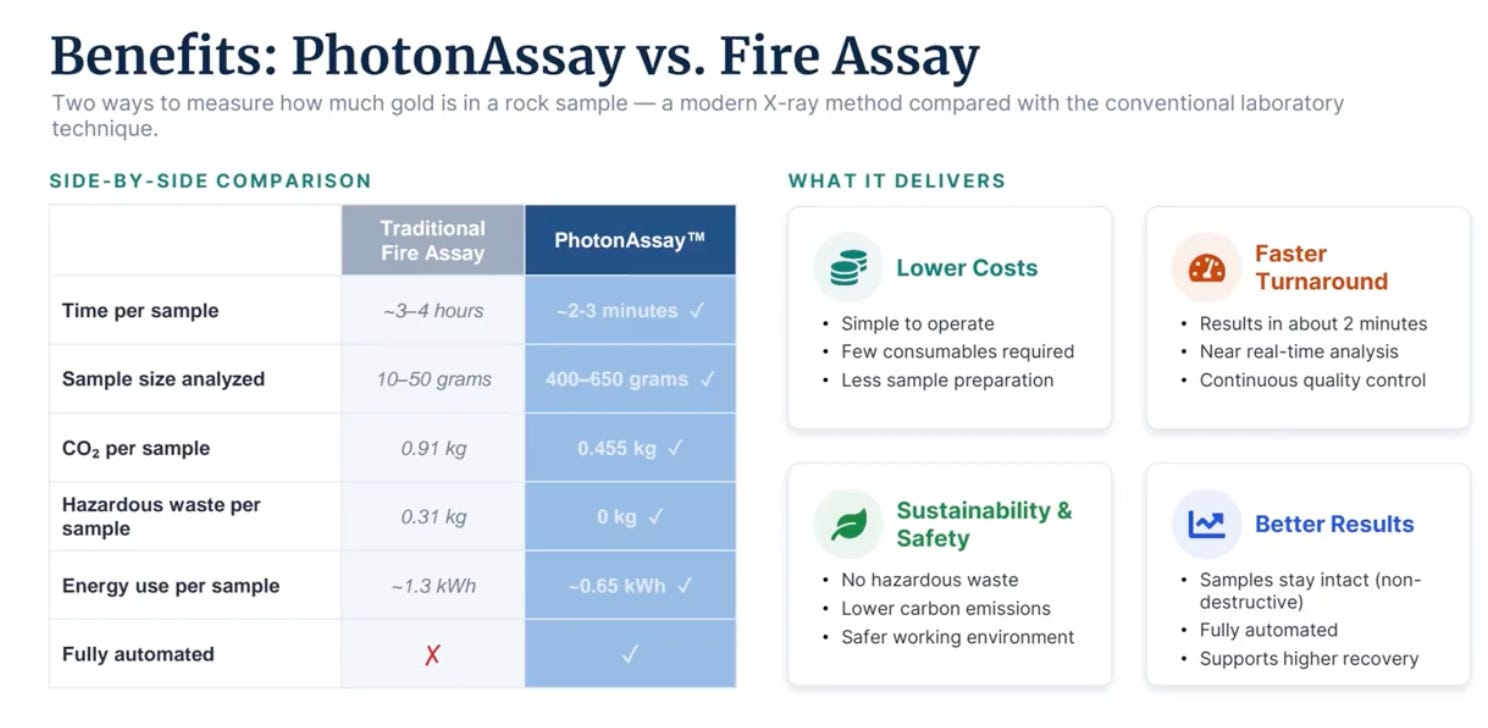
Chrysos has built PhotonAssay - a technology spun out of Australia’s national science agency (CSIRO) - that analyzes gold, silver, and copper content in drill core and mining samples using high-energy X-rays. It does in two minutes what fire assay does in four hours, on a sample 20x larger, without destroying the sample, without chemicals, and with 97%+ correlation to fire assay results. The company doesn’t sell the machines, it leases them under long-term contracts with minimum monthly payments, retaining ownership. Think of it as “assaying-as-a-service.” As utilization rises above the contracted minimums, incremental revenue flows at near-100% margins through Additional Assay Charges (AAC). In H1 FY2026, AAC represented 27% of total revenue, up from 11% just twelve months prior.
Every gold miner and exploration company needs to assay to test the gold content of their drill core, reverse circulation chips, and process samples. This is how they know what’s in the ground and whether it’s worth extracting. For over a century, the standard method has been fire assay: a labor-intensive, chemical-heavy, destructive process that takes a 30-50 gram sub-sample, dissolves it in molten lead and flux, and returns results in 4-24 hours. It works. It’s also slow, wasteful, environmentally problematic, and statistically limited by its tiny sample size.
Meanwhile, PhotonAssay uses high-energy X-rays from a linear accelerator to activate gold atoms within a 500-1,000 gram sample, causing them to emit a unique energy signature that is measured. The result: a non-destructive, chemical-free analysis in approximately two minutes, on a sample 20-30x larger than fire assay. The larger sample size alone is differentiated in that it dramatically reduces the “nugget effect” that plagues traditional assaying, where a tiny sub-sample can wildly misrepresent the true grade of the ore body.
Here’s what matters to customers:
Better product at equivalent price: PhotonAssay delivers faster, safer, more accurate results and Chrysos prices it to be competitive with fire assay. This brings with it far better unit economics to labs and miners alike. CEO Dirk Treasure has been explicit about this: the labs need to make at least the same profit margin as they do on fire assay, otherwise they have no incentive to convert. Chrysos is deliberately not maximizing short-term profitability, it is building for market share in the gold assaying market.
Non-discretionary spend: Miners don’t choose whether to assay. They have to. This is embedded in the mining workflow between drilling and processing. Therefore, with end market commodity prices up 2-3x over the past five years, they in the midst of an incredibly strong cycle.
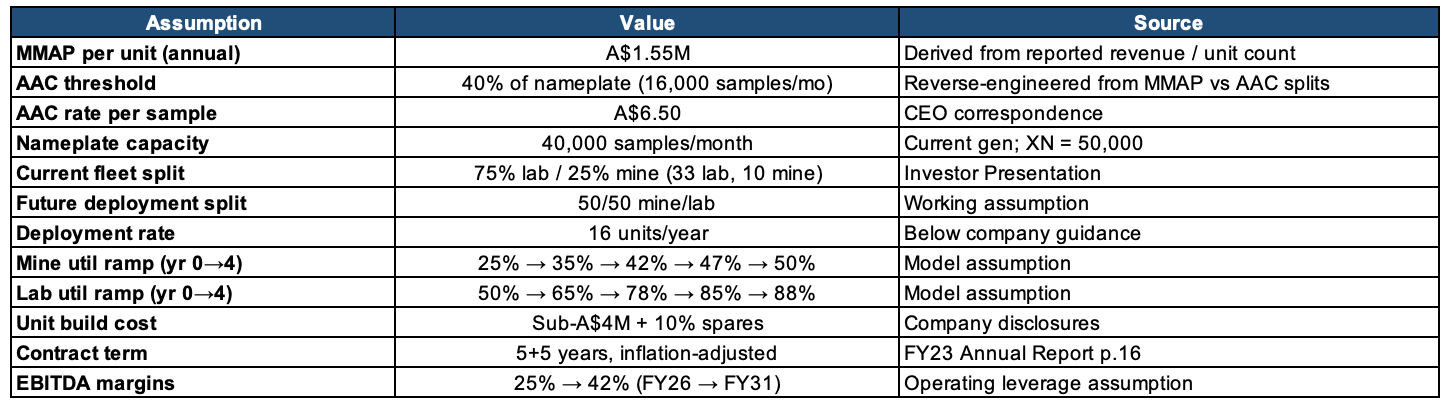
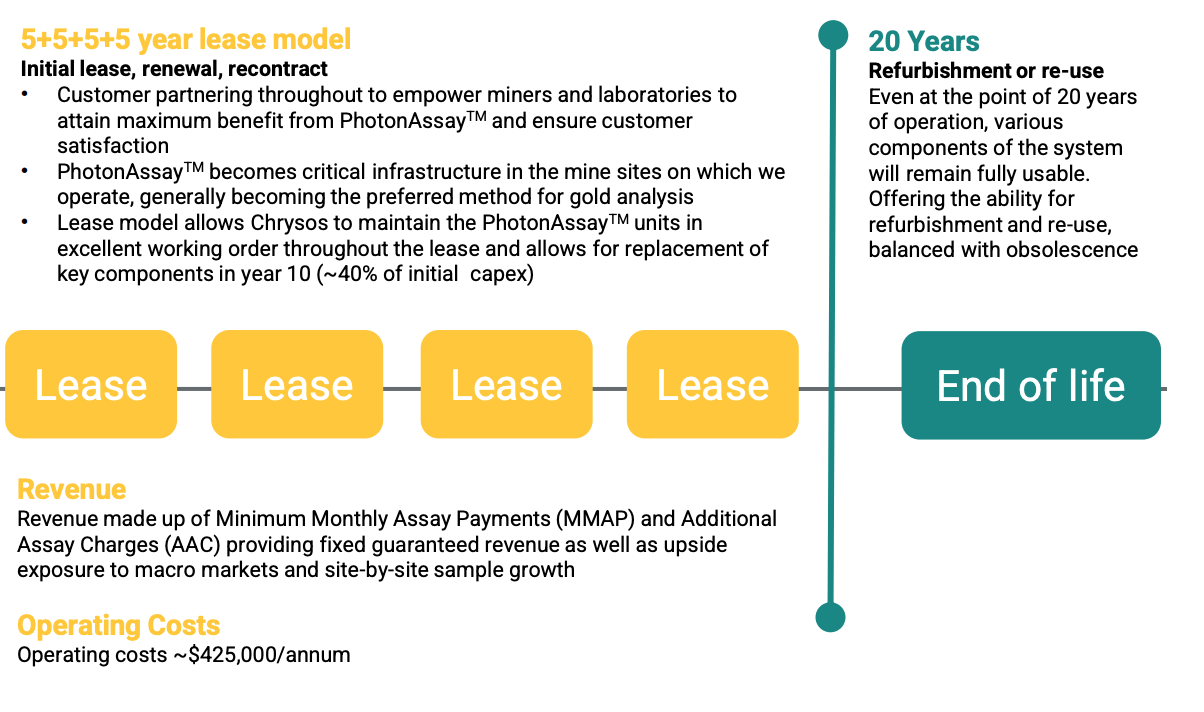
Annuity model with upside: Each PhotonAssay unit is leased under a long-term contract with Minimum Monthly Assay Payments (MMAP) of approximately A$1.55 million per year - paid regardless of usage. When sample volumes exceed the contracted minimum, Additional Assay Charges (AAC) kick in at roughly A$6-7 per incremental sample. The MMAP is the floor. The AAC is where the economics get exciting. Expect this to be especially relevant for lab installed devices, since their operators are naturally incentivized to utilize the machines as much as possible to flatter their bottom lines.
These form the basis of the following calculations. There are a lot of variables to get right and any investor should form their own perspective on these before making an investment decision.
Chrysos released its H1 FY2026 results on February 18, 2026, covering the six months to December 31, 2025. The numbers tell a clear story of accelerating operational leverage:
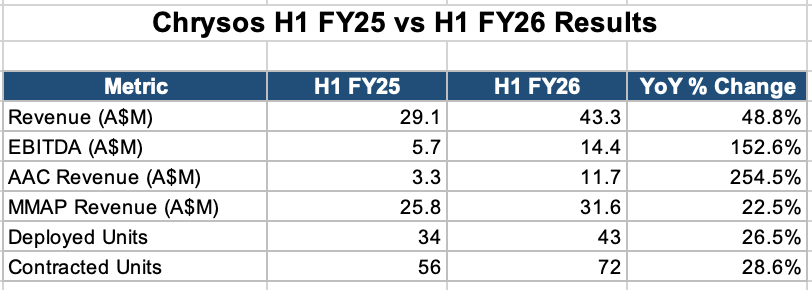
Additional Assay Charges grew 255% in a single half, from A$3.3 million to A$11.7 million, and now represent over a quarter of all revenue. This is the most important line item in the Chrysos P&L. It tells you that sample volumes are surging above contracted minimums across the fleet, and every incremental AAC dollar drops at gross margins approaching 100% because the equipment is already deployed and the fixed costs are already covered.
In January 2026, Chrysos processed approximately 950,000 samples in a single month (~55% utilization at nameplate), approaching the 1 million per month milestone. For context, the company processed 6.7 million samples in all of FY2025. The run-rate has effectively doubled.
CEO Dirk Treasure described it as a “very strong half” with “continued global conversion of miners to PhotonAssay, record sample volumes, accelerating utilization across our fleet, and meaningful operating leverage emerging in the business.”
FY2026 Full-Year Guidance: Revenue of A$80-90 million and EBITDA of A$20-27 million. Given that H1 already delivered A$43.3M in revenue and A$14.4M in EBITDA, the company appears to be sandbagging. Management has been deliberately conservative on guidance due to FX volatility (a 7.5% swing in AUD/USD meaningfully impacts reported revenue), which I view as a positive signal on the underlying business trajectory. (next report is Aug. 11th, so we’ll know more shortly)
The Chrysos investment thesis rests on two engines of growth running simultaneously: (1) deploying more PhotonAssay units into the field, and (2) increasing utilization of the existing fleet. Both are working. Let me walk through how the economics compound.
Each PhotonAssay unit costs sub-A$4 million to build, plus approximately 10% additional in spares, call it A$4.4 million all-in. Annual maintenance and servicing costs approximately A$440,000. Against that, each unit generates a minimum of ~A$1.55 million per year in MMAP revenue.
At MMAP alone, the payback period is roughly three years. But the economics improve dramatically with utilization, because AAC revenue flows at near-100% incremental margins.
The nameplate capacity of each current-generation unit is 40,000 samples per month. Labs can and do exceed this, Chrysos has noted that hub laboratories can operate above nameplate capacity during upturns. The new XN generation unit, just deployed to SGS in Perth, has a nameplate capacity of approximately 50,000 samples per month (25% higher), achieved through improved robotic automation that increases throughput to 83-84 jars per hour versus 72 for the current generation (note, if you do the math on 72 samples an hour, you get 1,728 a day x 30 = 51,840 per 30 day month… hence, the ability to run over nameplate). XN rollout will be measured - one unit now, a second in approximately 12 months, then moving to full commercial production 12 months after that. However, it represents a meaningful step-up in unit productivity over the medium term.
Not all units are created equal from a utilization standpoint:
Mine-deployed units operate at the mercy of the mine’s production schedule. During active drilling campaigns, volumes surge. Between campaigns, they can idle. I model mine units reaching 40-50% steady-state utilization over time. This is enough to generate some AAC, but never run flat out. Dirk has communicated: miners are “more stable in their volumes” but won’t reach lab-level utilization.
Laboratory-deployed units (units placed at central assay labs like SGS, PALS, Bureau Veritas, ALS, and Intertek) are different animals. These labs aggregate samples from dozens of mining clients. They run multiple shifts. They have an economic incentive to maximize throughput. I model lab units reaching 75-90% utilization over time, and they should generate significantly more AAC income per unit. This is where there is significant torque: a lab unit at 85% utilization generates nearly A$3.0 million per year, almost double the MMAP floor (using my assumptions).
Getting the lab utilization mix right is the key to accuracy in this model. The four largest lab companies (SGS, Bureau Veritas, ALS, and Intertek) collectively represent over US$50 billion in enterprise value! They are actively partnering with Chrysos to deploy PhotonAssay across their global networks. The incentive alignment is clear: PhotonAssay offers them a better product at equivalent economics to fire assay, with less labor, fewer chemicals, and a superior environmental profile.
Here is my five-year projection based on the following assumptions:
Deployment: 16 units per year (conservative within the 14-18 range that manufacturing capacity supports, and representing a meaningful step-up from the 9-11 units deployed historically). Manufacturing capacity is currently 18 units per year and should be increased over time if management is able to successfully execute. The big risk here is if the backlog dries up.
Here is an exert from my back and forth with the CEO: “Current capacity of 18/year. Reasonably easy to increase that over time when warranted”
Utilization ramp: New units start at 25% (mine) / 50% (lab) in year one and ramp to 50% (mine) / 88% (lab) by year three to four. I do not assume full utilization immediately to reflect a ramp as customers integrate PhotonAssay into their workflows.
Fleet mix: Current mix of 43 deployed units is 75% lab / 25% mine site. Moving forward, I estimate this to be 50% mine / 50% lab (closer to the TAM of 410 mine sites vs. 200 lab sites).
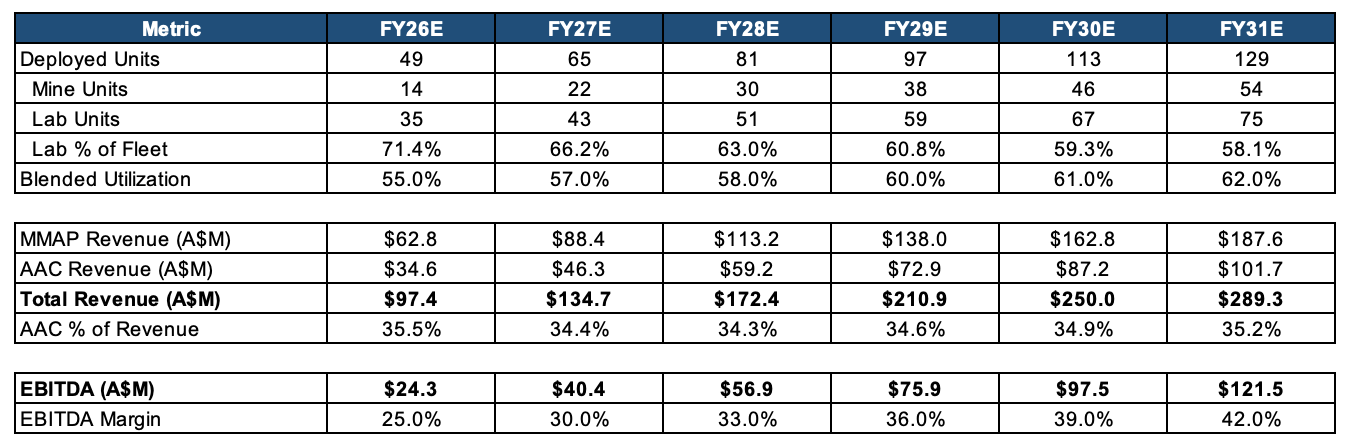
FY26 cross-check: My model outputs A$97.4M in FY26 revenue against management guidance of A$80-90M, which I think they are being overly conservative with.
AAC is the profitability driver: Notice how AAC revenue grows from A$34.6M to A$101.7M over five years, a 3x increase. Because AAC drops at near-100% incremental margin, this is what drives the EBITDA margin expansion from 25% to 42%. This is the operating leverage story, and is a key piece for any prospective investor to pressure test on their own. The big questions? How many machines will be bought and how quickly can they be manufactured? What is the actual useful life of these machines? Is there additional pricing power? Note: When modeling, I did not have machines dropping out.
The utilization ramp: I’m modeling blended utilization reaching 62% by FY31. The current fleet is already approaching 55% utilization (1 million samples/month across 43 units at 40,000 nameplate = 58%). As units continue to mature and lab deployments increase, there is upside to these numbers.
One of my key concerns in any high-growth, capital-intensive business is dilution. Chrysos has addressed this head-on in the last earnings release.
In H1 FY2026, the company had A$21.5 million in cash and access to a A$200 million syndicated debt facility. Total available funding capacity stands at approximately A$177 million. At sub-A$4.4 million per unit all-in, that’s enough to fund roughly 40 additional unit deployments, or 2.5 years of deployment at 16 units per year without accounting for operational cash flow.
116.5 million shares issued, 118.1 million diluted. For a company that has been investing heavily in fleet build-out, the discipline on dilution has been notable.
The critical question is whether operating cash flows will scale fast enough to self-fund deployments beyond the current debt capacity. I believe they will. Here’s why:
Operating cash flow in H1 FY2026 was A$8.8 million versus A$3.6 million in the prior corresponding period. As the fleet matures and utilization rises, EBITDA should track toward A$50M+ by FY28 in my base case. By that point, annual growth capex of A$70M for 16 new units can be substantially funded from a combination of operating cash flow and the remaining debt facility. And as the credit profile improves with rising profitability, the ability to refinance and expand debt facilities grows.
The path to free cash flow positivity will take longer, Chrysos is in the investment phase of its lifecycle and every dollar of EBITDA is being plowed back into fleet expansion. This is the right trade-off. When you have a product with zero credible competition, 5% market penetration, and 76% gross margins on a 20-year asset life, you deploy capital as fast as you responsibly can.
For now, the TTM EBITDA of A$16.1M (FY25) growing toward management’s A$20-27M guidance for FY26, combined with A$177M in available funding, should provide the runway needed to scale the fleet without meaningful dilution.
Chrysos estimates its total addressable market at 610 sites globally - 410 mine-site laboratories and 200 centralized (off-site) commercial laboratories. With 43 units deployed, the company states it has achieved approximately 5% market penetration (note: some sites have multiple units, so deployed units do not map 1:1 to sites penetrated). The runway is enormous.
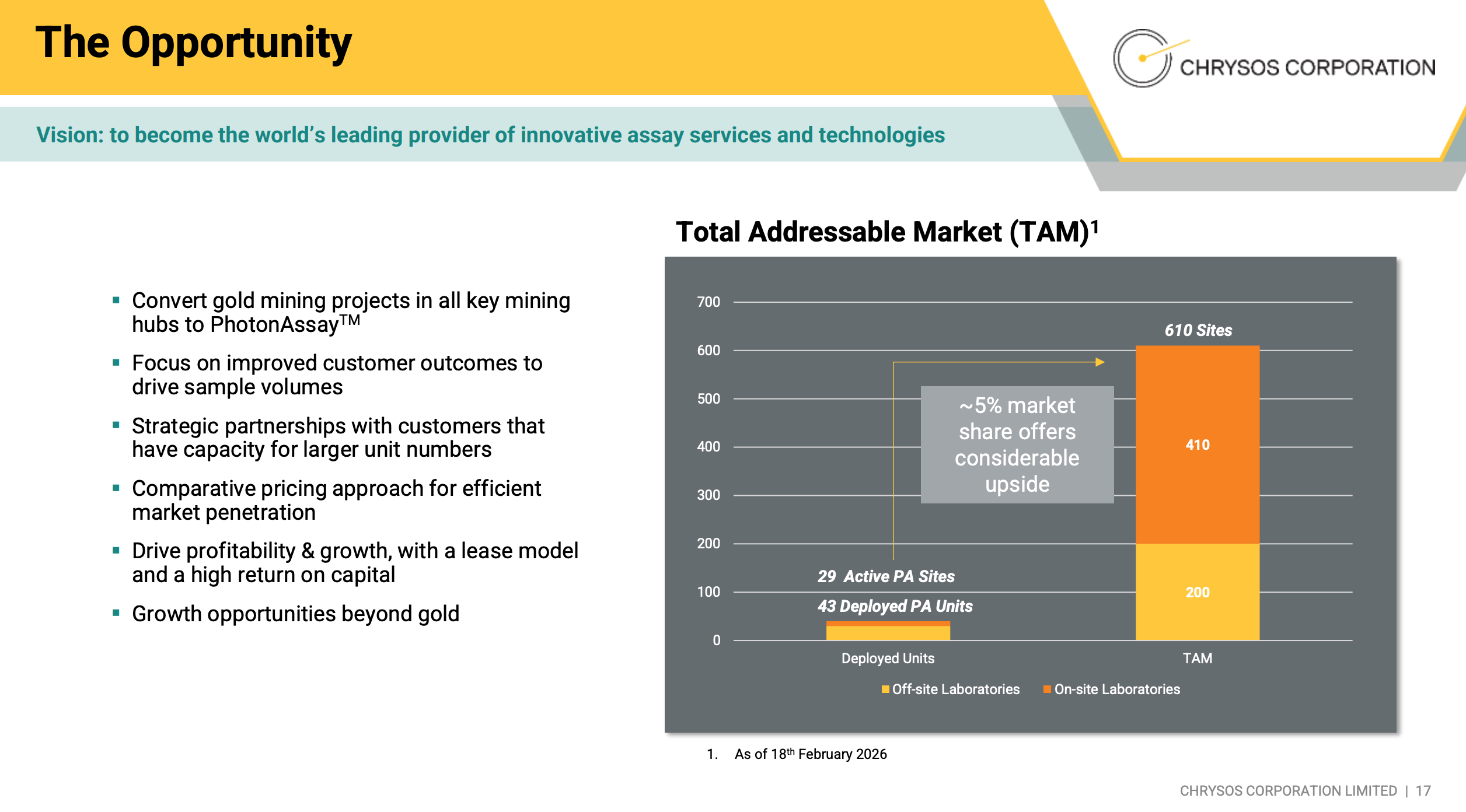
At 50% penetration, you’re looking at roughly 305 units, which at 16 per year would be reached around FY42, roughly 16 years from today. As mentioned, current manufacturing capacity is currently 18 units per year and, per the CEO, is “reasonably easy to increase over time when warranted.” Additional upside if they are able to prove this out.
The flywheel is also working in Chrysos’s favor. The company now has engagement with 70% of the top 20 gold miners and partnerships with the four largest commercial laboratories. In May 2025, Newmont (the world’s largest gold miner) signed a master services agreement and ordered its first unit. Bureau Veritas is bringing PhotonAssay into South America. Every major deployment is a reference customer that de-risks the next one.
The core thesis does not depend on this, but it’s worth noting two sources of additional optionality:
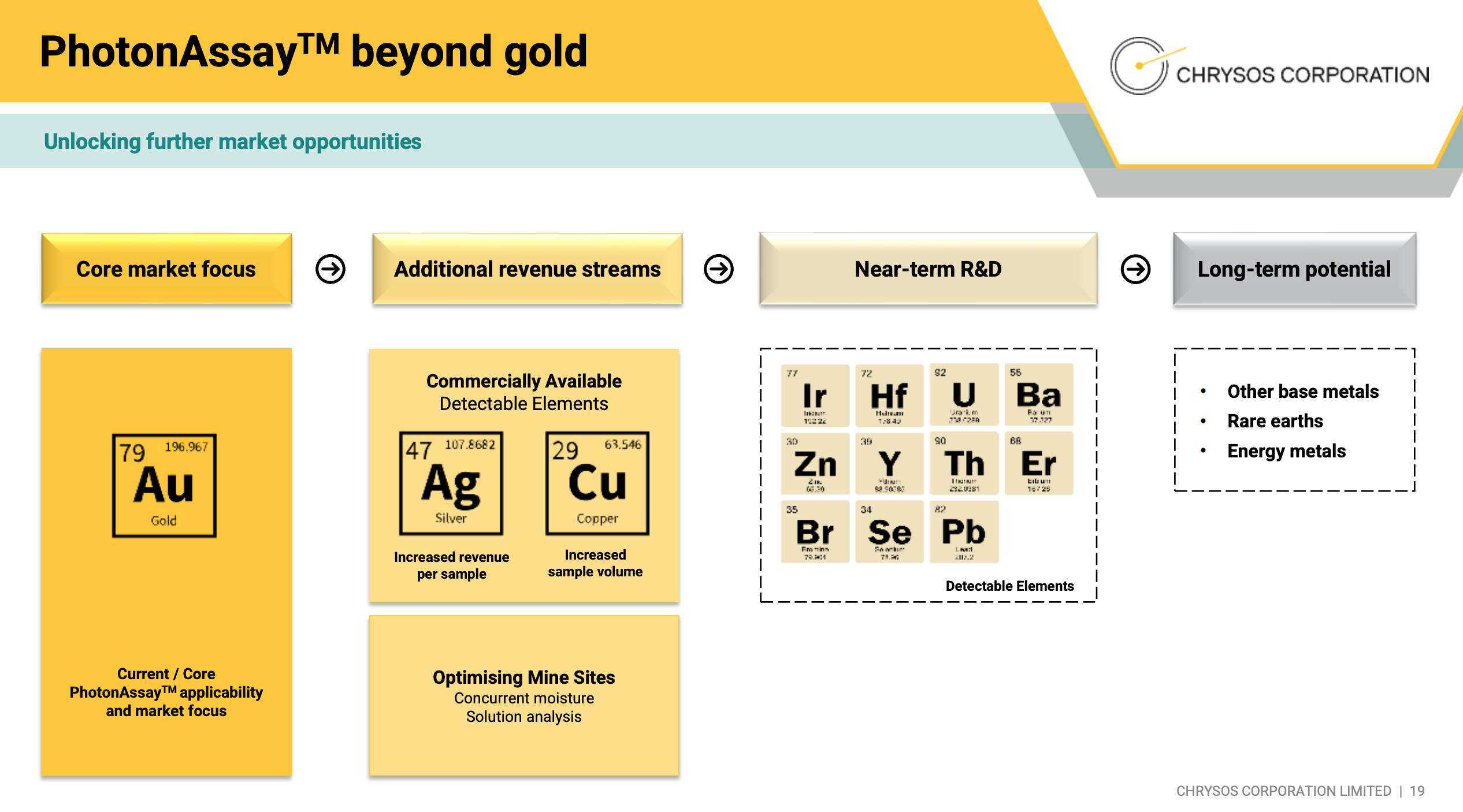
New element capability. PhotonAssay currently analyzes gold, silver, and copper. The logical expansion path - elements that co-present geologically with gold - include antimony, lead, and zinc. Each additional element increases the value proposition of an installed unit without requiring incremental capital. Chrysos has been clear that it remains “relentlessly focused on the gold market” for now, and I model this accordingly, zero contribution from new elements in my base case. But the technology platform has the latent capability to detect over half of all naturally occurring elements, and future expansion into base metals assaying could meaningfully enlarge the TAM. I find this to be key to maximizing company value, but am not going to spend time muddying the waters because I believe the business is worth more than market price for the gold portion alone.
XN generation. The first next-generation XN unit has been deployed to SGS in Perth, delivering 83-84 samples per hour versus 72 for the current generation. Nameplate capacity moves from 40,000 to approximately 50,000 samples per month. The XN rollout will be gradual (first unit now, second in ~12 months, then full commercial production ~12 months after that), at which point all future units would be XN. Over time, this raises the revenue ceiling per unit and accelerates the AAC opportunity. More importantly, this is a pivot to go vertical. Chrysos is looking to bring manufacturing in house, outside of China.
Neither of these is in my base case. Both represent upside that could be material over the medium term.
The IP protection around PhotonAssay has multiple layers, some legally driven, others reinforced by the market acceptance they are receiving. Here is how I perceive them:
Patent estate: PhotonAssay is based on high-energy photon (gamma) activation analysis, a method that CSIRO’s Dr. James Tickner and Dr. Nick Cutmore began researching almost 20 years ago, initially using a Sydney hospital’s radiotherapy linear accelerator during off-hours to test whether X-rays could activate gold in rock samples. That work produced a foundational body of patents covering the underlying analytical method, the sample handling geometry, the detector array configuration, the calibration algorithms, and the automation systems that make the technology commercially viable. Dr. Tickner, now Chrysos’s co-founder and Chief Technology Officer, holds over 90 patents personally.
Standard patent terms in Australia, the United States, and under the PCT system are 20 years from the priority filing date. The earliest foundational CSIRO filings date to approximately 2007-2010, which means some of the core method patents begin expiring in the 2027-2030 window. However, Chrysos has been continuously filing new patent applications covering subsequent innovations: improved detector configurations, the XN-generation automation system, moisture content correction methods during activation analysis (US patent 12,228,530, filed 2019 and granted February 2025), and novel sample preparation techniques for activation analysis (US publication 20260016427, filed 2023). These later filings extend hard patent protection on key system components through approximately 2039-2043. The result is not a single patent cliff but a layered portfolio. Critically, in 2016 Chrysos acquired the underlying IP from CSIRO outright, this was not a license arrangement. Chrysos owns the patent estate, and CSIRO cannot re-license the technology to a third party.
Operationalizing the Tech: Each PhotonAssay unit is a complex piece of equipment built around a linear accelerator (manufactured in partnership with Nutech), a proprietary robotic sample handling system (developed with partners SAGE and Automation Innovation), shielded activation and detection chambers, and software that transforms raw gamma-ray spectra into assay-grade gold, silver, and copper concentrations with 97%+ correlation to fire assay results. Calibrating these systems for the large variety of ore types encountered across global mining jurisdictions - each with different matrix effects, moisture content, and mineralogy - represents tens of thousands of operating hours of institutional learning spread across 43 deployed units on three continents. A competitor could read every patent in the portfolio and still spend five to ten years getting the output to a point where a Tier 1 miner would trust the numbers for JORC or NI 43-101 resource reporting.
Chrysos’s 2023 Annual Report discloses that the company has a “robust IP Roadmap” with a dedicated development team deliberately siloed from operations to focus exclusively on “expediting new IP” - a structure that ensures the know-how moat continues to widen even as the patent estate matures. The development team has split into two groups: one focused on continuous improvement of production units, the other exploring “step-change possibilities” and “adjacent markets.”
Global service and regulatory moat: When Dirk Treasure was asked directly about competitive threats - including from Chinese replication - he made two points. First, patents protect against direct copying. But second: Chrysos’s global footprint of 40+ units operating across Australia, Canada, the United States, Tanzania, the DRC, Ghana, Mali, Cote d’Ivoire, and soon South America provides “demonstrated capability for supporting complex equipment around the world, which is a moat in of itself.” Every deployed PhotonAssay unit requires country-specific radiation safety licensing for its linear accelerator, customs clearances, trained on-site technical support, and ongoing calibration by specialists who understand the local ore bodies. Chrysos has built this regulatory and logistics infrastructure in every major gold mining jurisdiction on Earth. A potential competitor would need to replicate it from scratch and they would need to do so without the reference installations, the customer validation data, and the operational track record that Chrysos has accumulated since the first commercial deployment.
Embedded workflow: PhotonAssay data feeds directly into JORC- and NI 43-101-compliant resource models that mining companies file with securities regulators and publish to investors. Once a miner has validated PhotonAssay against fire assay for a given ore body, a process that typically runs over many months across thousands of paired samples, switching to an unproven alternative means re-doing that validation work and accepting reporting risk during the transition. The labs face an analogous switching cost: they have invested in integrating PhotonAssay into their sample management systems, laboratory workflows, and client reporting. That integration cost has already been paid. Doing it again for a competing technology has no business case unless that technology offers dramatically superior economics and Chrysos, as the incumbent, has the pricing flexibility to respond.
Dirk has been explicit that Chrysos keeps “a fairly close eye on anything that we think would have potential to overlap with us in the future” and retains “optionality around whether we would acquire something like that.” As of today, there is nothing specifically on the radar (as I understand it). The practical result is a durable monopoly backed by a layered patent portfolio extending through the early 2040s, deep institutional know-how, a global regulatory footprint, and embedded customer workflows - a strong combination.
On a backward looking basis, this company seems incredibly expensive:
MC: A$708M, EV: A$736M
Revenue: A$80.4M, EBITDA: A$23.9M
EV/Sales: 9.1x, EV/EBITDA: 30.7x
What are the different scenarios I’ve modeled out to 2031? Note: This is sure to be laughably wrong, so be sure to come up with your own perspective.

Note: Table is based on the originally published price. IRR on current (8/5/26) range at 15x is now 12-27% because of the drop in price from original publication.
In all three scenarios, Chrysos is trading at a reasonable to cheap forward EBITDA multiple on FY31 estimates for a company with monopolistic market position, 76% gross margins, a massive deployment runway, and zero credible competition. The current enterprise value of approximately A$736 million reflects, in my view, a meaningful discount to the long-term earnings power of this business.
For any investment, arguably the most important factor is understanding the pricing power it holds. While I am not underwriting improved economics in my model, it is this variable I think will be the difference between a good vs great investment outcome.
Luckily, we have a lot more information about what the unit economics are for the labs that are using their technology. Specifically, Paragon Advanced Labs (PALS.V) recently went public and their primary business model is renting and operating Chrysos machines (around this they provide some value add services like crushing).
Here are the unit economics being forecasted for the lab by machine, the numbers are incredible. Almost $6.0M in EBITDA on $9.6M in revenue per machine.
40,000 nameplate x 80% utilization = 32K assays per month
Avg assay price is $25 x 32,000 x 12 = ~$9.6M in annual revenue
Monthly costs: $8 per assay x 32,000 and $40K in monthly overhead = $296K x 12 = $3.6M per year
Profit per machine: $9.6M - $3.6M = $6M
Each incremental assay is contributing ~$25 in revenue versus $8 in royalty. That’s great leverage. A couple points:
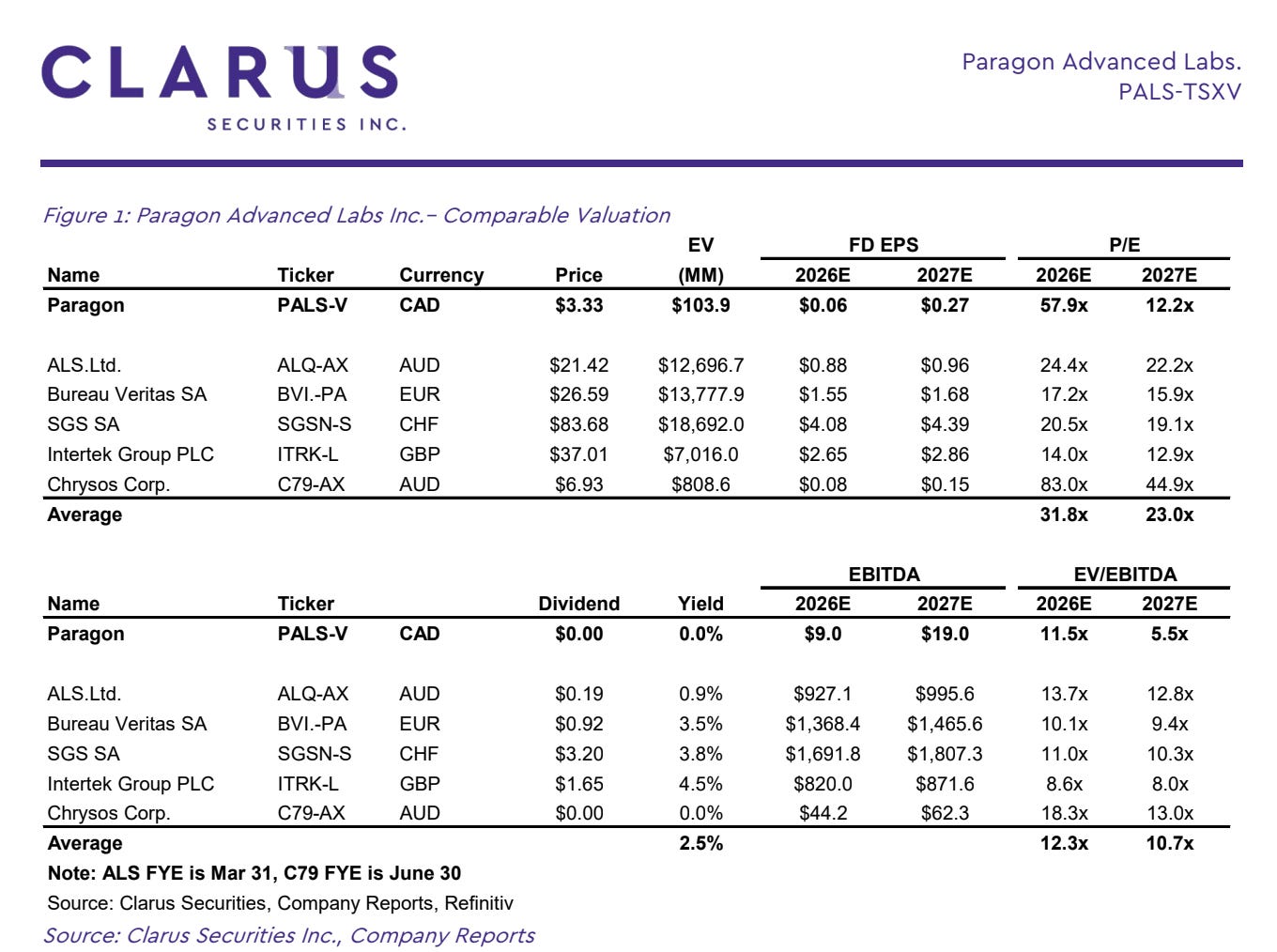
The Clarus report notes C$7-$8 in PALS royalty per assay, which is above the A$6.5 we have modeled (they also note annual capacity to produce 21 machines a year vs 18 reported by the company and 16 per year modeled).
Once adoption of photon assay continues, Chrysos could decide to increase pricing on renewal. The royalty could be increased 25% and the modeled lab EBITDA margins would still be north of 50%.
With a high valuation and tons of assumptions comes a ton of risk:
Execution Risk on Deployments: Chrysos has historically deployed 9-11 units per year. My base case assumes 16 per year. Manufacturing capacity supports 18, and the company has said this is “reasonably easy to increase,” but there is a difference between capacity and execution. Supply chain disruptions, installation delays, or customer deferrals could slow the rollout. The 34 units currently on order (with 5-10 in the warehouse ready to deploy) provide some visibility, but the manufacturing lead time of about two years is long.
Utilization May Not Ramp as Modeled: My thesis depends on utilization rising above contracted minimums. If gold exploration activity slows, if mining companies reduce drilling programs, or if labs don’t achieve the throughput rates I’m modeling, AAC revenue - the profit supercharger - will underperform. The risk is that blended utilization stalls in the 35-40% range, in which case Chrysos remains primarily a MMAP business with more modest growth and profitability. The good thing? Labs are incentivized to surpass minimum requirements. The incremental cost of a sale is far higher than throttling assays to avoid paying additional fees.
Capital Intensity: At A$4.4 million per unit, deploying 16 units per year costs A$70 million annually. The A$177 million in available funding covers approximately 2.5 years of deployment. I believe operating cash flows will bridge much of this gap by FY28-29, but there is a scenario where growth capex outpaces cash generation and dilution occurs.
Manufacturing: Current manufacturing is in China, which makes it vulnerable to stealing, duplicating and mass producing.
Customer Concentration and Contract Renewals: Chrysos’s revenue is concentrated among a relatively small number of mining and laboratory customers. While the long-term contract structure (5+5 years) provides visibility, the rolling lease renewals create periodic risk. If a major customer declines to renew, or if pricing comes under pressure at renewal, it could impact the revenue trajectory. Note: It is expected 40% of initial CapEx is needed after 10 years. Useful life is noted to be 20 years, at which point some components can be carried over.
Technology Risk: Chrysos benefits from a substantial patent portfolio and deep know-how derived from its CSIRO heritage. However, over a 10-20 year investment horizon, the possibility of a competing technology emerging cannot be dismissed. The company maintains that patents protect against direct copying, and the global installed base of units creates a servicing moat that would be difficult to replicate. There are no credible competitive threats I’ve identified today, but “no competition” has a way of changing in technology markets.
FX Exposure: A meaningful portion of Chrysos’s revenue is earned in non-AUD currencies (primarily USD and CAD as international deployments grow). A strengthening Australian dollar directly reduces reported revenue and profitability. Management has flagged this explicitly, noting that a 7.5% AUD/USD swing meaningfully impacts revenue, which is why FY26 guidance was set conservatively.
Valuation: At approximately 9x trailing revenue and a market cap around A$708 million, Chrysos is not cheap on traditional metrics. The market is pricing in significant future growth. If deployment slows or utilization disappoints, the multiple will compress meaningfully. This is a high-expectations stock and needs to keep executing.
Chrysos is, in my view, one of those rare businesses where the technology advantage is deep, the market opportunity is massive, and the serviced end markets are humming. It is a utilization play as much as it is a deployment play and the H1 FY2026 results show both engines firing. AAC revenue grew 261%. EBITDA more than doubled (the stock is actually down since). Monthly sample volumes are approaching one million. The company posted its first statutory net profit.
The path forward is straightforward: keep the business development momentum going, deploy 14-18 units per year, let utilization ramp across the fleet, watch AAC revenue inflect, diversify manufacturing out of China and let operating leverage do the rest. The A$177 million in available debt funding should minimize dilution during the critical scaling phase, and the long-term contract structure provides exceptional revenue visibility.
At 5% market penetration, with 72 units contracted and the world’s largest gold miners lining up to adopt PhotonAssay, this remains early innings. The company’s own guidance for FY26: A$80-90M in revenue, A$20-27M in EBITDA represents a stepping stone toward a business that I believe can generate A$250M+ in revenue and A$100M+ in EBITDA within five years. Fire assay has been the standard for a century. PhotonAssay is better, and the market is coming around to it.
I own C79 with the intention to keep it as a long-term holding unless something materially changes.
Disclosure: I hold a position in C79.AX. This is not investment advice. Do your own due diligence.
Appendix
Here are the first two paragraphs from a Clarus note covering PALS.
Paragon is deploying what is expected to be the largest commercially
available fleet of PhotonAssay machines globally. PhotonAssay is a proven
technology set to disrupt the mining assay industry with vastly superior
technology, while reducing the bottlenecks currently experienced by
mining companies.
DISRUPTING A US$5 BN MARKET: The global mining testing market is
estimated at US$5.3 BN, with exploration assays making up the largest portion,
followed by production and recycling. With a total of only 60 PhotonAssay
machines expected to be in operation globally over the next 12 to fourteen
months, it is estimated that the technology has the capacity to replace only
10% of the current industry and would need approximately 600 units to fully
displace the entire fire assay industry. With Chrysos Corp’s capacity to
manufacture a maximum of 21 units per year, there will only be a maximum of
150 units by 2030, which would account for 25% of the current market. With
limited production capacity, we believe demand will remain strong for the
units in place.
From their partner, Paragon Advanced Labs - PALS.V
Comments
Nothing yet. Say the first thing.
Sign in to join the conversation.