
When I pitched Deutsche Bank ($DB) back in '22, most shook their heads before I even got to the reasons: "Deutsche Bank? No, never, period." The name poses too much of a mental hurdle to even consider a discovery chat.
Deutsche Bank is up 3x over the past four years.
A global leader with a dominant market share, a brand portfolio spanning from affordable to luxury, a deep discount to its Sum-of-the-Parts, and, unlike typical SOTP pitfalls, a large share of the “parts” trade at observable market prices.
To illustrate the deep discount, a recent partial asset sale, a minor part of the revenue, was valued at ~20% of the company’s Market Cap.
None of that stops the market from hating it.
It has a China crisis. A governance overhang. A tariff headache.
Building the bull case isn’t hard; the math writes itself. Underwriting the bear case is the real work, and that’s what we do in this piece.
That enters Volkswagen Group. $VOW.DE (or $VWAGY in OTC)
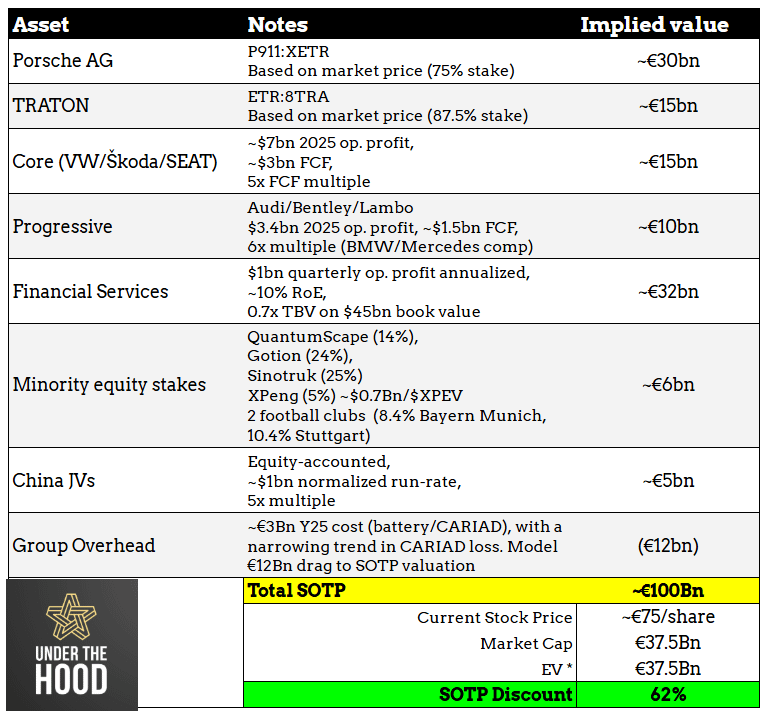
This research begins with a group overview to address common misconceptions, then walks through Sum-of-the-Parts math, a 62% discount, with two of VW’s own publicly traded stakes alone worth more than the whole company.
We then turn to the hard part: a China crisis, a governance overhang, and an EV misstep, along with the jaw-dropping 55% profit drop in 2025, segment-level results, and the dual-play setup for how the discount closes.
Who is Volkswagen Group (Perception vs Reality)
Sum-of-the-Parts Math
2025 vs. 2024: What Broke?
Behind the paywall
Segment Views
Selected Assets Deep Dive: Porsche, TRATON
Three Bear Cases: China, Governance, EV Handicap
Concluding Thoughts
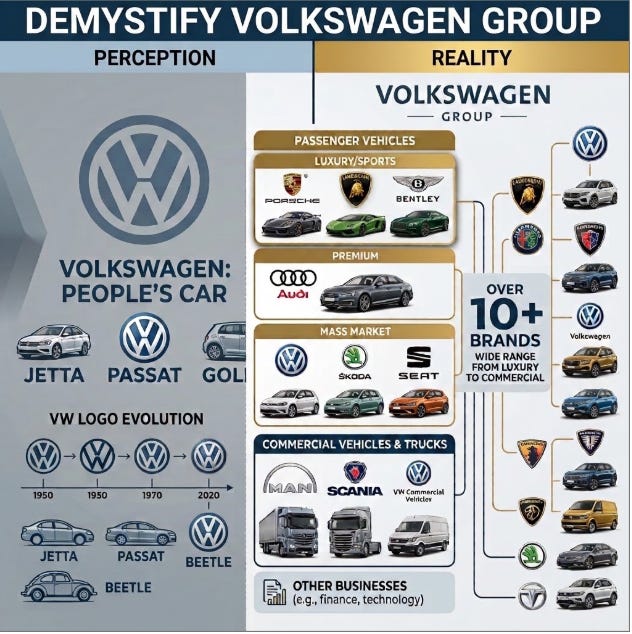
Most associate "Volkswagen" with models like Jetta, Passat, Santana (especially in China in the '90s and '00s), and its meaning: "The People’s Car.”
Most will also associate it with the infamous diesel emissions scandal, and a bloated cost structure, German labor-union protection, and marginal profitability.
Both are far from the truth.
Under Volkswagen is a portfolio of brands spanning every price point (from Jetta to Lamborghini), plus commercial trucks, motorcycles, and a sizable financial services arm. It commands ~10% of global auto volume, second only to Toyota.
Most of its brands/segments run profitably: even in 2025, its worst year in over a decade, the group generated ~€9bn in operating profit, trading at under 5x EV/EBIT at today’s price.
Volkswagen trades at ~62% discount to its Sum-of-the-Parts (SOTP), versus the normal conglomerate 10-30% SOTP discount range.
60%+ SOTP discount is uncommon. One of three things is often true when a discount gets this extreme:
The “parts” value is theoretical, not mark-to-market.
The conglomerate is rapidly declining, consuming all free cash flow, with no return in sight.
Management has no aligned interest in narrowing the price/value gap.
At €75/share, ~€38bn EV*, VW trades at ~62% discount to its €100Bn Sum-of-the-Parts valuation (see below). But the underlying story is even more compelling:
VW’s publicly listed stakes in Porsche AG and TRATON alone (~€45bn) are worth 15% more than VW’s entire valuation. These are mark-to-market prices, not imaginary numbers derived from peer multiples.
In other words, the market is pricing the core VW brand, Audi, Bentley, Lamborghini, Financial Services, and everything else at negative value.
There is more to it. SOTP could look attractive all day long and never move an inch, keeping the theoretical discount untouched.
VW isn’t sitting idle on that. In Jun’26, VW sold a 51% stake of Everllence (VW’s marine/large-engine business) to Bain Capital at €7.4bn valuation, 2x+ its ~€3.4bn book value, showing VW’s “hidden” assets can and do fetch premium pricing.
And there are more Portfolio Optimization events on the Horizon:
TRATON: stake reduction underway, from initial 90% to 87.5% in Mar’25, with management signaling 75% as the target floor.
Ducati: under active consideration for sale (a 2017 attempt was blocked by unions; the Everllence €7.4bn sale has emboldened advisors to push again).
Lambo: a potential IPO has been rumored; Bloomberg Intelligence values it at €19-22bn against ~€0.8bn of 2025 profit.
Football club stakes: Audi’s 8.3% of Bayern Munich and Porsche’s 10.4% of VfB Stuttgart both under review. (~€0.5bn)
July 9, 2026 “Future Plan”: propose up to 100,000 job cuts, four German plants under review for closure, model portfolio cut by up to 50%, management delayering, and an explicit target of lifting group operating margin from ~2.8-3.3% to 8-10% by 2030.
Before we get too excited, I will acknowledge none of the above has a clear date attached to it; there is no imminent catalyst, and there are multiple forces fighting against them. More on that later.
I want to double-click on its €38Bn Enterprise Value mentioned earlier. At ~€75/share and ~501Mn shares outstanding (295mn common + 206mn preferred), market cap is ~€38bn.
~€17bn in gross debt, ~€50bn in cash and securities, and a ~€27bn pension deficit net to a net cash of €6bn.
But I don’t take that €6bn, as the pension liability is very interest-rate-sensitive; thus, I’m adding a €6bn buffer and treating net debt as zero, yielding EV ≈ market cap ≈ €38bn, to be reasonably conservative.
The SOTP math is simple and not new.
The hard part is underwriting why the discount exists and whether it closes. VW isn’t cheap by accident:
A China crisis: JV profit down from a €5.2bn peak to under €1bn, foreign OEMs in what S&P calls a “long and painful retreat” from a market VW once relied on for a third of group profit.
A governance overhang: a circular ownership structure, a debt-laden family holding company, a labor-controlled supervisory board, and a state government with effective veto rights: a cap table built to resist exactly the kind of value-unlock this discount is begging for.
An EV handicap: Porsche’s volume-premium playbook ran headfirst into a botched EV transition: deliveries down 22%, €3.1bn in special charges, and a new CEO with 12-18 months to prove he can fix it.
Below, we work through all of them, the €10bn profit bridge behind the “55% decline” headline, segment-level detail, and the two paths (earnings power and asset sales) that could close this gap — plus why we think the bull case prevails.
Group operating profit fell from €19.1bn (2024) to €8.9bn (2025), a jaw-dropping 55% decline. The table below provides a segment-level view of revenue, operating income, and YoY changes.
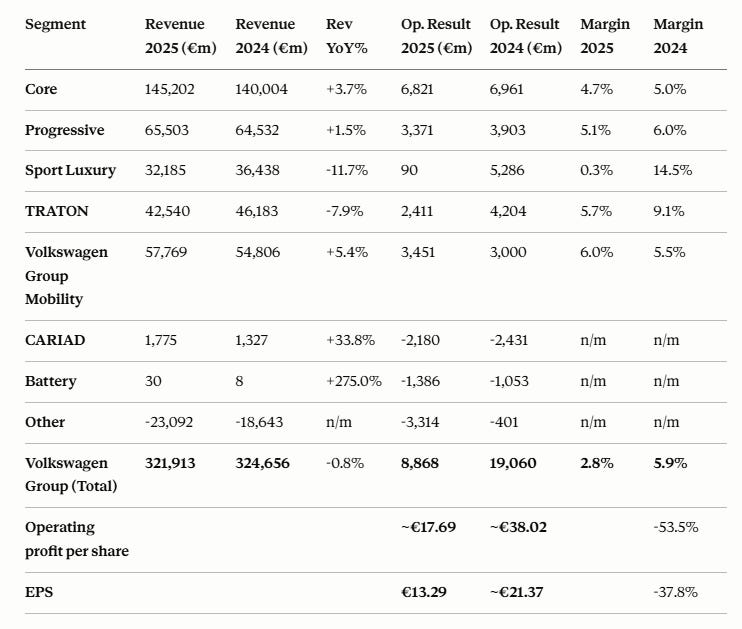
At first glance, one thinks the house of VW cards is collapsing.
However, of the €10bn+ decline in operating profit, ~€4bn was attributed to US tariffs, €3.5bn to one-time restructuring/goodwill charges at Porsche, €2bn to TRATON’s cyclical downturn, and €1bn to China, mostly explained by non-structural drivers. Of these, only China looks structural, while it is worth noting that China plays an increasingly minor role in the group’s overall profit.
In summary, although a 55% profit decline appears severe, it does not indicate a widespread collapse of the core business.
Comments
Nothing yet. Say the first thing.
Sign in to join the conversation.