
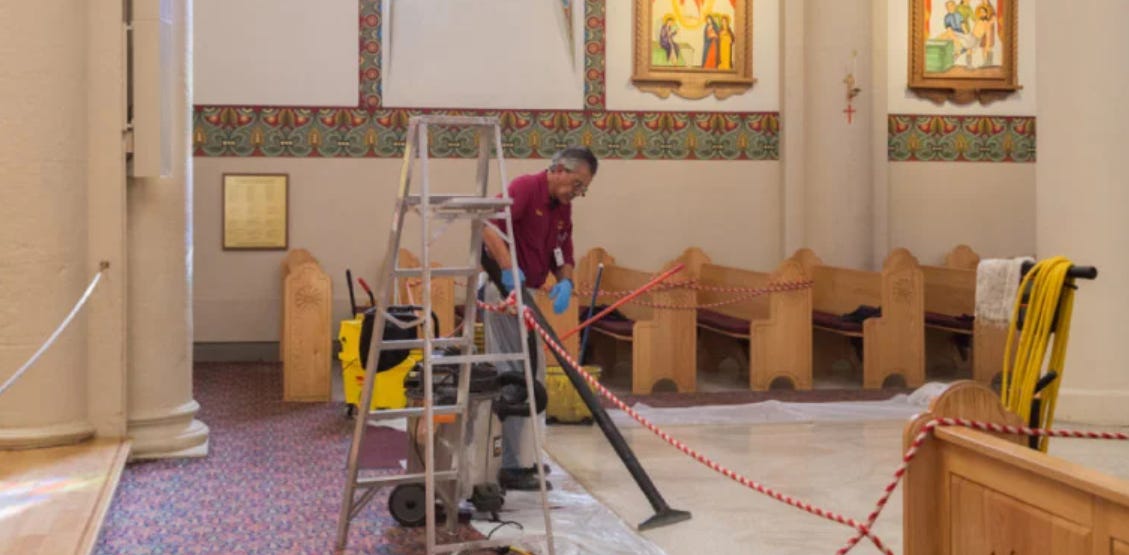
This is a busy day for churches, really busy. Typically, this is the day when the printer over heats, the stapler busts, and the church fuse box trips. Also Tesco in Kingsbridge is heaving with holidaymakers buying up chocolate eggs and lamb for tomorrow’s festivities. In parish life, Holy Saturday tends to be a day of contradiction. There was a time in the Church of England when couples got married on the day before Easter. Nowadays, I can picture the flower ladies going on strike if that happened. A vicar would end up hoist by their own petard for forcing the flower team to negotiate their efforts around a bride and groom. Volunteers up and down the land will be locked in churches, getting their places of worship ready for the big day.
In contrast to all this good and necessary busyness, the day itself—including the liturgy invites us to stillness and contemplation. Christians are meant to be holy on Holy Saturday. The clue is in the name. Inspired by Early Church practices, the revised liturgies since the 1960s call the faithful to a deeper, more discipled experience of this day. Much of the celebration of the Triduum (the three days) is actually quite recent. The old rites of Anglicans and Catholics had little in the way of this until a couple of generations ago. Some churches tonight even attempt an all-night vigil until Easter morning, just as Christians did in the time of Augustine. My wife’s curacy parish in Totnes does this, and I don’t know how the vicar there physically operates on Sunday. I’m rubbish at such things. In my last parish we experimented with a vigil until midnight, which rebooted with a beach service at 6am, but it was hard to get elderly volunteers to buy into it.
The liturgy calls us to enter a solemn emptiness, but the reality is that there is a supermarket big shop to be done, sanctuaries to be vacuumed, children to be entertained, choirs to rehearse, pews to be dusted, service sheets to be printed, and sermons to be penned. At Christmas, punters quip, “Busy time of the year, vicar!” The reality is that this Saturday is the day clergy are fried.
Going back to the liturgy, it is difficult to manufacture a dark night of the soul for a few hours on Holy Saturday. Nevertheless, I am reminded that a surface reading of St. John of the Cross’s great poem can be misunderstood as only loss and melancholy. There is anticipation too. The night is not empty despair; it is a guiding presence. As St. John writes:
“O night that guided me,
O night more lovely than the dawn,
O night that joined Beloved with lover,
Lover transformed in the Beloved!”
The darkness leads surely to union. It is a night inflamed with love-longing, where the soul slips away in secret, guided by the fire burning in the heart—more surely than the light of noonday—to the place where the Beloved waits.
Here there is a teasing of the soul reminiscent of the Biblical Song of Songs. The lover searches restlessly through the night:
“All night long on my bed I looked for the one my heart loves;
I looked for him but did not find him.” (Song of Songs 3:1)
Yet the waiting is charged with hopeful desire. The beloved calls through the darkness:
“I sleep, but my heart is awake.
A sound! My beloved is knocking:
‘Open to me, my sister, my love, my dove, my flawless one.
My head is drenched with dew, my hair with the dampness of the night.’” (Song of Songs 5:2)
So too for the Christian. We may go to bed feeling guilty that we’ve not been holy enough on this Holy Saturday. But we also retire knowing what we’ve always known: that Christ is risen, and the victim has become the victor. Night gives way to morning. The darkness is fleeting, and the Beloved will arrive with the dawn.
David Frost had a column in yesterday’s Daily Telegraph where I supplied a quote.
https://www.telegraph.co.uk/news/2026/04/02/britain-quietly-awakening-supernatural-christianity/
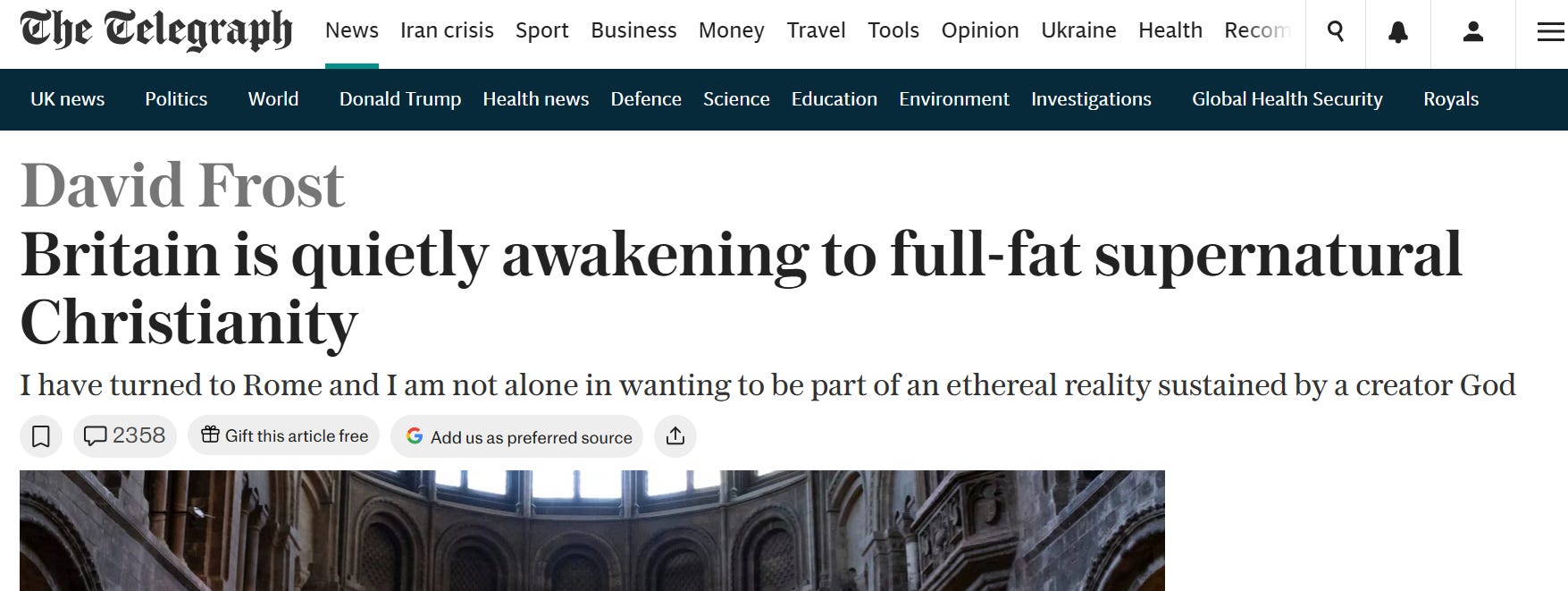
His optimistic analysis seems about right. As you may know last year’s Bible Society survey was suddenly withdrawn last month as YouGov admitted data corruption. Some responses were fake. At the time their insistent claim that churchgoing amongst the so-called “GenZ” had quadrupled did seem fanciful. I was bemused back in 2025 that the Bible Society didn’t reach out to national church bodies to verify this. The Humanists of course have been gleeful. Yet, as Lord Frost points out there is much anecdotal evidence that there is a “vibe” shift when it comes to Christianity in the UK.
No posts
Comments
Nothing yet. Say the first thing.
Sign in to join the conversation.