
You came for Lewis & Clark. Stay for everything else.
The Lewis & Clark Trail is filled with places that tell the story of the Corps of Discovery—forts and campsites, museums and monuments, historic communities, and landscapes that remain remarkably recognizable more than two centuries after Lewis and Clark passed through.
But there is another side to traveling the Trail. Along the route is an eclectic collection of places and experiences that have little or nothing to do with the expedition yet can make a Lewis & Clark road trip more surprising, entertaining, and memorable. They are the quirky roadside attractions, unusual works of art, unexpected pieces of history, and wonderfully odd places you might otherwise drive right past.
For this two-part Undaunted Travel series, we combed through the more unusual non–Lewis and Clark attractions featured on the Lewis & Clark Trail Experience and selected some of our favorites. We’ve arranged them roughly east to west, creating a different kind of journey across the country—one that occasionally steps away from the expedition to discover the unexpected.
Some stops are whimsical. Others reveal fascinating chapters of American history. A few are downright strange. But each offers another reason to slow down, take a detour, and discover what makes the communities along the Trail unique.
There were simply too many good ones to fit into a single story. So enjoy part one and look forward to next week’s continuation.
Pittsburgh: Where the Journey Begins—and Where Another America Took Shape
At the eastern end of the Lewis & Clark National Historic Trail, Pittsburgh is an appropriate place to begin thinking about what lies beyond the expedition.
The Corps of Discovery was still months away from leaving for the West when Meriwether Lewis arrived in Pittsburgh in 1803 to oversee preparations for the expedition’s mode of transport – the barge known as the keelboat. The city where Lewis had his boat built was already an important center of manufacturing and transportation. But Pittsburgh’s greatest transformation was still ahead. More than a century later, the region would become synonymous with steel.
Today, the Carrie Blast Furnaces, remnants of the enormous U.S. Steel Homestead Works, provide a dramatic introduction to that later chapter of American history. Furnaces No. 6 and No. 7 rise 92 feet above the Monongahela River. Massive infrastructure and furnaces lined with refractory brick are rare surviving examples of pre-World War II steel-making technology.
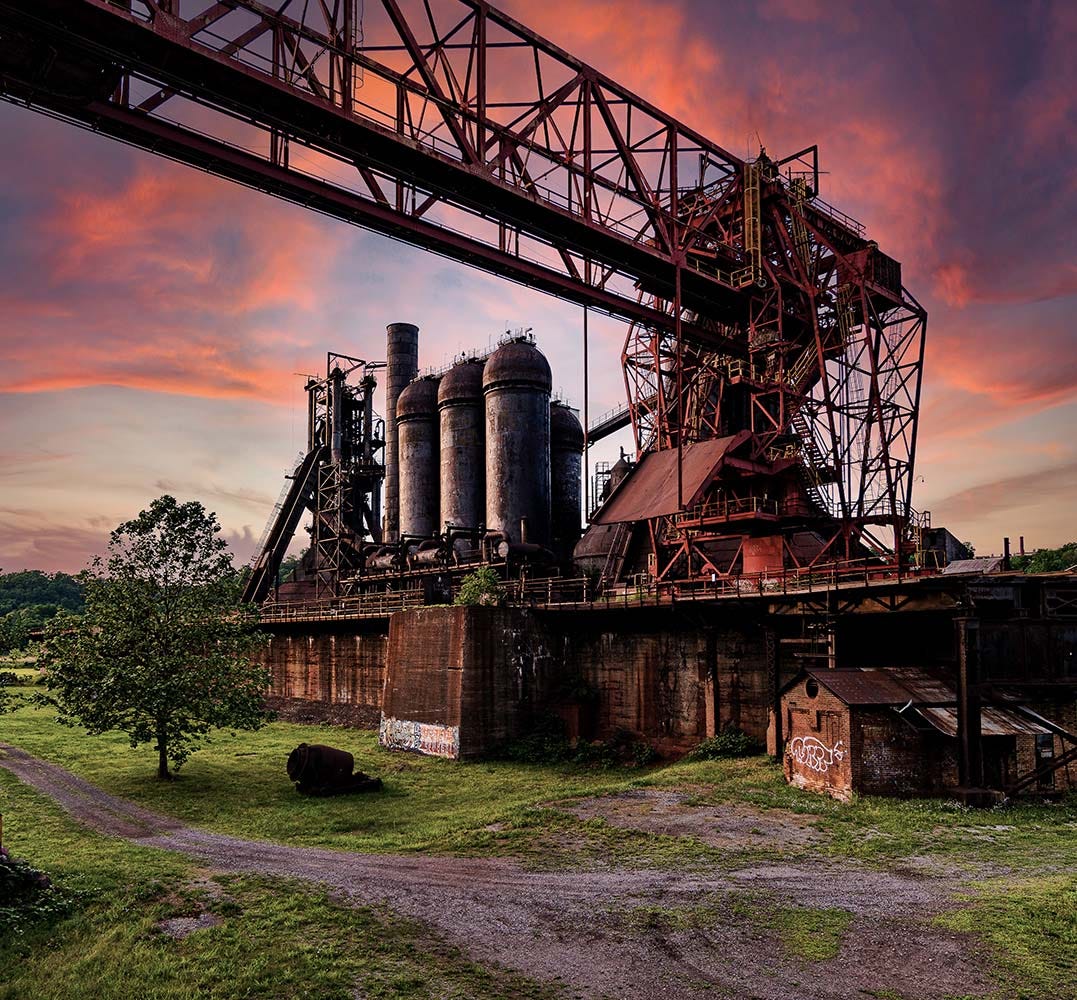
Lewis and Clark never saw these furnaces. They couldn’t have imagined them. Yet there is a powerful connection. The expedition helped expand the young nation’s understanding of the vast continent beyond the Mississippi. The industrial transformation that followed would eventually turn rivers, railroads, and western resources into the foundation of a vastly expanded American economy.
The furnaces are more than an industrial curiosity. They are a reminder of what happened after Lewis and Clark.
Vevay: A Giant Duck on the Ohio River
Follow the Trail west from Pittsburgh along the Ohio River, one of the great transportation corridors of the American interior. In Vevay, Indiana, you’ll find something Lewis and Clark almost certainly didn’t encounter on their journey: a giant rubber duck
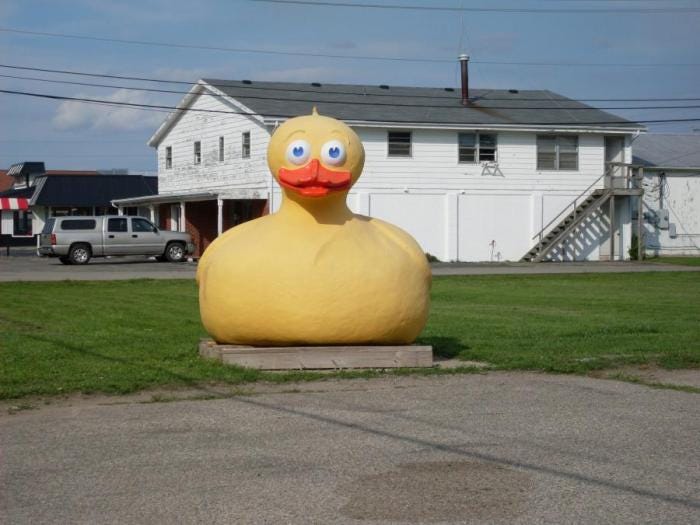
The Giant Rubber Duckie stands along Main Street near the Ohio River and has become one of Vevay’s most recognizable landmarks. The duck originally appeared as part of one of the community’s festivals and at one time floated on the river. After disappearing for a period, it was recovered and returned to town.
There is no grand historical interpretation required. You see a giant duck. You stop. You take a picture. And you smile.
That may seem a long way from Lewis and Clark, but perhaps it isn’t. The expedition was an adventure into the unknown, and curiosity was at its heart. Two centuries later, travelers following their route should retain a little of that same curiosity.
Metropolis: From Fort Massac to Superman
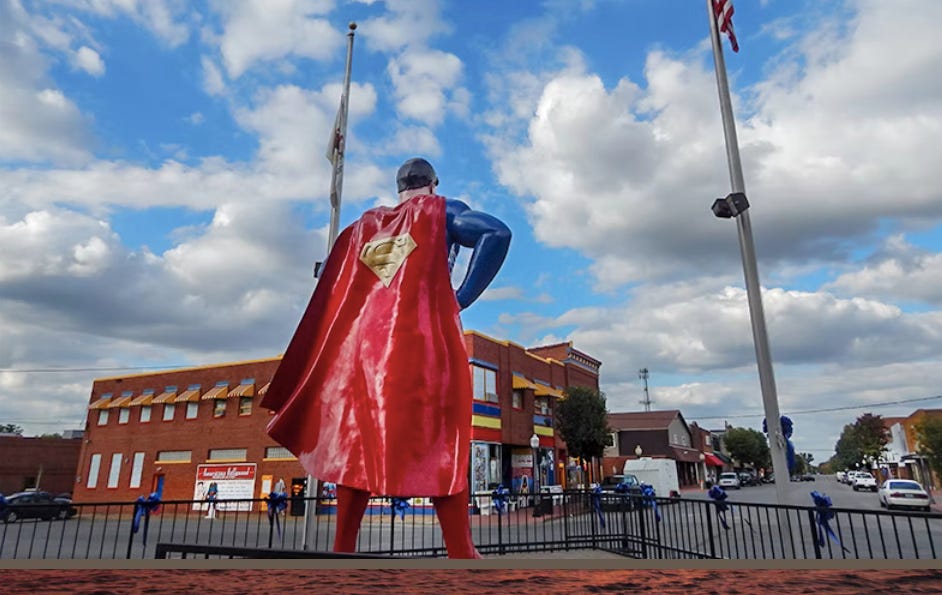
Metropolis, Illinois, is famous for Superman. A larger-than-life statue stands in Superman Square, and the community has embraced its identity as the superhero’s hometown with murals, shops, exhibits, and an annual Superman Celebration.
But there is another story here that brings us back to the Trail. Nearby Fort Massac predates the Lewis and Clark Expedition and represents the military and strategic history of the Ohio River corridor. Its location helps put the expedition into a larger context. Lewis and Clark were traveling through a landscape already shaped by Native nations, European powers, military outposts, trade, and competing claims to the continent.
Then, two centuries later, somebody put Superman in the middle of it. That’s part of the fun.
A Lewis & Clark traveler can stand at Fort Massac thinking about the complicated history of the Ohio Valley—and a few minutes later find himself standing beside a superhero. Both belong to the story of the place.
Cairo: Where the Rivers Come Together
At the southern tip of Illinois, the Ohio River meets the Mississippi. Lewis and Clark camped at the confluence, making this familiar geographic territory for anyone following the expedition’s route. Rivers were the highways of the early nineteenth century, and understanding their junctions was essential to understanding the continent.
Cairo was later transformed into a major center of commerce because of its strategic location. Today, however, the community bears the scars of the same rivers that once brought it prosperity. It offers an unexpected opportunity to see how later generations attempted to control, cross, and manage those waterways.
The Cairo Railroad Arch Bridge is an impressive concrete structure with a 94-foot-wide opening. Locals call it a tunnel. Its construction was an engineering feat in itself because the new concrete arch had to be built around the deep trusses of an earlier bridge. The old truss members actually passed through the new arch until they could be removed.
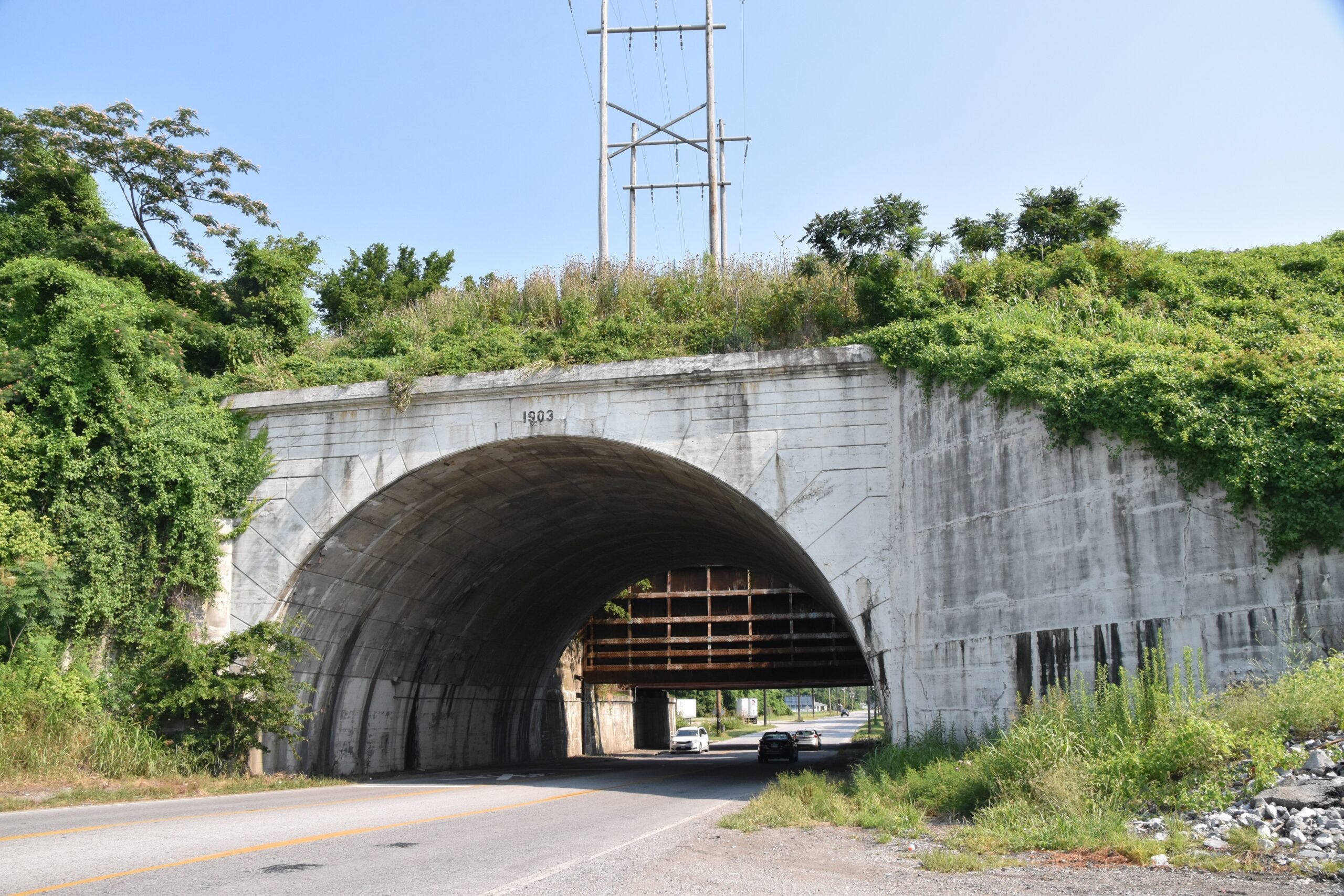
Beside it stands a massive riveted steel floodgate built in 1914, part of the efforts to protect the community from the flooding that has repeatedly shaped Cairo’s history.
Lewis and Clark were concerned with navigating rivers and understanding the country through which they passed. Generations later, Americans were engineering those same rivers—bridging them, controlling floods, and making them serve an increasingly industrial nation.
The confluence alone is worth the stop. The engineering marvel nearby makes the detour even more worthwhile.
Chester: Popeye and the River Country
Continue north along the Mississippi and you’ll come to Chester, Illinois, hometown of E.C. Segar, creator of Popeye.
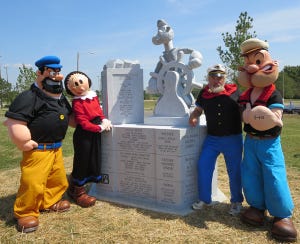
Popeye first appeared in Segar’s Thimble Theatre comic strip in 1929. The character became so popular that he eventually overshadowed the Oyl family characters around whom the strip originally revolved.
Chester has embraced its connection to Segar with the Popeye Character Trail. A bronze Popeye statue was erected in 1977, and since 2006 the town has added granite statues of other Segar characters.
For a Lewis & Clark traveler, Chester offers an interesting geographical connection. The town lies just south of the historic Fort Kaskaskia, another reminder of the military and colonial history that preceded the expedition.
Lewis and Clark moved through a Mississippi Valley already layered with history. Today, travelers encounter another layer: the popular culture created by a hometown cartoonist more than a century later.
Springfield: See the Expedition Through an Artist’s Eyes
Not every detour has to be unrelated to Lewis and Clark. In Springfield, Missouri, Wonders of Wildlife offers a remarkable opportunity to experience the expedition through the work of Western artist Charles Fritz.
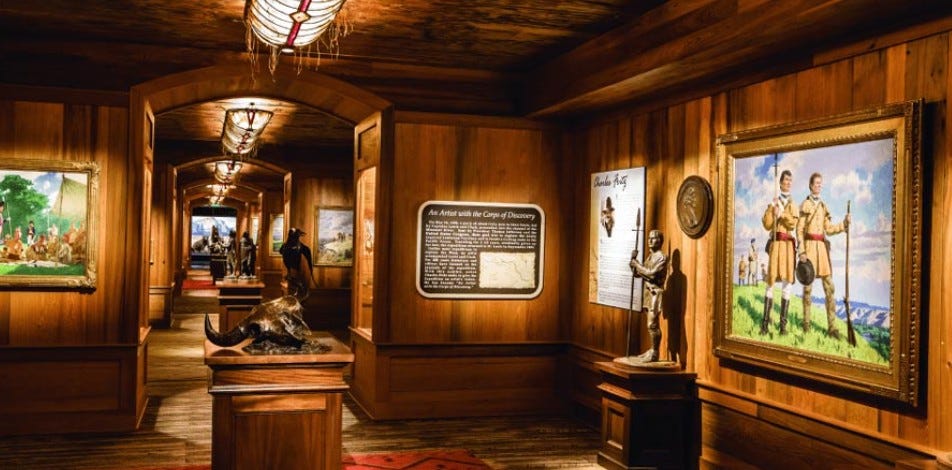
Fritz created a collection of 100 paintings based on the journals, historical research, archaeological evidence, and his own travels along the Lewis & Clark Trail. His work attempts to give visual form to a problem that has existed since the expedition itself: Lewis and Clark had no artist traveling with them.
The Corps recorded an enormous amount of information in words. They described landscapes, plants, animals, Native peoples, and events. But there was no painter standing beside them to capture the scenes.
Fritz spent more than a decade trying to fill that visual gap.
For travelers following the Trail today, his paintings offer something remarkable. They allow us to see the expedition not simply as a series of journal entries, but as a lived experience—a landscape filled with uncertainty, discovery, hardship, and wonder.
Columbia: Jefferson’s Gravestone—and the Expedition’s Architect
In Columbia, Missouri, the unexpected becomes downright surprising. Thomas Jefferson’s original gravestone is not at Monticello. It is on the campus of the University of Missouri.
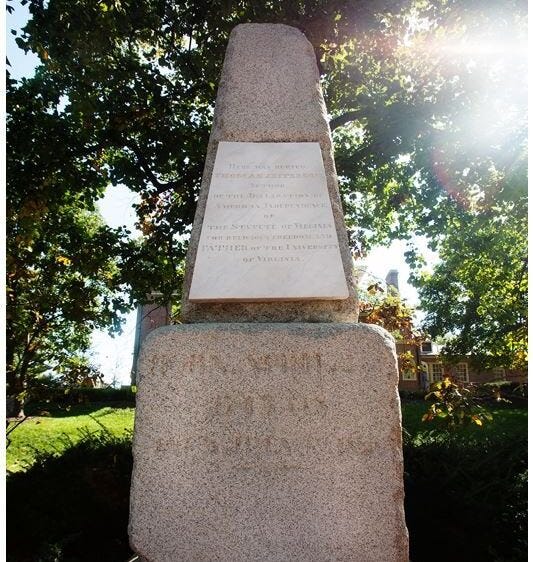
The connection to Lewis and Clark could hardly be stronger. Jefferson was the president who authorized the expedition and the driving force behind the Louisiana Purchase that made the journey possible. The university’s interest in acquiring the original gravestone was also rooted in Jefferson’s connection to the Louisiana Purchase and his advocacy for public education.
The gravestone arrived in Columbia in 1885. Then came a fire.
Academic Hall burned in 1892, badly damaging the marble plaque. It was cracked and broken into three pieces and spent decades being moved around campus and stored away. Eventually, the university sought professional assistance, and the Smithsonian undertook its restoration. The plaque is now displayed in Jesse Hall. There is another connection to the Trail. The Expedition camped at multiple sites along the River in Boone County, including at the Moniteau Bluffs near Rocheport.
So this isn’t merely a story about an unexpected gravestone. It is a chance to encounter the man whose vision sent Lewis and Clark west in the first place.
Lexington: A Cannonball, a River, and a Moment Involving York
Lexington, Missouri, offers another kind of unexpected history. The Lafayette County Courthouse still bears a cannonball fired during the First Battle of Lexington in 1861. The projectile remains lodged in one of the courthouse pillars.
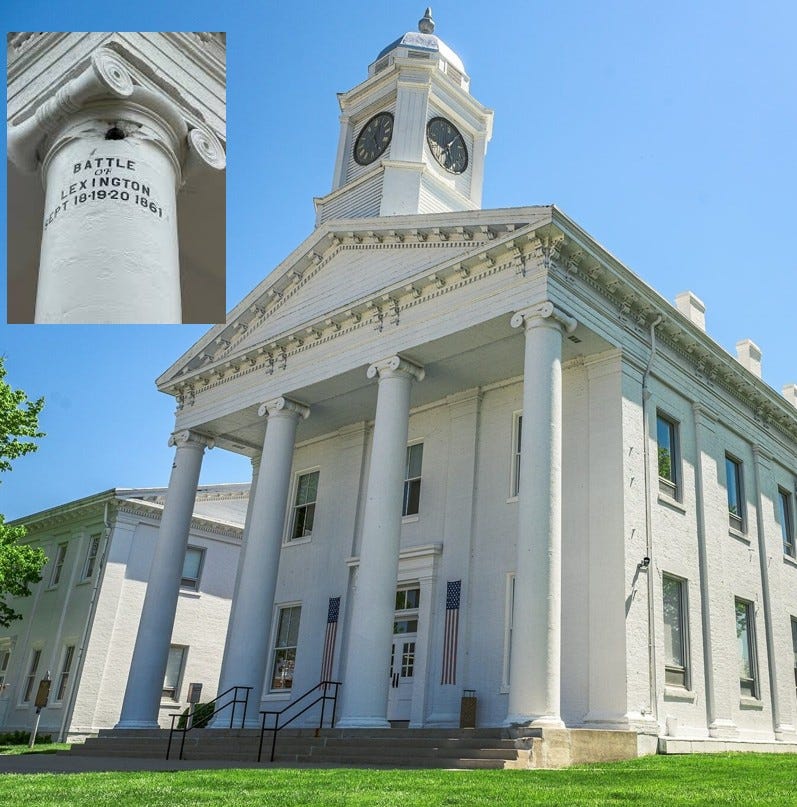
The courthouse itself dates to 1847 and is the oldest courthouse in continuous use west of the Mississippi River, according to the supplied material. But for Lewis & Clark travelers, Lexington has an earlier connection. When the expedition camped here, one of the soldiers threw sand into York’s face, nearly blinding him.
It is a tiny incident compared with the expedition’s great events, but that is precisely what makes it interesting. The journals occasionally preserve these fleeting moments—details of human behavior that remind us that the Corps of Discovery was not simply a collection of heroic explorers moving across a map. It was a group of people living together under difficult circumstances.
Lexington is also steeped in the history of later westward travel. The Santa Fe Trail passed through the community, and the town became the headquarters of Russell, Majors and Waddell, the freighting company that would launch the Pony Express.
Here, several layers of American history sit almost on top of one another.
While you’re in Lexington, look for another monument that has nothing directly to do with Lewis and Clark—but everything to do with the larger story of Americans moving west.
The Madonna of the Trail is one of twelve identical monuments dedicated to pioneer women. The statues were placed along the National Old Trails Road, which extended from Cumberland, Maryland, to Upland, California.
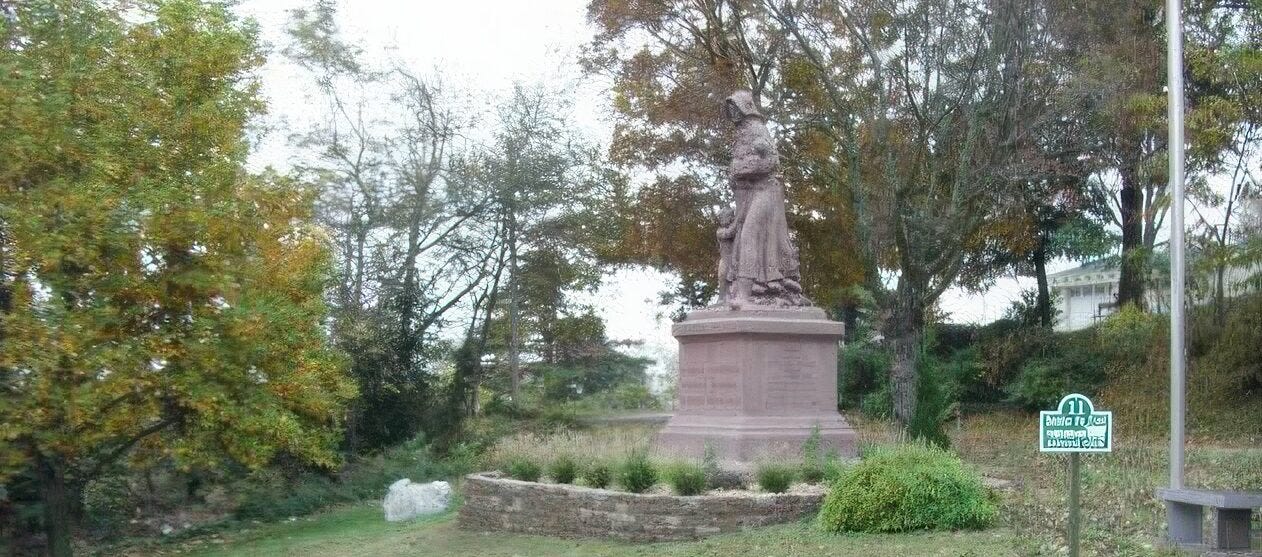
Lexington’s monument was dedicated in 1928 by County Judge Harry S. Truman. There is even a black-and-white film recording Truman making the dedication. Our incoming Lewis & Clark Trail Alliance President Pat Traffas made a video at the statue.
The statue commemorates the women who traveled west, established homes, and helped create permanent communities.
Lewis and Clark traveled through a country that was largely unfamiliar to Americans of their time. The travelers who followed them were not all explorers. They were families, farmers, merchants, women, and children—people trying to build lives.
The Madonna of the Trail helps broaden the story of what happened after the Corps of Discovery passed through.
Excelsior Springs: Take the Waters
If the journey is beginning to feel too serious, make a detour to Excelsior Springs.
The Hall of Waters was built beginning in 1936 as a Works Progress Administration project and became a distribution center for the community’s mineral waters.
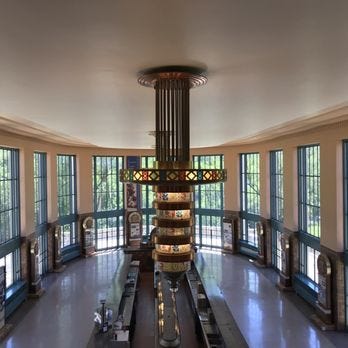
The building is an extraordinary piece of Art Deco architecture, with Mayan-inspired elements associated with water and water gods. At its height, it contained bathing departments, swimming pools, a polio pool, bottling works, and a sophisticated system of pipes for distributing different mineral waters.
The two-story solarium once contained what was described as the world’s longest water bar. The water bar is currently closed, but other portions of the building remain available to visitors, including historic exhibits and a surviving vintage bath department.
Lewis and Clark never stopped here for a mineral-water treatment. But their journey helped open the American imagination to the possibilities of the West. The generations that followed would discover their own reasons to travel—to seek land, opportunity, health, recreation, or simply something different.
Brownville: A Very Different Captain Meriwether Lewis
By the time you reach Brownville, Nebraska, you encounter an attraction that seems almost tailor-made for a Lewis & Clark road trip.
The Captain Meriwether Lewis Dredge is a National Historic Landmark and one of the few surviving dredges associated with efforts to improve navigation and reduce flooding on the Missouri River. The vessel operated from 1932 to 1965.
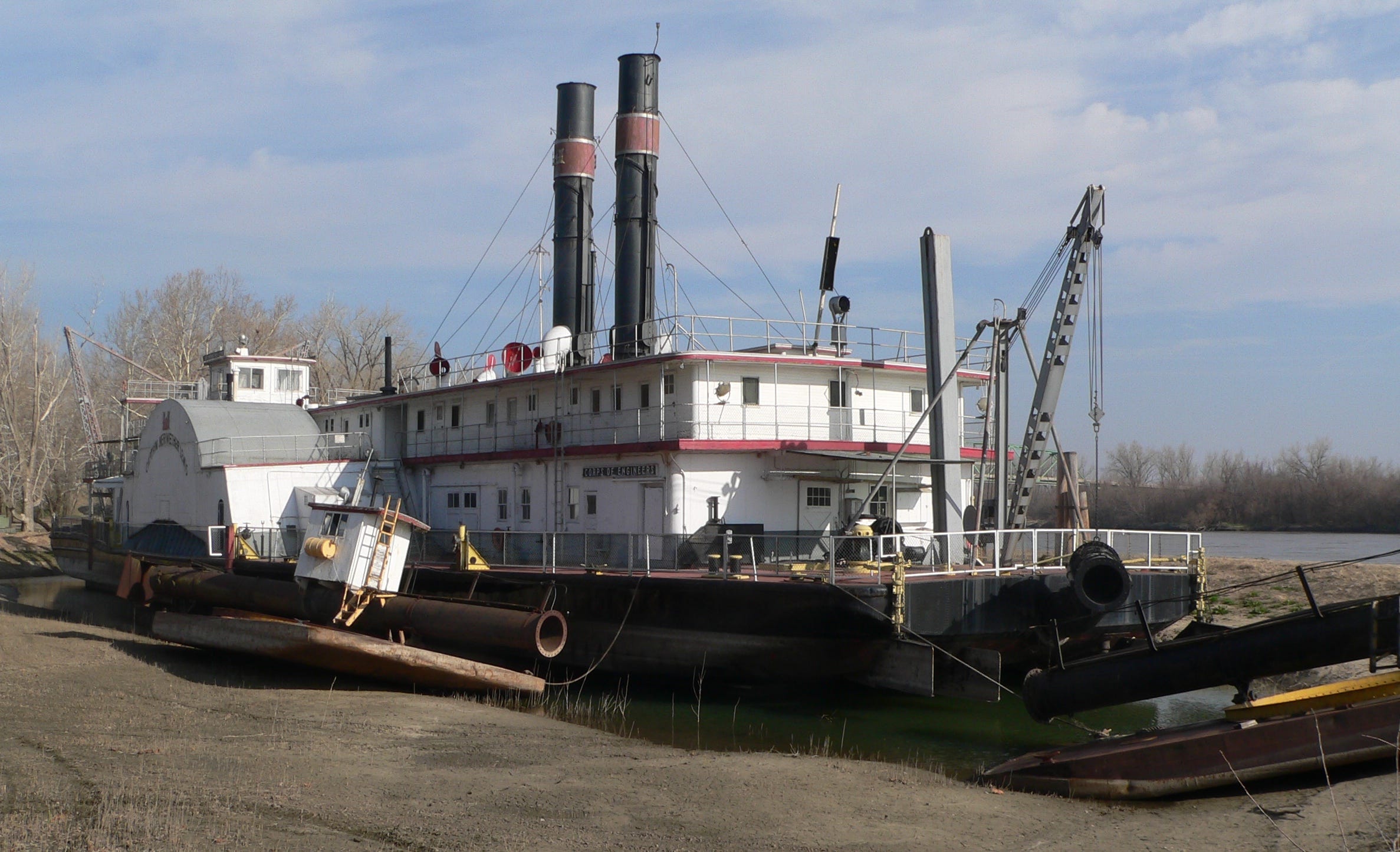
Today, it is preserved in a river lagoon, allowing visitors on select days to walk through the vessel and learn how engineers and crews worked to reshape the river.
The dredge, along with the Sergeant Floyd workboat in Sioux City, Iowa, helps tell the story of the U.S. Army Corps of Engineers and its efforts to tame the Missouri, prevent floods, and create reliable commercial navigation. In the process, much of the wild and scenic character of the lower Missouri was altered.
Lewis and Clark depended on the Missouri as their highway into the West. More than a century later, engineers were reshaping that same river for a very different America.
Same river. Very different journey.
The Detour Is Part of the Journey
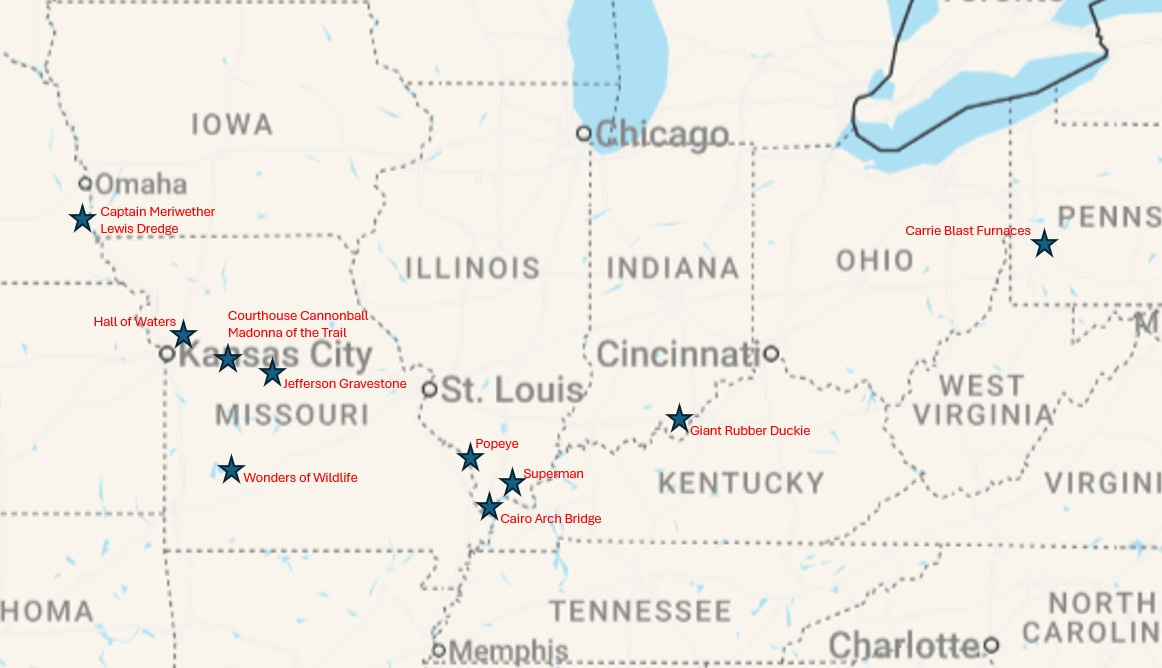
By the time you reach the Missouri Valley of Iowa and Nebraska, you have encountered steel furnaces, a giant rubber duck, an engineering marvel, Superman, Popeye, an artist’s vision of the expedition, Thomas Jefferson’s gravestone, a Civil War cannonball, a monument to pioneer women, a mineral-water palace, and a dredge named for Meriwether Lewis.
That’s a remarkable collection of stories.
And none of them requires you to abandon the Lewis & Clark Trail. Quite the opposite. They help explain the world through which the Trail passes.
The expedition is the thread that connects the journey, but it isn’t the only story worth discovering. The rivers, towns, and landscapes continued to evolve long after Lewis and Clark returned east. Every generation left something behind.
That is what makes traveling the Trail different from visiting a collection of historic sites.
The Trail is alive.
So don’t hurry. Find out why there’s a giant duck. Look for the cannonball. Wonder why there’s a superhero in Metropolis. Follow Popeye through Chester. Stand on the banks of the Missouri and imagine the river Lewis and Clark knew—and then look at what generations after them built along its shores.
And if you see something that makes you say, “Why is that here?”—stop and find out.
You may have just found the best story of the day.
Next: Part Two—Across the Great Plains and into the Pacific Northwest, where the unexpected gets even bigger.
Thanks for reading Undaunted Travel! This post is public so feel free to share it.
Continue your exploration by visiting the links below — and let them guide you from curiosity to connection with one of America’s most consequential chapters.
Lewis and Clark Trail News - our bi-weekly newsletter with Trail Happenings
Lewis and Clark Mobile App - take the Trail with you on your mobile device
Lewis & Clark Trail Alliance - learn about the work of the Alliance
Events along the Trail - our calendar of events you may wish to attend
Join The Alliance - Get involved
Additional Resources: Experience Lewis and Clark
We are grateful for the generous support of our corporate and travel partners whose sponsorship helps make this work possible. When planning your travels along the Lewis and Clark Trail, we encourage you to support the businesses and organizations that invest in preserving and sharing these stories—your patronage helps sustain both the trail and the experiences that bring its history to life.

No posts
Comments
Nothing yet. Say the first thing.
Sign in to join the conversation.