
For decades, the accredited investor rule has quietly locked out millions of capable Americans from investing in private markets—not because they lack sophistication, but because they lack wealth. Demand for change is at an all-time high.
The Securities and Exchange Commission (SEC) has taken no action—despite legal mandates and petitions from ICAN and others urging reform. But, today Congress is considering three bills that could redefine who gets access to private offerings.
And what’s striking? The push for change is bipartisan. Members of both parties recognize that the current regime is arbitrary, outdated, and unjust.
The only question is whether Congress will get the details right.
In 2022, ICAN submitted a formal petition asking the SEC to revise the accredited investor definition based on knowledge and experience rather than wealth. The agency never responded.
Even after completing its Dodd-Frank–required review in December 2023, the SEC stayed silent. So in late 2024, ICAN filed a writ of mandamus in federal court to compel action and break the logjam. While ICAN’s discussions with the SEC staff in 2025 have been more productive than at any time in the past, the administration has not yet formally announced any rulemaking.
Congress is acting. The SEC is dragging its feet. That’s why this legislative window matters so much.
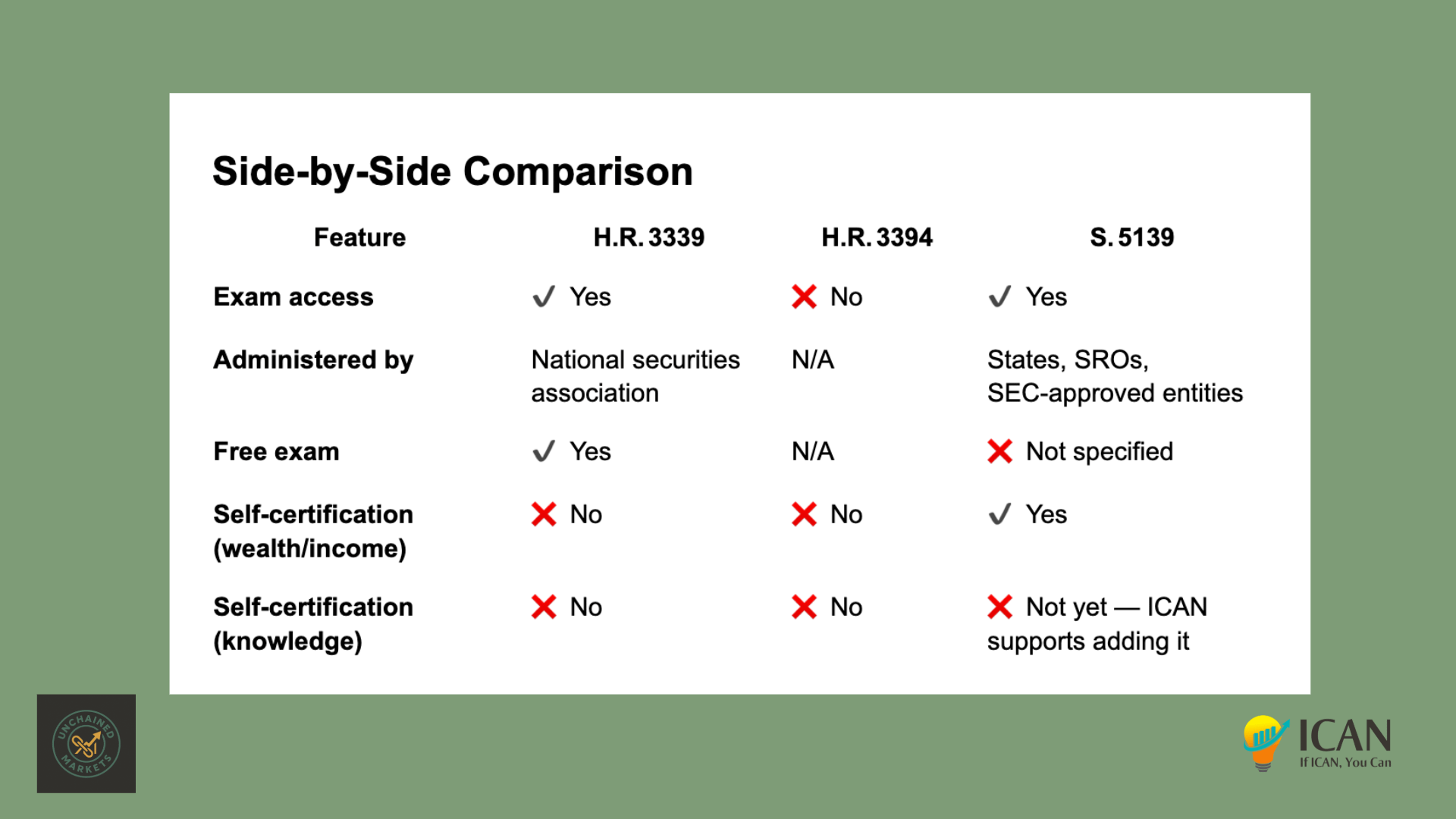
Here is our analysis of all three pieces of legislation regarding Accredited Investor Rule reform.
Requires the SEC to create a knowledge-based investor exam.
Allows the exam to be administered by a registered national securities association.
Requires the exam to be free of charge.
Sets a clear timeline: 1 year for the SEC to design, 180 days for launch.
✅ ICAN says: A strong first step. Focused and fair—but narrow. It should be expanded to allow state and private exam providers.
H.R. 3394 takes a step in the right direction by opening up accredited investor status beyond wealth and income to include “demonstrable education or job experience.” However, that laudable expansion comes with some unfortunate trade-offs that would entrench the very problems it seeks to fix:
Locks in the wealth and income thresholds in the statute, and indexes them to inflation—preserving exclusion permanently.
It shrinks—rather than expands—Accredited Investor eligibility, benefiting a narrow professional class while ignoring many savvy, self-taught investors.
Offers no exam, no self-certification, and no practical alternative to wealth.
It adds bureaucratic layers requiring a regulator like FINRA to verify education or job experience.
❌ ICAN says: This bill’s good intentions are outweighed by new regulatory baggage.
This Senate bill—Sponsored by Senator Tim Scott and Cosponsored by a bipartisan coalition of 10 Senators—offers the boldest and most inclusive vision:
Establishes a knowledge-based exam, which can be administered not just by FINRA but by state securities commissions, SROs, or SEC-approved entities.
Allows issuers to rely on investors’ self-certification of their qualifications, reducing compliance costs and mitigating risk of vexatious lawsuits.
Introduces new investor categories based on financial activity (e.g., owning $500,000+ in investments, or transactions capped at 10% of income or net worth).
Sets a firm 18-month deadline for implementation.
Includes an automatic trigger—if the SEC doesn’t act in time, the reforms go live.
Requires ongoing SEC review of the accredited investor definition to ensure continued relevance.
✅ ICAN says: This is the most comprehensive and investor-focused approach. We would like to see the bill require the test to be free, as H.R. 3339 does.
ICAN’s vision is an America where all people have the opportunity to improve their financial circumstances, and that of their family and community, through access to robust capital markets, helping to fuel vibrant local and national economies. Reform of the accredited investor rule is a key part of making that vision a reality.
ICAN supports real reform—and we’ve been fighting for it in court, in Congress, and in the court of public opinion. Any final bill should include:
Ability to become an Accredited Investor after passing a free knowledge-based exam that can be administered by states, SROs, and SEC-approved private entities, which captures the things investors need to know about the reality of today’s market.
Self-certification of knowledge or wealth — investors should be able to affirm their own readiness.
Auto-implementation clauses — don’t let SEC inaction kill reform.
“The accredited investor rule has long conflated wealth with wisdom. Congress seems to be taking seriously the idea that financial sophistication isn’t something you can measure with a bank statement.”
—Nick Morgan, ICAN President
“Technology has transformed how people learn, trade, and build wealth. Our securities laws need to reflect that—or risk leaving millions behind.”
—Mark Hiraide, Senior Legal Director & Policy Counsel, ICAN
This is a rare moment of bipartisan momentum to fix an outdated rule. If Congress gets this right, it can open the door for millions of Americans who are ready to invest but locked out by arbitrary standards.
ICAN urges lawmakers to embrace the inclusive, market-smart reforms in S. 5139, integrate H.R. 3339's requirement that the test be free, and accept H.R. 3394’s expansion of accredited investor status beyond wealth and income but reject its regulator-approval approach.
Learn More - https://www.icanlaw.org/accredited-investor
Thanks for reading Unchained Markets by ICAN Law! To share our work, click below.
No posts
Comments
Nothing yet. Say the first thing.
Sign in to join the conversation.