
In 2026, we’ve had the privilege of working with large enterprises, smaller mid-market firms, and consultants through our consumer bootcamp and through custom enterprise trainings.
I’ve noticed a few things in 2026 emerging as patterns that all companies must do.
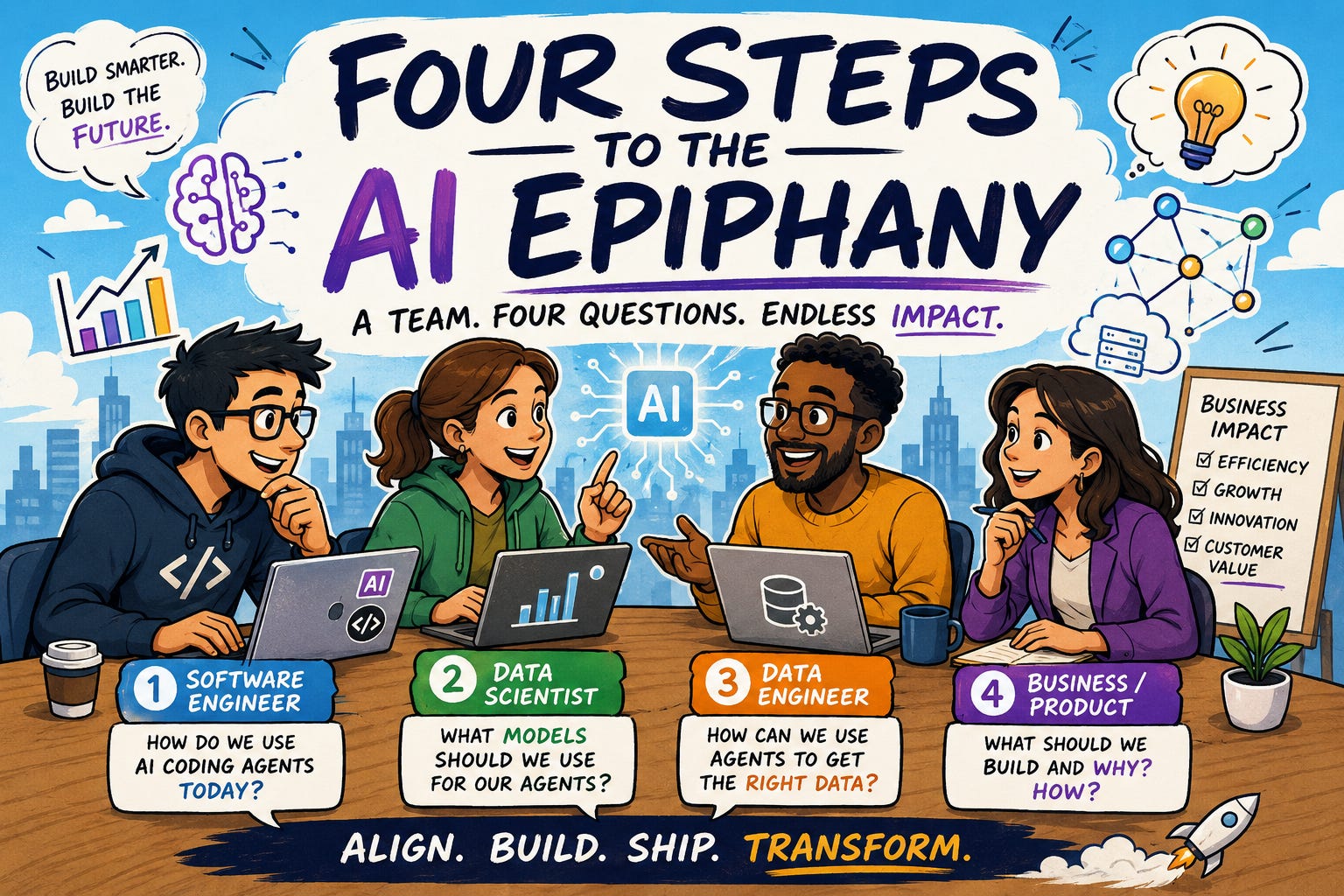
TL;DR: your teams must answer these questions:
Software Engineering —> “How do we use AI coding agents today?”
Data Science —> “What models should we use for our agents?”
Data Engineering —> “How can we use agents to get the right data?”
Business/Product —> “What should we build and why? How?”
Caveat: When it comes to deciding on the order that these things should be done in, you first must articulate a goal more specific than “transform the organization.” I would recommend that you start with a real ROI target for this quarter, this half, or this year, and whether you plan to hit it through savings (e.g., cost reduction) or new sales opportunities (e.g., increased revenue/net profit). Ideally, in any case, your target must flow down to the bottom line and your company’s net margins.
Four Steps to the Agentic AI Epiphany in 2026
1. Identify your deep production engineering talent
Skills gaps they need to fill today: the power and utility of the latest coding agents (e.g., Co-Pilot—>Cursor—>Claude Code—>Kiro—>???) as well as the tools that have emerged as industry standards for now (e.g., prompt templates, tools, MCP servers, skills, …), and best practices for how your organization will use them
What they will answer for the team tomorrow: “How do we onboard new engineers into our agentic coding workflows to maximize productivity?”
Going beyond and across domains: how do we host models and agents on cloud or local infrastructure efficiently to maximize not only performance but cost and efficiency?
2. Identify your deep data science (a.k.a. LLM engineering) talent
Skills gaps they need to fill today: state-of-the-art techniques used for pretraining, mid-training, and post-training of LLMs
What they will answer for the team tomorrow:
“What model should we use and why for any given client or internal team?”
“What tradeoffs are we making today by going with these models now?” e.g., when will we get too tired of our ouputs changing when the new model comes out?, when do big models get too expensive for simple tasks?, etc.
Going beyond and across domains: how do we test models & agents for prompt injection and other security issues after we’re done testing?
3. Identify your deep data engineering expertise
What they need to understand today: how LLMs and agents build on natural language techniques and classical information retrieval techniques to improve data extraction and agentic search & retrieval pipelines
What they will answer for the team tomorrow:
“how do we get the data we need into context to build our next MVP?”
“Why, when I put all of the data in one place and try to ask questions about it, does it not work? How can we do this better?”
Going beyond and across domains: how can data engineers help guide infrastructure decisions made at the product & solution architect level to make agentic search and retrieval easier with the data we collect this year rather than focusing on data that already exists in our historical archives?
4. Identify your problems: business domain expertise meets AI product management
What they need to understand today: Domain experts (SMEs/business people) must understand the importance of productizing (e.g., automating) current business processes, and how to do that. Product people must understand not only how to build products, but how to go up a level to understanding what the deep domain expert understands about customer and client problems.
What they will answer for the team tomorrow: the person with domain expertise who is a master of AI product management will be THE PERSON who leads teams of engineers and data folks to building and shipping successful LLM applications to production. All organizations must have these “what should we build and why?” people that combine strategic POC vision with MVP practicality and clarity.
Going beyond and across domains: how does this person also get into interactive development environments and begin vibe-coding their ideas directly? How do they develop deep empathy for their production engineers, data engineering, data science, devops, security, and site reliability teams?
Productization might just be the most important form of automation or optimization that your company can do.
The final step is, of course, to get all these people on the bus moving towards the same high-level mission, production vision, and strategy. For this, change management is key, but is beyond the scope of what we’re talking about here.
There are, of course, many technical issues that will remain. For instance:
As my agents are operating in production, how do I continue to manage context throughout the product development lifecycle?
As more agents that are built externally and internally start using agents I’ve already been operating, how do I manage all of that?
As my set of prompts, data, tools, skills, MCP servers, and suite of models start to solidify, how do I make sure that everything is not so rigid that it can’t adapt to the next big wave of technological adoption?
… and many more I am unable to think of, I’m sure.
To summarize:
Get production engineers to answer “how do we use coding agents today?”
Get data scientists to answer “what models should we use for our agents?”
Get data engineers to answer “how can we use agents to get the right data?”
Get business/product people to answer “what should we build and why? How?”
—
At AI Makerspace, we’ve developed a 1-week intensive curriculum that organizations can use to make progress on all of these fronts at once, and to help you identify who these people are in your organization. So far, companies are finding this kind of shock to the system quite useful. To learn more, reach out to me directly at greg@aimakerspace.io for the most recent iteration of what this looks like.
No posts
Comments
Nothing yet. Say the first thing.
Sign in to join the conversation.