
There’s been a lot of Canadian history made with ball and foot in recent years. The men reaching the 2022 World Cup and now braced to host in 2026. The women pinning an Olympic gold on a celebrated era.
Alexandre Da Rocha and his women’s national futsal team have already made a bit of their own, winning the Concacaf W Championship in Guatemala earlier this year, qualifying for the inaugural FIFA Futsal Women’s World Cup this month.
12 of the 14 players who lifted that trophy in May will be returning to the squad, no surprise given their run through that competition.
Canada lost their opening game 3-2 to Costa Rica, but rebounded with a 6-0 win over Honduras. Needing a win to move on they defeated the USA 3-1 in their final group stage match to set up a match against Mexico in the semifinal.
Down 3-0 before the half, Canada rallied scoring four unanswered goals before Mexico equalized at the death, sending the match to penalty kicks where Canada emerged victorious and booked their spot in the Philippines.
Canada then dominated the final, defeating Panama 8-2.
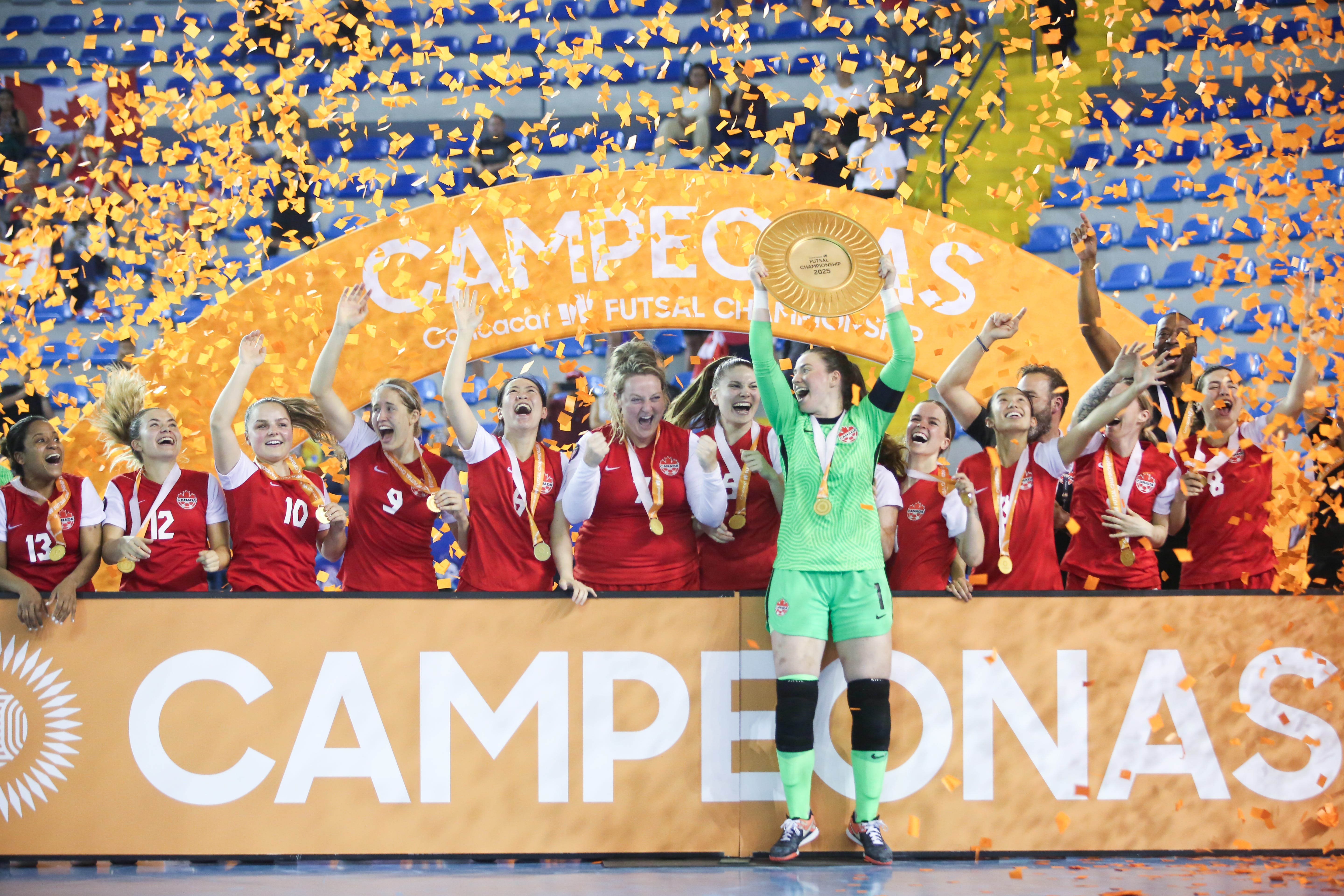
“The way that the team gelled together,” recalled Da Rocha of what saw the group through that run in Concacaf. “We didn’t have anyone that was – how do you say ‘égoïste?’ – no one was selfish, everyone supported each other; not only the players, but also the staff.”
“My co-head coach, Kyt [Selaidopoulos], who also coaches the men’s team as the head coach, and I, the whole staff, everyone was just on the same page every minute. We never lost our cool or patience. We had a very mature group,” he continued. “That was probably our biggest strength through the whole tournament, how everyone connected and stayed together.”
“We did lose our first game,” Da Rocha reminded. “We had to beat the US in the third game to keep going. We did that and we overcame a deficit against Mexico at halftime to bring it back to 4-3 and then they tied it up with seven seconds to go and we ended up playing PKs.”
“The way this team grew through the whole tournament was just very impressive in such a short amount of time, so having 12 returns is something that we would have expected,” he summarized. “The only two not coming – one is playing pro right now in Europe, she would have loved to be part of this experience, and the other one was not released from university to participate. So basically, that’s why we have so many because of the whole effect that we had.”
Katerine Delev and Magali Gagné were brought in to replace Sadie Sider-Echenberg and Keera Melenhorst.
Canada was drawn in Group B alongside Spain, Thailand, and Colombia.
Up first is Colombia on Saturday at 4 am, then Thailand on November 25 at 5 am. Canada will close the group stage on November 28 at 7:30 am against Spain. The first match is scheduled to be aired live on TSN+ and presumably the other Canada matches will be as well, the rest of the tournament looks to be available on FIFA+.
It will be a difficult group with all three opponents ranked in the top eight worldwide.
“Challenging is a good word,” agreed Da Rocha. “We are in a very tough group: Spain, probably favourites to win the World Cup; Thailand is ranked number four; Colombia is ranked number eight. We know it’s not an easy group, but if you want to perform in the highest stage possible you need to be playing top teams at some point in the tournament, we’re just going to be playing them early on.”
“There’s easily eight-ten teams that have a good chance of making it to the final at this tournament,” he observed. “So it is going to be challenging.”
Canada go in ranked 74th – though that may be misleading.
“We have only played five international games, the games that were played in Concacaf, so our ranking comes from only those five games,” explained Da Rocha. “We were not even ranked prior and we are adding three games to our itinerary once we get to the Philippines. We’re playing against Poland, then the Philippines, and then we’re playing Argentina as preparation for the World Cup.”
Split into four groups of four teams, the top two from each will advance to the knockout stages.
Two of the top performers from Concacaf – goalkeeper Léa Palacio-Tellier and pivo Esther Brossard – will be looked to lead the way once again.
Palacio-Tellier was named best goalkeeper in May, while Brossard with eight goals was both top scorer and best player.
“Léa was also our team captain,” noted Da Rocha. “She was outstanding, not only by her ability to stop the balls, but also the way she was able to lead the team on the court. She’s always very calm and players trust her.”
“Esther, she’s a young kid who is also a soccer player – she was at the CF Montreal Academy as a soccer player, went to the US, also played futsal in their high school years,” he said of the 19-year-old. “She was probably the first player who reached out to me once I was named head coach, saying, ‘Hey Coach, I know you know me as a soccer player, but I also play futsal, I want to try out for your team.’ And I said, ‘Well, I have an ID camp coming up and I’ll send it out to you.’”
“She was very big for us at the tournament,” Da Rocha highlighted. “Scored a lot of important goals, was always part of important situations offensively for our group.”
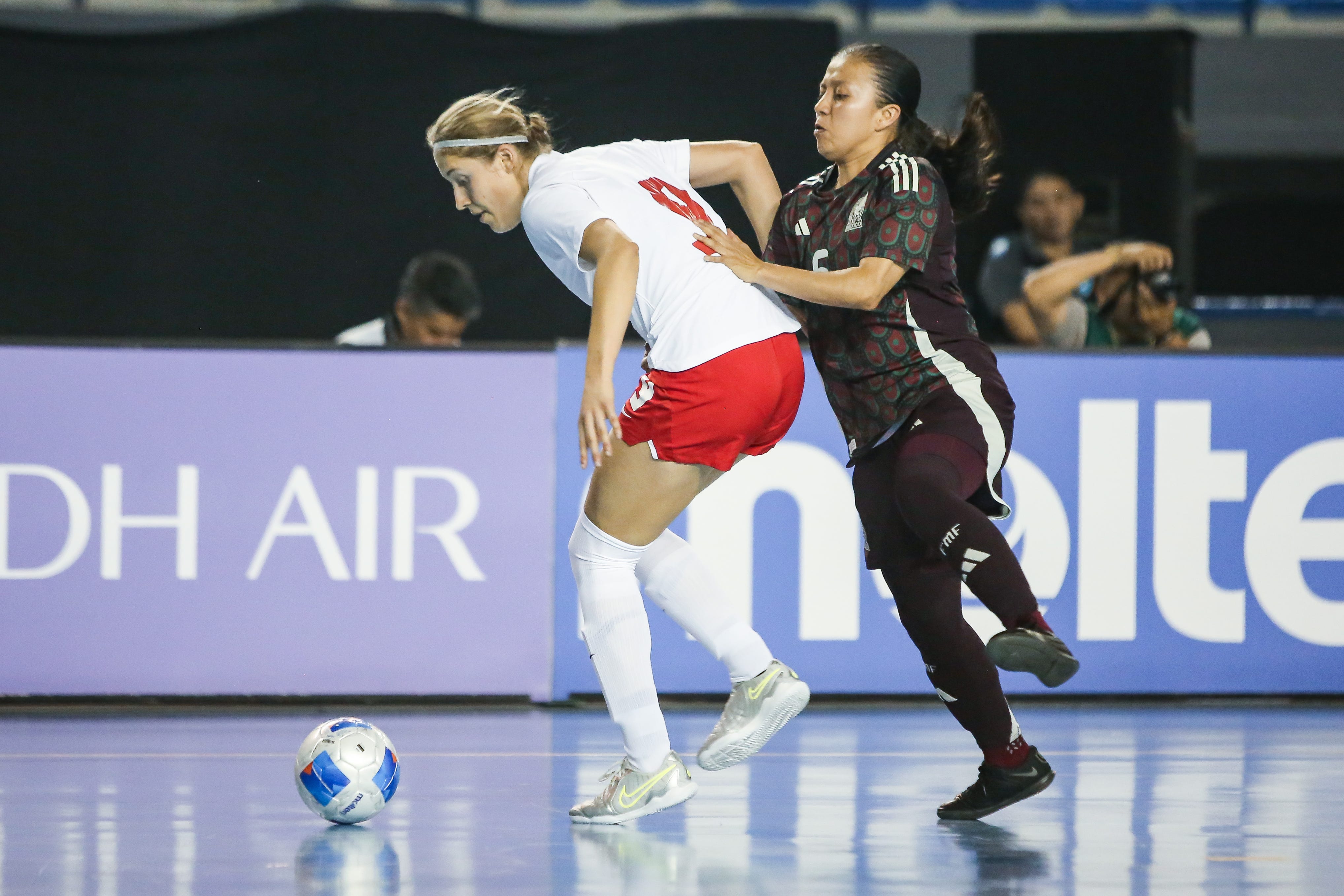
The group was able to get together a few times in the build-up to the World Cup, assembling for a pair of camps and staying in contact digitally.
“We had a four-day camp and a five-day camp, one in August and one in October, where we saw the players,” he outlined. “Also we’ve been doing weekly meetings, mainly tactical meetings. We’ve had some homework done. We’ve all also had challenges on the Nike Run app, they had physical training that we require them to do. We did meet up with the group weekly since July.”
Not only are they in a difficult group, but the side will have to overcome a major obstacle when that opening whistle blows.
“Our players have not been playing futsal since we qualified,” lamented the coach. “There’s no futsal leagues across the country that run during the summertime, so most of our players have been playing soccer and are just starting back into futsal. We had some camps, but it’s not the same thing as playing on a weekly basis.”
Just another thing for that character to overcome.
“Obviously we all want to win games, but I always want to leave an impression that fans will love what we’ve left out on the court for them,” promised Da Rocha. “During Concacaf we became fan favourites, the charisma that the players have they see.”
“Being down in the semifinal game, the game that qualifies you for the World Cup, coming back the way we did in second half, just shows how much character we have and belief that we can come back from tough situations,” he continued. “The maturity level of these players is also very impressive. Our average age is around 27 years old. Yes, it’s a new team, but it’s a team where we have humans that have a certain level of maturity – that really helps us in adversity.”
There is a sense of purpose that begins with the coaching staff.
“The staff is not only a very good staff, but everyone works together to make things happen. Kyt and myself, we bring that into the rest of the group – everyone feels implicated and that for us is very important,” Da Rocha stated. “The players and the staff, no one does not feel a part.”
“I’ll give you an example: Léa is our leading keeper, she was in net for most of the minutes. Jadyn [Steinhauer], a keeper from Saskatchewan, she comes in every time we have a penalty kick against us,” he detailed. “She’s the one that saved the penalty kick that qualifies us to the World Cup. The players were ecstatic to see Jadyn stop two penalty kicks.”
“And that’s the way this team is built. No one is going to feel like they’re less important because they play less or because they they’re not as involved,” Da Rocha stressed. “Everyone feels like they bring their own share to the success.”
Every single player named to Canada’s squad hails from either Quebec or Saskatchewan, the two provinces at the forefront of the game in Canada.
“Quebec has had their own premier league for over 10 years now and Saskatchewan has been doing same thing for the past four or five years. Right now those are the two provinces that are putting futsal on the highest stage possible,” explained the coach. “Some other provinces are starting now –I’ve been talking to a lot of technical directors from different provinces to try and move this sport forward. Ontario is doing a youth league in the next few years, they’re starting with the U-15 and they’re slowly going to move up.”
“In Quebec, in high school, futsal is by far the sport that has the most players of any in the province. We have many 1000s of futsal players playing all summer with their high school teams. That would be the example,” held up Da Rocha. “Whereas British Columbia where there’s really no futsal federated league – there is a league that exists, but it’s not with BC Soccer at this point. A lot of provinces have invited me to come over to discuss and try and start growing the sport, so we’ll see what happens in the next cycle.”
It takes a similar yet different skill set compared to the average soccer player to excel in futsal.
“It’s a lot of different things. There’s different positions. What we’re looking for is players that are able to control the ball properly because that’s very hard – and when I say that, it’s not only as a soccer player, but as a futsal player,” laid out Da Rocha. “We’re also looking into players who can be very good in transition both ways, offensively, defensively. What we’re having a hard time finding today is players who can take opponents one-vs-one.”
The smaller confines and fewer numbers require sharper wits.
“It’s how disciplined you are,” Da Rocha pinpointed. “On a soccer field where you’re 11 players, if you’re not well positioned or your run is late, you have ten other teammates to help you out. In futsal, field being smaller and less players, we can’t have a player that’s not disciplined tactically.”
“Tactical intelligence and awareness are important,” he underlined. “And for a goalkeeper it’s pretty simple: it’s shot stopping. We need a keeper who is going to stop balls from short ranges and if this keeper is good with her feet and also with her hands for throwing balls, it’s something that we would like to have in the group.”
With the first two matches in the books – 6-0 wins for both Argentina and Poland, over Morocco and the hosts, respectively, Canada are eager to make their mark at the World Cup.
“I’ve been to World Cups, Concacaf [events], World Championships, but to be part of the first-ever team to go to the World Cup means a lot to me,” said Da Rocha. “I want to make sure that my staff, my players, we all give our best and understand that this is a unique opportunity in front of us and we really need to take as much as we can of this experience, of this tournament.”
“I think we’ve made our country proud by qualifying in the way we did,” he closed. “We would like to surf on that wave again and make sure that regardless of results that people will be proud of the team that they’ll be seeing on their screens.”
No posts
Comments
Nothing yet. Say the first thing.
Sign in to join the conversation.