
Welcome to the production log of my first feature film, The Big Pay Off. My budget is $15,000 and I am producing and releasing it completely independently from the current Hollywood regime. If you are a new reader and are curious why I’m doing this, you can read my manifesto here. Thanks for stopping by!
One of the good things about shooting on the street in Los Angeles is that people are very respectful and polite. This being an industry town, however decimated, means people see a film shoot of any size and know not to interfere. If you’re set up on a side walk, passersby will not walk through your shot but change the side of the road or go around you even if you tell them it’s safe to walk in front of the camera.
The equation changes a bit if you’re shooting at night downtown and a club just let out hordes of drunken revelers. They will have no compunction about walking through your shot, but they will be good sports about it. They will inquire about the movie, perhaps offer you weed and ask if they can be in the scene. Then they’ll move on and forget about you as soon as they turn the next corner.
When I conceived of The Big Pay Off, my main strategy to add production value on a tiny budget was to shoot out and about in Los Angeles, an ugly town that looks amazing on camera. My budget for permits was and is exactly zero so it would all have to be done guerilla style— point and shoot, in and out, hope no one complains and sends the cops.
We have done this enough times now that I can offer a taxonomy of strangers’ reactions to our unsanctioned filming. If you are a nondē filmmaker and thinking about location shooting without permits, this might be of interest to you. Without further ado, here are the four types of people you will encounter, and some lessons learned along the way.
The helper
It was a late morning in June, and we were set up on a residential block in Burbank. Our production assistant Jack remarked that the houses lining the road looked perfect. What he meant was that they looked exactly like the kind of houses he would see in movies growing up. Because movies, and today’s entertainment CEOs will never believe this, but movies used to be shot in Los Angeles, on blocks just like these. What a concept!
We had set up a dana dolly for a short tracking shot of our main character walking down the road. My DP Kate and I were working out the blocking with the two actors in the scene. Suddenly, an old lady came out of the house we were in front of. She wished us a good morning and asked what we were doing. My first instinct is usually to lie but Kate is a better person and cheerfully explained we were doing a small movie and would only be set up there for about 15 minutes to get one shot.
“No problem”, the woman chirped. She was only asking because she put out her trash bins that morning and was wondering if she should take them in so we could park our vehicles in front of where we were. Indeed, that would be helpful. So we wheeled the trash bins away under the woman’s supervision and moved the car with the equipment in their place. She wished us luck with the shoot and went back inside her house. When we were done filming, it saved us time and effort to load out equipment.
This anecdote is only a small example, but in my experience, as long as you’re respectful of your environment, local residents will be supportive if not helpful. Don’t create a ruckus, have a nice conversation if someone wants to chat, and you won’t have any problems.
The questioner
We encountered the questioner, a variation of the helper, on the same day I described above. We had moved on to another block. We were now shooting inside of a moving car. Our two actors and Kate would drive around shooting the scene, myself and Jack would hang back fire watching the equipment. The actors and Kate would go for a couple of takes, come back, I would watch the playback, give my notes, then they would go off again.
While Jack and I were waiting around, the owner of the house we were in front of came home in his car. He stepped out, surveyed the equipment on the sidewalk and immediately came over to chat. He wished us a good morning and asked what we were doing. Kate wasn’t there to save me from myself so I countered my usual that we were shooting a student film. “What school?”, the man asked. Improbably, no one had ever asked me that before. I had told this lie countless times over the course of the shoot and no one had ever thought of asking what school it was for. I had no ready answer. There was an awkward pause, then I blurted out “USC”, praying he wouldn’t ask what program I was in.
Thankfully, he was satisfied with my answer and offered that he was working in the industry himself as a composer. Jack, who is working on his own project, was in need of a composer, so they briefly talked about it and exchanged contacts. Kate and the actors came back around, the man wished us luck with the shoot and went inside his house.
If you’re shooting around LA, the questioner is by far the type of person you’ll encounter the most. Nine times out of ten they are just curious to know what your project is about, eight times out of then they work in the industry themselves, six times out of ten they will have opinions about what you’re doing, which you are free to take in, nod politely, and then promptly ignore. One time out of ten, some guy watched a take from a distance, then came up to an actor, gave him a note on his performance and went on his merry way. I told the actor to ignore whatever the man had said, gave him my note and we went for another take.
The hall monitor
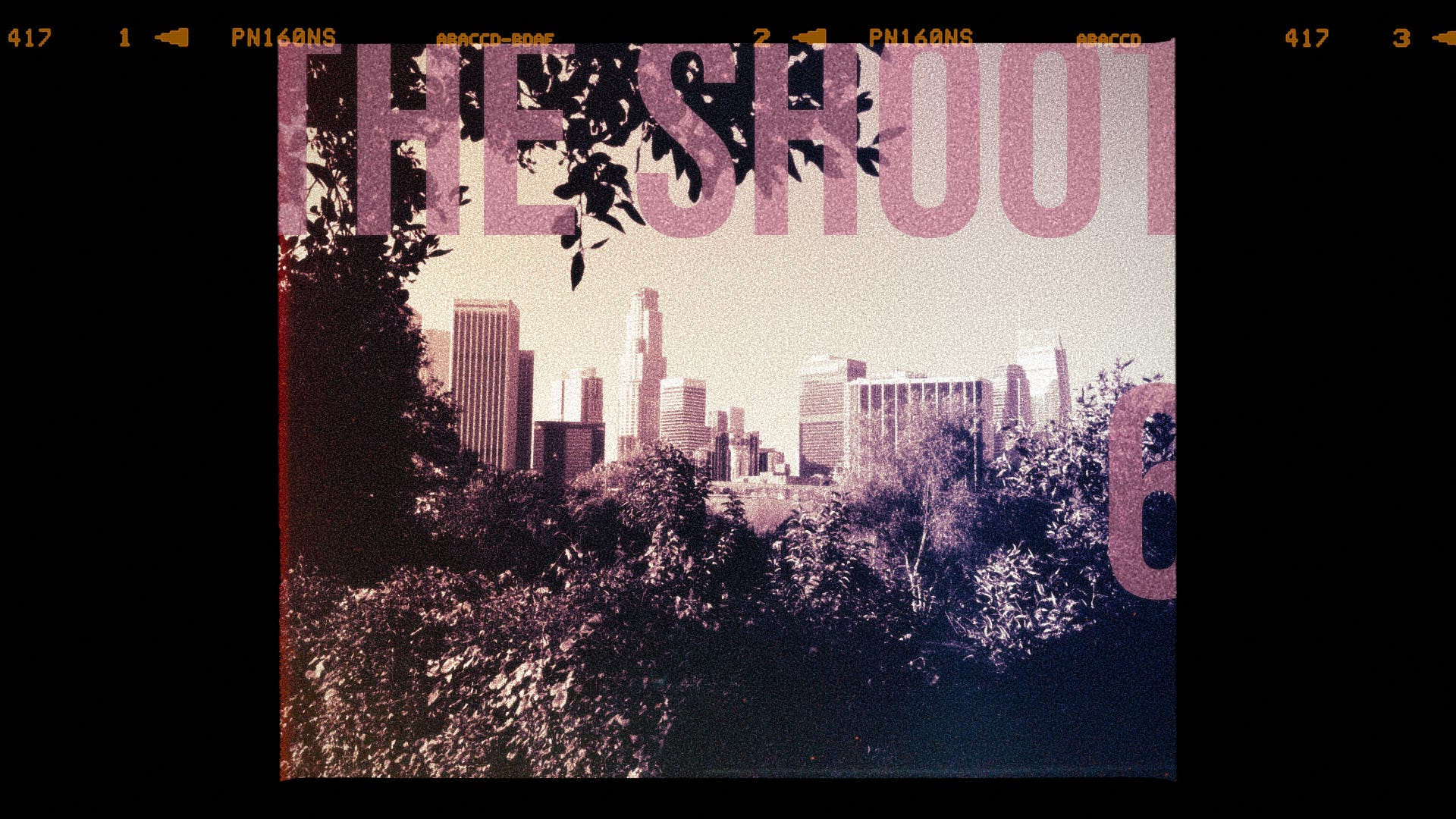
It was another lovely morning in downtown Los Angeles. We had scouted a spot in Vista Hermosa Park from which we could see the skyline. We had planned to shoot a short scene there with two actors. We had gotten there at 8am to secure the spot and take advantage of the beautiful Southern California morning light before the sun gets too far up in the sky and the light becomes ugly again.
Whenever we shoot in public, we always keep our footprint as small as possible. That morning, it was just Kate and myself, as well as two actors. We had planned to use the dana dolly in the park, so we shlepped the rails up the hill and set them down next to a tree. I stayed with the equipment while Kate went back to the car to get some more stuff. That’s when the hall monitor, a more disruptive version of the questioner, made his entrance.
A park worker came over and asked if we had a permit to shoot. We hadn’t even set up anything yet, nor were the actors there! I said we didn’t have a permit but were only shooting a short travelogue for Youtube. The man countered that wee needed a permit or had to leave. “We need a permit even for a youtube video?”, I asked. Somewhat mysteriously, his answer was that we weren’t allowed to shoot any commercials in the park. I assured him we weren’t shooting a commercial, that this was just a Youtube video for a small channel. “Okay, I’ll come by later to check”, he said, and left.
When Kate came back, I told her we would scrap the dana dolly. Everything would have to be on sticks. I wouldn’t wear headphones to check the sound, we wouldn’t slate— this would have to be as inconspicuous as possible to not upset the hall monitor. The actors showed up, I briefed them on the situation, we started shooting.
We were on our second set up when the hall monitor came over again. He asked if we were shooting a commercial. I assured him again we weren’t. He pointed at an Icee drink one of the actors was holding as a prop. “That’s a commercial beverage!”, he shouted. We explained that it was just incidental, the video was not about the Icee, and would it put his mind at ease if we got rid of the drink? He thought for a moment, then snorted that he would google us, and if he found out we were shooting a commercial, we would hear from him again. Exactly what he would google, or how he would contact us remained a mystery. He stomped away and we finished shooting the scene.
I know that for some people shooting in public without permits is somewhat of moral gray area, and that lying about what you’re doing to someone simply doing their job might make it even worse. My stance is that the supposed movie capital of the world should not make it impossible for small productions to afford shooting here. The Big Pay Off celebrates the city of Los Angeles in every frame shot on location. Kate and I love this city and wanted to express this in our work. The city and its biggest industry should embrace this instead of cutting us off at the knees.
In my experience, the hall monitor is not a figure you will encounter often. But if you do, how you react to them is crucial. I never admit that we are shooting a feature film because it both makes alarm bells go off and dollar signs appear in their eyes. But I never try to obfuscate the scope of what we’re doing. When the park worker first approached me, I told him we would be four people and would be out of there within ninety minutes. That’s exactly what happened. A lot of the time, the hall monitor simply wants to avoid a situation where dozens of big trucks and hundreds of crew trample around disrupting everything, and that is a completely fair concern. But more often than not, if they see that you’re a small production that won’t cause any disruption, if you remain calm and polite, maybe even crack a joke and make them laugh, they will let you do what you need to do without calling the cops on you.
The snitch
Because calling the cops, some people do.
We encountered our snitch during blue hour in Burbank, California. Beautiful, but we were on a time crunch to not lose light. We were shooting the penultimate scene of the movie in which our lead and main villain have a tense conversation in a stationary car. The car was parked on the curb. We were able to shoot the villain sitting at the steering wheel safely from the sidewalk. For the reverse, the camera would have to be in the road where cars were driving by. It wasn’t safe.
There was a small burger restaurant on the corner of the street we were on. It had a sizable parking lot. Not a single person came in and out of the restaurant the entire time we were there, nor was there a car parked in the parking lot. We decided to park the car parallel to the street in the lot, get our reverse shot and high tail it out of there. We planned to be there for ten or fifteen minutes tops.
As soon as we set up, the owner came out of the restaurant. He wished us a good evening and asked what we were doing. I gave him my usual spiel and assured him we would be gone within fifteen minutes. He seemed friendly enough and pointed out we didn’t ask him for permission. If we had, he would have allowed us to shoot there no problem. He was right, I couldn’t argue with him there, it was my mistake. I should have gone inside and asked for his permission. So I asked him on the spot and he agreed to let us shoot there. He then walked away, we got our shot and were gone within ten minutes.
As we carried the camera and some more equipment back to our base camp, a police cruiser stopped next to us. A voice boomed, “are you guys done shooting?” I said we were, and the police drove on. Immediately, I knew the restaurant owner had called the cops on us, despite his friendly façade.
We set up the next scene in the front yard of our base camp, which was the house of a friend who had given us permission to shoot there. On a hunch, I had looked it up the night before: in Burbank, a permit is not needed to film on someone’s property if the owner gives their permission. Finally, we were in the legal green zone!
We had completed one take when the police cruiser showed up again. A voice demanded to speak with the person in charge. I walked over, and a bizarre good-cop-bad-cop routine ensued. The cop closest to me was all smiles and did most of the lying for me (“I’m sure this is just a student film, right?” - “I’m sure you didn’t mean to do this, right?” - “I’m sure you’ll never do this again, right?”) while his partner, an unpleasant meathead, bellowed things like “we can write you a citation for this!” They confirmed with me the restaurant owner had called them, I groveled a bit (“lesson learned”), my friend who owned the house we were at told them we were allowed to shoot there, and our brave protectors and helpers, having done their duty to protect and help me, went their way to do some more protecting and helping without fining me.
I got lucky. I know people who did get a citation in a similar situation, and I know people who got fined by the city. Shooting on location without a permit is a risk, and you have to be prepared to deal with the consequences. I will say that we saw police driving by several times while shooting on the street and they never said anything. We even shot in front of the city jail with innumerable Sheriffs around, and no one batted an eye. The only other time we had an encounter with law enforcement was when we shot in Elysian Park and had to get one more shot after they had already closed down the park. They threatened to cite us for trespassing, which, again, is fair enough. (We still got the shot and sped out of there like literal bandits.)
The one lesson I can impart from this episode is that you should always ask for permission if you’re shooting on someone’s property. I can totally understand a business owner who doesn’t want to provide their parking lot to our shoot, however small and short lived it might be. Not doing that was my mistake and I take full responsibility for that. In my experience, business owners are more than happy to be helpful if you ask ahead of time. We even got to shoot inside of a restaurant for free for five hours simply by asking nicely.
In my opinion, shooting on the street without a permit is not as big of a deal as some people might claim. You just have to know your audience and be aware of your surroundings. It is much more risky to do it in an affluent residential neighborhood where rich busy bodies call the cavalry every time, as the German saying goes, they fart sideways. But do it on a busy street downtown or in Hollywood where you will see police everywhere and, counter-intuitively, no one will care.
Keep your shoot as small as possible, don’t make a show of it, don’t be an asshole, be nice to locals and friendly inquirers. Be smart, keep it moving. Don’t shoot a 9-page dialogue scene with complicated tracking shots in the middle of a busy sidewalk. Keep in mind day of week and time of day, and how they might influence your surroundings. Pro tip: don’t shoot next to a school on a school day at 3pm. Check the games schedule if you’re shooting around Dodgers Stadium, etc.
If someone wants to chat, have a conversation with them. Be friendly, don’t be scared.
And if you see the cops… well, run. Run for your life.
(This is not legal advice.)

No posts
Comments
Nothing yet. Say the first thing.
Sign in to join the conversation.