
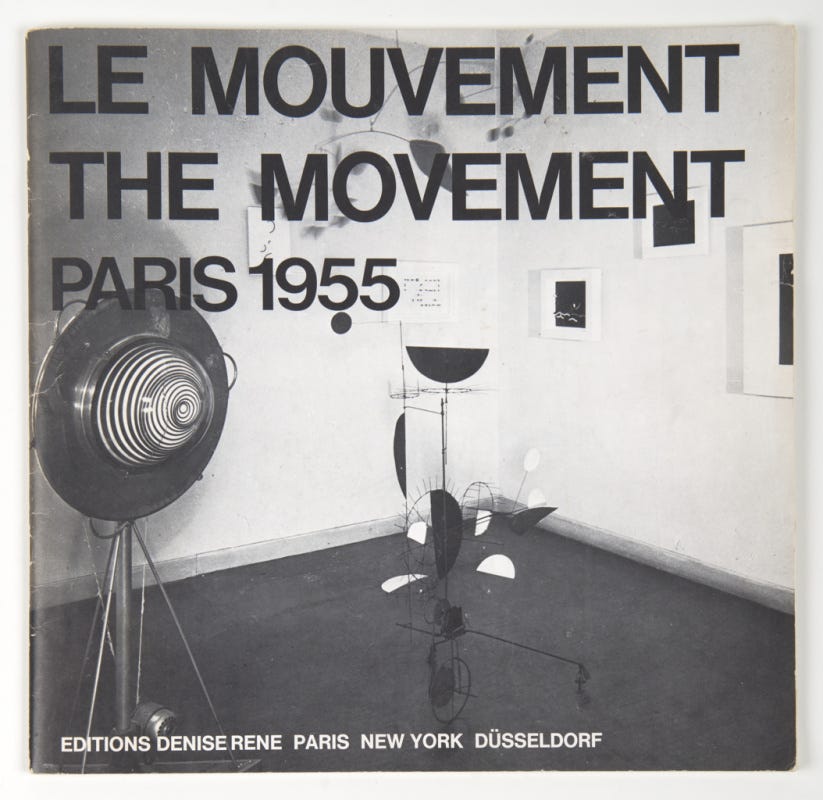
With many galleries today seemingly more focused on the commercial operation than the art, looking back through art history, several galleries stand out for creating movements, counter-currents, or parallel tendencies to the dominant sensibilities of their era. Galerie Denise René was one of these galleries, challenging the tide of the times with the exhibition Le Mouvement in 1955. Situated at 22 rue La Boétie in Paris’ 8th arrondissement, the gallery, named for its owner Denise René, sought to champion a rigorous, constructed vision of abstraction at a moment when gestural and lyrical painting dominated the Parisian scene.
Galerie Denise René had opened in 1944, around a decade before Le Mouvement. By 1946 it had become a dedicated space for abstract art, and a series of cornerstone exhibitions followed: Tendances de l’art abstrait in 1948, pushing a more structured vision of abstraction, and Klar Form in 1951, a traveling show that reached Scandinavia and Belgium. Before catalyzing kinetic art, René had already spent years building a network, a public, and an international legitimacy for a kind of abstraction that differed from the one then dominant in France.
Her role quickly surpassed that of a traditional dealer. René worked on three fronts simultaneously: discovering and supporting younger artists financially; constructing a history, placing pioneers alongside emerging figures so that novelty could appear as a solid continuation of the avant-garde; and internationalizing the scene. She understood early that a gallery should not passively wait for the world to come to Paris.
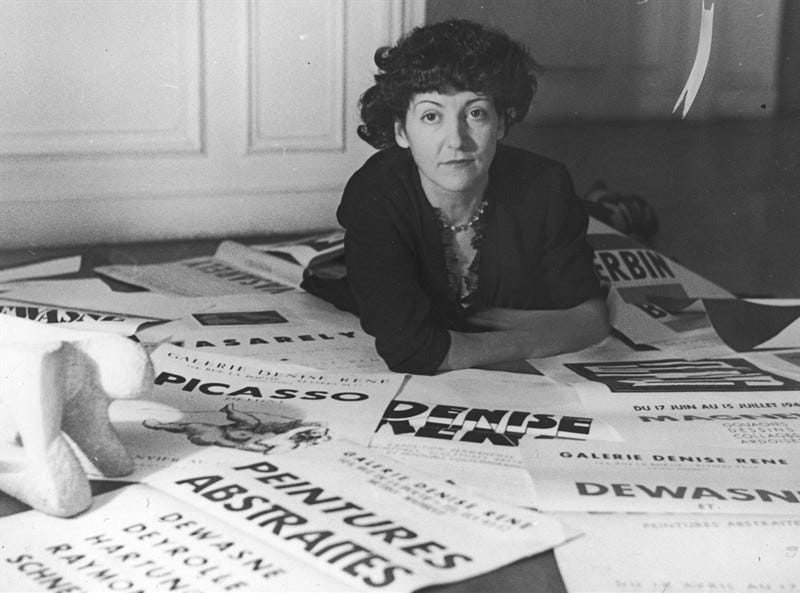
At this point, it is worth briefly clarifying what was at stake in this emerging language. Kinetic art, as it would later be defined, introduced movement as a central element of the artwork, whether real or perceived. This movement could be physical — produced by air, mechanisms, or motors — or optical, generated through vibration, instability, and the viewer’s own perception. In this sense, the artwork was no longer conceived as a fixed and self-contained object, but as something unfolding in time, dependent on space and on the spectator’s experience. It is precisely this shift that Le Mouvement sought to bring together: not a single definition of movement, but a range of approaches that, taken together, redefined what an artwork could be.
Le Mouvement was a testament to this vision. The exhibition brought different generations into dialogue — Jean Arp, Alberto Magnelli, and Sophie Taeuber-Arp appeared alongside younger artists such as Vasarely, Robert Jacobsen, and Jean Dewasne. The approach reached its pinnacle in 1955, drawing on figures like Marcel Duchamp and Alexander Calder to lend context and legitimacy to lesser-known artists: Jean Tinguely, Jesús Rafael Soto, Yaacov Agam, and Pol Bury. Denise René did not invent a movement from nothing. She created the conditions in which a new sensibility could begin to be read as one.
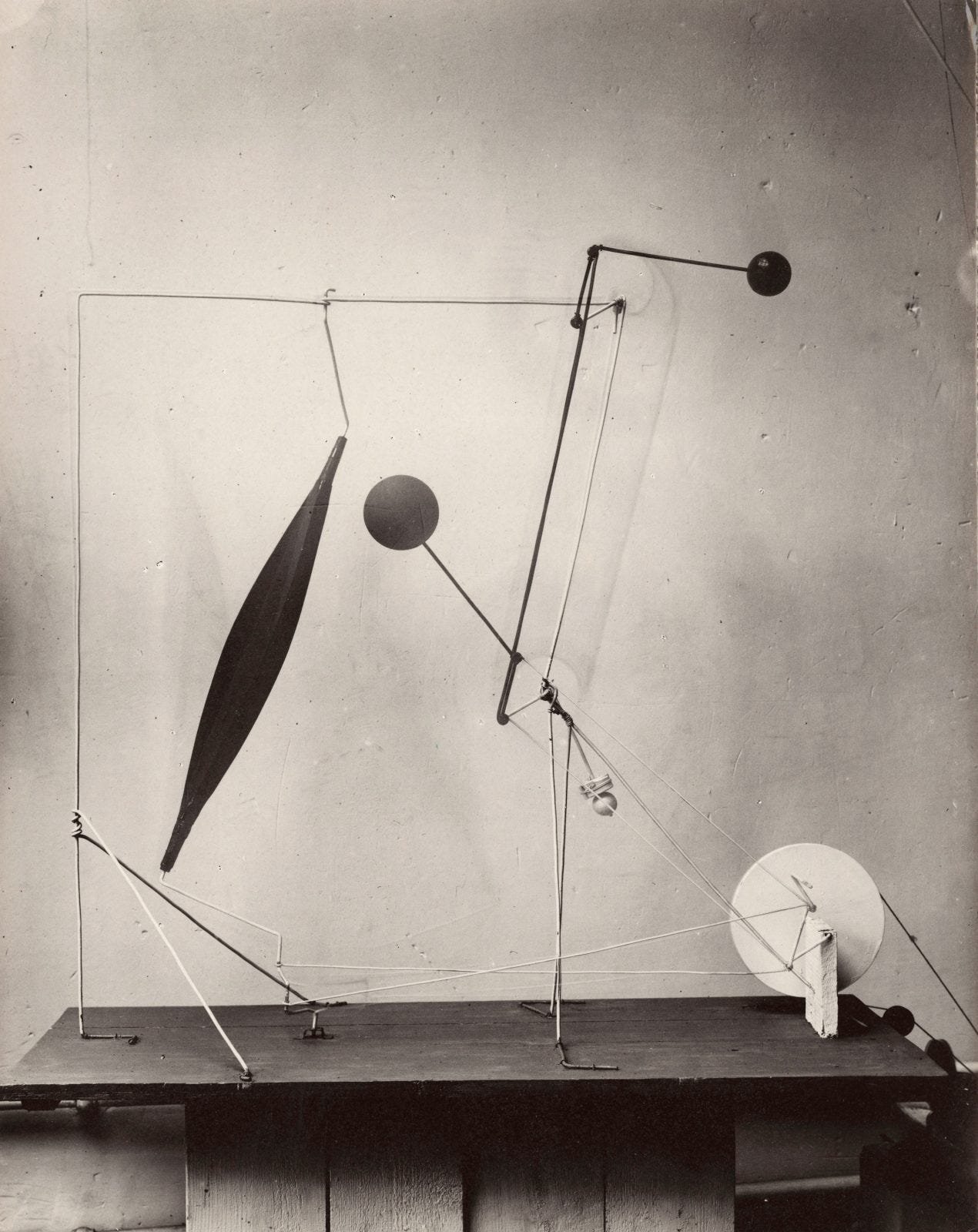
So what was Le Mouvement, really? The ambition was not simply to show works in motion. It proposed a deeper redefinition of visual art through movement, space, and time — bringing together real movement produced by air or motor, suggested movement, optical vibration, perceptual instability, and the participation of the viewer. Its lasting importance came from offering not a single formula, but a new field of inquiry in which the artwork ceased to be fixed, becoming instead changeable, active, and open to the experience of the spectator
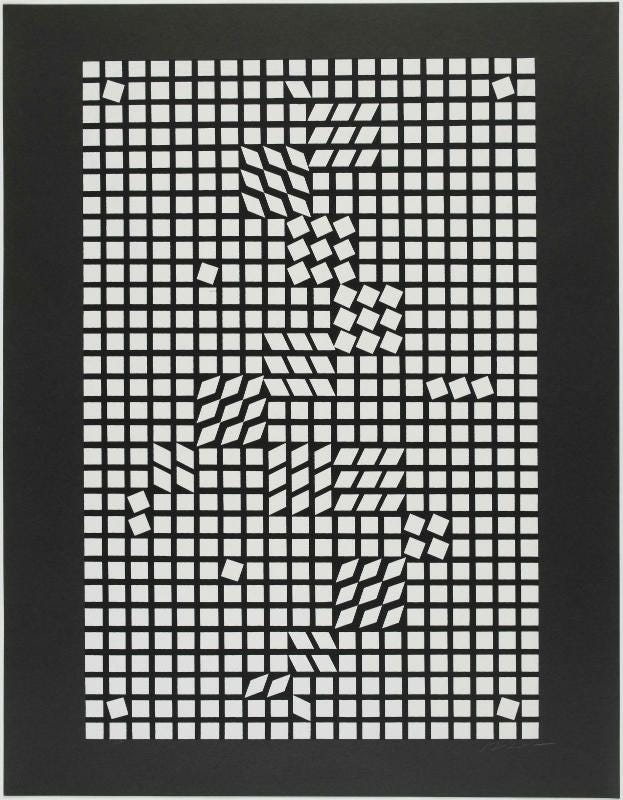
Each artist interpreted movement in their own way. Calder’s mobiles encapsulated suspended, aerial movement — a sculpture that could change constantly without losing its identity. Duchamp introduced optical and mechanical experimentation, linking the exhibition to a longer history shaped by rotations, visual machines, and illusion. Vasarely occupied a singular place, both exhibiting and providing the theoretical foundation for the project. In 1955, he published the now-famous Yellow Manifesto, formulating the idea of a “kinetic plasticity” and arguing for a transformation of art toward more open, reproducible languages tied to perception. Stumbling upon it at the Grand Palais last year, I was struck by how precise and uncompromising the language was — not the hedged vocabulary of an artist seeking acceptance, but the confidence of someone who already knew where things were going. Tinguely introduced a more unstable, mechanical, even ironic register. Soto, still in an early phase, was already moving in the direction that would define kinetic art. Bury explored a quieter, minimal instability. Agam worked through variability and shifts in point of view.
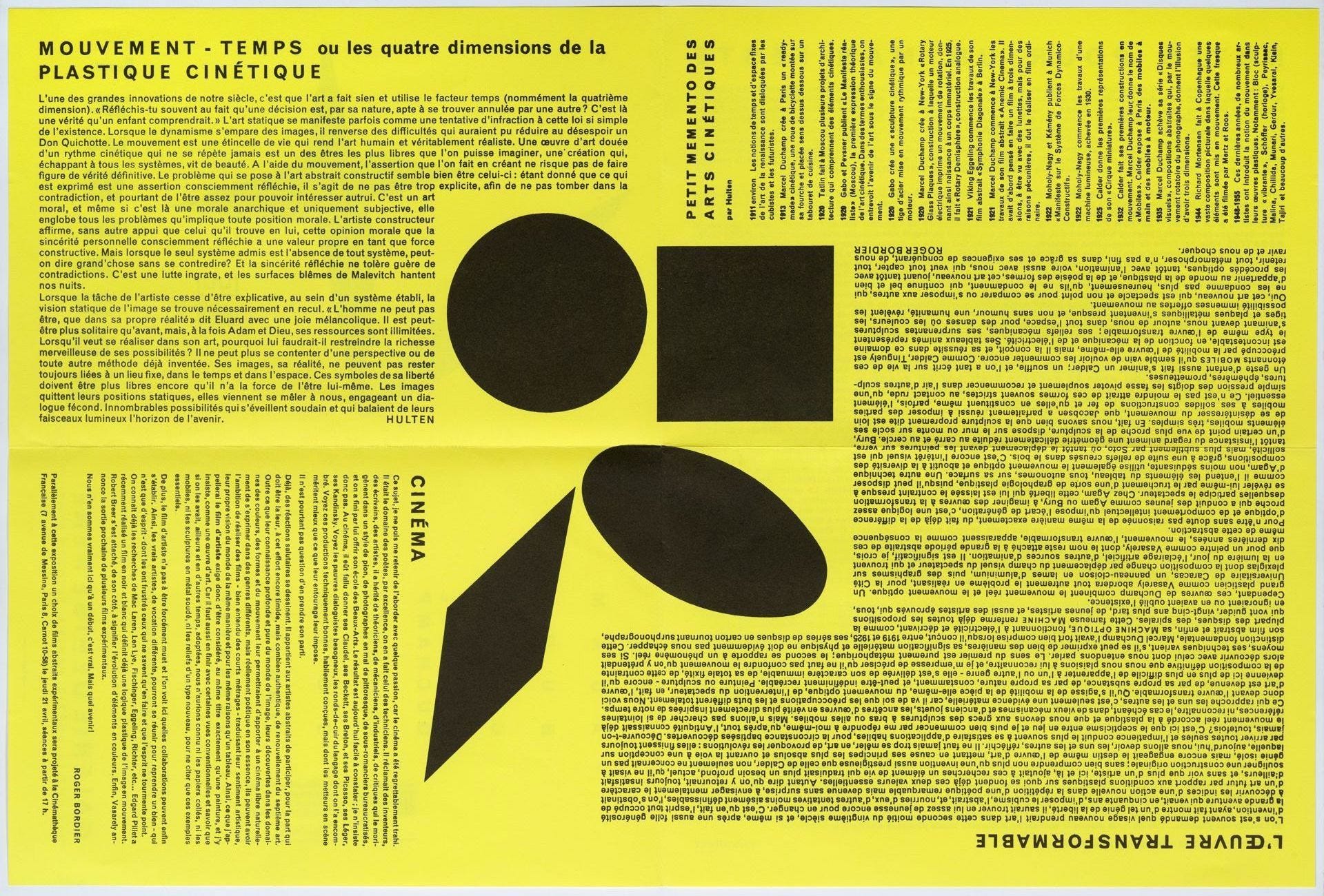
These differing approaches did not create clash but harmony, and that harmony is what gave the exhibition its richness and its lasting importance.
Considering Le Mouvement today invites reflection on what a gallery can actually be. René’s example is a reminder that a gallery need not function purely as a marketplace — that it can carry a deeper conviction around a sensibility, a movement, or a way of understanding art that exceeds each artist taken individually. She was not simply exhibiting works but constructing a framework, defending a vision, and taking risks for something that had not yet fully found its place in the artistic landscape.
It would be worth recovering a little of that energy — not nostalgically, but as a reminder that a gallery can also be a place of discovery and conviction, and not merely a site for the circulation of works.
This article is written as a prelude to the upcoming exhibition dedicated to Alexander Calder at the Fondation Louis Vuitton.
Pablo Nouhet,
Paris, France
March 24, 2026
No posts
Comments
Nothing yet. Say the first thing.
Sign in to join the conversation.