
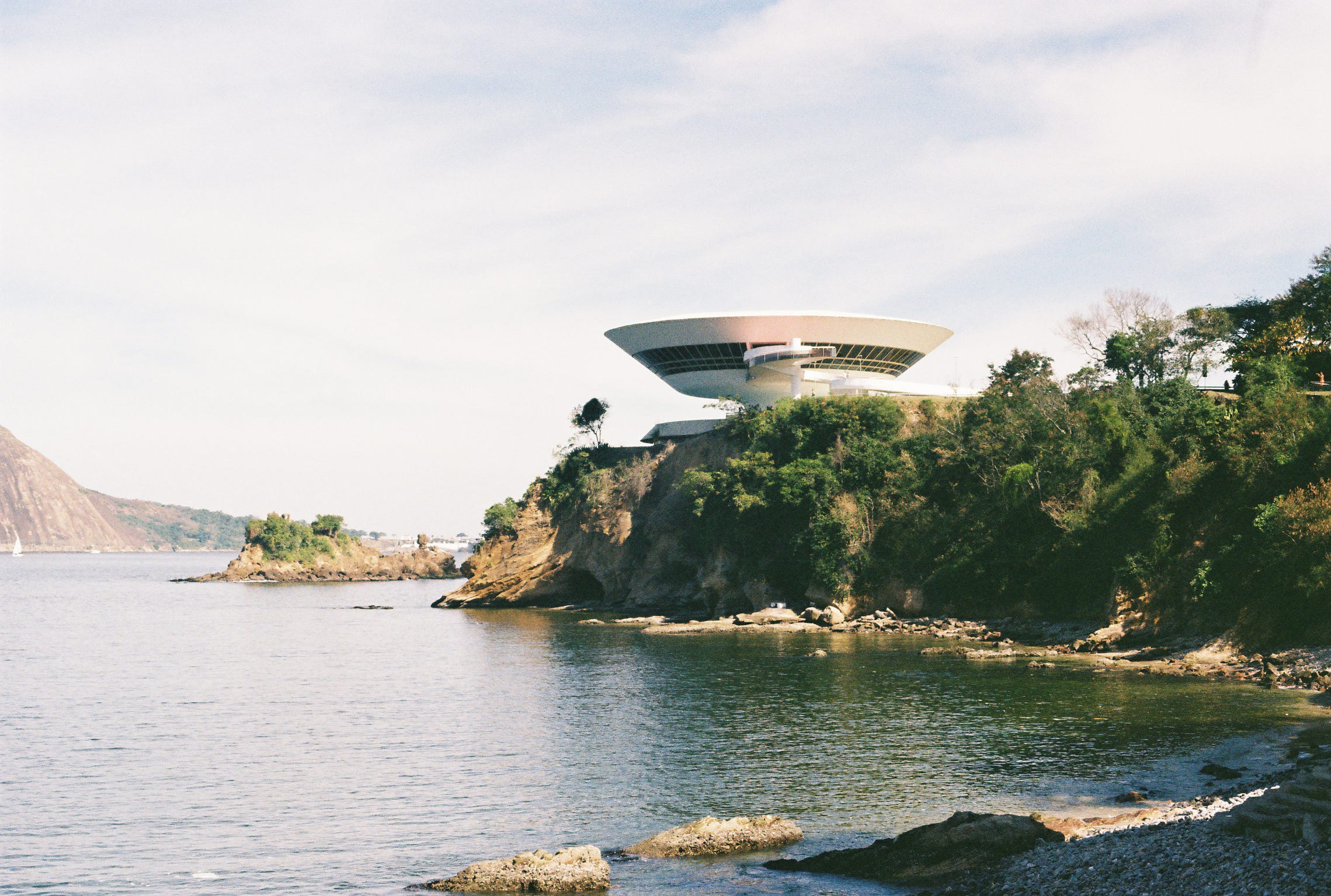
The Niterói Contemporary Art Museum (MAC), inaugurated in 1996 and designed by Oscar Niemeyer, is one of the most iconic works of modern Brazilian architecture. Suspended above Guanabara Bay, the building is more than a home for contemporary art; it is a sculptural object where modernist utopia and the Carioca landscape converge. This text is about that encounter—about the experience of standing before a structure that transforms the act of lookin
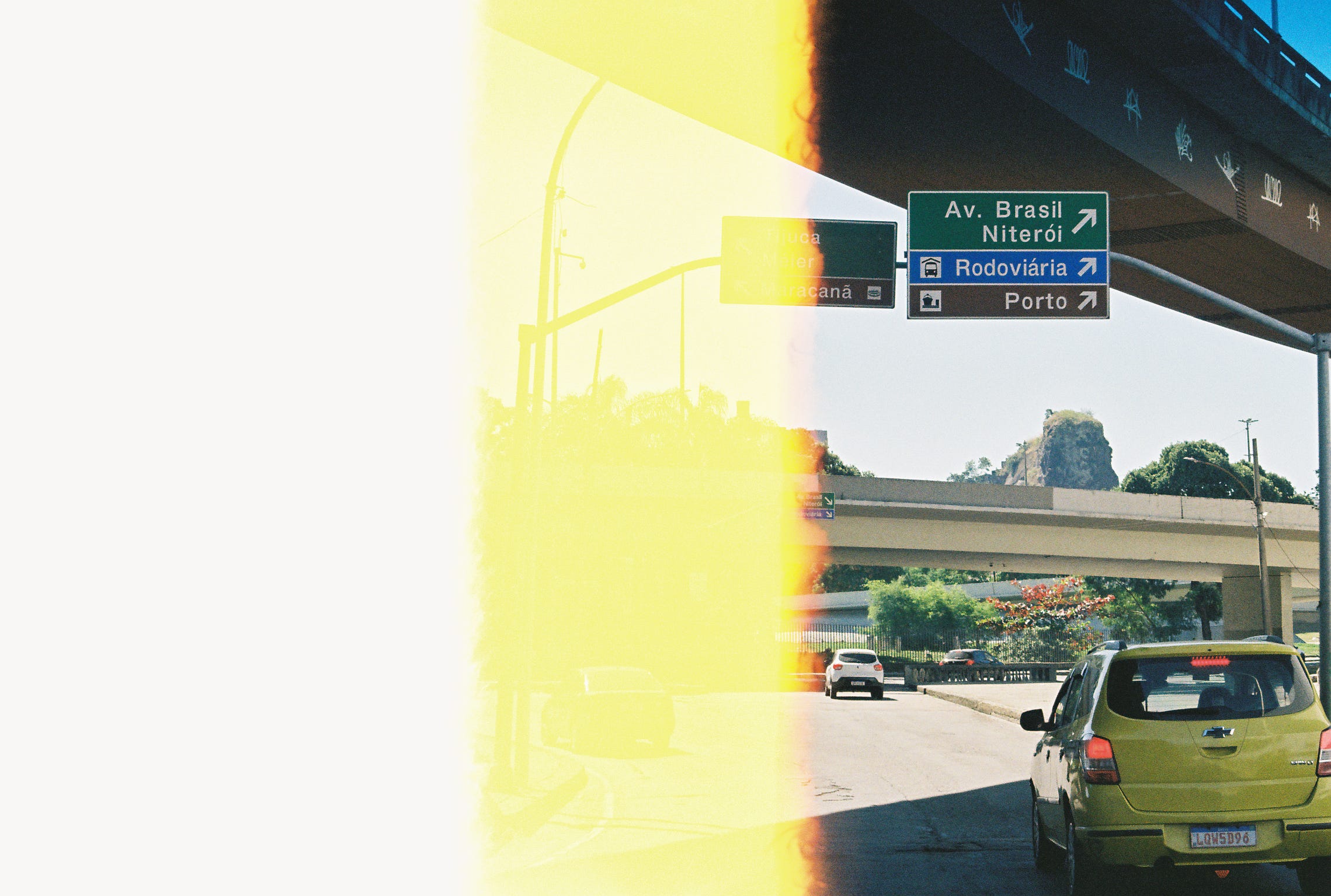
In late summer 2025, I landed in Rio de Janeiro with a few friends, including Luca, my co-writer for Umbra. After an afternoon lounging on Ipanema in the shadow of Dois Irmãos, at nightfall we headed to the bars of Lapa and soon found ourselves shoulder-to-shoulder with locals at Bar da Cachaça, a neighborhood classic. In Lapa, I felt the Brazil people dream about before arriving: old motorbikes tearing around corners, worn but colorful buildings, and streets full of people in shorts and tank tops—a scene that in most places would be chaotic, but here felt like pure festivity.
The next morning we left Rio for the MAC in Niterói, crossing Guanabara Bay via the Ponte Presidente Costa e Silva. Nearly an hour later, the taxi dropped us down the hill from the museum. The surroundings came as a surprise: in photographs, the MAC always seemed isolated, framed only by mountains and open nature
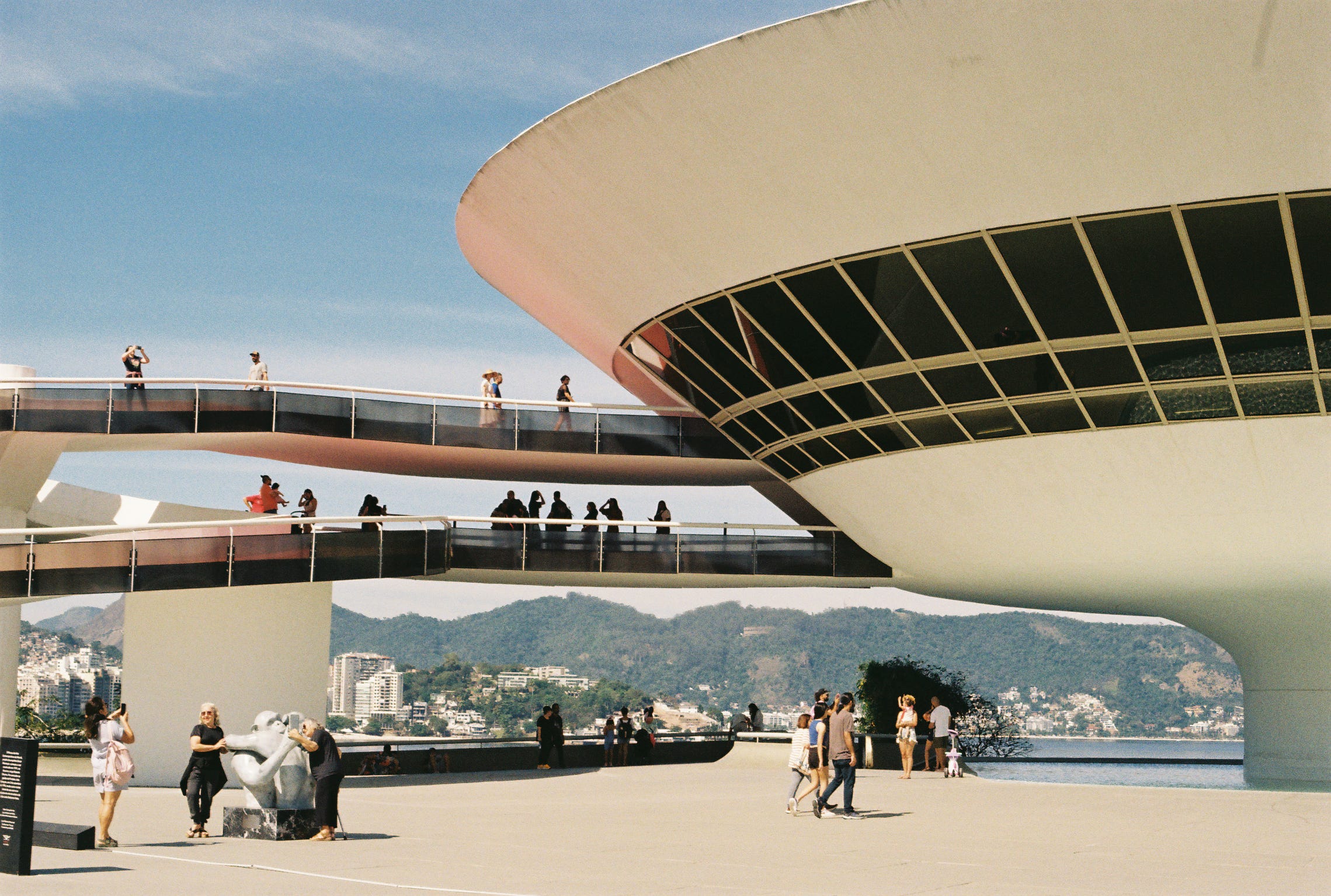
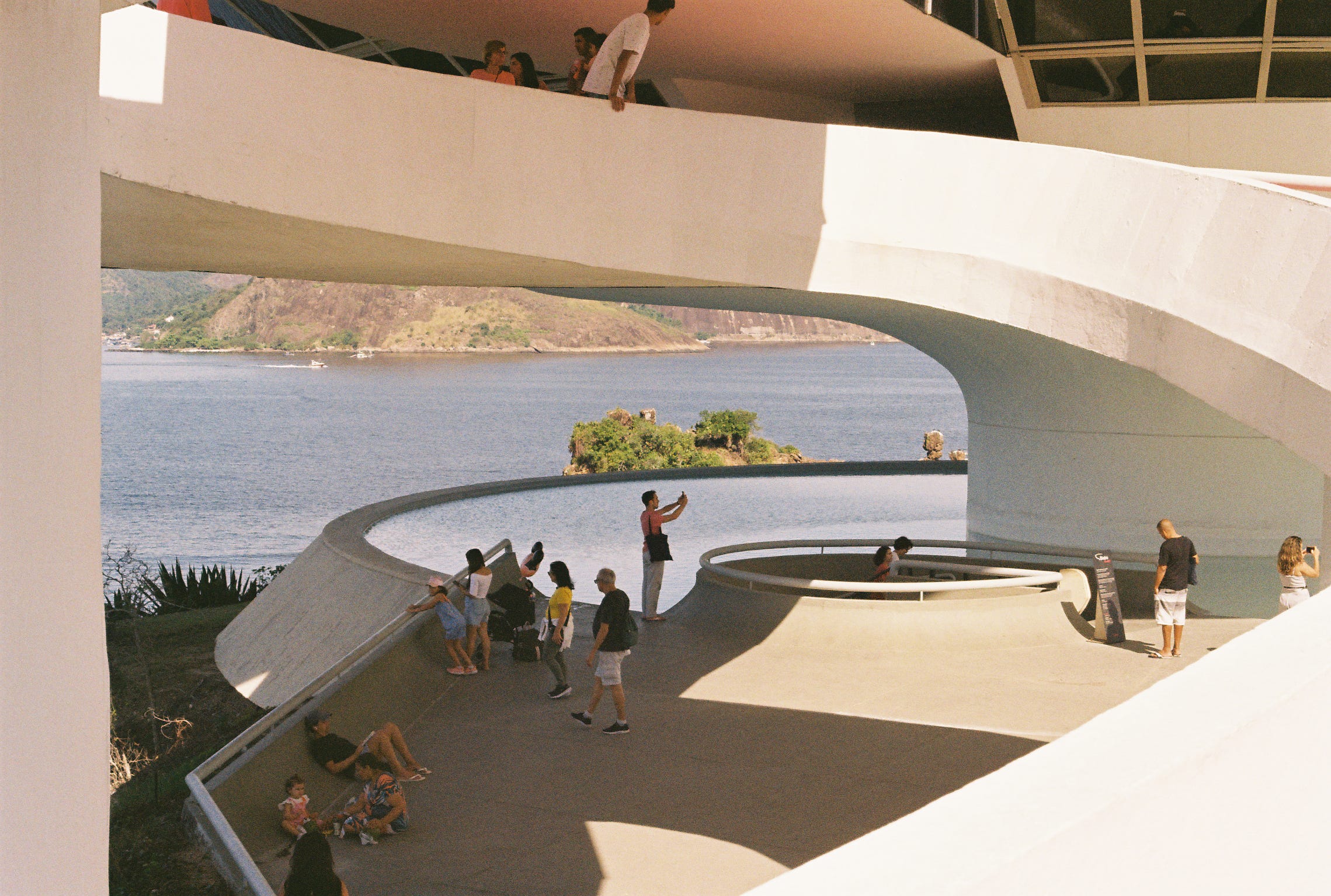
We climbed the hill, and I found myself gazing across a flat pavilion at Niemeyer’s modernist utopia, radiant in the midday sun. Just days earlier, I had wandered among Niemeyer’s structures in São Paulo’s Ibirapuera Park, yet the MAC stood in a league of its own. My eyes traced the building’s curvature to the undulating helical ramp that serves as its entrance, its reddish flooring more modest in person than in photographs. I took out my camera—an old Olympus OM-2—and began to shoot, trying to capture the structure’s essence.
At first, the encounter felt purely visual, almost cinematic
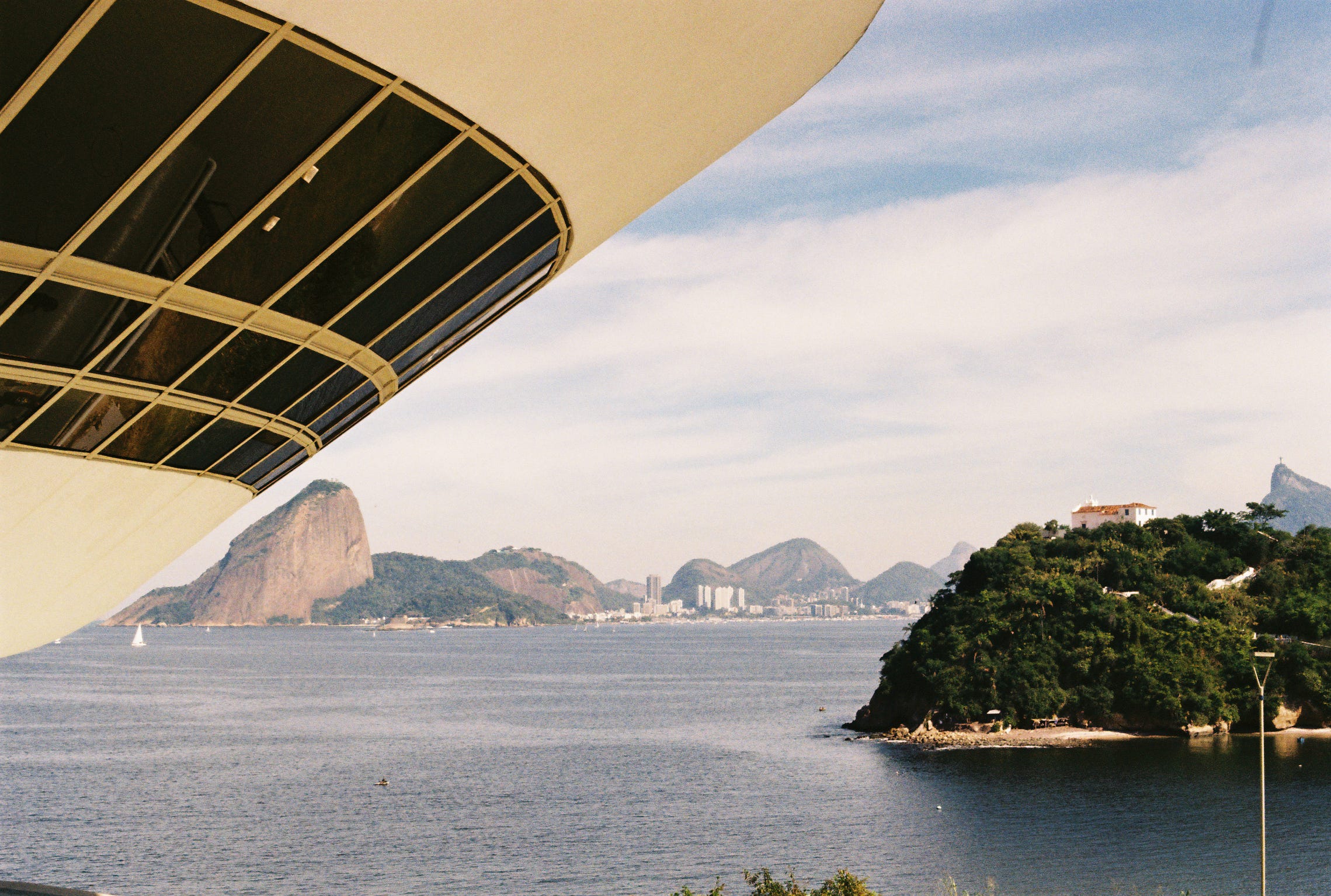
As I circled the building, I began to see the harmony between the museum and the surrounding landscape. The separation between structure and mountains was not accidental; there was a precise distance that made everything fit seamlessly, creating a dialogue between the man-made and the natural.
In the moment, I could not find the words to articulate it—it was more perception than clear idea.
Only later did that intuition become legible. Several weeks afterward, while developing the photographs back in France, I confirmed that the feeling had a basis: the museum’s curvature followed the profile of the mountains and the opening of the bay. There was respect for space, an equilibrium between concrete mass and surrounding nature. The structure does not cut the horizon; it places itself before it with precision. In those photographs, I had been trying—almost subconsciously—to capture that interaction between building and bay.
Later, while researching, I found words by Oscar Niemeyer that helped me understand what I had felt:
“I am not attracted to straight angles or to the straight line, hard and inflexible, created by man. I am attracted to free-flowing, sensual curves. The curves that I find in the mountains of my country, in the sinuousness of its rivers, in the waves of the ocean, and on the body of the beloved woman. Curves make up the entire Universe, the curved Universe of Einstein”.
What I sensed intuitively on site was, in fact, engineered with extraordinary precision. The museum opened when Niemeyer was 88 years old. He was not a young architect searching for experimentation, but an established figure working from experience. The project was developed with structural engineer Bruno Contarini, a regular Niemeyer collaborator whose intervention was key to resolving the large cantilevers and central support.
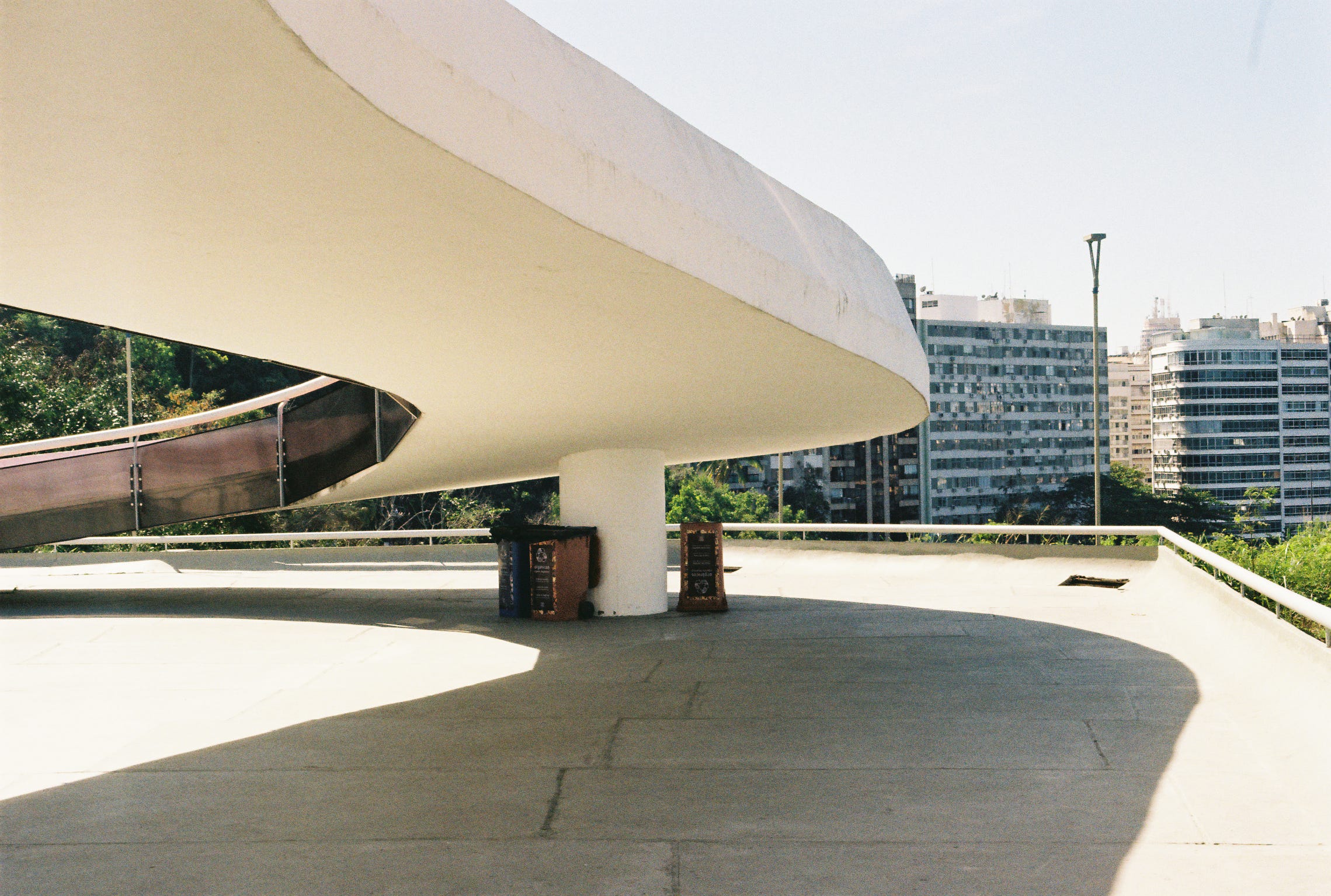
The building is supported by a single reinforced-concrete cylinder that concentrates the loads and frees the perimeter. The main volume, fifty meters in diameter, projects cantilevers of more than twenty meters, which explains the feeling of lightness I had perceived. This is not an improvised form; it is a structure calculated to the millimeter.
The ramp, nearly one hundred meters long, is not just a formal gesture. It is part of the system that elevates the visitor and gradually separates the building from the ground. Even the reflecting pool serves a clear function: to mark the distance between concrete and rock
Beyond its formal and structural intelligence, the MAC also transformed the city that hosts it. Historically eclipsed by Rio de Janeiro across the bay, Niterói gained a new center of gravity as the museum became a destination in itself, much like the Guggenheim in Bilbao. It was not only the collection that attracted visitors, but the architecture.
“When I began designing the museum, I had one idea in mind: a circular, abstract form in the landscape.”
In Niterói, Niemeyer’s curves are more than style: they are a spatial method for aligning structure, topography, and view.
Pablo Nouhet,
12/02/2026
Paris, France
© Pablo Nouhet, all photographs taken by the author
No posts
Comments
Nothing yet. Say the first thing.
Sign in to join the conversation.