
Issue #24
I previously wrote about how SaaS has been left for dead, but it might be imprudent to write it off quickly. I now realise that there’s an instructive parallel in history.
The SaaS industry is experiencing a familiar pattern: terminal value compression driven by existential uncertainty. AI agents threaten to unbundle integrated workflow platforms. Multiples have compressed from 8-12x revenue to 4-8x as investors question whether the likes of Atlassia, Salesforce, Workday, and ServiceNow can survive an AI-native world.
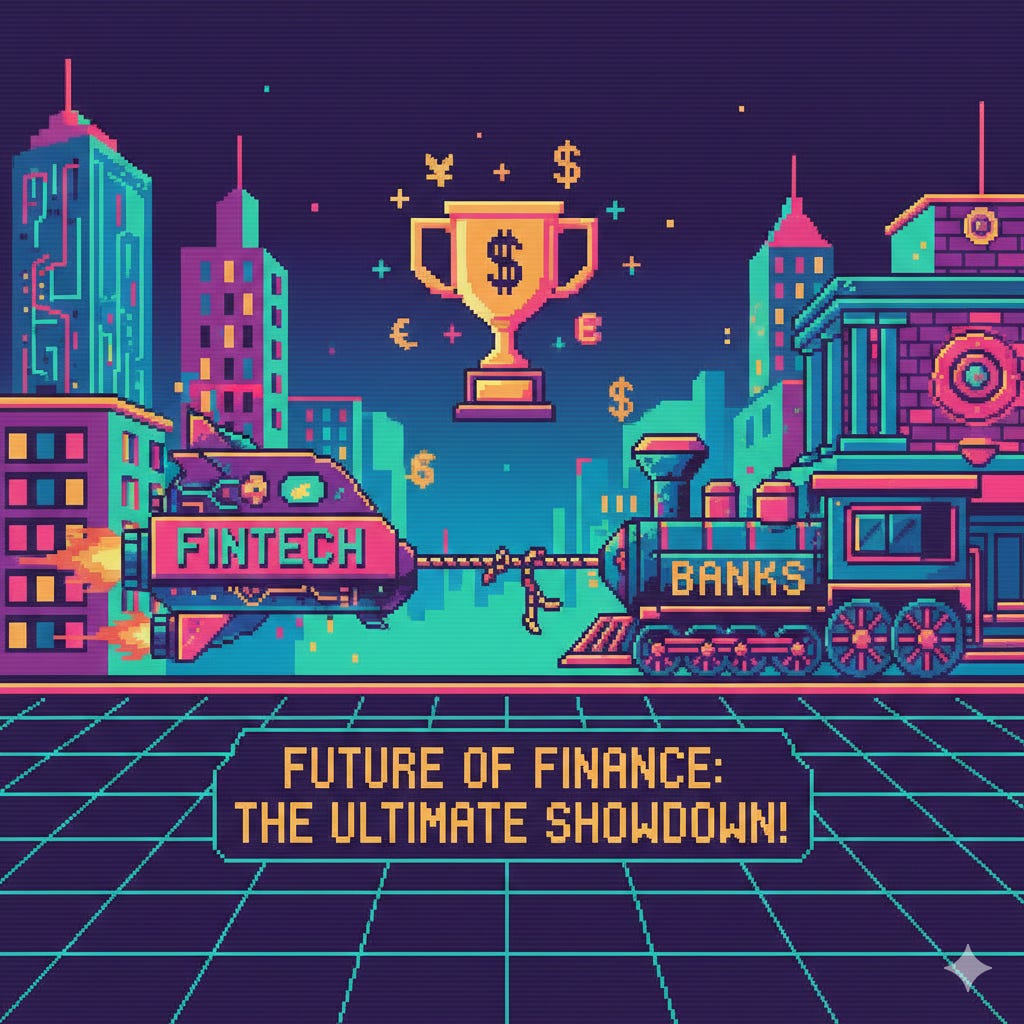
We've actually seen this movie before. Between 2014 and 2025, banking went through an almost identical cycle with fintech. The parallels are striking and instructive.
In 2014, the narrative was simple: software first Fintech players would eat banking. Fintech startups were unbundling the integrated banking model:
Lending Club/Prosper: P2P lending bypassing bank balance sheets
Robinhood: Zero-fee trading killing brokerage revenue
Venmo/Square: Payments moving off-balance-sheet, destroying deposit franchises
Betterment/Wealthfront: Robo-advisors automaing wealth management at a fraction of the cost
The terminal value question was existential: if customer relationships could be disaggregated, what was a bank actually worth?
Traditional banks compressed. P/E multiples fell from 13-15x to 10-12x. Tangible book valuations dropped from 1.5-1.8x to 1.0-1.3x. The market priced in fragmentation.
The technology advantages seemed insurmountable:
Cloud-native architecture vs. legacy mainframes
70-80% lower cost to serve (no branches, no legacy IT)
Superior mobile UX
Millennial preference for digital-first experiences
Sound familiar?
Replace "fintech" with "AI" and the narrative is nearly identical:
AI agents: Unbundling integrated SaaS workflows
Greenfield advantage: Build AI-native from scratch vs. bolting onto existing platforms
Organizational focus: 100% focused on AI product vs. managing legacy business
UX preference: Conversational interfaces vs. dashboards and forms
The terminal value question: if AI agents can replace workflow software, what is platform lock-in actually worth?
SaaS multiples have compressed accordingly. The market is pricing in the same fragmentation fear that hit banking a decade ago.
Three things resolved the uncertainty:
Customer acquisition costs were unsustainable
Fintechs: $200-500 per customer
Banks: $50-100 per digital customer (leveraging existing brand/branches)
Domain expertise couldn't be replicated
Fintech underwriting wasn't inherently superior
Default rates climbed as credit cycles turned
Profitability was a mirage
Most fintechs remained unprofitable despite "software economics"
Profitability got worse, not better, as they scaled - early customers were venture-subsidized and cherry-picked; growth required down-market expansion with worse economics
The market realized: banks had defensible moats. Technology alone couldn't overcome distribution + domain expertise.
Terminal value rebounded. By 2019, banks traded at 12-14x P/E as the "fintech-enabled banks" narrative replaced "fintech replaces banks."
The same unit economics test is coming for AI-native SaaS:
CAC asymmetry persists
AI startups: $500-2000 per enterprise customer (venture-funded, unproven), still difficult to transition from POC budgets to production
Incumbent SaaS: $100-300 (existing sales motion, installed base upsells)
Workflow expertise matters
AI handles simple tasks but struggles with complex enterprise workflows , ironically needs SaaS defined guardrails and context
Security, compliance, auditability favor integrated platforms
Profitability challenges emerge
AI startups burn on inference costs + customer acquisition
Watch for down-rounds in 12-18 months
If this parallel holds: "AI-enabled SaaS" beats "AI replaces SaaS."
The banking story had a second act. Interest rates rose from near-zero to 5%+, creating a stress test that revealed structural advantages:
Cost of capital asymmetry became obvious
Banks funded at 1-2% (deposits)
Fintechs funded at 6-8% (capital markets)
300-400bps advantage was insurmountable
Results:
Bank NIMs (net interest margins) expanded from 1.67% to 2.6%+ (JPMorgan 2021-2023)
Fintech margins compressed or went negative
Even successful fintechs needed to *become banks* (SoFi, LendingClub acquired charters)
Terminal value fully rebounded. Banks returned to 13-16x P/E—at or above 2013 levels.
Here's the critical difference: SaaS doesn't have an equivalent structural moat to cost of capital.
Banks permanently had cheaper funding. But SaaS cost advantages are temporary - inference costs are falling rapidly (Kimi 2.5 delivers Opus-quality at a fraction of the cost).
Additionally: AI enables business model shifts that fintech didn't
Fintech couldn't change banking's fundamental economics. AI potentially changes software's economic model in two ways:
Seat-based pricing breaks: If AI agents handle workflows without human seat requirements, the entire SaaS revenue model compresses. One AI agent doing the work of 10 seats = 90% revenue loss on existing contracts.
Context vs. configuration: AI agents holding complete workflow context in memory vs. humans configuring rigid software. This changes *usage behavior*—enterprises might shift from "100 licensed users occasionally using configured software" to "5 users directing AI agents that maintain continuous context."
This has no banking parallel. Banks couldn't be threatened by fundamental repricing (a deposit is a deposit). But SaaS *could* face wholesale revenue model destruction if seat-based economics collapse.
The compression risk isn't just "AI replaces features" - it's "AI reprices the entire category."
Despite the divergence on cost structure and business models, three critical parallels remain:
1. Distribution advantages persist
Just like banks had deposit relationships, SaaS has installed base. Salesforce pushing Dreamforce to millions of existing users instantly vs. startup cold outreach. The CAC asymmetry favors incumbents even with cheap inference.
2. Incumbent adaptation speed surprises markets
Banks weren't slow, they just hadn't prioritized digital until threatened. Zelle (2017) beat Venmo at its own game, reaching 2x the volume by 2019. SaaS companies are showing similar velocity with rapid AI feature releases.
3. Customer stickiness exceeds disruption narratives
Bank switching stayed below 5% annually despite fintech alternatives. Multi-product relationships, trust, and integration depth created lock-in. Customers used fintech as *addition* not *replacement*.
SaaS likely similar: deep enterprise integrations, change management costs, data/workflow lock-in. Watch renewal rates; if they stay >90%, the parallel holds.
AI startup unit economics: Watch for CAC/LTV challenges and down-rounds (like Lending Club 2016-2017)
Incumbent AI adoption: High penetration in installed base = Zelle analog
Enterprise switching behavior: Low switching at renewal = banking pattern holds
The wildcards:
Seat-based pricing erosion: How fast does agent-based economics destroy per-seat revenue? And can incumbent players adapt with usage based pricing?
Integration requirements: Do enterprise IT/security requirements favor established vendors?
Inference cost trajectory: If costs stay elevated, incumbents win decisively
Scenario 1: Bifurcated market
Horizontal/simple SaaS disrupted; vertical/complex SaaS survives. Terminal value: partial rebound for complex SaaS, compression persists for simple tools. Banking analog: Payments/brokerage disrupted, commercial banking defended.
Scenario 2: Incumbent adaptation wins
Distribution + installed base + domain expertise decisive. Terminal value: full rebound to pre-compression multiples. Banking analog: Fintech-enabled banks dominated.
Scenario 3: Disruption succeeds
Seat-based economics collapse + AI agents replace workflows. Terminal value: permanent compression. Banking analog: This would be like Lending Club winning over incumbent banks for lending - the parallel breaks entirely.
Terminal value compression driven by disruption uncertainty often reverses when:
Unit economics of disruptors prove challenging (fintech CAC/profitability → AI startup burn rates)
Incumbent structural advantages clarify (deposit funding → installed base distribution)
Adaptation happens faster than expected (Zelle → AI feature velocity)
The banking/fintech cycle took 11 years to fully resolve (2014-2025). SaaS/AI is moving faster; expect clarity within 24-36 months.
The parallel isn't perfect. SaaS lacks banking's structural cost moat, and AI enables business model shifts that fintech couldn't threaten with banks. But the pattern rhymes: distribution advantages, domain expertise, and customer stickiness are more durable than disruption narratives assume.
The lesson from banking: markets overestimate technology disruption and underestimate incumbent adaptation.
Thanks for reading UC Intelligence! This post is public so feel free to share it.
Comments
Nothing yet. Say the first thing.
Sign in to join the conversation.