
So, many of you have been extremely curious about my thesis, which I keep mentioning without ever revealing what it’s actually about😉 Yeah... I like providing high quality material for conspiracy theories😜
But since I’ve been conducting a little referendum here over the past week, asking you to choose the topic of my next article, and you have so intelligently voted for me to reveal what my thesis is about... well, I suppose you’ve left me with no choice… The mystery has to die today... isn’t that right my little rebels? 😉 Well... not entirely.

To be perfectly honest, I’m not planning to kill the mystery in its entirety just yet.
I won’t be revealing my innovative methodology or the experimental stimuli, and that’s intentional ;) Partly because intellectual property matters, but mostly because my PhD builds upon this thesis in many respects.
Besides, this thesis is practically a PhD disguised as a master’s thesis anyway, at least in terms of its complexity, originality, and sheer length… [But sure, let’s not dwell on its obvious brilliance, my mom and dad have that covered anyway😜] But then again, I have this incurable tendency to take everything I do to the extreme... something that probably doesn’t surprise you, my readers, in the slightest by now😉
One more warning before we begin: by the time you reach the end of this article, you’ll probably have more questions than when you started reading it.
“Stop building the suspense already Tzlil, and just tell us!”
Alright, alright... no need to yell!
Buckle up... here we go.
Nearly a decade ago, when I was still in my twenties (you know... back in Biblical times... ancient history 😉), I started working as a Marketing PMO at Bagira, a world renowned Israeli simulation company. They are absolutely phenomenal. I highly recommend googling them and seeing their work for yourselves.
Before that, I had worked in a very different corner of the security industry as the Sales Director for the Israeli market at a tactical gear company. My job was to develop the company’s sales strategy and ensure that the IDF received the best possible equipment through large scale tenders. It also meant spending a great deal of time in the field, learning firsthand what our combat units actually needed from an operational perspective. I might write about this at length one day, because it truly is fascinating, but it’s beyond the scope of this piece ;)
So, for me, coming from a low tech background, getting hired by a high tech company in the security sphere meant, among other things, suddenly shifting my focus from the Israeli market to an international one; It required not only a different practical approach, but also what I can only describe as a mental shift; Up until that point, I had been working closely mainly with special IDF units. Then, all of a sudden, I found myself flying to the United Kingdom to introduce advanced simulation systems to the British Army inside a closed military base.
See what I mean by a mental shift? It wasn’t just a different job... It was a completely different mentality in every possible aspect.
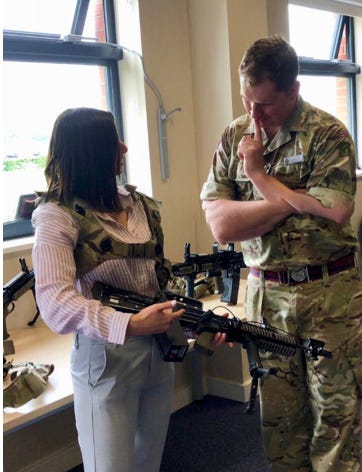
This is an advanced laser‑based firing system that my boss and I flew to England to demonstrate to UK army units, ahead of a major procurement tender.
So, why am I telling you this? Good question!
Because that’s how I was exposed to the unbelievable immersiveness of VR for the very first time.
I had just started working there and was trying to learn countless advanced systems in an incredibly short amount of time… One day, they put a VR headset on me. Then they strapped special monitoring sensors and haptic feedback sensors to my chest, embedded in a tailor made Multicom textile harness, and dropped me into a Gaza-like alley.
Without any warning whatsoever, I was suddenly attacked by a highly realistic virtual Palestinian sniper who opened fire on me.
And let me tell you something... TMI: I almost peed myself. I could actually feel the impact of the shots hitting my chest! It was freakin’ insane!
I’ve never been shot before, thank God, but in that moment it felt as though I had been. The environment was remarkably realistic, my quasi-VR body gave me a genuine sense of embodiment, and my brain immediately accepted the scene as real. I wasn’t expecting a jihadist sniper because no one had mentioned this rather “lovely” surprise beforehand... The shock was therefore very real, and the haptic feedback made me instinctively jump backward.
I remember grabbing my chest in complete panic while the virtual jihadist sniper lined up another shot. I ripped the VR headset off and had to sit down for a moment just to process that I wasn’t actually there... in Gaza... but back in the office... here in the Holy Land.
“You’re safe,” I kept telling myself as they handed me a glass of water. But to be perfectly honest? It took me about a week to shake the feeling off; For the first two days afterward, I could still feel this strange sting in my chest.
Now that’s one unforgettable welcome to a new company, don’t you think? 😂
“This is a game changer,” I remember thinking that very moment. And I knew this romance wasn’t going to end there... Oh, and the virtual Palestinian sniper? Let’s just say I eliminated him during a different session😉
Anyway, that was my introduction to VR and my first real encounter with its extraordinary power, technology that, now more than half a decade later, has advanced tremendously!
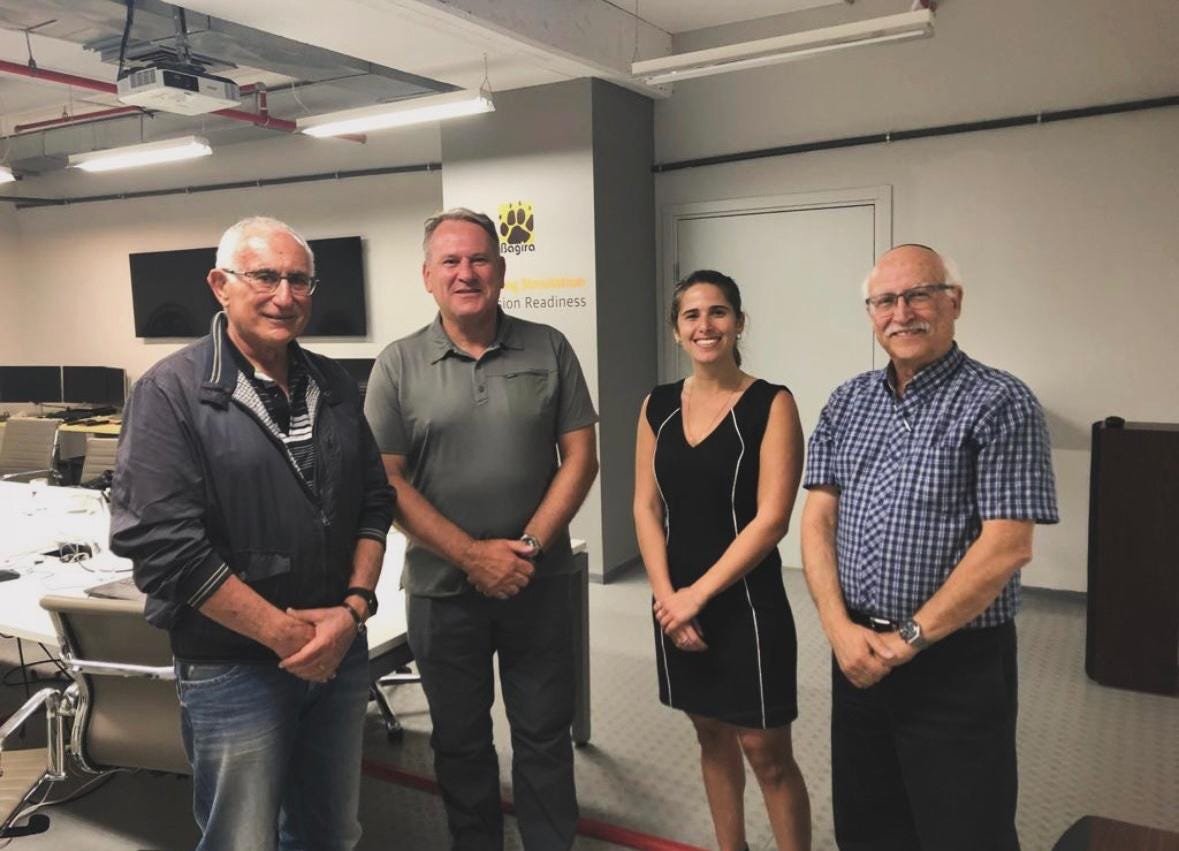
One of the highlights of my time there was organizing Col. Richard Kemp’s visit to the company’s offices in Israel. Col. Kemp has spent most of his life fighting terrorism and insurgency, commanding British troops on the front lines of some of the world’s most challenging conflict zones, including Afghanistan, Iraq, the Balkans, and Northern Ireland. In recent years, he has also devoted himself to exposing misinformation about Israel and defending its right to exist and defend itself on the international stage; I had the privilege of bringing him in to experience some of our advanced simulation systems firsthand and introducing him to the remarkable work being done there. It was a tremendous honor.
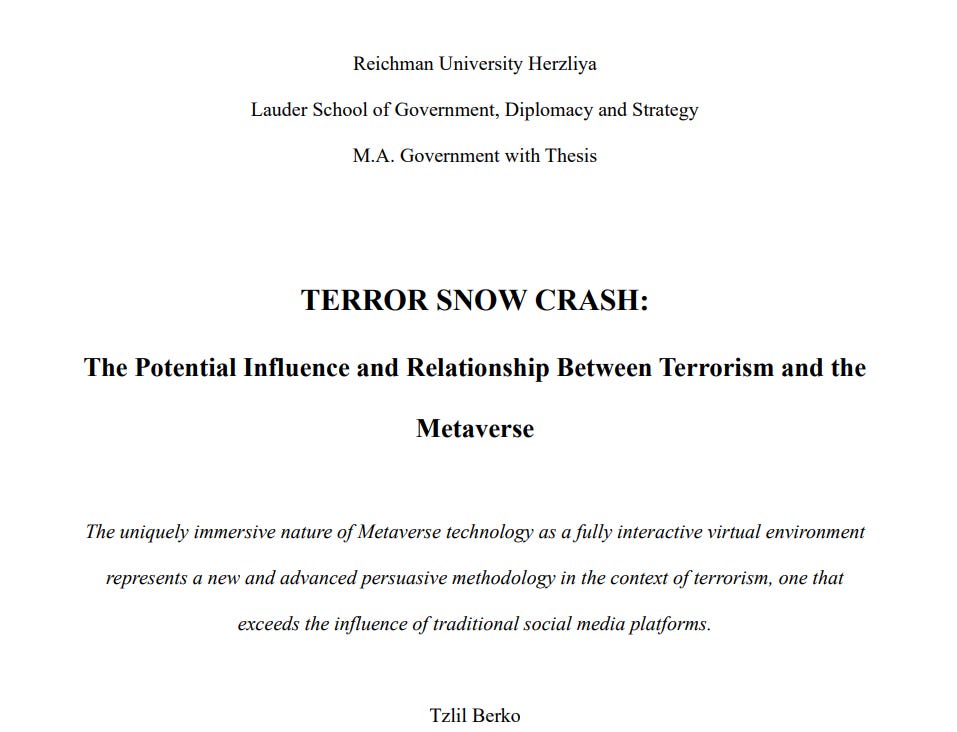
An unusual name, isn’t it? What is Snow Crash, and why terror? Well... let me give you the gist.
Remember the snowy static that covered old television screens whenever the signal disappeared? What looked like harmless visual noise inspired the title Snow Crash, the groundbreaking novel that introduced the world to the concept of the Metaverse.

This amazing photo isn’t mine. I came across it online and would love to credit the photographer, so if you know who took this genius shot, please let me know.
The Metaverse is a hyper-immersive universe you enter through VR goggles, where the line between physical and virtual disappears; it generates such an intense sense of presence that you can meet, move, and interact with others as if within arm’s reach, no matter where you are in the world, with avatars embodying and expressing your identity in this boundless space.
Snow Crash, the dystopian novel that coined the very term “Metaverse,” imagined a virtual plague capable of crashing both computers and human minds.
The metaverse, while offering amazing new opportunities, also presents great threats if abused as an operational tool by Islamist Jihadist terror organizations for radicalization and recruitment, among others, carried out within the virtual space and extending into real-life (IRL) terror acts.
Let’s steal a slide from one of my lectures for a second:
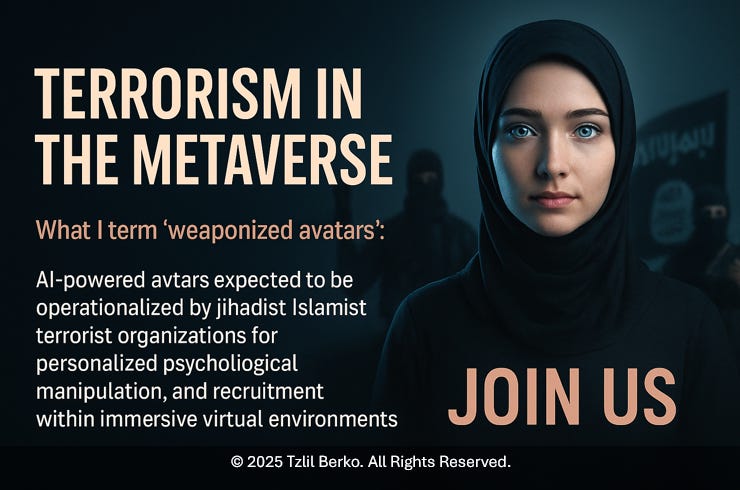
Terrorist organizations and extremists are known to be early adopters of various technologies in multiple dimensions and quickly adopt and utilize them to advance their malicious goals.
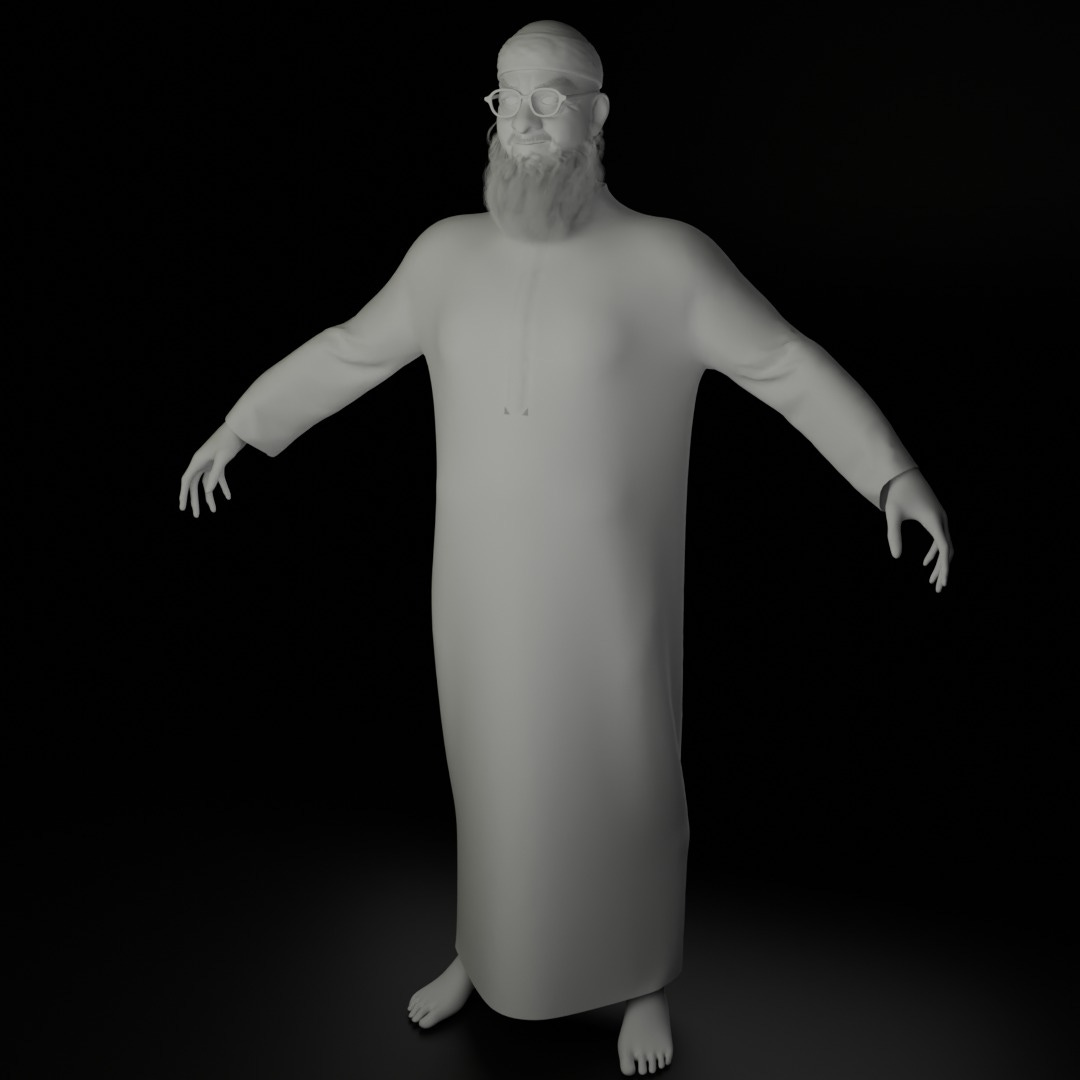
Weaponized avatars (coined by the author) as a dominant metaverse application will play a significant, fundamental role in revolutionizing how terrorism functions in the modern world, where the metaverse will shape not only the virtual future of the internet but, also the physical one; We’ve seen the effect of social media on increasing the spread of radicalization and terrorism and can speculate that a social/immersive metaverse will have a similarly dramatic, if not even more profound, impact.
Unlike existing research, which predominantly examines radicalization through theoretical frameworks within flat-screen 2D environments, my study not only draws on established theories but also operationalizes this process within a controlled immersive 3D setting, addressing a domain that is inherently difficult to access both technologically and ethically.
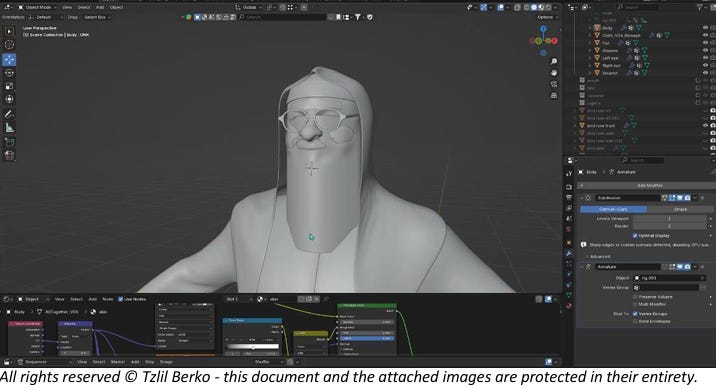
My study was conducted in collaboration with the International Institute for Counter Terrorism (ICT) and the Advanced Reality Lab (ARL) at Reichman University.
The findings of my research form both the technological and theoretical foundation of my PhD on Islamist terrorist recruitment in the Metaverse. This study also constitutes one of the core chapters of my doctoral research.
And my PhD?
Well... no spoilers😉 But let's just say it takes things several steps further by infusing avatars with large language models (LLMs), enabling them to engage in intuitive, personalized, real time interactions, while integrating significantly richer 4D and Mixed Reality elements to explore entirely new dimensions of influence and persuasion.
This trajectory underscores the danger of a terrorist driven Snow Crash, where arch-terrorists such as Hassan Nasrallah (may this Satan rust in little pieces) could be virtually resurrected to converse with, radicalize, recruit, and influence followers with striking immediacy across a universe unbound by place or time.
Well... unlike Black Mirror, you won't be able to simply turn off the TV when the episode ends. This immersive technology is heading our way, whether we are ready for it or not…
© 2026 Tzlil Berko. All Rights Reserved.
The emerging technology of the Metaverse is not yet here in its full capacity, but it’s rapidly approaching and will overtake us like a wave already in motion. If proactive measures are not urgently considered to anticipate its exploitation by Islamist jihadist terrorist organizations, the landscape of radicalization may cross a threshold from which reversal becomes increasingly difficult; Under such conditions, early adopter Islamist jihadists could weaponize these immersive environments to accelerate the global spread of violent political and religious extremist ideology, enabling mass recruitment and coordinated mobilization on an unprecedented scale.
Against this backdrop, my study doesn’t merely observe an emerging threat; it compels us to confront it. This study doesn’t merely trace this trajectory through theory, but operationally exposes it, forcing this emerging threat into the spotlight before the wave fully breaks upon the shores of the free world.
In this sense, the Metaverse may be understood as a contemporary analogue to the Tower of Babel, reflecting humanity’s extraordinary technological ambition to transcend physical boundaries and reshape human interaction. Yet, in the hands of Islamist jihadist terrorist organizations, even the most remarkable innovations are utilized malevolently; The modern Tower of Babel of terrorism may already be under construction, built not from stone, but from code, avatars, and immersive architectures of influence and meta-persuasion, where extremist, Islamist ideology is no longer merely disseminated, but experientially lived, and where recruitment to jihad may evolve from passive and distant propaganda into direct, embodied social encounter, untraceable and unlimited by space or time.
If the next frontier of radicalization and recruitment by Islamist jihadist terrorist organizations lies in weaponized AI-powered avatars, as my study cautiously projects in the near future, democratic societies may recognize the danger only once they are already inside it. Let my study serve as a wake-up call.

© 2026 Tzlil Berko. All Rights Reserved.
Well... sorry to disappoint, but that’s all you’re getting from me today. 😉
I warned you that you’d reach the end of this article with even more questions than when you started... and I wasn’t lying.
For now, there is only one thing you need to know:
My research explores what I call Meta Persuasion from an offensive cyber perspective. In other words, I deliberately choose to think like the predator, not because I admire predators… but because the only way to build meaningful defenses is to understand how they hunt.
More to come.
Stay tuned and stay coded 😉
© 2026 Tzlil Berko. All Rights Reserved.
This article and its contents, including all text, ideas, concepts, analyses, and original intellectual property, are protected by copyright law. No part of this publication may be reproduced, distributed, translated, adapted, published, or transmitted in any form or by any means without the prior written permission of the author, except as permitted under applicable copyright law.
Dear friends🥰
Israeli bank accounts cannot be monetized on Substack, so if you enjoy my writing and wish to support my work, please do so through this link: Buy Me a Coffee :) MANY THANKS!

Tzlil Berko is a seasoned professional in private security with experience in tactical gear and simulation technologies. Her thesis research focuses on terrorism in the Metaverse.
She is a fellow at the Investigative Project on Terrorism (IPT), where she publishes on counter-terrorism and emerging threats. Tzlil is also a creative writer, represented alongside her parents by The Blair Partnership Literary and Entertainment Agency, and is the co-creator of a television project inspired by the published books of her mother, Dr. Anat Berko, and their extraordinary family story.
No posts
Comments
Nothing yet. Say the first thing.
Sign in to join the conversation.