
Just gonna ramble here about what I’m thinking about AI Agents. (I’m super underqualified so take this with a grain of salt)
Think of a human as an RPG character with a skill tree: physical strength, fine motor movement, movement to transport things, language, reasoning / judgment, creativity, social / emotional intelligence, calculating, pattern recognition.
Everytime we invented something, we only replaced one skill:
Cars & Planes → replaced human movement
Typewriter → fine motor movement (writing)
Calculator → human brain for calculation
Agriculture machines → physical strength applied in a specific manner
And each time, the displaced workers could fall back on the remaining skills. When steam engines replaced muscle power, you still needed human judgment to run the factory. When spreadsheets replaced bookkeepers, you still needed human reasoning to interpret the numbers. There was always an escape route into the un-automated parts of the skill tree.
But now, Claude is on track to replace all soft skills within the skillset, including the most important ones — reasoning, judgment and social intelligence.
And once we achieve Physical AI which similar to LLMs can generalize across tasks, we replace all physical skills within the human skill tree too.
The optimist says “modern telephones replaced switchboard operators; agriculture machinery replaced the farming workforce; the invention of cars replaced horse-related jobs”. Humans will always invent new jobs to create value and earn a living.
But I’d argue this time it’s different. When cars were invented, horses became completely useless outside of occasional entertainment — horseriding, equestrian, zoos — and they just spend time lazing around.
Humans are the new horses.
I think 2026 is a crucial year which starts the “Post-Claude era1” which is an inflection point in humanity’s productivity.
Every day I wake up and there are just endless things to build. The last time I felt this energised was when I tried using DeFi and stablecoins in 2021.
Matt Shumer’s viral X article covers it quite well. Something big is happening. But only to those paying close attention, just like during COVID times.
I would stress that we are very early. It’s only materially impacted software engineers so far. Other professionals in Law, Finance & Audit are still living in the pre-Claude Code era.
Within SWE, CC is already in charge of 4% of all Github commits (100% of mine). At the current trajectory, Claude Code will be >20% of all daily commits by end of year.
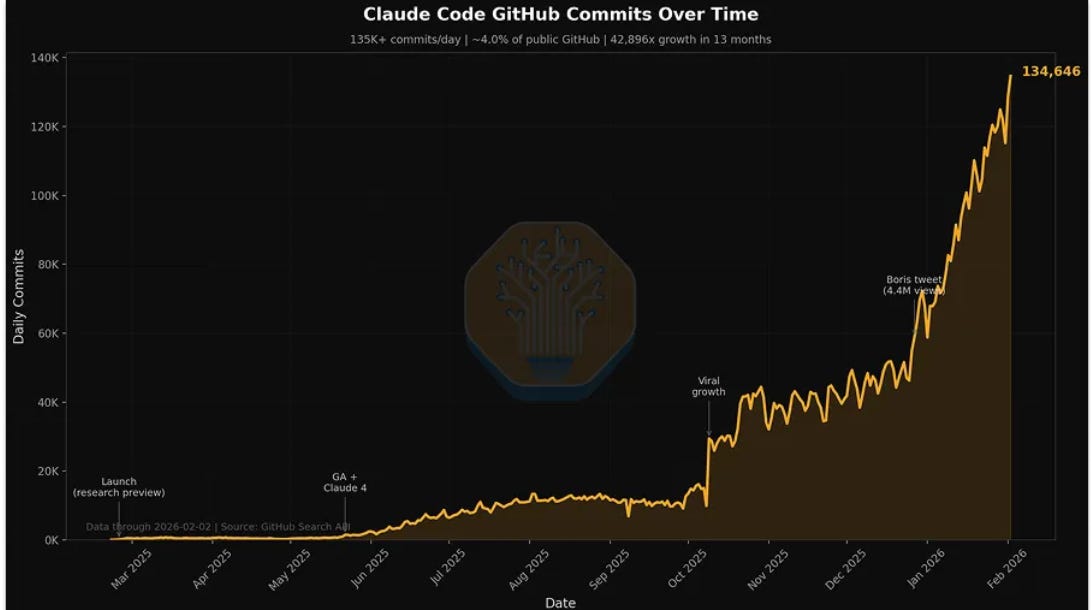
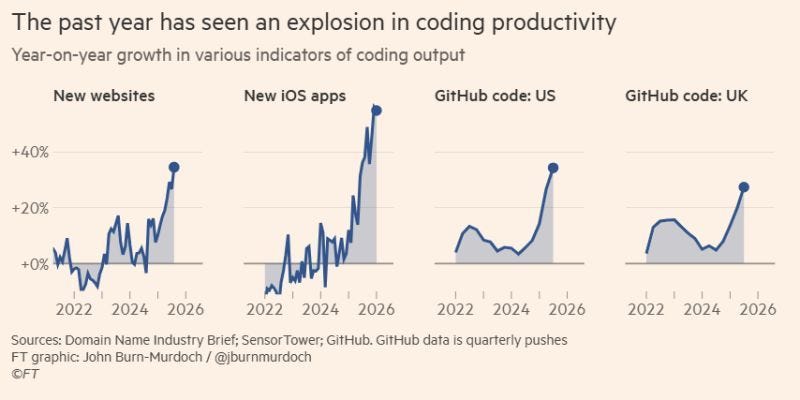
And this is just the beginning. Claude Cowork hasn’t even gained as much adoption as Claude Code, and yet it could be even more disruptive as Claude Cowork is simply Claude Code packaged for jobs which do not interface with code (i.e., everything except SWE / quants).
In a few months, we will also get the “Claude Cowork” moment, just like how we had this “Claude Code” moment. And it will be even more impactful.
In my view, Claude almost fully replaces jobs that are largely rules-based, logical and repetitive (AI agents have a slight flexibility to reason around the rules) and jobs that can be done to a “good enough standard”.
These are jobs2 like:
Customer service agents (Sierra.ai, Decagon)
Insurance claim agents
Financial auditors (rip PwC, EY, KPMG, Deloitte)
Legal paperwork (great X article)
Admin assistants (a nicely packaged clawdbot)
Back office automation (compliance, expenses, regulatory reporting, KYC/KYB onboarding, AML screening)
Coding (translating specs to code) and financial analysts (translating a company’s financial statements to a model)
Anthropic own data makes it pretty clear that all white collar categories (i.e., non-physical) work will soon be replaced by Claude.
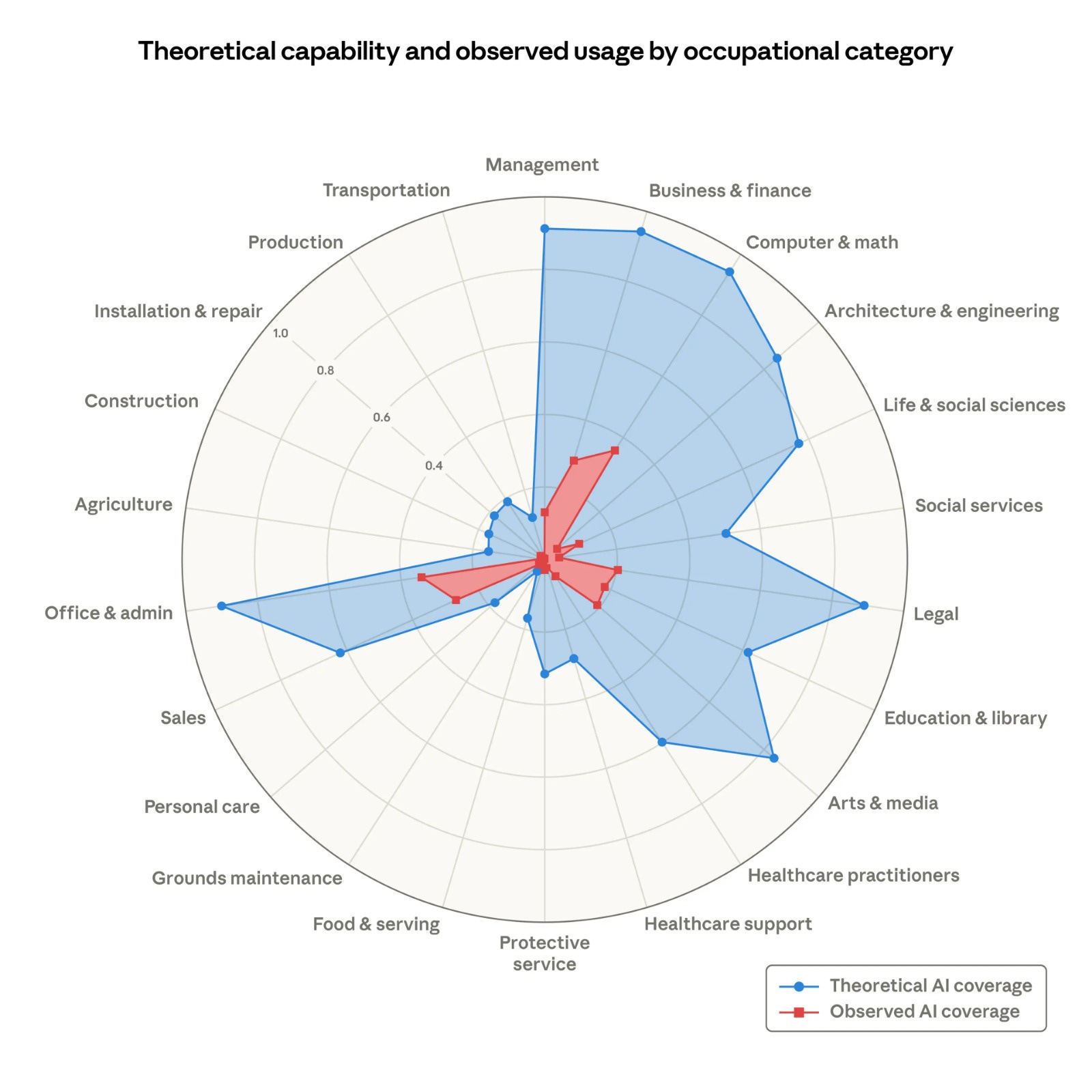
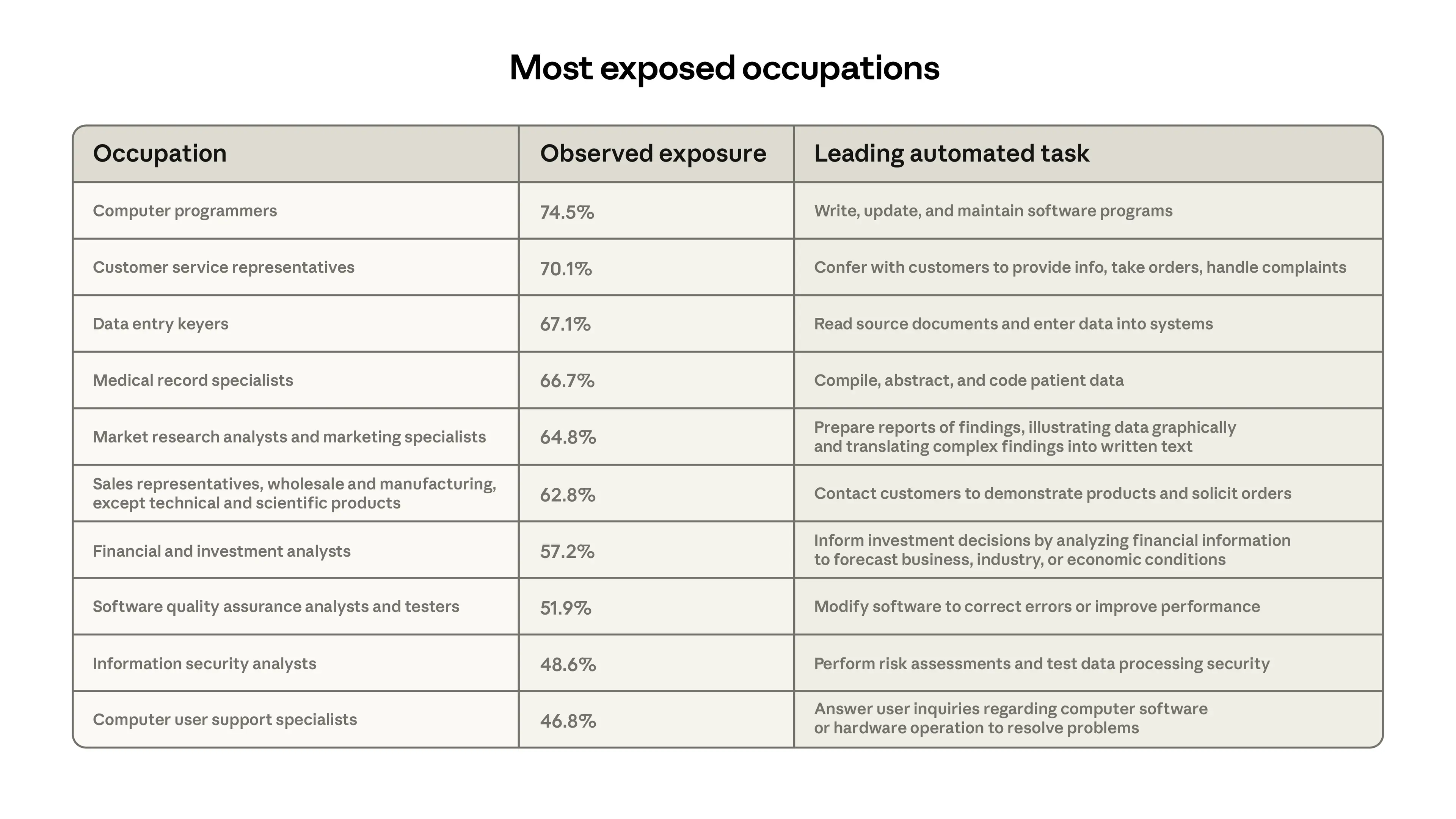
Hence I expect unemployment to slowly increase, starting from fewer fresh grad jobs (we’re already seeing this in UK and Singapore). The hypothetical Citrini’s 2028 Global Intelligence Crisis scenario is less likely on that timeline, but plausible if you extend it to 2030+.
I don’t see it happening by 2028 due to multiple bottlenecks in getting sufficient power, chips, and data centres to increase compute capacity. There simply isn’t enough compute to fill in the blue gaps in the chart yet.
This is basically a seesaw between supply and demand.
Sustainable adoption will come from agents replacing large expensive teams such that cost savings > cost of deploying agents (e.g., customer service agents) and where incremental profits > cost of deploying agents (e.g., hedge fund analysts).
We’re already seeing this as per Chamath’s tweet:
Since November 2025, our AI costs have more than tripled and we are now spending many millions per year trending to $10M+ per year.
That, in and of itself, feels very scary to me running a small startup.
Mostly because I do not yet see an equivalent uptick in productivity or revenue... while their revenues may be doubling and tripling every month, ours are not so this is starting to eat into margins.
Companies are spending aggressively on AI but the ROI hasn’t caught up yet for everyone.
On the supply side, Claude is currently heavily subsidising subscriptions — a $100/month Claude subscription gives you >$2000/month of API-equivalent usage.
What’s going to happen is that as demand increases, then Claude sub price increases until only those getting their money’s worth will subscribe. Then we’ll build out power, data centres and GPUs to produce more compute so the prices come back down.
I think there are only four areas where it makes sense to have a “job” in:
Physical jobs. This one is obvious but very unsexy. Going back to the skill tree, all the physical jobs are yet to be replaced… until we solve Physical AI and generalised humanoid robots
Join AI. Harder, but join a top-tier AI Research lab, create data for the latest models, or help implement AI improvements in companies and make them leaner.
Jobs that require relationships and secrets. Partners in law, consulting, business. Trading where secrets are what drives alpha. By definition if an LLM knows it, then everyone knows it, then there is no edge. The moats here are trust, access, and information asymmetry. These are things that aren’t in a model’s weights.
Entrepreneurship. The cost of building has dropped 90%, hence you now only compete on other factors i.e., distribution and taste (knowing what to build). I expect the % of population being entrepreneurs to increase greatly. Companies need to hire less, which is great for entrepreneurs.
And above all, you need to OWN AI.
There will be only a handful of companies who can control and own the AI stack. This small class of AI owners are more powerful than world leaders.
As we have seen, the Department of War went all out in pressuring Anthropic on safeguards. Why would they do that if they could just swap Anthropic for OpenAI or Gemini? Anthropic is clearly crucial for national security and to win wars.
If we can’t join the AI overlords directly, perhaps we could hold equity in the AI stack (models, compute, energy, and everything in between) so we can benefit from the value accrual to the handful of AI companies.
This logic extends to countries too. Every nation will eventually need to on-shore their AI capabilities: their own LLMs (or access to open-source ones), GPU data centres, and power generation.
Because if the US decides to sanction you and Anthropic stops serving you overnight, you lose all your employees (AI Agents) and your white-collar GDP goes to zero.
If someone bombs your data centres, your GDP goes to zero.
If you get energy from a neighboring and country and they cut you off one day, your GDP goes to zero.
As all employees of the future are AI Agents, controlling your AI stack becomes the #1 national priority.
I have a friend from university who works at a LLM lab in SF and he’s been saying since 2022 that we’ll achieve AGI in a few years and there will be Universal Basic Income so there’s no need to worry about anything in life.
I used to think he was crazy, but now I’m starting to see it.
The question isn’t really whether AI replaces most cognitive work. It’s whether the transition is fast enough to be disruptive (the COVID analogy) or slow enough to be absorbed (the agriculture analogy).
As always, the answer is somewhere in between — faster than the optimists expect, slower than the doomers predict.
Either way, if you want to make yourself Claude-proof: Work in the right areas, build things, own the stack.
Humans are the new horses.
I use “Claude” here but the AI space changes so rapidly, so who knows, Google Gemini will likely have the same capabilities in the next 90 days and push it out to all Google customers
Obviously not the entire job will be replaced as each job involves some relationships and stakeholder management, but the number of lower-level white collar workers you need will decrease greatly
No posts
Comments
Nothing yet. Say the first thing.
Sign in to join the conversation.