
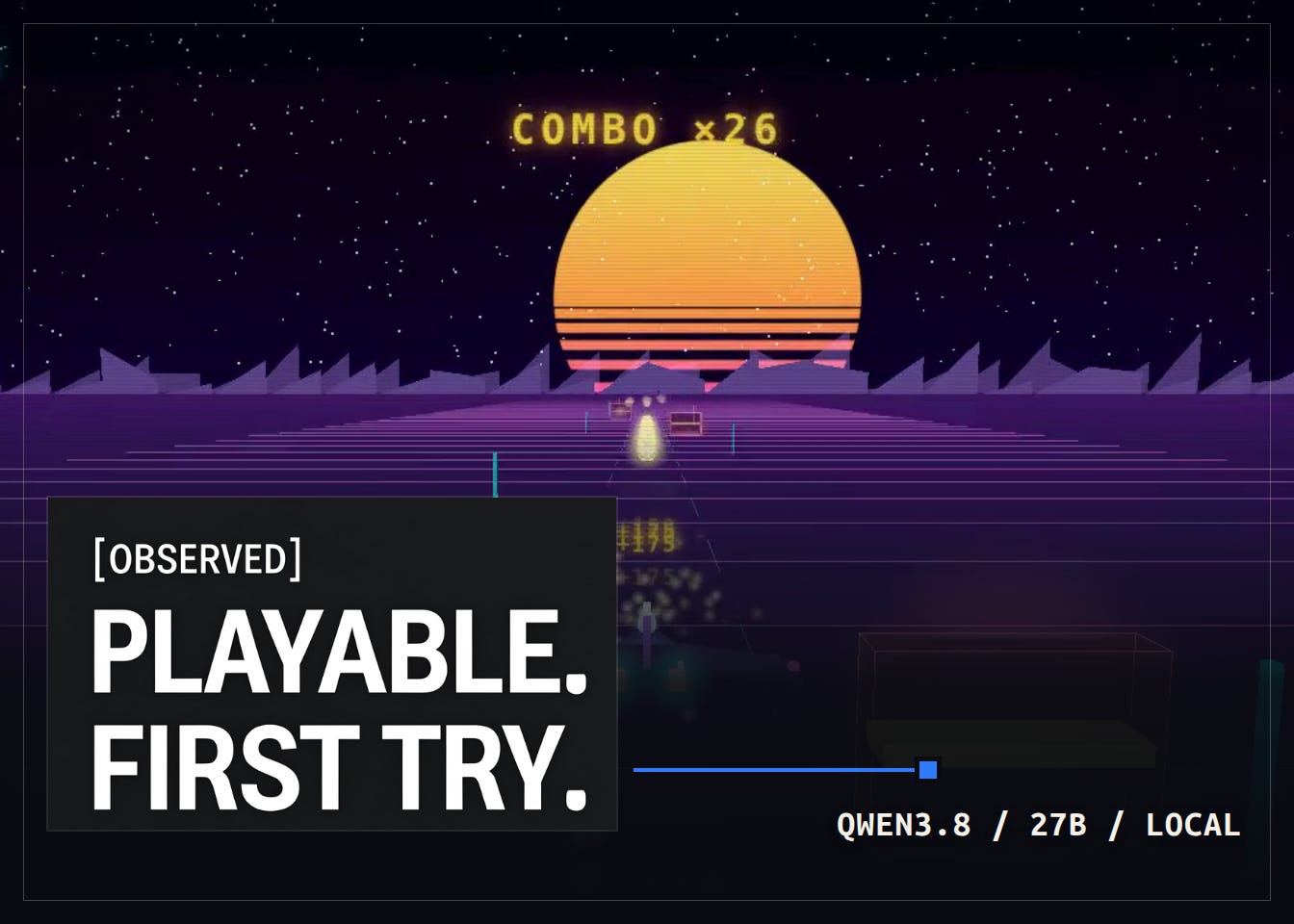
I was paying roughly $200 a month for AI coding when a local 27-billion-parameter model made the bill feel weird.
Two hundred bucks. Every month. And I barely noticed, right up until a model running on hardware I already owned got too close to ignore.
It did not beat every frontier model. But on one game build I cared about, it got close enough that I sat down and did the subscription math. That math is why you are reading this.
The extra $180 was not buying me an obvious win anymore.
I gave Kimi K3, Qwen3.8 27B, and GPT-5.6 Sol the same prompt: build Neon Velocity, a polished browser racing game. The three GAME_PROMPT.md files were byte identical.
I expected Sol to dominate. That is what $200 a month is supposed to buy you. Kimi would probably hang close. The local Qwen model would need a rescue.
That is not what happened. Sol did.
Kimi produced the best result. Qwen finished autonomously on its first attempt and landed pretty dang close to Kimi. Sol's first attempt face-planted on an initial loading failure and needed repair. To be fair, the repaired build played. I preserved the video to prove it.
My ranking for this workload was:
1. Kimi K3
2. Qwen3.8 27B
3. GPT-5.6 Sol
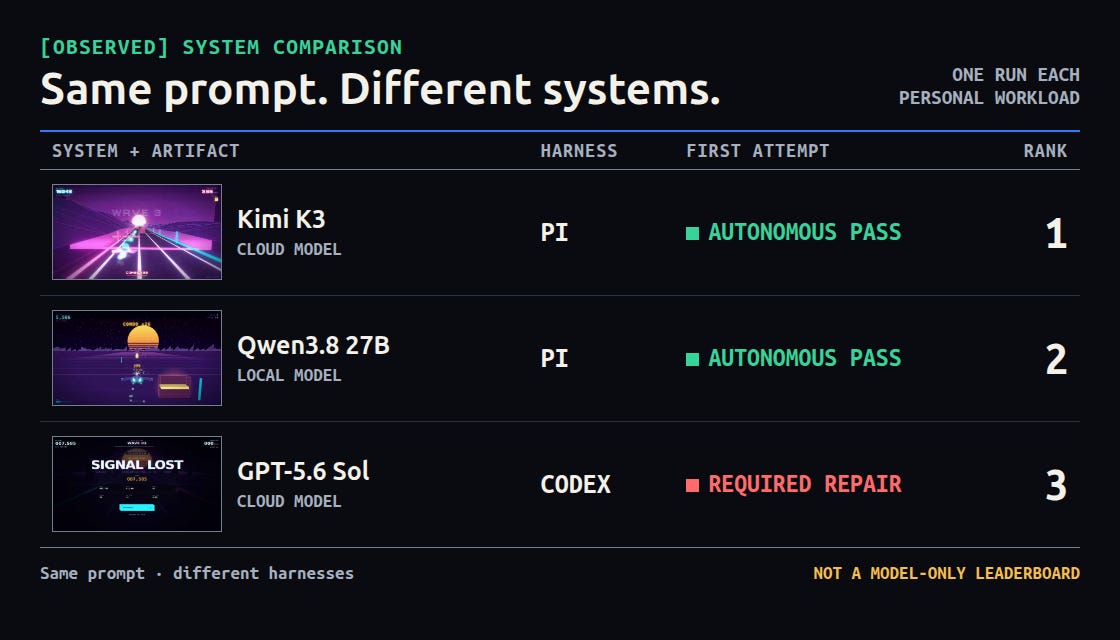
Now, the obvious objection: one run per setup, and I ran each through a different tool. Kimi and Qwen went through Pi, Sol through Codex. So no, this is not a leaderboard, and I am not selling you one. I am showing you the receipt that changed my wallet. Your honest test is the same one I ran: hand each system one real job from your actual workload, watch where you have to step in, and buy based on that. The videos show the builds worked. My notes show where I had to babysit.
A local 27B model did not need to beat everything. It just needed to be good enough at bounded, inspectable work to make the $200 default look lazy.
OpenAI's current Pro tiers still include a $200 highest-usage option. Ollama Pro is $20 a month. My coding subscription was the $200 a month Codex plan.
That creates a simple gap:
$200 - $20 = $180 per month
Annualized, that is $2,160.
Is that total cost of ownership? No. I already own the hardware, and electricity, maintenance, model downloads, usage limits, and the occasional cloud overage are real too. But $2,160 a year is also real, and mine had stopped buying anything I could point to.
That is the $180 Routing Gap: the money you burn when one premium model plays every role instead of only the roles where it changes the outcome.
Share with a friend who also likes saving money
The rule I use now is straightforward:
Pay up when a mistake will multiply downstream. Route down when the work is bounded, inspectable, and easy to rerun.
Planning a migration can multiply errors across hundreds of implementation decisions. Converting an approved plan into code is usually easier to inspect. An external side effect deserves human approval regardless of the model.
Do not ask which model is best in the abstract. Ask which role in your workflow is expensive to get wrong.
Give me 15 minutes and I’ll show you which model should plan, which should write the code, and when a stronger fallback is worth paying for. You’ll also get my completed decision sheet and a full public system your AI coding agent can run to put the method to work.
Comments
Nothing yet. Say the first thing.
Sign in to join the conversation.