
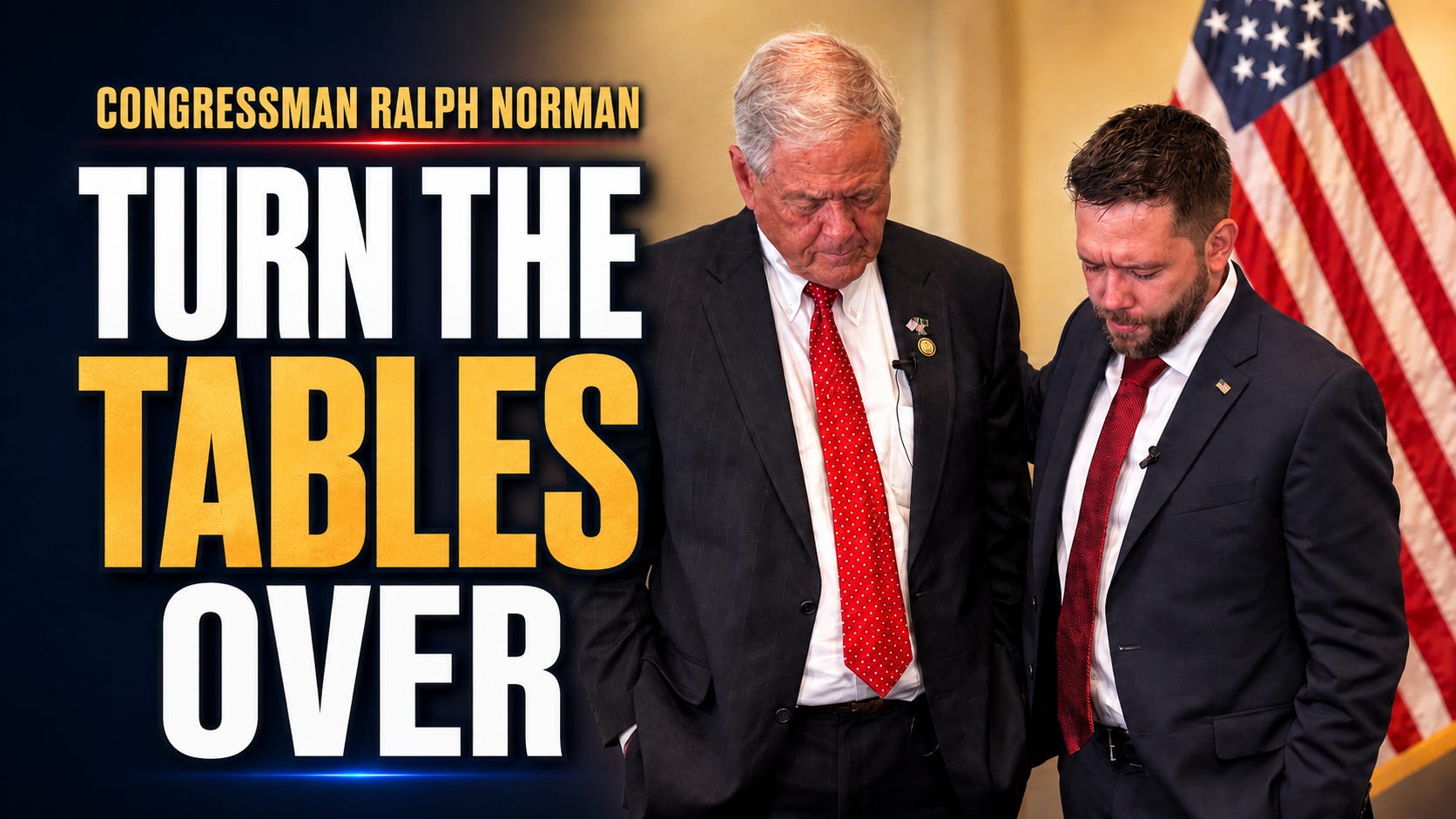
Near the end of my conversation with Representative Ralph Norman, we stood together in Speaker Mike Johnson’s conference room, where I had been recording a series of interviews about faith in public life.
An American flag filled the corner behind us, and a camera light remained on its stand as I placed my hand on Norman’s shoulder and prayed.
The photograph from that moment says something the interview alone could not quite capture. Norman received the prayer with his head bowed and the easy stillness of someone familiar with being prayed for, and perhaps with needing it.
Washington has a way of flattening people into voting records and cable-news clips. Across from me sat a man who has spent most of his life building businesses, raising a family, and trying to understand where faith belongs in the public square.
Norman is a lifelong resident of South Carolina’s 5th District. He graduated from Presbyterian College in 1975 and later joined his father’s construction business, helping it grow into a successful commercial real estate operation.
Public service came later. He served in the South Carolina House before winning a 2017 special election for the congressional seat vacated by Mick Mulvaney, and he has represented the Rock Hill area in Washington ever since. His official congressional biography still reads like the résumé of a businessman who gradually found himself pulled deeper into government.
I wanted to know how a Christian carries his faith into decisions that affect hundreds of millions of people. Norman’s answer began with the habits of an ordinary morning.
He wakes up, prays and asks Christ for guidance. That practice, he told me, changes the way a person sees everything that follows.
Norman remembered visiting the Museum of the Bible shortly after it opened and asking about its central theme. The answer was wonderfully plain: “Read the Bible.”
Scripture, he was told, requires neither protection nor introduction. It has survived every empire that attempted to suppress it and every generation that assumed it had outgrown its wisdom.
That story stayed with Norman because it removed the impulse to make Christianity clever. The Bible already carries the weight; our responsibility begins with opening it.
I told him about the Nehemiah Alliance and our hope of gathering millions of Americans for a defined 52-day season of prayer and repentance, with fasting built into the practice. A short unified prayer would be said each day, while participants took responsibility for the people and places within their influence.
“You’ve got to do it,” Norman answered.
He understood the importance of placing dates around a spiritual commitment. Concern can remain abstract for years, while a dedicated season gives conviction somewhere to take root.
No one can predict what will happen if millions of Americans begin praying together each day. I suspect the earliest fruit will appear in the people who pray, because asking God to change a nation eventually forces us to consider the condition of our own hearts.
Norman believes America’s spiritual decline has become visible in family life and in the formation of young people. His answer keeps returning to the same place: begin in Genesis, continue through all 66 books and allow Scripture enough time to reshape the way you see the world.
The most memorable image he offered was a seed.
Norman sometimes carries one with him when speaking in churches and asks the audience to consider how something so small can remain dormant until it is placed in the ground. Life emerges through a process no person can manufacture, though the gardener still carries responsibility for tending what has been planted.
“We have to bear fruit,” he said.
Sin, in Norman’s telling, resembles the weeds that slowly overtake an unattended garden. Neglect eventually becomes its own decision because whatever remains uncultivated will soon be claimed by something else.
That image explains much of Norman’s outlook. His Christian faith came through a Methodist upbringing where church attendance was expected and belief could be seen in the lives of his parents.
Politics eventually became a calling.
When I asked how that calling developed, Norman spoke about pursuing a particular office that he believed God had placed before him. The campaign ended differently than he expected, and the outcome was difficult to understand at first.
He never named the race in that moment, although the timing made his recent campaign for governor difficult to overlook. That effort had ended the previous month after he finished outside the Republican runoff, closing a statewide campaign he had spent nearly a year building. Local coverage of his Senate filing noted how quickly the political landscape changed afterward.
Norman said God’s guidance frequently becomes clearer with distance. A person can pray about a decision and still spend time wondering why it failed, only to recognize later that a closed path was part of the direction.
Christian faith, as Norman described it, forms people through discipline and often asks for obedience before the outcome makes sense.
His favorite passage is Esther 4:14, where Mordecai tells Esther she may have come to her position “for such a time as this.” Norman believes every person carries a calling that unfolds as God directs each season.
The verse has given him language for public service, especially when the path ahead remains unclear. It also carries unusual weight in light of what happened shortly after our conversation.
South Carolina was grieving the sudden death of Senator Lindsey Graham, who had represented the state in the Senate since 2003. Norman remembered him as a man with an unmatched personality and a gift for communicating through humor.
Politics, Norman said, is a blood sport. Graham spent decades living inside that world, where every friendship can become a negotiation and every conviction eventually acquires a political cost.
Our brief conversation about Graham carried the quiet awareness that every public career ends. Titles expire, elections pass and the questions of faith become personal in a way no campaign can manage.
On July 18, soon after our interview, Norman announced that he would run for Graham’s Senate seat.
Comments
Nothing yet. Say the first thing.
Sign in to join the conversation.