
Welcome to Two Truths—a best-selling newsletter by health journalist Cassie Shortsleeve and Motherspeak creator Kelsey Haywood Lucas. Two Truths explores the many facets of maternal health and living well in today’s world. It’s been named a “best parenting Substack” by Motherly, recommended by The Skimm, and featured in Today, Fast Company, The Bump & more.
Issues like this one—original reporting on topics that are critical to women’s and maternal health—are free because of our paid subscribers. Help us meet our goal of 1,000 paid subscribers and directly support independent journalism that supports moms and women by upgrading for just $5/month. 🤍
» And if you’re here via a link, don’t forget to type your email below. It’s the best way to keep up with our independent journalism that supports moms and women.
This issue is written by Cassie Shortsleeve
In 2023, when the Food and Drug Administration approved the first oral medication specifically indicated for the treatment of postpartum depression (we covered it in Two Truths here), Women’s Health asked me to report a piece on moms’ mental health. In that piece, I talked a lot about depression and anxiety—common perinatal mental health conditions that impact some one in five to one in seven new moms. I also talked about how far maternal mental health, as a field, has come—and how far it has to go.
This past week, the trial of Lindsay Clancy—a mother and nurse who killed her three young children in 2023 before attempting suicide—began; postpartum psychosis, a different and severe mental health condition, is at its center. We covered Clancy’s story and published a primer on postpartum psychosis in the second issue of this newsletter. We updated our conversation with reproductive psychiatrists Lucy Hutner, M.D., and Kara Brown, M.D. last week when the trial started.
Since then, at least on my feeds, the Clancy trial has been all over—especially here in Boston, where I live. It has shown us not just how far we still have to go when it comes to taking women’s health seriously, but it has reminded me of the power of the media we consume. The words we read, the videos we watch, the comment sections we find ourselves scrolling, the posts we pause on—we take all of it in. (Psychologist Tanya Cotler, Ph.D., helped us understand the power of that a bit better last summer when she introduced us to the term “collective grief” in our coverage of the flooding and deaths of 28 people, many of them children, at Camp Mystic.)
This is all to say that I think this trial has the opportunity to bring much increased awareness to maternal mental health—and that that is a good thing. Over the past week, I have seen TV news anchors sharing their personal struggles with depression live on air; I’ve heard moms opening up about their experiences with postpartum psychosis; I’ve seen so many brilliant doctors educating around the topic.
Yet, I’ve also seen salacious information spread about details of the case, aspects of the trial meant for the courtroom teased by major news outlets, strangers stringing together theories about the darkest days of someone’s life, and people conflating various postpartum mental illnesses. So while, yes, increased awareness around maternal health is a good thing, that’s only true if what we’re reading or watching or playing is accurate, informed, sensible, and, most importantly, full of resources if you need help.
So this week, I wrote another piece for Women’s Health inspired largely by much of the coverage I’ve seen about this trial, and about postpartum psychosis in media outlets and on social media.
I take all of my health reporting seriously, but my maternal health reporting is particularly important to me. As a journalist, I don’t take lightly the job of not just reporting the news but also discerning what to say, how to say it, and deciding whether something needs to be said at all.
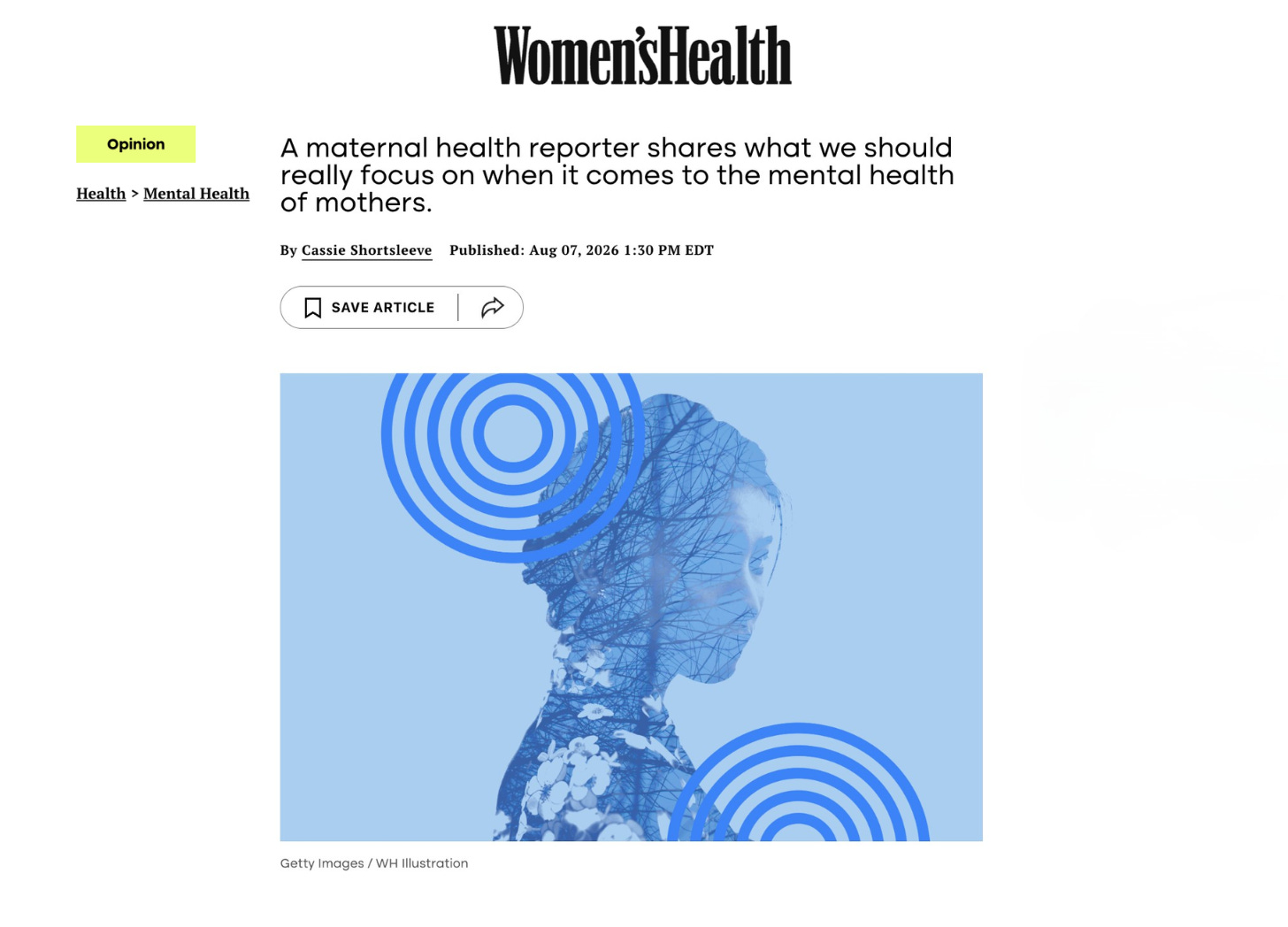
In a digital ecosystem where everyone with a platform or a following can feel required to “weigh in” or “speak up,” my recent piece for Women’s Health, published today, is about what we should really focus on when it comes to mothers’ mental health. You can read it here.
As always, if you need mental health support, please see the resources listed at the end of this issue. 🖤
Want to sponsor an issue of Two Truths or learn about partnership opportunities?
Resources and Support For Maternal Mental Health
Emergency assistance is available 24/7 at 911
The National Suicide Prevention Lifeline is available 24/7 at 988
The National Maternal Mental Health Hotline (1-833-TLC-MAMA or 1-833-852-6262) provides access to a trained counselor 24/7 and is available in Spanish and English
Postpartum Support International provides educational resources on PMADs, free support groups, webinars, advanced trainings for providers, and more
Postpartum Support International’s provider directory includes a list of thousands of trained professionals organized by state
The Motherhood Center offers counseling, support groups, and webinars
The Postpartum Stress Center offers educational resources, counseling, a referral list of trained providers, and advanced training for providers
SUPPORT YOUR MENTAL HEALTH WITH POSTPARTUM SUPPORT INTERNATIONAL (PSI). PSI is a global champion for perinatal mental health that connects individuals and families to the resources and support needed to give them the strongest and healthiest start possible. Visit postpartum.net for information on perinatal mental health disorders, access to 30+ free, online support groups, an online provider directory, the PSI HelpLine, local support coordinators, a perinatal mental health discussion tool, specialized support resources, and more. Call the PSI HelpLine toll-free at 1-800-944-4773 for basic information, support, and resources. Support via text message is also available at 800-944-4773 (English) and 971-203-2773 (Español). Remember: You are not alone. You are not to blame. With help, you will be well.
Please save, utilize, and share these resources. Consider forwarding this newsletter to a mother, partner, or support person who may benefit from reading it.
Comments
Nothing yet. Say the first thing.
Sign in to join the conversation.