
Did I hear it first in Spokane, Washington, where the band we were touring with—having just broken up, again—delivered an incandescent set? Or was it in Moscow, Idaho, in the crappy bar with the great graffiti?
Gouged into the wooden bathroom stall: “I FUCKED YOUR MOTHER!”
Beneath this, in neat ballpoint: “Go home, dad. You’re drunk.”
Wherever I went the album was already there, waiting for me: Half-hidden, haunting, unbearably intimate.
News traveled slower then; Spiderland had actually come out a full year before (March 27, 1991) but the echoes were only now reaching me. Lacking visual cues and with only a nonsense name to go on—what was a “Slint”?—the record was hard to grasp. It was clearly “alternative,” whatever that meant, but it had the dynamics of metal, vaulting from creepy-quiet to ear-blistering in an instant. The tension/release structure recalled hardcore, which in retrospect checks out: Half the group had sprang from the furiously moody Squirrel Bait.
In 1992, the term “post-rock” had yet to be coined, but Spiderland surely fit the mold. It rocked, but it was recorded like a jazz album: Open-sounding, unadorned, the actual sound of people playing in a room. But forget the pleasing harmonics of tube amps pushed into saturation; when the guitars go ballistic they’re infused with the cold, harsh buzz of distortion pedals. And the vocals: ranging from cryptic, inaudible whispers to puke-your-guts-out screams (singer Brian McMahon had, in fact, thrown up immediately after delivering the album-ending screams). Whatever it was, or wasn’t, Spiderland was inescapable, a star chart to some alternate universe. And it’s only now that I see what it really was: A classic coming-of-age record.
Remember, if you can, a time when music was passed hand-to-hand, ear-to-ear; a time before you might hear The Specials or Joy Division played in an upscale market. You actually had to be there, where it was happening, to catch it. For a moment there, I was: It was the spring of 1992, and my band Circus Lupus was on tour with Crain, the ones who broke up every few days.
In retrospect, Crain were the likeliest vector—like Slint, they were from Louisville—but they weren’t the only one. One show, I caught “Nosferatu Man” chugging through the PA; another, I heard the opening band soundchecking on “Washer” and its mournful, downturned figure. Crashed out on a couch somewhere I no longer remember, “Good Morning, Captain” filtered through the walls as I settled into fitful sleep.
Touring the States in a creaky van has never been for the faint of heart. But ever since I’d first picked up the bass, aged 12, it was all I’d wanted. Now, 21 years old and living my dream, I was coming up against some hard truths. There were moments of thrilling revelation—the Chicago skyline booming out over Lake Michigan, the savage beauty of the Columbia River Gorge beckoning as we rolled into Oregon—but they competed with all the other parts: Playing to disinterested drunks; sleeping on strangers’ floors; doubting if my bandmates actually liked me, or I them.
In darker moments, I wondered if traveling the heartland playing angular post-hardcore wasn’t actually a strategy for success, if in turning my back on the straight world I’d fucked my life up forever. As the miles ticked agonizingly by I hung there, caught in a web of thrill and doubt, vulnerability and awe. No wonder I fell so hard into Spiderland.
Spiderland is as much a place as it is an album. As Slint guitarist David Pajo says in a recent episode of the Life of the Record podcast:
“Britt pointed this out to me later…that with ‘Breadcrumb Trail’, you immediately have entered this world, and if you stick with it, you stay in that world until the record ends. And that’s really true. Like, there’s so much atmosphere on that record, and I don’t know how you record atmosphere. And I don’t think there is a how-to, but it’s just like one of those things where everything aligned. Like it really is like, calling the album Spiderland too, like you do enter Spiderland once you drop the needle on ‘Breadcrumb Trail’.”
If punk projected a toughness I didn’t actually feel, Spiderland summoned feelings even more confrontational. It was beautiful and strange, built on time signatures that even now I struggle to comprehend. Behind this a white-hot vulnerability, expressing in music what I couldn’t in words: that I was fast cresting the hill into adulthood, fearful there might be nothing on the other side.
Today, in this—what, post-post-rock?—landscape, it’s difficult to remember how shocking the album’s tenderness felt. Like another epochal album released just a few months later—My Bloody Valentine’s Loveless—it sounded like the invention of a new color. Steve Albini—who’d recorded Slint’s prior album, Tweez—wasn’t exactly known for his gushy emotionality. But the first time he listened to the gutting, dead-of-night despair of “Washer,” he felt profound embarrassment on singer Brian McMahon’s behalf. The second time, he wept.
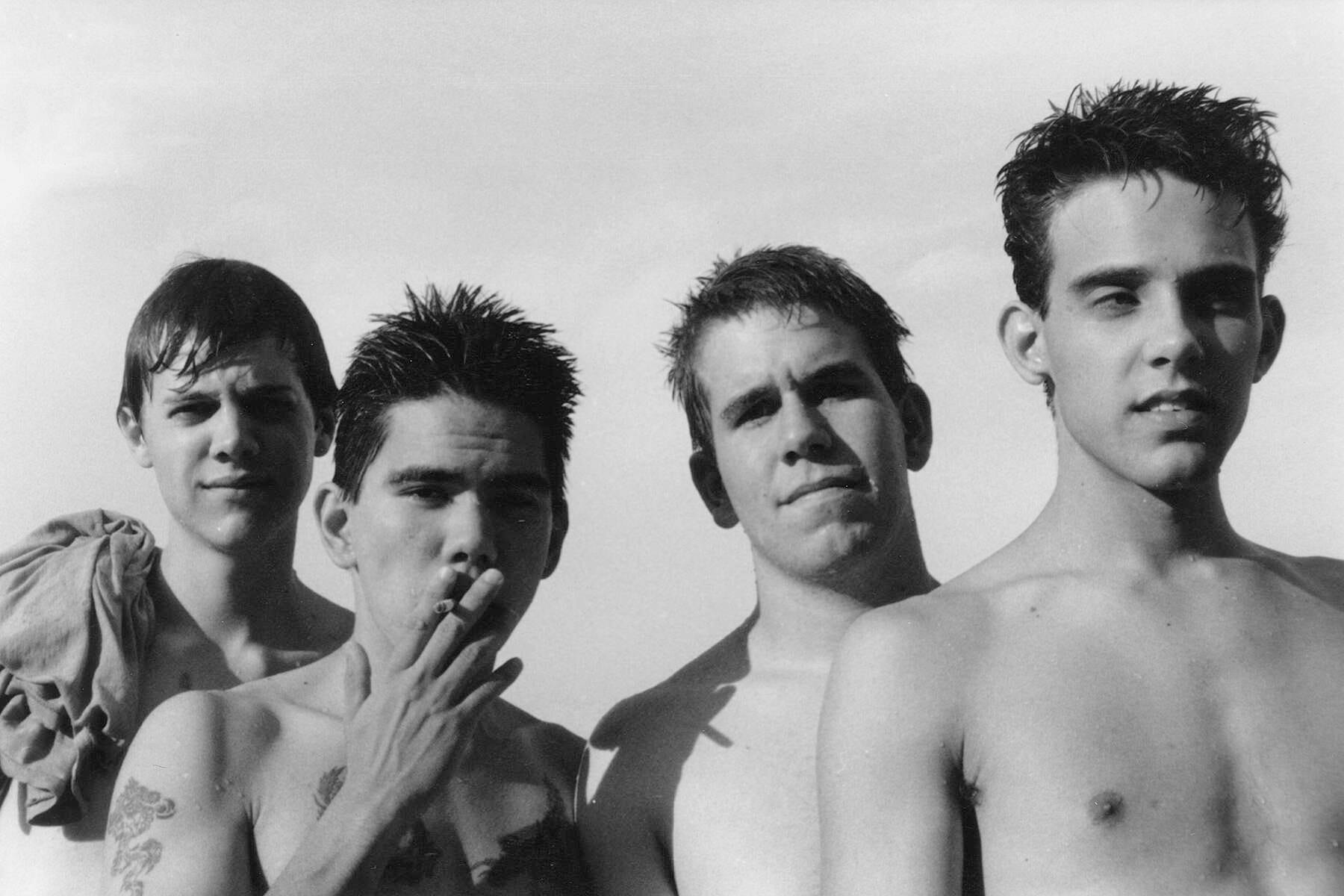
Mystery is a color of its own. While none of the members of Slint was older than 22 when Spiderland was recorded, they understood this well. From the now-iconic cover—shot by Will Oldham in a flooded quarry outside Louisville—to the black hole left by Slint’s sudden dissolution, Spiderland is thick with unanswered questions. There is nothing to interpret but the music itself, and even this has its limits. As bassist Todd Brashear notes in the podcast:
“In my opinion, the part [of the 33 1/3 book on Spiderland] where it analyzes the music, I just pretty much skipped all that. I was like, ‘Whatever. I don’t know.’ Like, I mean, I have some musical knowledge, but if somebody’s like, ‘Now, is that in 13/6?’ I’m like, ‘Fuck if I know.’ I mean, I don’t know, we just played it.”
I can relate. At 21, I was “just playing it” too, hoping to make music that might at best be semi-memorable. I couldn’t imagine taking time to parse it later, couldn’t imagine a world in single albums merited 2 1/2 hour podcasts. (To be fair, neither could I imagine podcasts—which probably explains why I’m not a fabulously wealthy podcast entrepreneur.)
While I’ve enjoyed previous episodes of Life of the Record, I left this one feeling slightly disappointed. Because it’s self-led—there is no interviewer, just the artists reminiscing—the level of disclosure and insight varies widely. The band members don’t actually reveal a great deal about the music or themselves, a sense I came away with after catching the band’s 2005 reunion. During that performance, at Seattle’s gilded Showbox, the songs were pitch-perfect but also seamless, holding me at arm’s length, refusing to allow me any closer. We already gave you everything; can’t you leave us alone?
It’s tempting to ponder what could’ve transpired had the band remained together and accepted—as per the note on Spiderland’s back cover—the offers from “interested female vocalists.” It would be years before the band discovered one from the then-unsigned Polly Jean Harvey; Corin Tucker sent one as well. In some alternate universe, Slint teams up with one (or both) of these powerhouse singers to forge a very different path. Instead they went so far inwards they imploded, but in the process created an entire new genre.
And so we’re left with this sonic moment, frozen—like the unfortunate spider on the album’s back cover—so that it could be captured. Perhaps the music is simply too intimate and personal to exist outside the safety of our headphones or the stillness of an empty house. But I do know this: When I found Spiderland, or it found me, it helped me touch on emotions so subterranean—my fear of the unknown, of having blown it—I feared they might annihilate me. Instead, it gave me a vocabulary and a map. Whenever I feel the need to return it’s always there, waiting patiently for me.
No posts
Comments
Nothing yet. Say the first thing.
Sign in to join the conversation.