

Unity, Unreal, Godot, Unity, Unreal, Godot… Our relationship with game engines has been nothing but a game developer’s k-drama. One day, we were swooning over Unity, the next day we were rage-quitting after a compiler error, only to crawl back apologetically 24 hours later. Choosing a game engine was the first major commitment in our game development journey. It shapes everything from our day-to-day workflow to our wallet — potentially costing serious $$$.
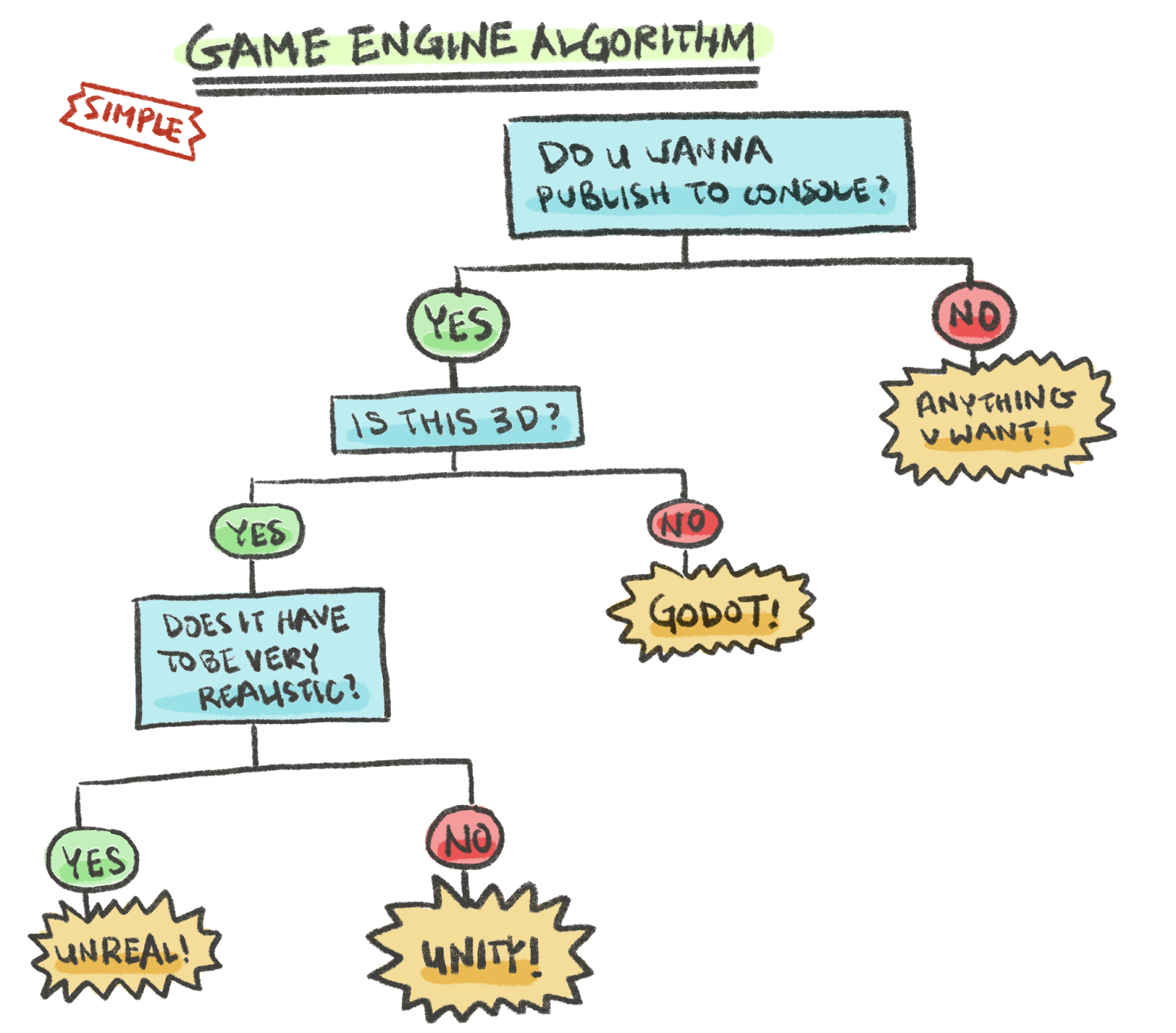
After probably a bit too much deliberation, we went with Unity because we wanted to make a 3D cartoonish game that we could also publish to consoles like Switch if we wanted to. (You can check out our reasoning in the simplified algorithm above.) But there's more to this story than a simple decision matrix!
Let’s get to the meaty part first! Godot is free, but both Unity and Unreal can charge hefty fees..
Unity :
Fees start to apply when you've made more than $200K in revenue or taken on more than $200K in funding.
You also have to pay the fee to publish to consoles instead of just desktop, web, or mobile.
Fees at the moment are fixed at $2,200 per Unity user in the company per year. So our two person game studio would have to pay $4,400 per year.
Q. What about the “Unity runtime fee”? They were planning on charging 2.5% of a game’s monthly gross revenue, but thankfully they have moved away from that pricing model!
Unreal :
we've made more than $1 million in revenue (All lifetime gross revenue)
After your first $1 million gross revenue from your product, you owe 5% from any additional revenue you make
Revenues generated from sales in the Epic Games Store are royalty-free
Then we can think of 4 different scenarios.
Low Revenue & Low Engagement
Revenue: $500k
Engagements: 500k
Unreal: $0
Unity: $2,200 / user / year
High Revenue & High Engagement
Revenue: $25 million/month
Engagements: 2.5 million/month
Unreal: $1,200,000/month
Unity: $2,200 / user / year
Low Revenue & High Engagement
Revenue: $2,000,000/month
Engagement: 25 million/month
Unreal: $50,000
Unity: $2,200 / user / year
High Revenue & Low Engagement
Revenue: $20 million/month
Engagement: 500k/month
Unreal: $950,000
Unity: $2,200 / user / year
In all scenarios, Unity was significantly cheaper. We might be wrong with some of the calculations, so take this with a grain of salt.
We are not intending to make a multiplayer game right now, but it's definitely on our radar. Based on several Reddit threads and blog posts, Unreal is supposed to have an easier multiplayer integration. But it looks like Unity also offers multiplayer capabilities, see here. Godot does not seem to be as suitable for this quite yet.
We liked that Unity does its coding in C#. It is more intuitive than C++ for us coming from the Java and OCaml worlds, and the Blueprints visual scripting language from Unreal seemed daunting. All three engines appear to have similar UIs, but Unity also felt a little more approachable because there are way more YouTube and blog tutorials about it.
This led us to choose Unity in the end. Since then, we've seen a lot of impressive projects using Unreal and Godot, so we're hoping to try them out too in the future.
Talk to you next time,
Jinny & Charles
No posts
Comments
Nothing yet. Say the first thing.
Sign in to join the conversation.