
Last week, we talked about the unusual setting for our next novel: the African Sahel. Read all about it in last week’s post:
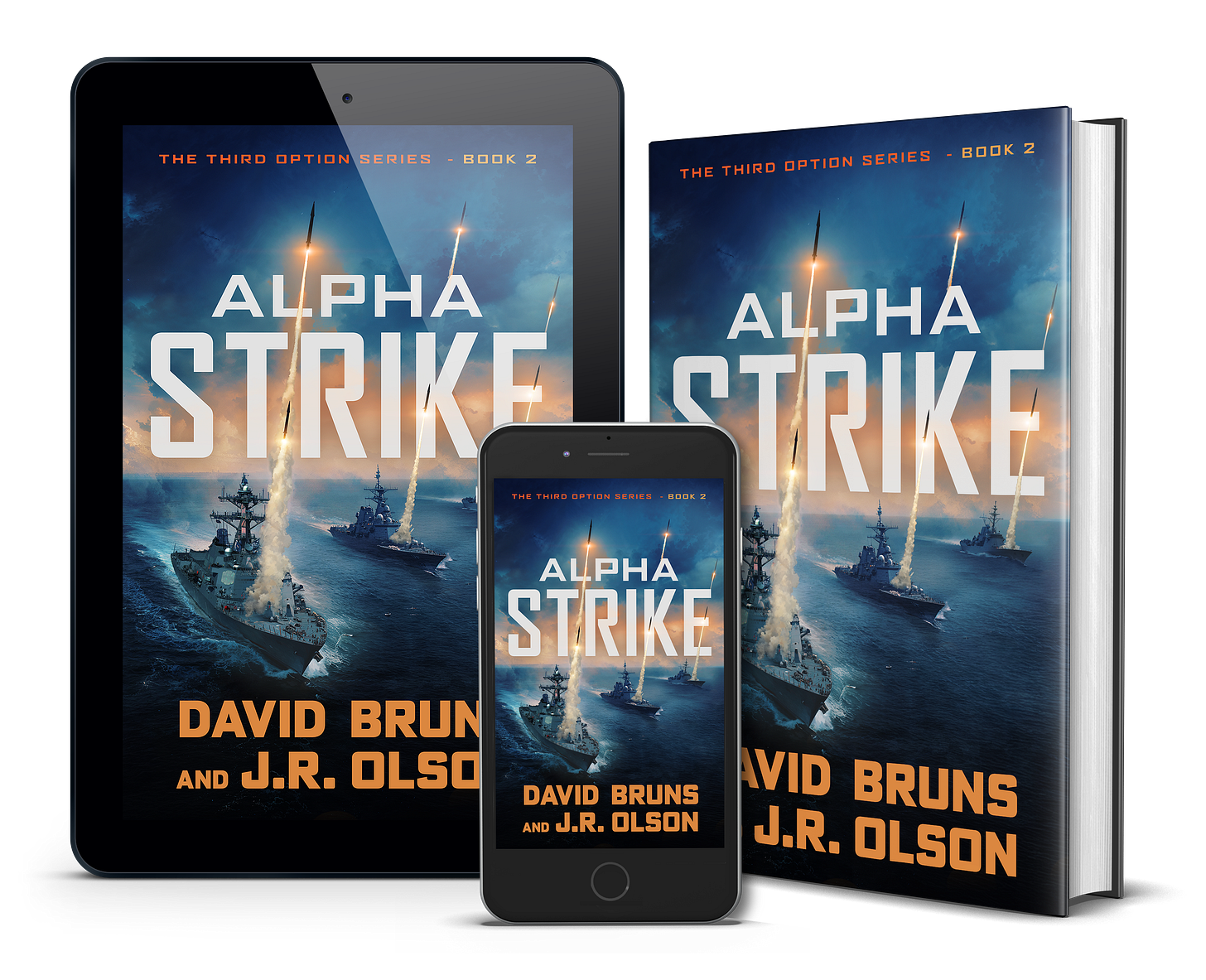
We don’t often write Prologues in our novels, but we did for Alpha Strike, on deck for release on July 21st in the all the formats.
Why? The short answer is that the first “chapter” didn’t feel like Chapter One. It felt like something outside the story, but at the same time, something the reader needed to know up front.
Hence, the use of the mysterious Prologue.
We are about to introduce you to one Ashur Badawi. Badawi, banker to Bashar al-Assad of Syria, is a Despicable Person.
But Badawi’s flavor of evil is not active. He doesn’t rampage through our novel shooting people. Rather, Ashur Badawi possesses the kind of passive evil that makes your skin crawl. A man who has the means to help his fellow humans and chooses not to, or worse yet, doesn’t even see the pain and suffering he’s caused.
We could go on with a long description of how BAD he is, but we’re writers. You know the first rule of writing:
SHOW don’t TELL.
You can read the Prologue to Alpha Strike right here on Substack. Members of the BORG—that’s the Bruns-Olson Readers Group—can download it to their ereader.
Download the ALPHA STRIKE PROLOGUE now
Alpha Strike, Book 2 of The Third Option series, releases in ebook, print, and audiobook on July 21, 2026.
The morning sun lit the road ahead as the Mercedes S-Class sped west on Rt. 1 out of Damascus. In the backseat, Ashur Badawi picked at his cuticles, the only outward sign of the stress that raged inside his body.
I should have brought the laptop home with me, he chided himself.
How could he have known the Syrian rebels would make that much progress overnight? He’d been told by Bashar al-Assad himself only yesterday that they had at least two weeks to make arrangements. A lie. While Ashur slept next to his wife last night, Bashar had fled to Moscow on his private jet.
Ashur cursed under his breath. That bastard. After all Ashur had done for him, all that beautiful money, he’d cast his banker aside like so much excess baggage. Ashur had laundered billions of dollars for the Syrian dictator. Without him, Bashar al-Assad’s regime would have collapsed years ago.
“Bastard,” he muttered.
“Pardon, sir?” Yakub’s eyes found his in the rearview mirror.
Ashur shook his head and looked out the window. On a normal weekday morning, this road would have been packed with commuters, but today it was empty.
The emergency alert arrived on his mobile phone while he was eating breakfast, the first inkling to Ashur that his world was collapsing. He stared at the screen, unwilling to process the words.
Damascus under attack….Eastern suburbs taken…Shelter in place.
As if to punctuate the news, he heard the deep boom of distant artillery.
His first call was to the palace, to Bashar’s head of security. The call went to voicemail. The knot of worry in his guts tightened as he worked his way through his list of contacts until someone finally answered and gave him the news.
Bashar al-Assad, after a decade of fighting and hundreds of thousands of casualties, had fled in the night, taking his family and his wealth with him.
“What is happening, Ashur?” Alia asked, her voice sharp with anxiety. Even little Umar, barely two, seemed to sense something was wrong. The child cried, and his mother picked him up.
“Nothing to worry about, habibiti,” he assured her. “I need to go out.”
Her eyes widened. “Is it safe? The television says we need to stay home.”
“Yakub will take me. I’ll be gone an hour, maybe two at the most.” He kissed her on the forehead, texted Yakub, and hurried off to dress.
His choices were automatic—dark blue suit, white dress shirt, matching blue tie, and cufflinks—but his mind worked overtime. He wondered if he should pack a bag, but that didn’t fit with the lie he’d told his wife. He’d leave with the clothes on his back.
Ashur went to the small safe in his closet and typed in the code. Inside were passports for the family, an MP-446 Viking 9mm handgun, and bundles of crisp bills, American dollars and euros. Close to $50,000 at yesterday’s exchange rate.
He took the weapon and his passport but left the money. Alia didn’t have the code to open the safe, so he left the door ajar. He would get cash at the factory when he retrieved his laptop.
The laptop. The thought of losing his laptop made him dizzy with fear. It was the key to everything, his life’s work. His entire money-laundering enterprise was on that device. Rebuilding that financial network would take years.
Whereas other bankers opted for the convenience of cloud storage, he knew it was a trap. In the cloud, the details of his intricate money-laundering process were vulnerable to hackers and foreign intelligence agencies. Good luck trying to hack the money-laundering machine he had developed. To Ashur, the best firewall in the world was the off switch on his laptop.
With his laptop in hand, he was powerful, in demand by criminal enterprises across the globe. Without it, he was just another banker.
Never again, he vowed as he tucked the handgun inside the sleek holster at the small of his back. I will never let the laptop out of my sight again.
Alia waited at the door of their apartment, Umar in her arms. The boy’s chubby brown cheeks were dry of tears, and he smiled up at his baba. Ashur gently chucked the child under the chin and pressed his lips to the top of his head. Then he kissed his wife tenderly.
“Be careful,” she whispered. Her eyes were glassy with unshed tears.
Was it love or fear? he wondered. Theirs had been an arranged marriage, a way for him to get closer to the Assad family—for all the good it had done him—but they’d been happy after a fashion.
He gave her a confident smile, kissed her again. “Two hours,” he said. “A quick trip to the factory, then I’m done.”
The thud of distant artillery sounded in the lower register of his hearing. Alia heard it, too.
“Take me with you.” She grabbed his arm. “I’m afraid.”
Ashur peeled her fingers from his limb. “I’ll be back before you know it.”
The tears threatened to spill over. “Promise me, Ashur. On the head of our child.”
Ashur had held her gaze, then placed his hand on the boy’s dark hair.
“I promise,” he lied.
Now, Yakub steered the car down the ramp, off the highway. He did not stop at the blinking red traffic light as he took the turn into the deserted cement factory at speed, leaving a plume of sun-drenched dust in their wake. He halted outside the admin entrance at the side of the building.
“I’ll be five minutes,” Ashur said, opening his own door. “Wait here.”
The Al Badia cement factory had not been in production since 2016 when Islamic State forces overran the site and took more than three hundred workers captive. Although the Syrian military regained the site, production was never restarted. Instead, Assad put the building to use first as a prison for dissidents, then converted some of the factory space to the manufacture of Captagon.
The illegal stimulant was Bashar al-Assad’s secret weapon in his civil war. Based on a prescription drug produced in Germany in the 1960s, Captagon acted like an amphetamine, producing dopamine in the brain and offering the user a sense of well-being and euphoria. It was used as a recreational drug all over the Middle East and distributed to soldiers on both sides of the Syrian conflict as “chemical courage” before battle.
It was also a financial windfall for Assad. Pills produced for pennies could be sold on the black market for $25 apiece. Dirty money gushed into Assad’s coffers to the tune of over two billion dollars a year, all laundered through Ashur Badawi’s proprietary network of crypto accounts and international shell companies. Today, Assad had three dozen factories scattered all over Syria, producing pills around the clock and transporting them to the Mediterranean port of Latakia for distribution across the Middle East.
The factory floor was quiet and empty this morning. Ashur could not recall the last time he’d seen the manufacturing line idle. The stillness left him with an eerie tickling sensation on the back of his neck, like he was being watched. His footsteps on the cement floor echoed in the silent room, and when he climbed the stairs to his office, the metal steps rang like a gong.
Using the keypad on the wall, he disarmed the security system and unlocked his office door. The interior smelled of burnt coffee. His assistant had forgotten to shut off the coffee maker again.
On an ordinary day, the smell would have irritated Ashur, but today, it didn’t matter. He would never drink her shitty coffee again.
Ashur made his way to the alcove at the back of the office, shielded from the picture windows that looked out over the factory floor.
The Swiss-made Waldis safe gleamed like a black monolith in the dim light. Considered one of the most secure safes in the world, the Waldis was the only place he would leave his laptop unattended. Ashur pressed his thumb to the biometric reader, then dialed in the combination. He gripped the handle, cranked it ninety degrees, and pulled. The heavy door opened easily on perfectly balanced hinges.
He let out a sigh of relief at the sight of his laptop, but he was in a hurry. He seized an aluminum briefcase and hauled it out of the safe. It landed on the carpeted floor with a satisfying thud. $1.2 million in crisp one-hundred-dollar bills weighed almost twenty kilos.
He cast his eyes around the interior of the safe. There was at least another $3 million stacked in bundles, but to take all of it, he would need to find something to carry it in, and that would take time he did not have. With his laptop and the aluminum case in hand, he shut the safe door and spun the dial.
Ashur didn’t bother rearming the security system or locking the office door. He clattered down the metal steps and hurried across the factory floor. The briefcase bumped against his leg as he clutched the laptop to his chest. He used his hip to open the door.
“Yakub!” he shouted. “Let’s go!”
He stopped cold. In the dirt parking lot, sunlight reflected off the idling black sedan.
Yakub should have been waiting to open his door, but instead he knelt in the dust, his hands cupped behind his neck. His handgun rested on the hood of the vehicle.
There were two of them. Bearded and thin, dressed in dirty uniforms of desert camouflage. And guns. They both carried rifles with curved magazines jutting from the underside. Ashur noticed that they held the weapons easily, and while their uniforms were filthy, the rifles were clean and oiled.
A few meters away sat a dusty Toyota technical, its engine ticking. The .50-caliber machine gun mounted in the truck bed was locked in the forward position.
A rifle muzzle snapped in his direction. “Stop,” the taller of the two said in Arabic. The other stood in front of Yakub, dividing his attention between his prisoner and the newcomer.
Ashur held his breath. “I have money.” His mouth was so dry he could barely get the words out.
The tall one assessed him coolly. “Show me.”
“There’s more upstairs,” Ashur continued. “In a safe. I can open it for you. Much more than this. Just let us go, and I’ll—”
The tall one stepped forward and slammed the rifle butt into Ashur’s forehead. His head snapped back, his body followed, and he crumpled to the ground. His laptop fell flat on the dirt.
The pain was intense. His eyes streamed tears, his ears rang, and he tasted dirt on his tongue. In the distance, he heard the two rebels talking excitedly about the briefcase, then with anger. A heavy boot connected with his stomach, and a fresh wall of pain slammed into him. He curled into the fetal position, wrapped his arms around his head.
“Open the case,” the tall one shouted, “or I’ll shoot you in the balls.”
Ashur rolled onto his hands and knees, looked up. The greedy eyes of both fighters snapped between the case and Ashur. He was careful not to look at Yakub as he reached for the case and began to work the combination lock. Ashur let the lid fall open, and piles of American dollars tumbled into the dirt.
The fighters gasped. Ashur twisted the case, and more money fell out. “There’s more upstairs. Three times this amount—”
Behind them, Yakub moved. He was a big man, but he was fast. His hand slipped to his belt, withdrawing the knife he concealed there behind the buckle.
Ashur had seen him do this trick a thousand times.
The weapon was a flat blade, stiff and short, perfectly balanced for throwing. His hand snapped back and he released the knife. A split second later, the blade protruded from the shorter fighter’s brain stem. The man swayed and toppled over.
Yakub was already in motion, lunging for the handgun atop the hood of the car.
Mesmerized by the sight of all that money, it took the tall one a moment to realize what had happened. He twisted, his rifle coming up, fire spitting from the muzzle. Blots of red pinned Yakub to the side of the car.
The tall one advanced on the fallen driver, his rifle at the ready.
Ashur, his head still ringing from the injury and the close-quarter rifle bursts, reached around to his lower back for his own weapon. The Viking 9mm felt heavy in his hand. He tried to remember if the gun had a safety. Did he have to do something or just point and shoot? His head throbbed as he tried to recall the details.
Yakub twisted on the ground in agony, making low guttural noises, his sweaty face caked with dirt.
As the tall one stood over Yakub, Ashur aimed his own weapon and pulled the trigger. His hand jerked back, and he nearly lost his grip on the gun.
The fighter’s chin disappeared in a spray of blood and bone. He stumbled, then swung toward Ashur, the rifle muzzle coming up, spitting fire.
Ashur closed his eyes and pulled the trigger again and again until nothing happened.
He opened his eyes. The tall fighter had fallen back against the car, sitting on Yakub’s prone body. His eyes were glassy, turned toward the sky. The rifle was still in his hand, his finger on the trigger.
Ashur dropped the handgun and shoveled the money back into the briefcase with both hands. He snapped the lid shut, grabbed his laptop, and lurched to his feet.
Then he heard a noise. A bubbling groan.
Yakub was alive. His driver and bodyguard of more than eight years lifted his head. Red blood frothed at his lips.
“Help me,” he moaned.
He’s dying, Ashur told himself.
“Please.” Yakub’s voice was weak and thready.
Ashur looked at the pale blue sky, squinted at the hot sun. When he looked down again, he could see ripples of heat rising from the road.
“Please.” More a sigh than a word.
Ashur stepped over the bodies to the open driver’s side door. He sat behind the wheel and placed the briefcase and laptop on the floor in front of the passenger seat.
Then he slammed the door shut and drove away.
Copyright © 2026
by David Bruns and J. R. Olson. All rights reserved.
As always, thanks for being a supporter –
David & JR
PS – Are you looking for the FREE download of Death of a Pawn?
PPS - This email is free, but it’s not cheap. If you’d like to show your support, here’s where you can find all the Two Navy Guys’ books.
PPPS - If you enjoyed this post, you can get it delivered to your inbox every week for free.
Comments
Nothing yet. Say the first thing.
Sign in to join the conversation.