
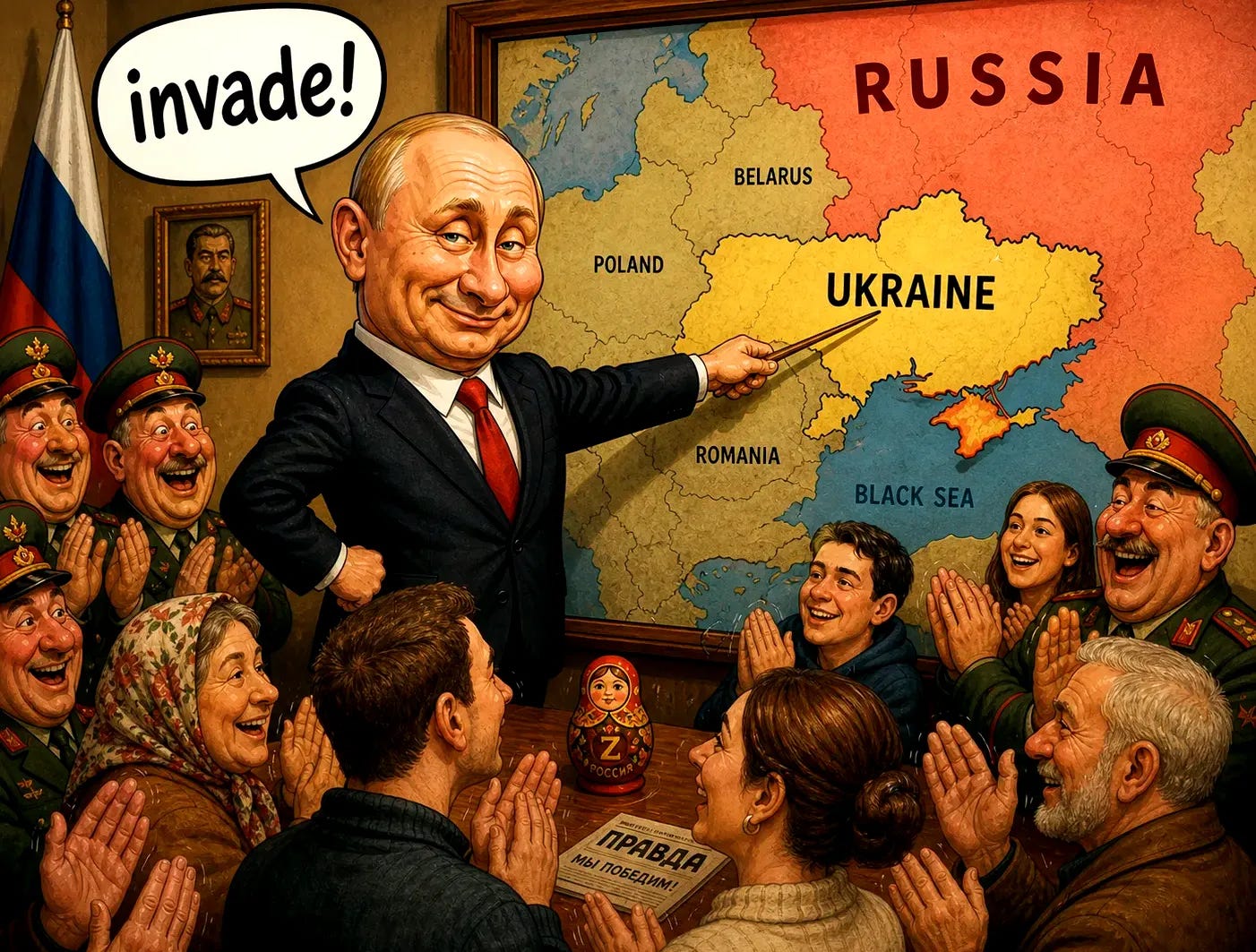
Editor's note: We don't publish guest essays because we expect every reader to agree with them. We publish them because they advance serious arguments that deserve to be examined - and challenged. . On this blog, thinking is allowed, even thinking aloud.
BY ALEXEY ULKO
Ever since Ukrainian strikes on Russian logistics and oil infrastructure became visible, many observers have resumed asking why ordinary Russians should be made to suffer.
The word “suffering” is, of course, hyperbole; any minor inconvenience felt in Russia pales in comparison to the immense anguish endured by millions of Ukrainians over more than a decade of Russian aggression.
Yet the question remains: why should the Russians bear any burden, and does the concept of collective responsibility apply?
Criminal law relies on individual guilt, prompting arguments that treating citizens as collectively responsible simply by virtue of holding a Russian passport borders on authoritarian or discriminatory doctrine.
However, much of the prevailing analysis is logically flawed. It tends to revolve around crude binaries, such as whether holding Russians accountable implies that every individual bears equal guilt. Naturally, it does not.
The war itself, whether traced back to the 2014 occupation of Crimea or the 2022 full-scale invasion, represents merely the visible manifestation of a far deeper problem.
The atrocities perpetrated by Russian soldiers and commanded by Russian authorities are the consequences of a broader framework.
Russian responsibility lies in the culture, worldview and institutional system that made such actions possible.
For military forces to systematically violate the rules of war, deliberately target civilians and launch follow-up strikes on rescue workers and medical personnel, a specific environment in the army must cultivate them for a long period.
This is not merely a series of isolated crimes; it is a culture embedded within the Russian military, which in turn reflects the cultural consensus of the broader society.
The issue is not whether specific atrocities can be directly attributed to individuals who claim to oppose the war. It is about the creation and maintenance of a cultural system rooted in the collective consciousness of tens of millions of people.
Understanding why torture, rape and double-tap strikes are treated as acceptable requires examining the national culture that nurtures such practices, particularly the subconscious doctrine of Russian exceptionalism.
The reflexive desire to evade responsibility and construct a vague foundation for moral self-justification and an indignant moral response is itself a primary symptom of this underlying condition.
This inability to self-reflect or assess actions from an ethical standpoint is evident not only among ordinary citizens, but also among highly educated figures, including prominent humanitarians.
Many are quick to invoke collective identity when claiming prejudice against Russians, yet immediately reject any collective duty when accountability is raised.
One cannot claim membership in a culture while selectively disavowing its structural outcomes simply by declaring opposition to Vladimir Putin.
This responsibility spans decades of building and sustaining a system where criminal conduct, material self-interest and indifference to foreign suffering are deeply ingrained.
It is reinforced by enduring self-congratulatory myths: Russia as a bridge between East and West, Moscow as the Third Rome. And the vastness of its territory as proof of greatness and an insistence on its unique spiritual depth.
This was further amplified by Soviet self-laudation, which echoed Lenin’s belief that Marxism was all-powerful simply because it was right. Such absolute self-righteousness, combined with a sense of perpetual victimhood and a distorted sense of proportion, has produced a worldview that is deeply provincial yet convinced of its own universal validity.
This insularity becomes painfully evident in the present wave of emigration.
As millions of Russians leave the country, many struggle to integrate into the world —whether in post-Soviet states, Asia or Europe.
They find themselves at a loss, unable to adapt or comprehend how their presence is perceived and why this impenetrable feeling of self-importance does not work any longer.
This widespread failure stems from a sharp collision with reality: the realisation that Russian culture, far from occupying a central or exceptional position on the global stage, is merely one among many.
The resulting confusion often triggers defensiveness and backlash, all driven by a mindset that is simultaneously aggressive, naive and insular.
However, until this exceptionalism is recognised as a pervasive cultural ailment rather than a mere set of political opinions, true self-reflection will remain non-existent and no effective therapy is possible.
Alexey Ulko, Fellow of the Oxford Nizami Ganjavi Centre, an art critic and filmmaker based in Tashkent, Uzbekistan.
His current research focuses on several interconnected areas. One strand is the framework he describes as the “five dimensions of culture”, which offers a way of approaching contemporary art history in Central Asia. Closely related to this is his work on the cultural dynamics of the present moment, interpreted as a form of hybrid war involving multiple actors and multiple layers of influence. This perspective requires moving beyond the increasingly dated conceptual vocabulary of both post-Soviet and (de)colonial studies and developing more robust and analytically rigorous frameworks capable of addressing the complexity of current cultural processes.
Comments
Nothing yet. Say the first thing.
Sign in to join the conversation.