
In his eerily realistic fiction novel, The Ministry for the Future, Kim Stanley Robinson writes of a German-named affliction called Götterdämmerung syndrome, or twilight of the gods. This pathology manifests when the privileged and powerful recognize their death is imminent and, in a fit of narcissistic rage, seek to destroy the world as they die. Resulting from immense self-absorption and entitlement, “they become extremely angry when their privileges and sense of entitlement are being taken away”.
Robinson later invokes a less extreme example of this allegory, referring to politicians who “bray loudly about the god-given right to kill everything in creation without restraint”. In their arrogance, powerful people are exhibiting the same narcissistic self-importance and entitlement as the mythological gods of old.
In Canada, the greatest privilege is generally acknowledged to be held by white, heterosexual, cis-gendered men. What may be overlooked is the majority benefit afforded to christians, given that christianity is the most common religion practiced in the country. Despite being considered a secular country, the historical era of “christian Canada” continues to directly and indirectly structure contemporary “secular” Canadian institutions, resulting in privileges the Ontario Human Rights Commission have termed systemic faithism.
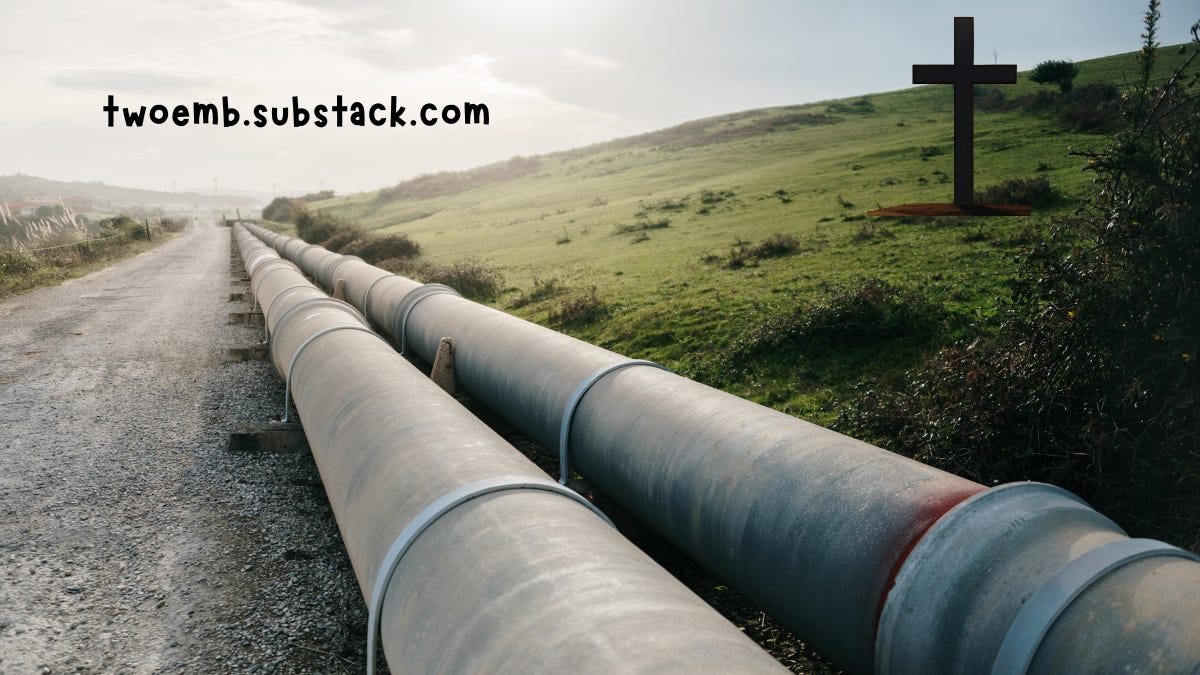
One well-articulated christian privilege is the presumed “god-given right” to exploit the earth’s natural resources. This environmental pilfering is carried out in the name of god, country, and capitalism under the guise of “great moral values” such as protecting human and national freedom.
In his doctoral dissertation, Fuel and Faith: a spiritual geography of fossil fuels in Western Canada, Darren Fleet details complex faith-based structures supporting extractive industries across the Western Canada. Building on Fleet’s work, I have highlighted three key themes which I apply to the analysis that follows: extractive populism, anti-government sentiment, and persecution narratives. I explore factors which allow or encourage factions of Canadian christians to deny the existence of anthropogenic climate change despite overwhelming scientific evidence and significant theological discrepancies.
The contradictions between materialism, such as not wanting to downgrade to a smaller house or car, and the tenets of christianity which guide followers to love their neighbours and protect the planet seem to reveal a paradoxical entanglement of capitalist and christian values.
An insightful analysis McLean, Laxer, and Peker details the interconnectedness between religion and a populist defense of the fossil fuel industry in Alberta. Their paper demonstrated how the far-right organization Take Back Alberta and the United Conservative Party took advantage of anti-state sentiment following the implementation of Covid-19 pandemic restrictions, and made the case that government overreach extends to environmental regulations.
Like McLean and colleagues, I have noticed a pattern in Manitoba in which far-right christian conservatives are much more likely than others to believe that climate “alarmism” is some kind of hoax perpetrated by the “woke left”.
In Manitoba, the region with the highest number of people who do not believe the earth is getting warmer is the political riding of Portage-Lisgar. This region encompasses a large part of Manitoba’s “bible belt”, including the city of Winkler, wherein 89% of the residents identified as christian on the 2021 census, as compared to the national average of 53%. Portage-Lisgar also earned the dubious distinction of placing in the bottom ten of all federal districts, based on the percentage of people who acknowledge the earth is getting warmer, ranking only above Albertan districts.
There are factions of the christian community in Canada who believe climate change is a hoax created by “elites” who seek to “use the state to crush individual liberties”. Others assert that pollution is the “sacrifice we make for capitalism”, with some going as far as to outright deny the existence of global warming. There are those who claim the environment is god’s creation meant for man to govern, that it is god’s will for humans to harvest the earth, and as such, they are fully entitled to exploit nature’s reserves. Christian eschatology admonishes believers to have faith in “god’s plan”, and to focus on the promise of reward in the afterlife.
Many express the attitude that it’s okay if we don’t take care of the earth in the present, because the world is going to end soon anyhow, and those who believe will be saved. Those in these latter schools of thought could be said to be suffering from Götterdämmerung syndrome themselves.
In the coming articles, I will investigate how christian faith influences the Canadian far-right’s perspectives on climate change and, in particular, how this plays out in provincial politics across Manitoba. Right-wing advocacy groups such as Manitoba Stronger Together (MST) and the Frontier Centre for Public Policy (FCPP) describe their organizations as non-partisan, and as not subscribing to any political ideology.
Expanding upon the themes I identified in Fleet’s work, my articles will analyze MST and FCPP’s publications on environmental issues. I will show that, while they may not endorse any political parties, they do subscribe to clear political ideologies and employ extractive populism, anti-government sentiment, and persecution narratives to further their respective causes.
Stay tuned!
© Jillian Enright, Neurodiversity MB
Part four: Far-Right Christian Conspiracy Theories
Poilievre’s Pipeline Goes From Figurative to Literal
You can leave a “tip” on Ko-Fi at https://Ko-Fi.com/NeurodiversityMB
Become a paid subscriber to my Substack publication
Check out my online store at https://NeurodiversityMB.ca/shop
Read and share my articles from twoemb.medium.com
You can also follow me on facebook & Blue Sky, and find all my links on LinkTree
This series of articles was originally written as a paper for an Environmental Communications course, and has been edited for ease of reading and to fit the online newsletter format.
Canada. (2022, July 18). IRCC Anti-Racism Strategy 2.0 : Wheel of privilege and power. Immigration, Refugees and Citizenship Canada, Government of Canada. https://www.canada.ca/en/immigration-refugees-citizenship/corporate/mandate/anti-racism-strategy/change.html
Dochuk, D. (2019). Anointed with oil : how Christianity and crude made modern America (First edition). Basic Books, Hachette Book Group.
Drysdale, K. (2026). Manitoba Municipal Election 2026. Manitoba Stronger Together (MST). https://www.manitobastrongertogether.ca/manitobamunicipalelection2026
Fleet, D. (2021a). Fuel and Faith: A spiritual geography of fossil fuels in Western Canada. [Doctoral Dissertation, Simon Fraser University]. Library and Archives Canada.
Hochschild, A. R. (2016). Strangers in their own land : anger and mourning on the American right. The New Press. https://www.hoopladigital.com/title/12049580
Leis, D. (n.d.). About Us: What is the Frontier Centre? Frontier Centre for Public Policy (FCPP). https://frontiercentre.org/about
McLean, J., Laxer, E., & Peker, E. (2024). Taking Alberta Back: Faith, Fuel, and Freedom on the Canadian Far Right. Religions, 15(10), 1250. https://doi.org/10.3390/rel15101250
Mildenberger, M., Howe, P., Lachapelle, E., Stokes, L., Marlon, J., & Gravelle, T. (2016). The Distribution of Climate Change Public Opinion in Canada. PLoS one, 11(8), e0159774. https://doi.org/10.1371/journal.pone.0159774
OHRC. (2014). Residual christianity and systemic faithism. Human rights and creed research and consultation report. The Ontario Human Rights Commission. https://www3.ohrc.on.ca/en/iii-background-and-context/4-systemic-faithism
Robinson, K. S. (2020). The ministry for the future. Orbit Books.
StatsCan. (2022a, October 26). The Canadian census: A rich portrait of the country’s religious and ethnocultural diversity. Statistics Canada. https://www150.statcan.gc.ca/n1/daily-quotidien/221026/dq221026b-eng.htm
StatsCan. (2022b, December 16). Distribution (in percentage) of main religious groups, Winkler (CA), 2011 and 2021. Government of Canada, Statistics Canada.
Weber, M. (2012). The Protestant Ethic and the Spirit of Capitalism. Renaissance Classics. [1904].
No posts
Comments
Nothing yet. Say the first thing.
Sign in to join the conversation.