
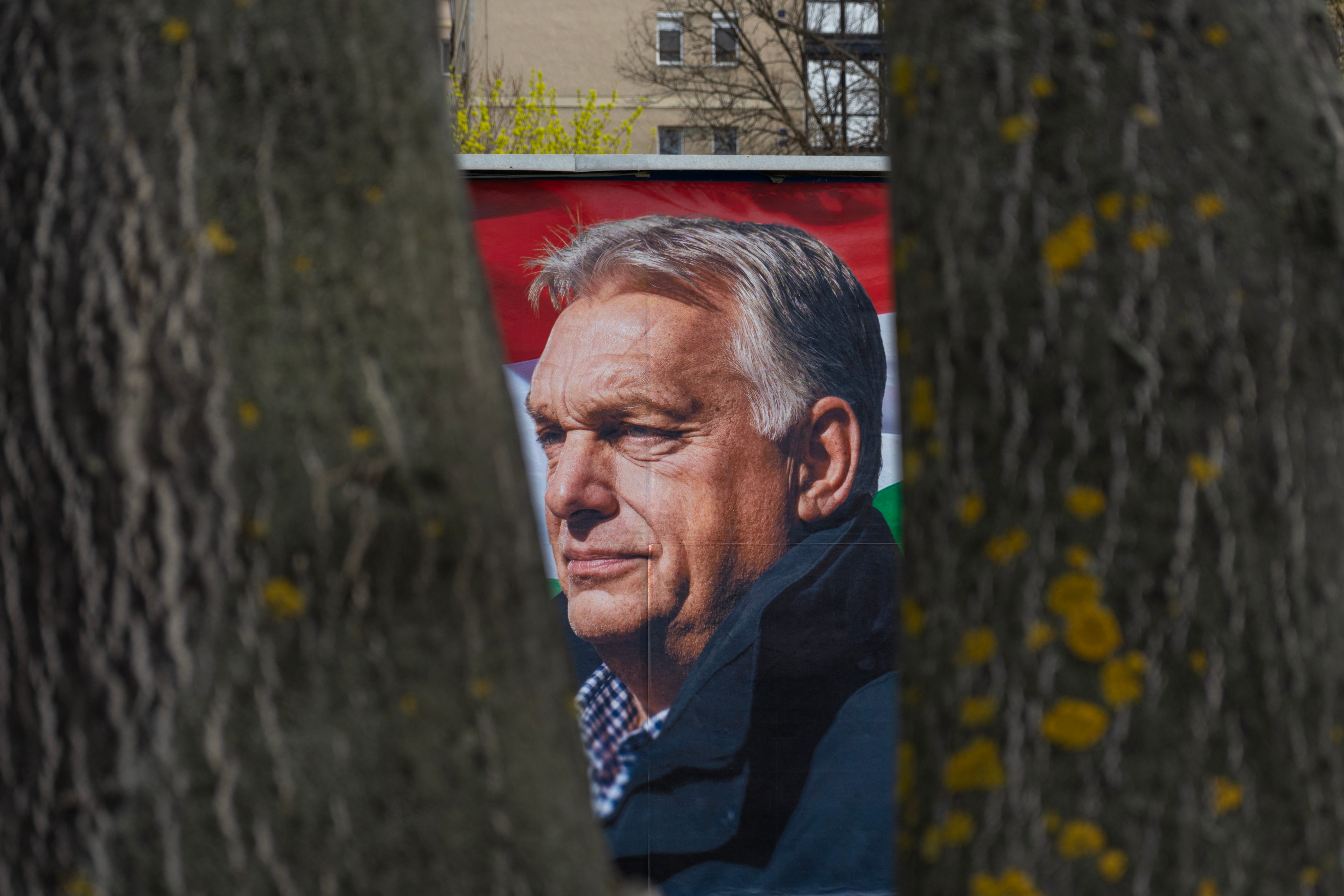
So, fare-ill Viktor Orbán.
He’ll still be Hungary’s prime minister for another two weeks, but Orbán’s defeat on April 12 was so crushing and his successor’s exertion of power so complete that this 16-year fixture in European politics is already just a chalk outline.
Blissful as it was to watch Budapest celebrate his demise and anticipate the roll-up of his accumulative state1 and the de-funding of his foreign entourage, the militant democrats among us know this is just one battle in a forever war. The tide will never turn against populism or authoritarianism. Keeping a majority coalition in favour of free and fair economic and political competition is a permanent revolution. It’s a complex argument for managed uncertainty against three-word slogans and a promise to stop the world changing. Sustaining consensual efforts to boost growth while rebalancing public finances and containing ethnic, cultural and religious resentments is the work of political wunderkinder. And they’re a rare breed, especially now.
In Europe alone, elections are looming that will pitch the open society against its enemies in Sweden, three eastern German states, Italy, Spain, Slovakia, Poland and – the big one – France. Outside Europe, the most consequential choices between liberalism and illiberalism will be in Israel and the US, where midterms will deprive Donald Trump of at least one Congressional house and launch a succession battle. With Orbán out and Trump emasculated, the central obstacles to Europe and its economic, political and military ambitions will be out of the way. Right?
Wrong. Orbán, like the British before him, has been a convenient invisibility cloak for governments who, even now, worry about poking Moscow, losing their last drops of Russian energy, re-arming, and provoking their farmers. As for the maniac 77,302,580 Americans chose to return to office, does anyone believe he will smile and accept his new impotence? In his latest Inside Trump’s Head podcast, Trump-watcher Michael Wolff revealed that White House advisers were attempting to “course-correct” in time for the midterms but …
“Course correcting is the absolute opposite of what he does. Trump is strictly a double-down guy ... Instead of answering those issues, what he’s fuming about is the Fed, fuming about the ballroom. I mean, he’s even back –in these conversations I’ve had over the last couple of days – to talk about, wait for it, Greenland … You would think he would understand: ‘I tried the Greenland gambit. I got an enormous amount of blowback. It really came clear that this could not happen in any way and in any dimension’. So you think he would get that and at least have a new idea … But it’s not. It’s as though he’s right back at the beginning of this discussion: what a good idea it would be if we had Greenland. And why can’t we have it?”
The return of Greenland as a transatlantic divider is bad enough but it won’t stop there. Once he’s paid Iran to pretend to lose and forced the hoodwinked Israelis into a premature settlement, Trump will turn on those European Judases. His most obvious act will be a performative exit from NATO. Actual Yanxit™ requires a two-thirds Senate majority Trump won’t obtain followed by a year’s notice, during which the US is still bound by the treaty’s collective-defence clause. Sure. Our enemies will know by then (if they don’t already) that the US will never come to a fellow NATO member’s aid. NATO is now nothing but mutual convenience. On the Europeans’ side – satellite surveillance, strategic airlift, pay-to-play missile defence and an established integrated command. For the Americans – European intelligence sharing (redacted for the director of national security, obviously) and strategically placed bases in Ramstein, Grafenwöhr, Lakenheath, Aviano and Rota. The desire to keep those goodies may just be enough for the Pentagon to resist orders from Trump and his compliant defence secretary to deploy the 11th Airborne to Nuuk.
At the same time as he’s ordering withdrawal from NATO and threatening Greenland, Trump will be unable to resist threatening or even imposing higher tariffs on imported goods from the EU and the UK. The US-UK and US-EU trade “deals” struck in May and July last year were never more than bids at deflection to buy time until the end of his term or life – whichever came first. Today, they’re legislated, zombie agreements that apply until Trump is offended by British failure to join his bombing campaign over Iran or realises that the EU hasn’t paid him a promised €600 billion in cash.
Today, European policymakers come in four flavours. The first, personified by NATO secretary-general Mark Rutte, is disappearing by the day. Like Tony Blair and Peter Mandelson, Rutte is so obsessed with hugging Washington close to stave off isolationism that he takes sides against the rest of the alliance to avoid something that’s already happened. For all his big talk of strategic autonomy, Emmanuel Macron is closer to this flavour than the other two. Heading type two is Spanish prime minister Pedro Sánchez, who has conjured passive indifference to European collective security into an active campaign against Israel and the US. Naturally, this is about domestic politics rather than international principle but it’s an appealing model – working for Gerhard Schröder in 2002 and Orbán in 2022 – and one that Keir Starmer, his British counterpart, typically found too late and too hesitantly.
In third place is Alex Stubb, Finland’s president. As commander in chief of a frontline military that is used to semi-detachment from NATO, Stubb leads the realist faction – using golf to manage Trump but preparing at speed for the end of the alliance and a potential war with Russia. European NATO should hang on to US intelligence, surveillance and targeting support for as long as possible, the Stubbers believe, but not at the expense of Denmark’s sovereignty. Flavour four is Ukraine - the European country with the most skin in the game, which has come to accept that Washington is no longer an ally and sees its role as imposing Russia’s needs on Kyiv. As a counterweight, the Ukrainians are shopping for new allies in the Gulf and a post-Netanyahu Israel while proposing a new security architecture for Europe encompassing the EU’s martial powers plus Norway, the UK and Turkey.
With the exception of Kyiv, the Europeans are preparing for the formal end of the transatlantic alliance but still too slowly. Defence spending has increased substantially but, as the public dispute between Britain’s Labour government and the party’s most distinguished living defence secretary shows, the real choice between arms and alms still has to be made. Germany has so much to catch up and so much fiscal space that it can dodge this for now while Italy and Spain have no intention of facing it. The French and British still want to be continental hard powers but have yet to make the case to voters.
It’s just the latest example of Juncker’s curse2. Governments (and not just those in Europe) will do nothing ambitious until they are out of options. They keep believing there’s still hope of saving the US alliance. There isn’t. Since nothing in life happens that hasn’t been trailed by Douglas Adams, Stephen Fry or Aaron Sorkin, the European dilemma recalls a story told to the president by his priest in West Wing: Take This Sabbath Day …
You remind me of the man that lived by the river. He heard a radio report that the river was gonna flood the town. And that residents should evacuate their homes. But the man said, ‘I’m religious, I pray. God loves me, God will save me’.
The waters rose up. A guy in a rowboat came and shouted: ‘Hey, you! The town is flooding! Let me take you to safety!’
The man shouted back, ‘I’m religious. I pray. God loves me. He’ll save me’.
A helicopter was hovering overhead and a guy with a megaphone shouted: ‘Hey, you! You down there! The town is flooding! I’ll take you to safety!’
The man shouted that he was religious, that he prayed and that God would take him to safety.
Well, the man drowned.
Standing at the gates of St. Peter, he demanded an audience with God. ‘Lord,’ he said, ‘I’m a religious man, I pray. I thought you loved me. Why did this happen?’
God said, “I sent you a radio report, a helicopter and a guy in a rowboat. What the hell are you doing here?’
Hat-tip to Gábor Scheiring, who we interviewed for the podcast last week, from his Retreat of Liberal Democracy: Authoritarian Capitalism and the Accumulative State in Hungary (2020).
“We all know what to do, but we don’t know how to get re-elected once we have done it,” said Jean-Claude Juncker, then president of the Eurogroup (2007).
No posts
Comments
Nothing yet. Say the first thing.
Sign in to join the conversation.