
By Shibra Arshad
August 23, 2026
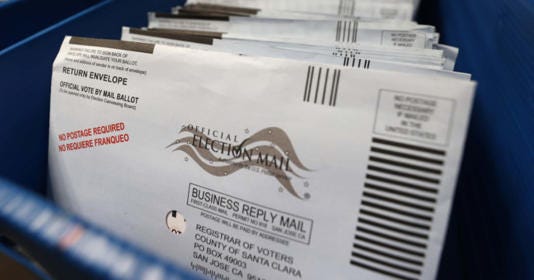
The US Postal Services (USPS) on Friday, August 21, published a 95-page rule book, tightening requirements for mail-in voting ahead of the November congressional elections.
The decision comes days after federal court earlier this month issued a preliminary injunction blocking the US Postal Service (USPS) from implementing President Trump’s 2026 executive order restricting mail voting.
The newly released USPS rule book is a move to aligns with President Donald Trump’s March 31 executive order, tightening the rules to use mail-in ballot.
The agency said it has released rule so it could take immediate effect if a court lifted its injunctions on it and be in place for the upcoming election.
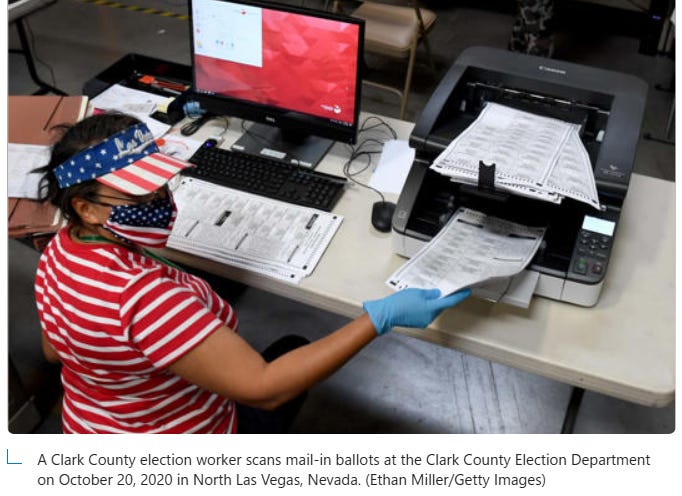
Under the rule, USPS would not deliver ballots in states that do not comply with the rule’s new standards.
“Any state that intends to receive mail-in or absentee ballots from individual voters through the Postal Service must ensure that such individuals have been enrolled with the Postal Service for inclusion on the state’s Mail-In and Absentee Participation List,” the new rule reads.
The executive order by Trump administration, among other things, ordered the agency to mandate that all states that plan to use USPS to send mail-in ballots notify the agency at least 90 days before an election and to send USPS a list of eligible voters the state plans on providing a mail-in ballot to at least 60 days before the election.
USPS has finished writing the new rule, but it cannot actually start using it right now because a federal judge has temporarily blocked Trump’s March executive order.
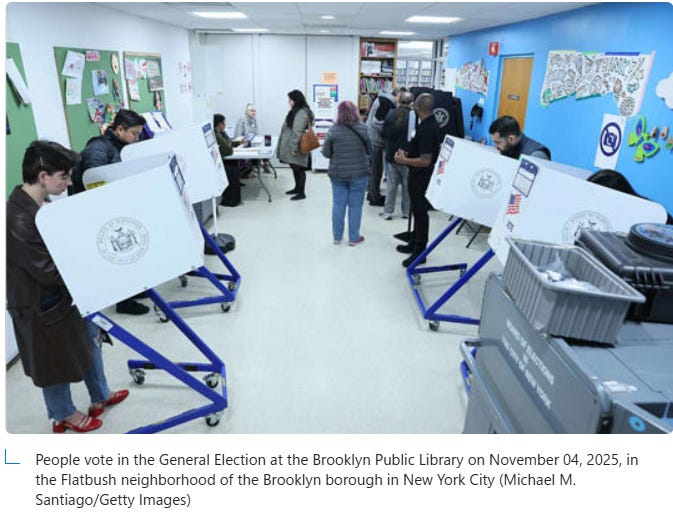
The new rule wants states to submit an individual’s name and address to the USPS and include a “uniquely serialized Intelligent Mail barcode (IMb)” on both the outbound federal ballot and the return ballot sent to the individual to include the name on the list.
The rule, which USPS will officially publish on Aug. 26, would only take effect for the upcoming midterm elections if a federal court lifted its injunction on Trump’s executive order.
In a filed opposition to court’s injunction, the Trump administration argued that the judicial review was premature under the ripeness doctrine, claiming that the plaintiffs cannot demonstrate any harm from the proposed law until it takes effect.
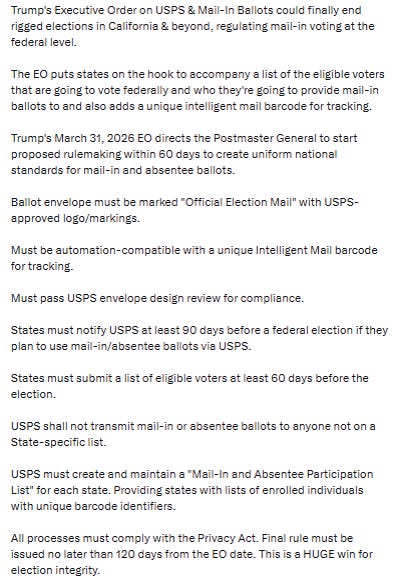
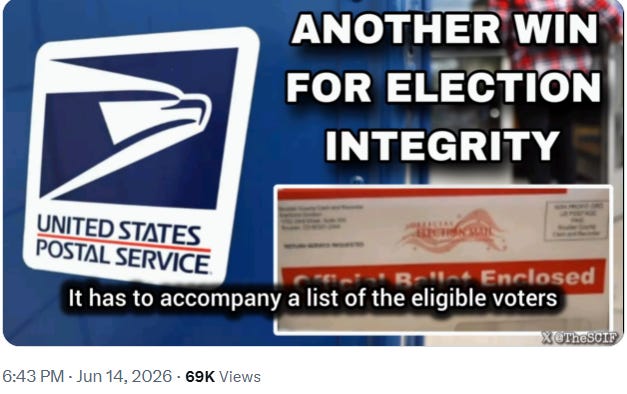
WATCH: The SCIF on X: “Trump’s Executive Order on USPS & Mail-In Ballots could finally end rigged elections in California & beyond, regulating mail-in voting at the federal level. The EO puts states on the hook to accompany a list of the eligible voters that are going to vote federally and who they’re https://t.co/DVfTeLAZX5” / X

READ MORE:
President Trump Could Declare National Emergency Over ‘Chinese Election Interference’
Election integrity - what’s that?
Supreme Court Set to Decide Fate of Mail-In Ballots — Could END Post-Election Counting Nationwide

BOTTOMLINE
USPS finalized a rule on “Ballot Mail for Federal Elections” (tied to President Trump’s March 31, 2026, Executive Order 14399) that requires states to submit mail-in/absentee voter lists and meet other standards—or risk the Postal Service refusing to transmit those ballots—while noting it will not implement the changes for the November 2026 midterms unless court injunctions are lifted.
Trump’s EO directed the Postal Service to initiate rulemaking so it would not transmit mail-in or absentee ballots for federal elections unless voters were enrolled on state-specific “Mail-In and Absentee Participation Lists.”
It also involved related efforts around citizenship verification lists via DHS and other measures framed as enhancing election integrity and enforcing federal law.
Non-compliant mailings could be rejected or not accepted into the mail stream. The agency has described this as a neutral operational check supporting federal law rather than election administration itself.
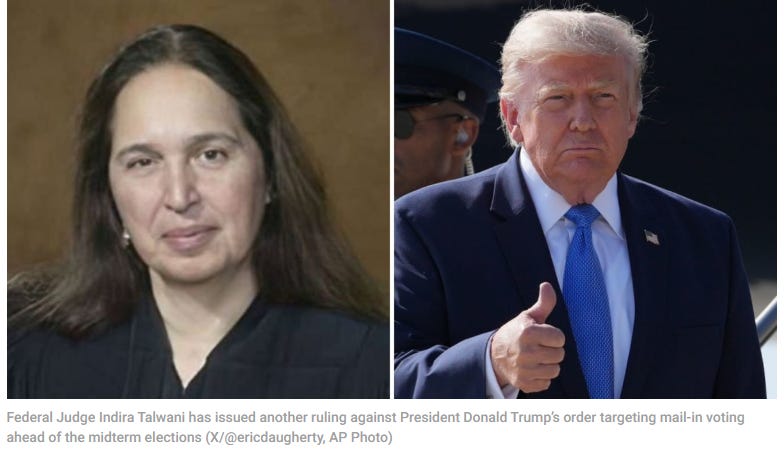
Federal courts (including rulings by U.S. District Judge Indira Talwani in Massachusetts in cases such as State of California v. Trump and League of Women Voters of Massachusetts v. Trump) have blocked key parts of the EO and related rulemaking as exceeding presidential authority.
Multiple Democratic-led states, voting-rights groups, and others challenged it; injunctions remain in place, and the matter has been heading toward further review (including potential Supreme Court action).
This is the “move that puts states on notice”: even while currently enjoined, the finalized standards signal that non-compliant states could face barriers to USPS delivery of mail ballots if the legal landscape changes before the midterms.
Your support is crucial in exposing fake news and in helping us defeat mass censorship.
Comments
Nothing yet. Say the first thing.
Sign in to join the conversation.