
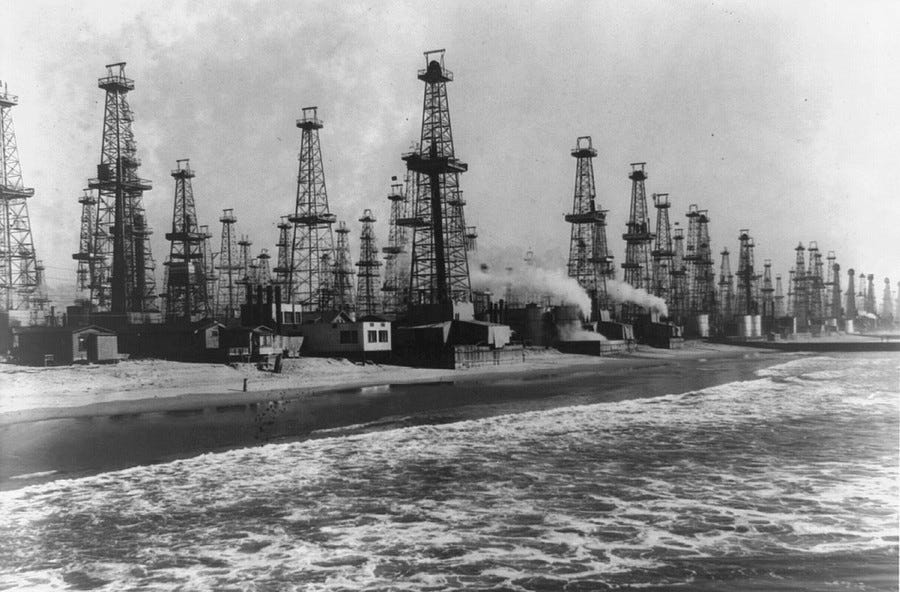
Above: in the early part of the twentieth century, oil wells dominated the beach in Venice, California. (Los Angeles County Chamber of Commerce/Library of Congress).
In a recent series of articles, we reported on Gavin Newsom’s anti-oil industry policies which have led to mismanaged petroleum resources and has created a looming energy crisis:
As previously described, California politicians naïve Net-zero policies have kneecapped California energy independence. This has resulted in decreased tax revenues, increased debt and unemployment, and a large increase of oil imports from foreign countries with less stringent environmental oversight.
In this article, we examine California’s vast existing petroleum resources, of which could make California a worldwide powerhouse of energy production and energy exporter.
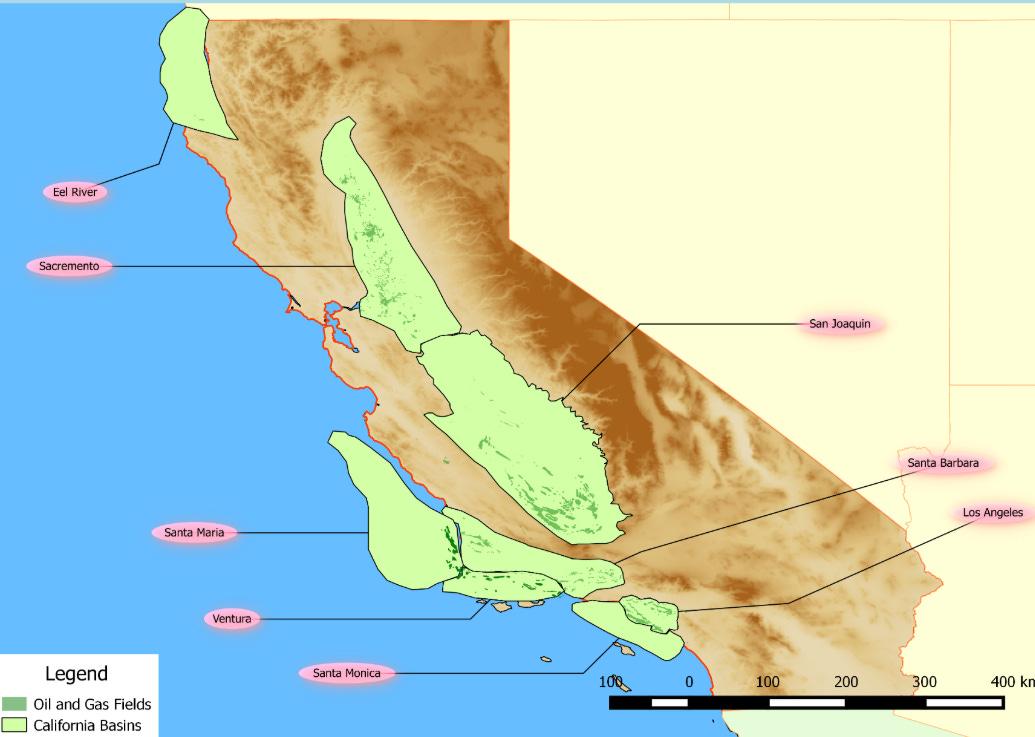
Above: massive oil deposits could make California a world-class oil producer. Unfortunately, Gavin Newsom’s misguided Net-zero Policies have hamstrung California’s energy production potential.
California is the eighth-largest crude oil producer in the United States and ranks fourth in barrels of oil equivalent produced (in 2014, California was the 3rd largest producer). The state has been producing oil since the 1860s, making it one of America’s oldest petroleum provinces.
Today, approximately 80-90% of California’s onshore drilling takes place in Kern County in the San Joaquin Valley. California is home to four “super giant” oil fields that have each produced over 1 billion barrels of oil, and 21 additional “giant” fields that have each produced over 100 million barrels.
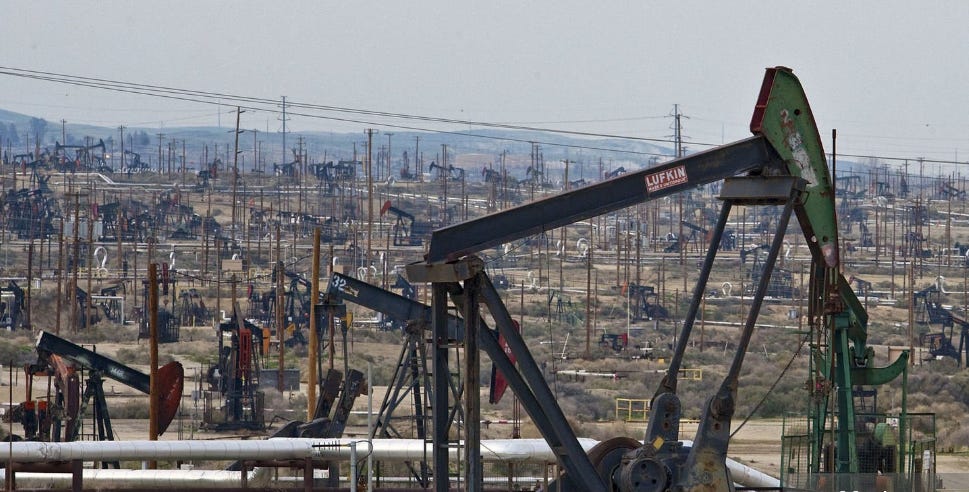
Above: view of a part of the vast Midway-Sunset oil field, the largest in California and the third largest in the United States. First discovered in 1894, the Midway-Sunset oil field has so far produced over 3 billion barrels of oil and still holds more than 500 million barrels in reserve.
California heavy crude oil is thicker (higher viscosity) and typically has a higher sulfur content (sour) than light crude (Texas Tea), and thus requires refineries that are engineered to handle a thicker sulfurous feedstock. California refineries that are still open were originally built and engineered to process native heavy crude feedstock.
This heavy crude, which is also found in Venezuela and is best suited to feed most of the USA’s Gulf refineries, is in high demand as it produces preferred diesel transportation fuels and other critical products. In fact, many American oil refineries cannot run efficiently or produce a full range of useful petroleum products without blending heavy crude with light crude. This is because without heavy crude oil, those refineries cannot produce industry critical refined products such as jet fuel, diesel fuel, lubricating oil, naphtha (for plastics), paraffin (for many industrial applications), and asphalt. . A good recent article explaining this and associated geopolitics is: “Dense, sticky and heavy: why Venezuelan crude oil appeals to US refineries.”
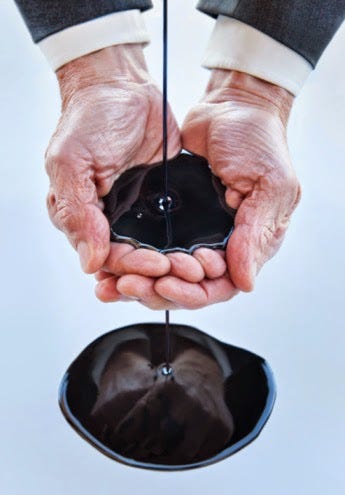
California may have the largest reserves of heavy crude oil in the United States, and according to some reports the reserves are second only to Venezuela worldwide. Attempts to quantify just how much heavy oil is recoverable in California is difficult, mostly due to lack of economic incentives, per energy experts below:
Expert Quote 1
California’s known crude oil reserves range in estimation because oil companies tend to only report on reserves that they are confident they may receive a permit to drill for and recover. This reluctance to report all findings, let alone pursue all possible leads, is a testament to how the unwelcoming business environment of California affects what should be one of the most productive oil industries not only in the country, but in the entire world. As of 2024, California is estimated to have 1.716 billion barrels of proven reserves, accounting for 3.1% of the country’s total. However, due to the lack of incentive to explore all potential leads, other estimates place the potential reserves far higher, upwards of 30 billion barrels, as reported by Californians for Energy and Science. Source.
Expert Quote 2
That wide range of oil reserves estimates can partially be explained by the fact that California’s oil companies only report proven reserves if there is a possibility they will acquire a drilling permit. For this reason, they’ve been writing off proven reserves of oil, while the amount of so-called contingent reserves – recoverable if permits were available – is proprietary. But estimates of California’s actual total reserves, including unproven but likely deposits, are much higher. Taking into account offshore and onshore reserves, a 2014 study by petroleum geologist Tim Considine for the California Policy Center estimated California’s total crude oil reserves at 30 billion barrels. This figure is corroborated by a 2025 report issued by Californians for Energy and Science, an industry group promoting oil and gas development in the state. One thing is certain, California has abundant reserves of crude oil. Source.
Crude Facts
Sixty percent of California’s raw energy inputs relies on petroleum.
Due to anti-oil and gas industry policies, California oil consumption now comprises 63 % of imported foreign oil.
California native production has largely decreased from a high of 402 million barrels in 1986, to only 118 million barrels in 2024.
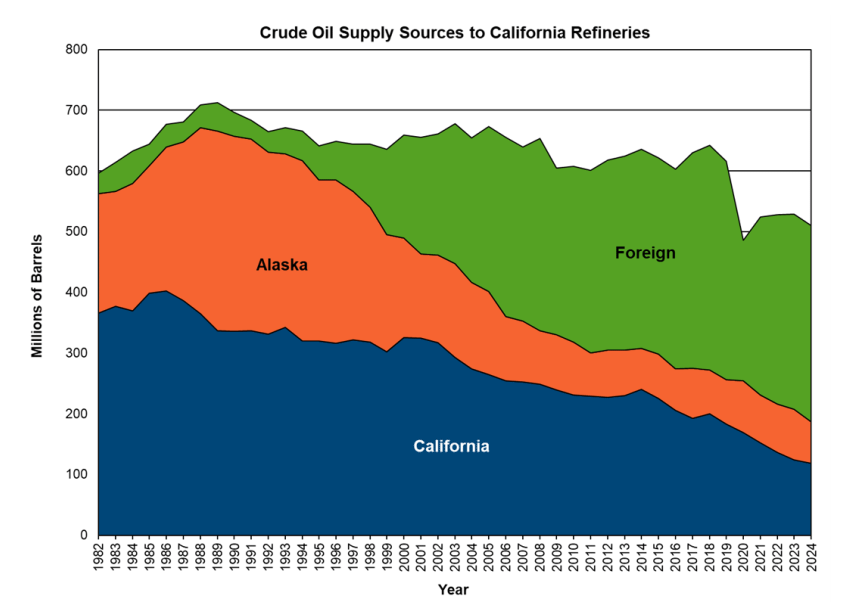
Above: California heavy oil production continues to decrease while foreign oil increases. Gavin Newsom’s tenure has unfortunately accelerated the demise of the oil and gas industry in California. Source.
According to the California Energy Commission, California produced 325,000 barrels per day of crude oil from in-state wells in 2024, and imported 1.1 million barrels per day. More than half of the oil that imported was heavy oil, despite California having some of the biggest reserves of heavy crude in the world.
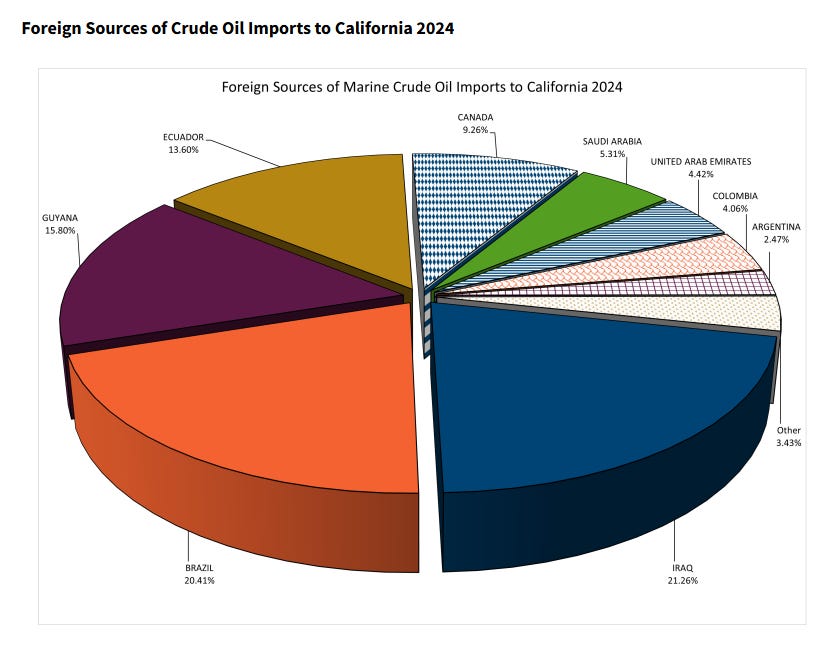
Above: South America provides a big piece of the California oil pie. Extraction of this oil can be very damaging to rainforest ecosystems. Source.
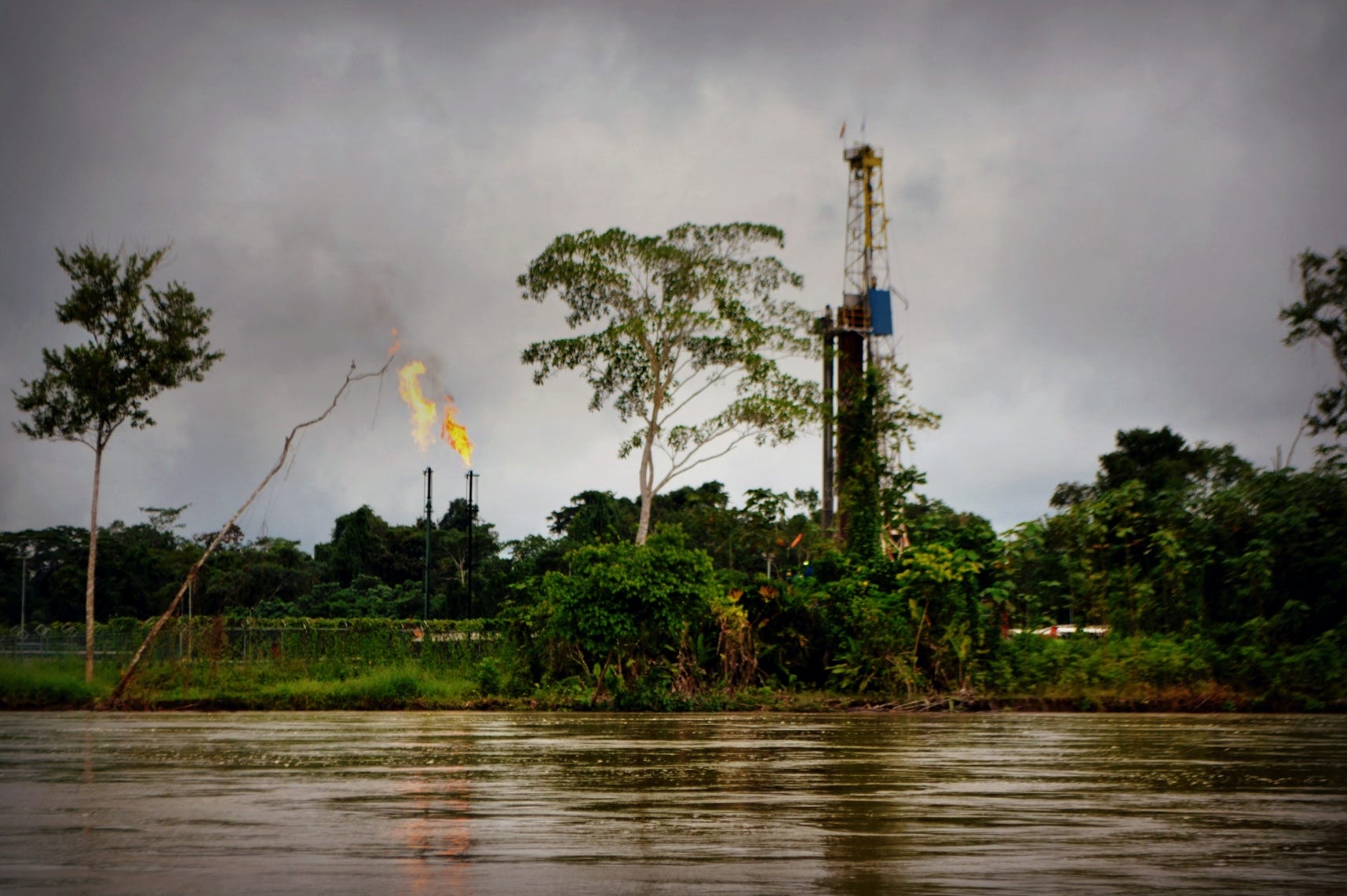
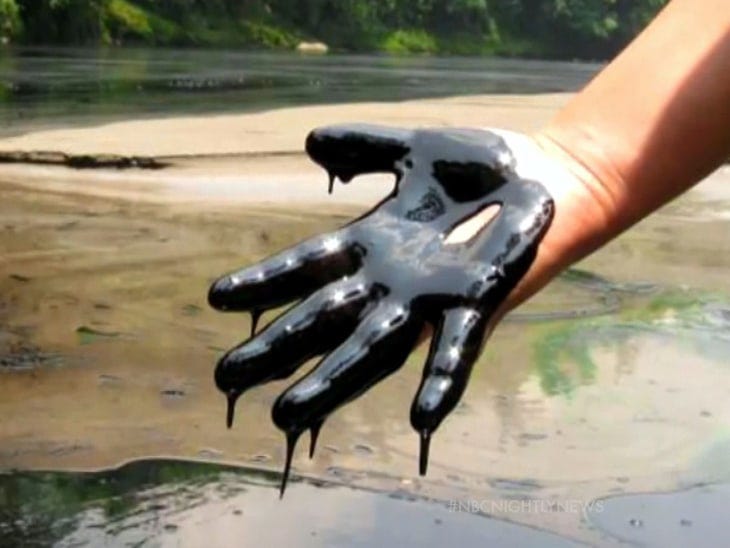
Above: Oil extraction operation in the Amazon rainforest. Source: NBC.
As shown in the previous pie chart, and below, the top 4 foreign countries with the biggest pieces of the California oil import pie are:
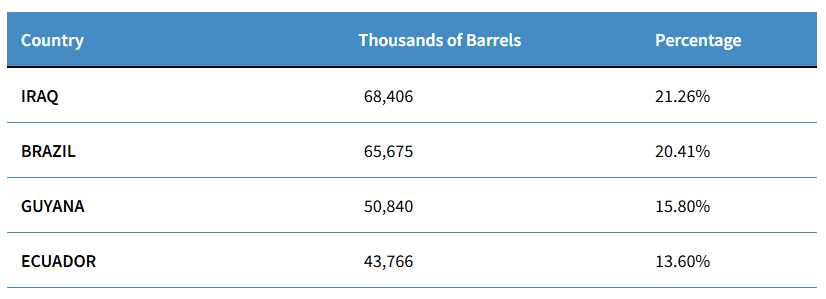
While Iraq obviously does not extract oil from pristine rainforest regions, Brazil, Guyana, Ecuador, and Columbia do. We note that the bulk of the Guyana oil is from offshore, but of course, California has a moratorium on offshore oil extraction. The untold environmental destruction in other countries is difficult to reverse and flies in the face of California’s Environmental Stewardship as espoused by California politicians.

In 2025, the normally naïve and willfully blind California government decided to take a second look at California’s dependency on Amazon oil and the associated rainforest destruction. This is was covered recently in the excellent Sacramento Bee opinion piece entitled A new California bill highlights the true impact of California’s oil import dependency.
In yet another twist, more South American countries would like to sell their oil into the California market, as explained in a very recent 2026 article about Peru: Peru leads amazon oil and gas expansion, threatening indigenous communities and protected forests. Peru is apparently anxious about developing its oil and gas resources for its own use and to supply thirsty California as well.
Above: Amazonian Demi-glace sauce ala French Laundry.
In sum, Governor Newsom’s war on domestic oil has been an deeply injurious to the California economy, and has been waged incessantly - until recently, of which time the Governor realized that $8.00 a gallon gas is not good press or timing for his run for President in 2028.
California’s overburdensome rules and regulations, designed to make expensive “renewables” appear more affordable than oil, have had their desired effect. Production has fallen dramatically; the oil industry, once a powerhouse in California is on defense; renewables look artificially cheap; and the Governor can brag to his supporters that he is fighting “climate change.”
This approach has had a terrible flip side: dramatically reduced federal, state, county, and city tax revenues, lost jobs, higher gas prices (the effects of which overwhelmingly impact the poor), and increased oil imports. The foreign imports increase environmental damage as a result of the necessity to ship hundreds of thousands of barrels of oil across the seas, and further negatively impacts the environments of poorer countries with less stringent environmental regulations and oversight.
All of California’s in-state transportation fuels for jet, ships, trucks, and vehicles are made in-state as there are no pipelines over the Sierra Mountains to get those fuels from other States.
CA fuel demands for :
3 of the busiest Ports in America, requiring bunker fuel for the merchant ships.
13 million gallons of aviation fuel daily for its 145 airports,
42 million gallons a day of gasoline fuel for cars, and
10 million gallons a day of diesel fuel to support the state’s trucking infrastructure.
The real shocker is that closure of in-state refineries will “lessen” crude oil imports, but increase the need to import finished transportation fuels from new refineries in Asia !!!!!
Yes, CA is becoming a national security risk for the entire country !
Ron
Comments
Nothing yet. Say the first thing.
Sign in to join the conversation.