
Rates of depression have increased steadily over recent years. A recent paper found 1 in 10 adults and 1 in 5 children were depressed.
“From 2015 to 2019, there were widespread increases in depression…, and in 2020, past 12‒month depression was prevalent among nearly 1 in 10 Americans and almost 1 in 5 adolescents and young adults.” (Goodwin, 2022)
Depression can be debilitating, and it’s part of a larger pattern of behavioral and neurological changes that have occurred over recent decades.
And, my personal favorite:
“Increasing Homicide Rates and Linoleic Acid Consumption Among Five Western Countries, 1961–2000” (Hibbeln, 2004)
So it’s a big issue, and there’s good reason to think seed oils are involved.
“Oxidative stress is an etiologic factor in depressive/ neurodegenerative disorders…” (Liao, 2020; all further quotes from this study are bolded.)
Curcumin (CUR in this paper) is a component of the spice turmeric, giving the spice its characteristic bright color.
“Curcumin (CUR) is the major active component extracted from Curcuma longa, which exhibited anti-inflammatory, antioxidant, immunomodulatory, and neuroprotective activities [23, 24].”
Curcumin is touted as a health-promoting chemical due to its use in Asian medicine, where it is claimed to have anti-inflammatory effects. Inflammation is a good thing, however. If it’s an effective preventative against the peroxidation causing inflammation, that’s an interesting thing!
So here’s a great model for making rats, or, I would imagine, people, depressed. It’s called chronic unpredictable mild stress (CUMS).
“24 h food deprivation followed by 24 h water deprivation, 45° cage tilting for 24 h, restraint for 4 h in an empty water bottle, 20 min of noise, 1 min tail clamping, and damp bedding were selected as stressors in our study.”
That would certainly be enough to make me depressed, if I was unable to escape. But it’s a neat model because there are no chemicals involved. They just annoyed the poor rats into depression. Sounds pretty similar to modern life for an American kid!
Sadly, they don’t describe anything about what these rats were fed. No doubt it was something similar to the crap-in-a-bag Peter from Hyperlipid has aptly named. They say it was “food and water”, and that’s it. See here for what a standard “control” diet looks like.

D12450B (on the left) is a standard control diet. From:
So we’ll just have to assume it was something like that. It’s the Dietary Guidelines, basically, as the dieticians wished we ate: low-fat, vegetable oils, and lots of starch and sugar. The starch and sugar are the best part of that diet, btw.
Corticosterone is used because it’s more appropriate to measure this in rats than cortisol, but it plays the same role as cortisol does in humans. Note that stress causes an increase in this stress hormone, the hormone does not cause the increase in stress.
So what does being tormented into depression do to the rats?
This is pretty much a confirmation of the effect, in my view. They’re stressed, so their stress hormones go up.
“Effects of CUR on Corticosterone Level. As displayed in Figure 3, the serum corticosterone level significantly increased (p < 0:01) in the CUMS group compared with the control group. However, the administration of CUR markedly decreased (p < 0:01) the corticosterone level when compared with the rats in the CUMS group.”
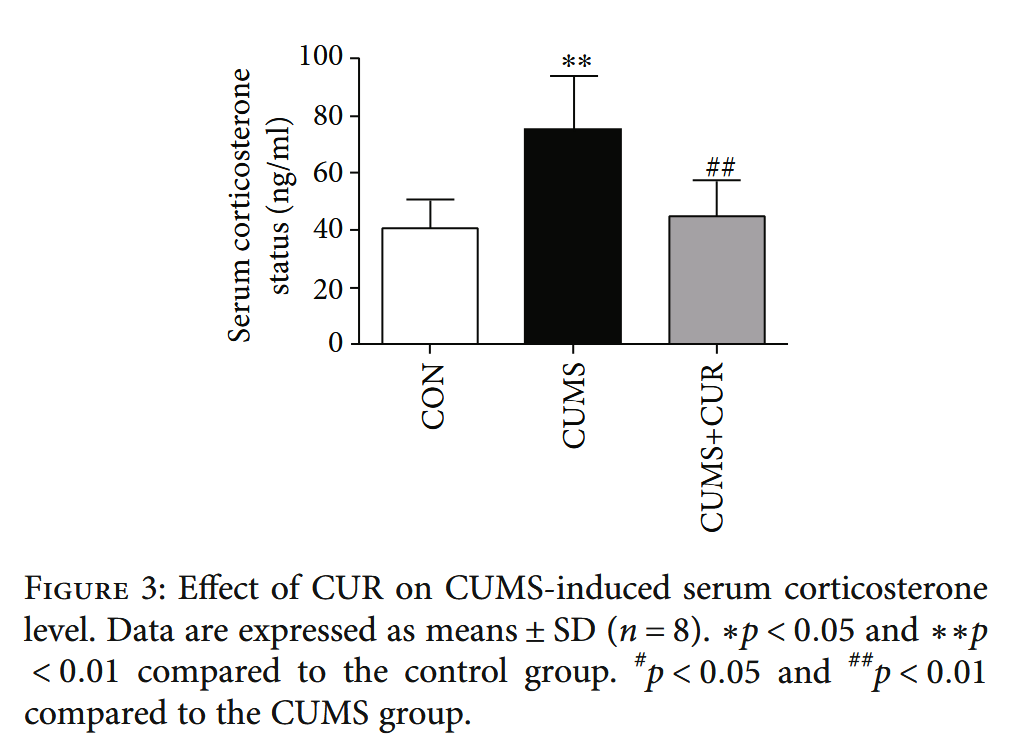
What’s fascinating is that curcumin reduces the levels of corticosterone almost to the control level. Is it through a direct effect on the production of the hormones, or is it because the source of the stress is being chemically removed?
It causes oxidative stress. This is what really surprised me.
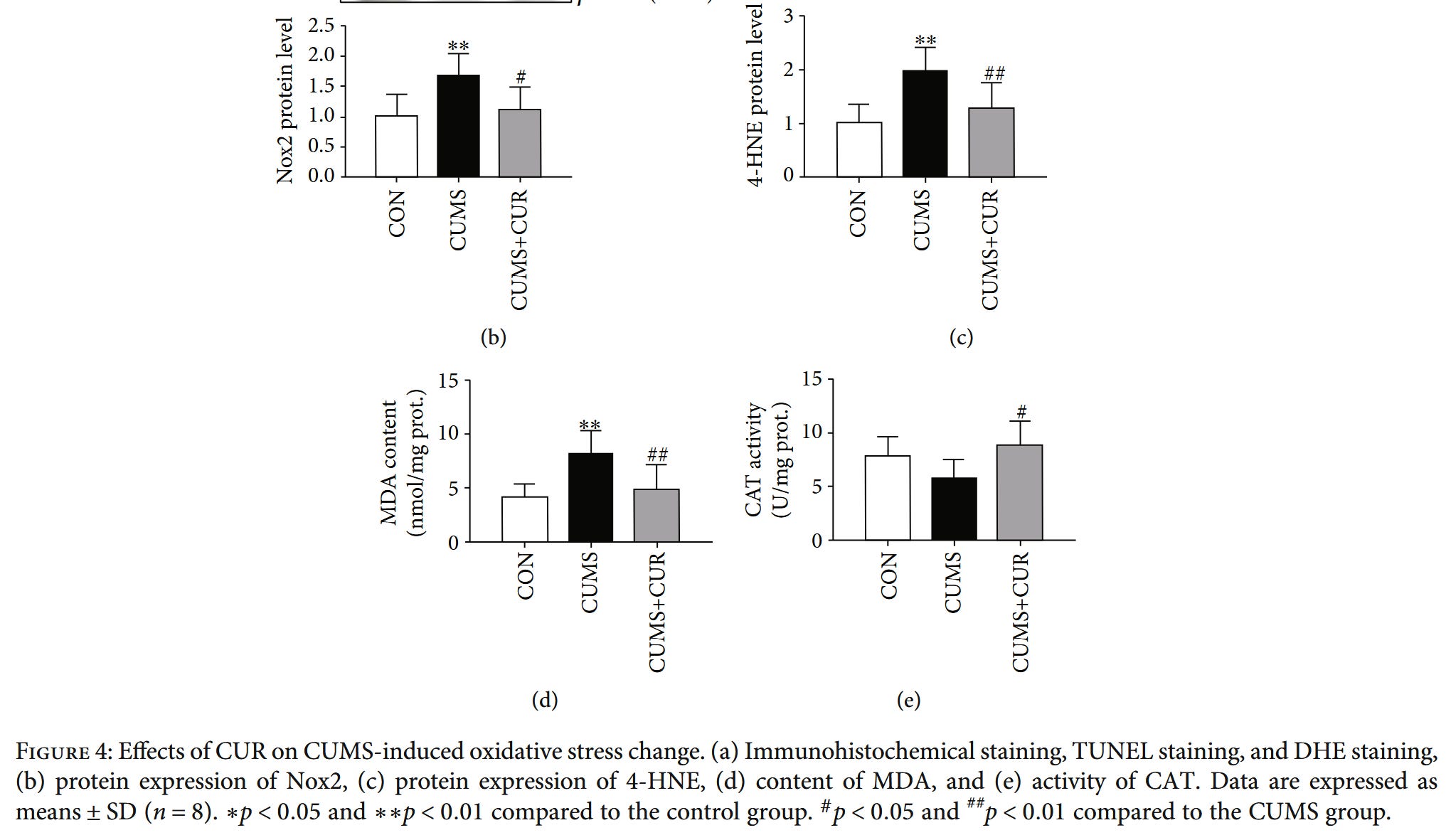
The researchers measure this through “protein expression of oxidative stress markers (Nox2, 4-HNE, and MDA)”. They also track 8-OHDG. As is typical, oxidative stress is measured by using peroxidized omega-6 (Ω-6) fat, such as 4-HNE, mostly derived from linoleic acid. MDA is a chemical that can be produced from either Ω-6 or -3 fats, but in this case they’re using a test, thiobarbituric acid reactive substances (TBARS), which is more likely to react to anything other than MDA. It’s much more likely to react to linoleic acid hydroperoxide, for instance.
The reference they provide for MDA is interesting. “Determination of Antioxidant Enzyme Activities and Lipid Peroxidation. Malondialdehyde (MDA) content was determined according to the previous report [34].” 34 is (Ohkawa, 1979). Ohkawa makes clear that the test isn’t actually measuring MDA, but can return an identical result for peroxidized linoleic acid. In this study, they’re measuring homogenized rat brain (homogenization increases lipid peroxidation, so not a good process), so it could be measuring any of a number of fats from the rat brain.
Nox2 is an enzyme that is stimulated by unsaturated fats to produce “superoxide”, another way of creating oxidative stress.
8-OHDG is a marker of DNA damage, which can be induced through peroxidized linoleic acid.
“Linoleic acid hydroperoxides (LOOH) formed 8-oxo-dG [another form of 8-OHDG] at a higher level than H2O2 in guanosine or double-stranded DNA.” (Kanazawa, 2016)
So it’s clearly an effective antioxidant, protecting against 4-HNE and MDA, the measured Ω-6 oxidative stress measures. (8-OHDG also decreased.) It also decreased Nox2, the prooxidant enzyme stimulated by unsaturated fats like those in seed oils, and increased catalase (CAT) an antioxidant produced in the body. A decline in endogenously-produced antioxidants is a typical effect of oxidative stress, as the body is unable to adequately respond to pro-oxidant toxins.
This is also surprising. I’m not going to go through the symptoms individually. They’re pretty rat-specific, but the uncorrected symptom is a decline in food intake caused by CUMS.
It makes me wonder about the effect of curcumin on obesity (Bradford, 2013).
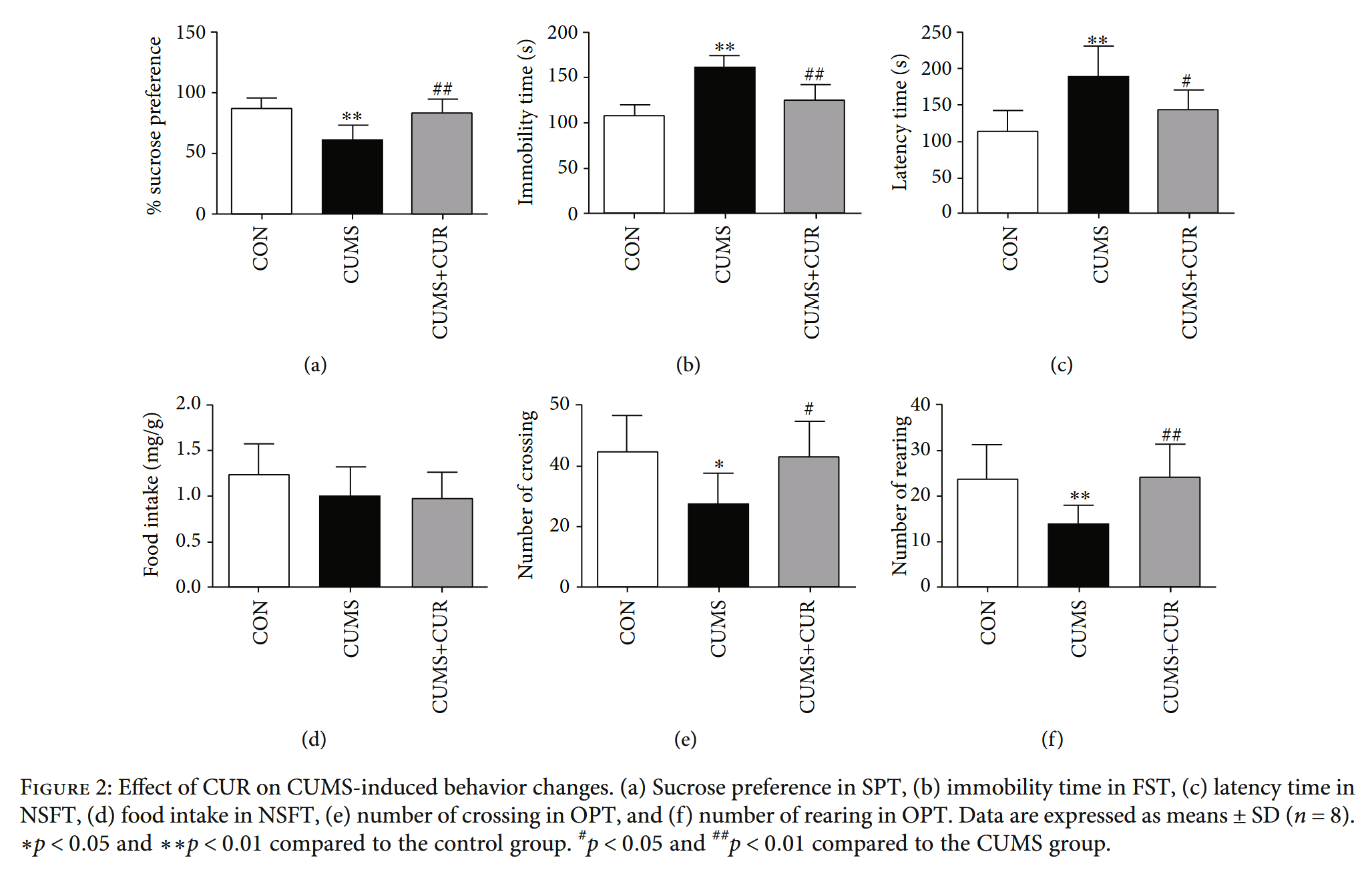
This is a pretty strong test of the idea that oxidative stress is involved in depression. What’s most surprising to me is the chemical response to the bothering protocol (CUMS). What translates the stress from these various annoyances into lipid peroxidation?
But the fact that curcumin corrects stress hormones, lipid peroxidation, and depressive symptoms is pretty remarkable.
Turmeric is a major part of Indian cuisine, which is also high in seed oils. One would expect it may be protective against that aspect also, but I think the use of traditional Indian fats like ghee is probably more powerful, ultimately. Given the increase in the various chronic diseases in India, whatever level of turmeric they’re consuming is clearly not enough of an intervention.
It’s entirely possible that curcumin is correcting depressive symptoms through a pathway not measured in this study, so this should be seen as an association.
I’d like to see the same effect produced through introduction and removal of the fats that are causing oxidative stress in this model, to confirm the pathway. Ideally with an arm getting curcumin instead of having the fats removed.
But I do owe my somewhat-kooky friend who is a big fan of turmeric tea an apology.
Bradford, Peter G. 2013. “Curcumin and Obesity.” BioFactors 39 (1): 78–87. https://doi.org/10.1002/biof.1074.
Goodwin, Renee D., Lisa C. Dierker, Melody Wu, Sandro Galea, Christina W. Hoven, and Andrea H. Weinberger. 2022. “Trends in U.S. Depression Prevalence From 2015 to 2020: The Widening Treatment Gap.” American Journal of Preventive Medicine 63 (5): 726–33. https://doi.org/10.1016/j.amepre.2022.05.014.
Kanazawa, Kazuki, Miku Sakamoto, Ko Kanazawa, et al. 2016. “Lipid Peroxides as Endogenous Oxidants Forming 8-Oxo-Guanosine and Lipid-Soluble Antioxidants as Suppressing Agents.” Journal of Clinical Biochemistry and Nutrition 59 (1): 16–24. https://doi.org/10.3164/jcbn.15-122.
Hibbeln, Joseph R., Levi R. G. Nieminen, and William E. M. Lands. 2004. “Increasing Homicide Rates and Linoleic Acid Consumption Among Five Western Countries, 1961–2000.” Lipids 39 (12): 1207–13. https://doi.org/10.1007/s11745-004-1349-5.
Liao, Dehua, Chuanfeng Lv, Lizhi Cao, et al. 2020. “Curcumin Attenuates Chronic Unpredictable Mild Stress-Induced Depressive-Like Behaviors via Restoring Changes in Oxidative Stress and the Activation of Nrf2 Signaling Pathway in Rats.” Oxidative Medicine and Cellular Longevity 2020 (1): 9268083. https://doi.org/10.1155/2020/9268083.
Ohkawa, H., N. Ohishi, and K. Yagi. 1978. “Reaction of Linoleic Acid Hydroperoxide with Thiobarbituric Acid.” Journal of Lipid Research 19 (8): 1053–57. https://doi.org/10.1016/S0022-2275(20)40690-X.
Ohkawa, H., N. Ohishi, and K. Yagi. 1979. “Assay for Lipid Peroxides in Animal Tissues by Thiobarbituric Acid Reaction.” Analytical Biochemistry 95 (2): 351–58. https://doi.org/10.1016/0003-2697(79)90738-3.
No posts
Comments
Nothing yet. Say the first thing.
Sign in to join the conversation.