
By Natalia Balague Serre, Lluc Montull, Maria Antonia Lizarraga
ENERGY SCIENCE
We are excited to introduce you to our TSEE guest writers: Natàlia Balagué and Lluc Montull are Professors of exercise physiology at the National Institute of Physical Education of Catalonia in Barcelona, and La Seu Spain. Maria Antonia Lizarraga is a Professor of Human Nutrition and Dietetics at the University of Barcelona.
In this article, they discuss how we perceive our body’s internal states and how our subjective perceptions of energy states may help us better monitor our health and potentially intervene to prevent disease.
Sensations emerge when physical signals (particles of light, air pressure, chemicals, temperature, etc.) are transduced into neural activity by specialized cells (sensory receptors like photoreceptors, mechanoreceptors, chemoreceptors, thermoreceptors, etc.).
Raw sensory inputs are converted into meaningful, interpretable experiences, and coherent mental impressions. How that activity becomes subjective experience remains one of science’s biggest open questions.
Contemporary neuroscience often describes perception as a process in which the brain continuously generates predictions about sensory inputs. It also continuously updates these predictions based on incoming information, amplifying, attenuating, or bringing sensory signals into conscious awareness.
Current research on awareness increasingly suggests that conscious experience cannot be fully explained by localized brain mechanisms alone. Rather, it emerges from dynamic brain–body–environment interactions.
Growing evidence indicates that physiological systems often register and respond to environmental contingencies before these processes reach conscious awareness.
For example, the autonomic nervous system controls involuntary body functions such as changes in heart rate and sweating. Autonomic activity, which can be measured by heart rate variability or skin conductance, may precede explicit recognition of external stimuli. These findings suggest that what is often described as anticipation or “intuition” may correspond to non-conscious processes that integrate these signals and guide behavior prior to explicit cognitive awareness.
Interoception refers to the sensory system that allows us to perceive signals from inside our bodies, such as feeling your heart beat.
Interoceptive awareness fuses signals coming from multiple levels and communication pathways, including electrical and molecular signaling, to shape our moment-to-moment psychobiological state and our capacity to adapt. It provides us with an outstanding potential to dynamically and rapidly integrate massive amounts of internal and environmental information.
This is key for facilitating our self-regulation of health and performance of tasks in our everyday lives.
The integration of sensory information with psychological and contextual inputs (e.g., sense of purpose, prior experiences, beliefs, expectations, motivation, behavioral goals, emotions, attention) shapes perception. This is why two individuals—or even the same individual at different times—can perceive the same sensation quite differently.
As shown below, the psychological and contextual inputs operate at different timescales, and therefore carry different weights in shaping perception. Some of them are more stable or change more slowly (e.g., sense of purpose, prior experiences, beliefs, motivation) with respect to others. Consequently, they exert longer-lasting effects and have a greater impact than those that are less stable or change more rapidly (e.g., acute fatigue, emotions, attention focus).
The relationship among the different psychobiological constructs is bidirectional—from top to bottom and from bottom to top—indicating that perception is constrained by their continuous interaction.
For instance, the perception of bodily signs can be amplified by prior experiences (e.g., previous injuries), as demonstrated in studies of interoceptive awareness in injured young football players. Perception can also be attenuated when interoceptive signals are interpreted as unimportant and receive little value and attentional focus.
Valuing and providing education on subjective monitoring seems crucial for enhancing interoceptive awareness and promoting self-consciousness, autonomy, and self-regulation of health and performance.
Expressions like “I am low on energy,” “My battery is drained,” “This kid has a lot of energy,” or even “This room has good energy,” are commonly used.
But what do they really mean?
The sensations of energy and fatigue have been traditionally conceptualized as opposite poles of a single bipolar continuum. However, some research indicates that they are better considered as two separate constructs with different underlying neurobiology.
Energy is thought to have evolved as an “approach-oriented” sensation with feelings like arousal and vitality that encourage an organism to move toward positive stimuli. On the other hand, fatigue is considered an “avoidance-oriented” sensation that promotes rest and recovery through different neural and inflammatory pathways.
Mitochondrial processes likely modulate brain–body interactions that contribute to the subjective experience of energy and related affective states. Consequently, changes in how we perceive our energy may provide critical insight into our internal experience of things like vitality, mental clarity, calmness, and adaptive capacity.
Monitoring and regulating energy can be challenging because we don’t currently have biological sensors or measurement scales to easily quantify changes in our energy levels or allow us to rate our energy. A similar problem is found when monitoring perceived fatigue, because it is often difficult to quantify fatigue in absolute terms.
In contrast, we can monitor shifts in perceived exertion. Individuals can successfully identify, for example when exercise feels more or less effortful, without having to specify exact amounts.
Although it is hard to perceive and quantify energy in absolute terms, we do sense when energy availability becomes insufficient relative to task demands.
This sensation drives, for instance, our decisions to continue or stop tasks.
Exhaustion has been conceptualized as a form of task disengagement: we decide to “give up” (i.e., disengage from the task) when continuation of exercise, for example, is perceived as impossible.
The dynamic psychobiological model of exercise-induced fatigue points out that although exercise performers are conscious of task disengagement this does not mean that stopping is voluntary.
From a dynamic perspective, perceived exertion is conceived as an emergent product of the interaction among body, brain, and environment. In a similar manner, we can hypothesize that the shortfall or abundance of perceived energy, playing a relevant role in exercise tolerance, may reflect the flexible trade-off among these interacting components.
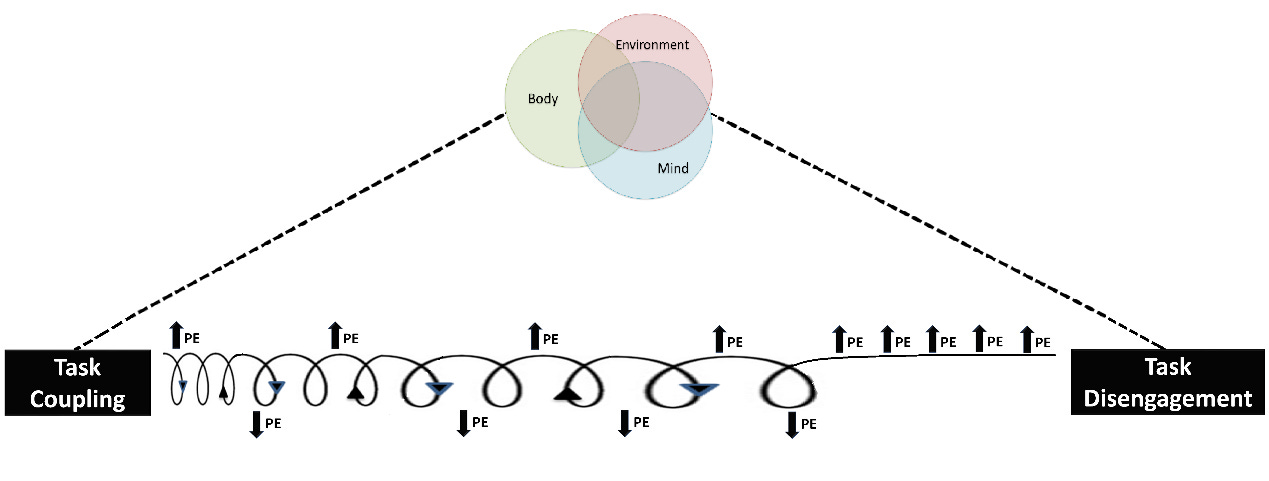
The figure below shows the fluctuating dynamics of perceived exertion (PE) with workload accumulation. We can speculate that perception of energy with respect to the task fluctuates as well, increasing—perceiving exertion as heavier—and decreasing—perceiving exertion as lighter—over the course of the continuous exercise.
Assuming that there is no single site or process causing fatigue, the dynamic psychobiological model of exercise-induced fatigue proposes that it is the weakening of the strength of couplings between the brain, the body, and the environment that finally produces the task disengagement.
The loops at the bottom of this figure represent renewed psychobiological synergies that enable us to continue the task. When new synergies cannot be formed, increases in PE stabilize. These nonlinear dynamics (from fluctuating to non-fluctuating dynamics of PE) are also observed in psychological and kinematic variables.
Another common subjective experience that is easy to perceive is whether an energy investment was “worth it.”
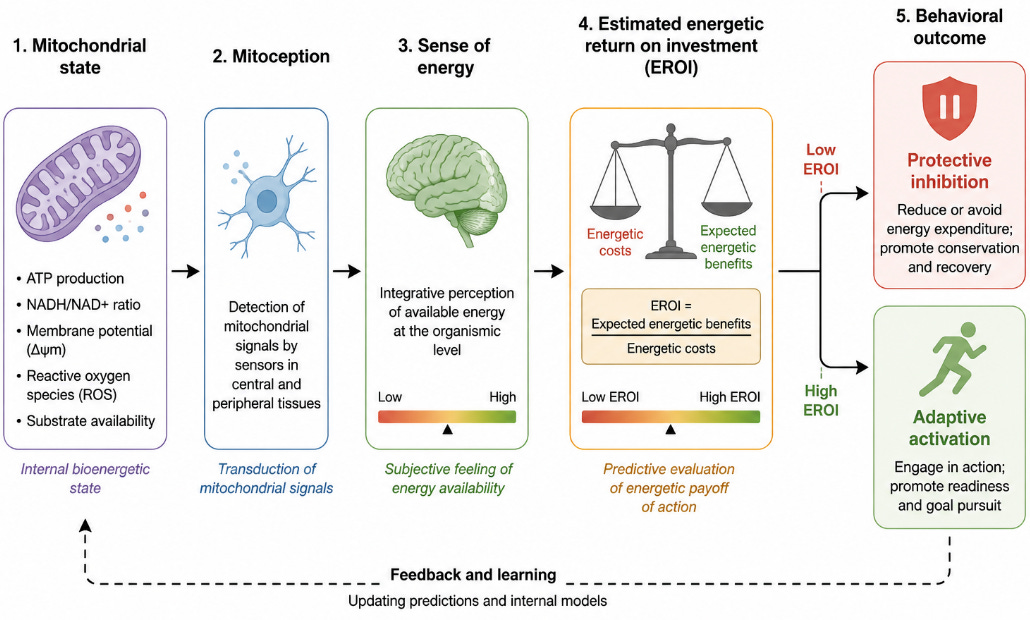
The concept of Energy Return on Investment (EROI), used as a unifying principle in biology, economy, and sustainability, can explain this phenomenon. EROI is defined as the ratio between the energy obtained and the energy invested.
The changes in the EROI ratio (e.g., more or less energy obtained with respect to the energy invested) are particularly related to the perceived efficiency. When movements or actions feel smooth, coordinated, or “fluent,” it results in a higher perception of energy efficiency. The reverse is also true.
The flow state can be interpreted as a high EROI condition, in which the energy invested feels matched by performance outcomes. For example, during a competition, a player may perceive high EROI when actions feel effortless, energy is conserved, and performance results are positive.
The graphic below connects the energy production with its perception, the estimated energy return on investment, and the corresponding behavioral outcome.
Great progress has been made in identifying energy-related biomarkers, such as Growth Differentiation Factor 15 (GDF15). GDF15 is a cytokine of mitoception now considered a signal that informs the brain about the organism’s energetic state.
However, although quantifiable, this biomarker provides limited dynamic information over short timescales and is not yet available for routine clinical use or accessible to most individuals in everyday settings.
In contrast to objective energy monitoring, subjective monitoring of energy perceptions allows for the real-time integration, synthesis, and reduction of multiple converging sources of information. Furthermore, because people can assess it themselves, it may allow us to capture the dynamics of energy resistance, including its potential nonlinear changes over time and overlaid with our personal experiences and circumstances.
Monitoring the dynamics of energy perception could serve as a convenient and accessible way to anticipate and identify transitions between states of low-, mid-, and high-resistance to energy flow.
Because energy perception draws on information from prior experiences, it is anticipatory and predictive.
As a result, changes in perceived energy could prompt interventions, such as increased rest, improved nutrition, or modifications to the physical or social environment. This could potentially prevent prolonged exposure to detrimental energetic conditions that could lead to disease.
Our physiology is shaped by our perceived and anticipated reality, as well as genetic, social, and cultural factors. In biology and medicine, substantial focus has been placed on monitoring, quantifying, and evaluating one or a few physiological markers in isolation. This approach fails to consider how these physiological markers are related to relevant psychological, emotional, or social variables that integrate subjective experiences.
Monitoring energy perception may also contribute to developing self-awareness, autonomy, confidence, and self-regulation. These are all essential qualities for an effective preventative approach to health.
In this context, the promotion of educational programs that emphasize the value of energy perception and enhance self-awareness and self-regulation may help prevent accumulation of allostatic load and promote health.
In summary, monitoring the dynamics of perceived energy is not merely an accessory variable of subjective monitoring, but it could serve as a central axis for protecting health and ensuring sustainable performance.
Perceptual cues that indicate whether a situation constitutes a threat play a critical role in regulating the allocation of limited energy resources. Integrating this perceptual dimension into clinical and training models could enable a more prevention-focused, human-centered, and coherent approach to health, thereby supporting longevity and improved quality of life.
We’re excited to be assembling a community around the Science and Experience of Energy with this Substack. We hope to bring people together to reflect on connections between energy science and the human experience.
If this post resonated with you, please consider sharing it with others.
No posts
Comments
Nothing yet. Say the first thing.
Sign in to join the conversation.