
ENERGY SCIENCE
Our TSEE guest writer Matthew Phillips is a Neurologist and Director of Neurology at Waikato Hospital in New Zealand. In this post, he discusses how metabolic dysfunction and mitochondrial biology may contribute to neurological conditions. Training our brains to have greater metabolic flexibility could be a useful treatment approach to explore.
“The only constant in life is change.”— Heraclitus.
In 2021, a 64-year-old man and his fiancée walked into my office. He had been experiencing 18 months of slurred and slowed speech, difficulty swallowing, fatigue, and weight loss.
After a thorough workup, I made the unfortunate diagnosis of amyotrophic lateral sclerosis (ALS). ALS is a devastating neurodegenerative disorder in which motor neurons progressively degenerate and die. This man had the bulbar-onset form of ALS, which typically progresses rapidly and often leads to respiratory failure and death within 2-4 years.
After discussing the diagnosis and available options—which are largely supportive—his fiancée asked whether there were any other possibilities. She had heard of our work using ketogenic metabolic therapies in other neurodegenerative disorders, such as Alzheimer’s and Parkinson’s disease. She wanted to know: Could it help?
Despite the promising findings in those disorders, I was uncertain—and perhaps even a little skeptical—that a metabolic approach could help someone with ALS. I had seen too many patients succumb to this disorder, and I was not aware of anyone attempting this approach. Still, after discussing the potential benefits and risks, as well as the inherent uncertainty, we agreed to try.
I guided him through a time-restricted ketogenic diet. He was instructed to eat two meals per day, while substantially increasing dietary fat and minimizing carbohydrates. He maintained this approach for the next 18 months, during which we regularly assessed his functional status, breathing, swallowing, quality of life, fatigue, blood markers, and other measures.
And he did remarkably well. Over those 18 months, rather than the expected progressive decline, his function, breathing, swallowing, quality of life, and fatigue generally stabilized or improved. Moreover, despite extensive fasting, his previously pronounced weight loss slowed.
Since this study involved just one patient, we cannot draw definitive conclusions. However, the outcome was certainly unusual and encouraging. Although the ALS continues to slowly progress, he is still doing ok and remains living at home.
What happened?
At first glance, neurodegenerative disorders such as Alzheimer’s disease, Parkinson’s disease, and ALS look very different. Clinically, Alzheimer’s typically announces itself through cognitive impairment; Parkinson’s through movement problems; and ALS through progressive weakness of the limbs and the muscles involved in speech, swallowing, and breathing. Based on these different presentations, neurologists are trained to “split” these disorders by their clinical features, as well as by the characteristic brain regions and proteins involved.
Yet beneath these obvious differences lies a shared vulnerability that enables neurodegenerative disorders to be “lumped.” This is not always apparent to the clinician, radiologist, and pathologist. One way of conceptualizing this common ground is through what we call the metabolic iceberg, composed of a tip, a bulk, and a base.
- The visible tip represents what we recognize clinically. This includes the neurological symptoms, as well as the degenerating brain regions and protein aggregates.
- The hidden bulk represents what may be a deeper biological problem. In this case, it may be impaired mitochondrial biology throughout the body, involving multiple interconnected processes.
- The underlying base encompasses factors that, over years or decades, shape the trajectory of impaired mitochondrial biology. These include exposure to modern industrial toxins, dietary patterns, cognitive, physical, and psychosocial behaviours, and genetic susceptibility.
The idea is that a particular suite of factors influences mitochondrial biology over years or decades, disproportionately affecting the “mitotypes” in certain brain regions. These effects eventually surface as the distinctive clinical features that we recognize as the disorder.
The metabolic iceberg gives us a way to think more deeply about Alzheimer’s, Parkinson’s, ALS, and other neurodegenerative disorders. Rather than isolated diseases of different brain regions, they may be different manifestations of a shared disturbance of energy metabolism, centered around impaired mitochondrial biology.
It may also help explain what happened to our patient.
Although mitochondria have traditionally been portrayed as cell “powerhouses,” they are, of course, more than that. Perhaps owing to this enduring metaphor, the energetic impairment in neurodegenerative disorders is often framed primarily as a problem of energy deficiency. Put simply, the thought is that neurons and their mitochondria do not have enough energy, therefore we need to provide them with more (or a better) fuel.
This has helped motivate the application of ketogenic metabolic therapies, such as intermittent fasting and ketogenic diets, to these disorders. Both approaches increase the availability of ketones, which provide an alternative energy substrate. The metabolic properties of ketones are different from glucose, the dominant brain fuel under typical dietary conditions.
The basic idea, then, is straightforward. Essentially, neurodegenerative disorders involve an energy deficit, and ketosis may help by providing more (and a superior) fuel. While there is likely some truth to this, there may exist a deeper problem that has not received as much attention.
Crucially, these disorders also involve impaired metabolic flexibility—the ability of neurons and mitochondria to switch between fuels and metabolic pathways according to environmental circumstances. A metabolically inflexible brain is largely limited to glucose. However, it can be “trained” to increase its use of other fuels. During fasting or carbohydrate restriction, for example, it can be trained to increase its use of ketones. And during exercise, lactate becomes another important fuel source.
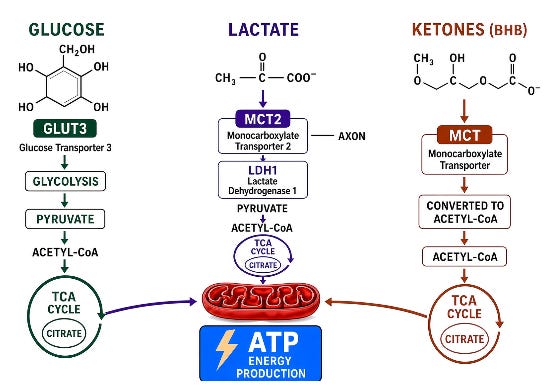
The problem, then, may not simply be that the brain has too little energy. It may also be that it has become constrained in the ability to change how it transforms energy. This reframes neurodegeneration as a problem not only of energy deficiency, but also one of energy rigidity, a concept that aligns with the Energy Resistance Principle.
Prolonged reliance on a particular energetic pathway may contribute to a state in which the system becomes increasingly resistant to using energy effectively.
Given this perspective, metabolic therapies may do more than provide more energy through a superior brain fuel. Perhaps some of the benefit of ketosis comes from repeatedly asking neurons and mitochondria to operate under a different set of metabolic conditions—to switch fuels, engage different pathways, and adapt.
In other words, the therapeutic signal may lie not only in ketosis, but in the transition between metabolic states.
If this is true, one of the most underappreciated features of ketogenic metabolic therapies may be that they restore metabolic options for the brain.
For example, if neurons become less able to effectively use glucose - as can occur with insulin resistance - ketones can provide an alternative substrate that enters energy metabolism through a different route. In this sense, ketones can function as a metabolic back-up fuel for the brain. But perhaps that framing can be expanded even further.
Ketones are not exotic molecules. They are a natural component of human metabolism and would have been routinely available during periods of food scarcity in our evolutionary past. Our hunter-gatherer ancestors ate intermittently and did not have continuous access to carbohydrate-rich foods. Thus, transitions between fasting and feeding were likely commonplace. And ketones may have been the brain’s primary fuel—perhaps utilized even more than glucose.
The ability to switch fuels may therefore be less of a therapeutic method than a fundamental feature of healthy physiology, one that raises a broader possibility.
Metabolic flexibility itself may be a form of brain resilience.
The healthy brain can use glucose; it can increase its use of ketones during fasting and carbohydrate restriction; and it can also increase its use of lactate, particularly when circulating lactate rises during exercise.
By this view, ketones do not just increase brain energy. Their availability - and, in a broader sense, the repeated transitions between metabolic states associated with them - may train mitochondria, neurons, and the brain as a whole to adapt. This is where “mitohormesis” becomes interesting. Modest metabolic challenges may provoke adaptive responses that ultimately improve mitochondrial resilience.
Viewed through the metabolic iceberg, these adaptive signals occur in the hidden bulk. If they improve mitochondrial biology, their effects may eventually trickle upwards to the visible tip, potentially influencing neurological symptoms.
This perspective changes how we think about metabolic therapies. If brain adaptability is important, then perhaps the goal should not simply be to maintain a particular metabolic state. Instead, we might deliberately train the brain to transition between metabolic states.
Fasting and ketogenic diets already do this to some extent. In addition to creating a series of transitions between catabolic (breaking things down) and anabolic (building them up) states, both strategies increase the brain’s exposure to ketones, encouraging it to operate on an alternative fuel rather than relying predominantly on glucose.
Exercise adds yet another dimension. As exercise intensity increases, lactate production rises. Lactate is not merely a waste product; it can be transported to the brain and used as an energy substrate, among other functions.
This raises an intriguing possibility. Perhaps the next generation of metabolic therapies should be primarily designed not as monotherapies, but as multimodal interventions that deliberately expose the brain to fluctuating metabolic conditions and stimulate mitohormesis.
The most obvious way to do this is to integrate two or more interventions—intermittent fasting and a carbohydrate-restricted diet, for instance, as in our patient with ALS.
Another possibility is to alter existing interventions. Rather than maintain ketosis indefinitely, for example, a “cyclical” ketogenic diet could be used to periodically introduce modest amounts of carbohydrate. The goal would not simply be to maximize ketone levels, but to repeatedly engage the metabolic machinery required to transition between glucose and ketone metabolism.
Similarly, prolonged periods of lower-intensity exercise activity, such as brisk walking, could “cycle in” brief periods of higher-intensity functional exercise. The latter increases lactate production to introduce another metabolic challenge.
While the findings to date are promising, multimodal metabolic therapy protocols have not (yet) been definitively proven as treatments for neurodegenerative disorders. For now, they simply illustrate a different way of thinking about metabolic therapy by reframing the question from “How can we give the brain more energy?” to “How can we give the brain more ways to transform and use energy?”
This reframing may be crucial for enhancing brain health.
Despite accumulating evidence, many people continue to think about brain energy as though the brain were a battery. If energy is insufficient, give it more fuel and recharge it. But a battery is not a particularly good metaphor for a living biological system.
Perhaps the brain is more like an improvised jazz ensemble. It has multiple functional units (separate instruments), which appear to predictively process information in parallel (play music in concert). And like the ensemble, it can change its performance depending on its external circumstances.

A metabolically rigid brain may know only one state (composition), but a metabolically flexible, healthy brain can switch between them. Importantly, a healthy brain can transition between metabolic states without losing its ability to function.
Ultimately, brain health—perhaps health more generally—is probably not simply about having more energy, maintaining a static threshold of energy sufficiency, or even possessing a surplus of energy at all. Perhaps it is about having more possible ways to transform and employ the finite energy that is available.
A healthy brain is not merely an energy-rich brain—it is an adaptable brain. And perhaps the fundamental currency of metabolic and mitochondrial health is not energy abundance, but a dynamic adaptive capacity to changing circumstances in the environment. A capacity to adapt to—and ultimately, thrive on—change itself.
Which might lead to some important therapeutic implications… maybe even in a disorder as challenging to treat as ALS.
No posts
Comments
Nothing yet. Say the first thing.
Sign in to join the conversation.